Forget picking a winner for a minute. What if you could just bet on the pace of the game itself? That’s exactly what over/under betting—also known as totals—is all about. You’re simply wagering on whether the combined score from both teams will go over or under a specific number set by the sportsbook. It's a fantastic way to get in on the action without having to pledge allegiance to one side, and you can find these markets at all top offshore sportsbooks, including MyBookie, BetUS, Bovada, and Sportsbetting.ag.
Understanding Over Under Betting
At its core, betting the total is all about predicting the game’s flow. Are we in for a high-scoring shootout or a gritty, defensive battle? Offshore sportsbooks like MyBookie and Bovada do their homework, analyzing tons of data to set a projected total score. Your job is to decide if they got it right.
Think of it as a line drawn in the sand. Let's say the total for an NFL game is set at 47.5 points. You have two simple choices:
- Bet the Over: You’re rooting for points! If the final combined score is 48 or more (say, 28-21), you win.
- Bet the Under: You’re pulling for a defensive slugfest. If the final score is 47 or less (like 24-20), you cash your ticket.
The great thing about this betting style is its incredible versatility. It applies to pretty much every sport you can think of. You can bet on total points in a basketball game at a site like BetUS or the total goals in a soccer match over at Sportsbetting.ag—the concept is always the same.
The beauty of totals betting is its focus on the game itself rather than allegiance to a team. It allows you to root for offensive fireworks or a defensive masterclass, completely changing how you watch the game.
It’s a different beast from point spread betting, which is all about the margin of victory. Totals only care about the final, cumulative score, making it a refreshingly straightforward option for new and experienced bettors alike at offshore sportsbooks such as Xbet and BetAnything.
If you're still getting a handle on all the lingo, seeing how totals stack up against other bet types is a big help. Check out our detailed guide on understanding betting spreads to see how oddsmakers approach games from different angles. This simple wager opens up a whole new dimension of sports betting.
How Sportsbooks Set the Total Line
Ever looked at an over/under line and wondered where that number comes from? It’s definitely not a random guess. Offshore sportsbooks like BetUS, Sportsbetting.ag, and Bovada have teams of expert oddsmakers and powerful algorithms working behind the scenes. Their goal is to land on a single number that perfectly splits the betting public.
This isn't a simple process. They're crunching a ton of data, looking at everything from team offensive and defensive stats to how these two squads have matched up historically. They even factor in external stuff like weather for an outdoor game or a last-minute injury to a star player that could completely change the scoring dynamic.
Balancing the Books with Data and Action
Once they've calculated an initial total, the real work begins. Oddsmakers use sophisticated models to come up with that first number, but it's the betting public that truly shapes the final line. To start, they’ll set odds around -110 for both the over and the under on a line like 47.5 points in an NFL game. This encourages an even amount of money on both sides.
But that initial line is just a starting point. As soon as bettors at offshore sites like MyBookie, Bovada, or Xbet start hammering a particular side, you'll often see that number move. If a flood of money comes in on the "over," the sportsbook will likely bump the total up a point or two. This makes the "under" look more attractive, helping them balance their books and avoid a massive payout on one side.
This constant push and pull is what makes the betting market so fascinating. For a deeper dive into this, you can check out our guide on why betting lines move or stay the same in the NFL.
The whole process, from the initial number crunching to the final line you bet on, is a blend of predictive math and real-world market reaction.
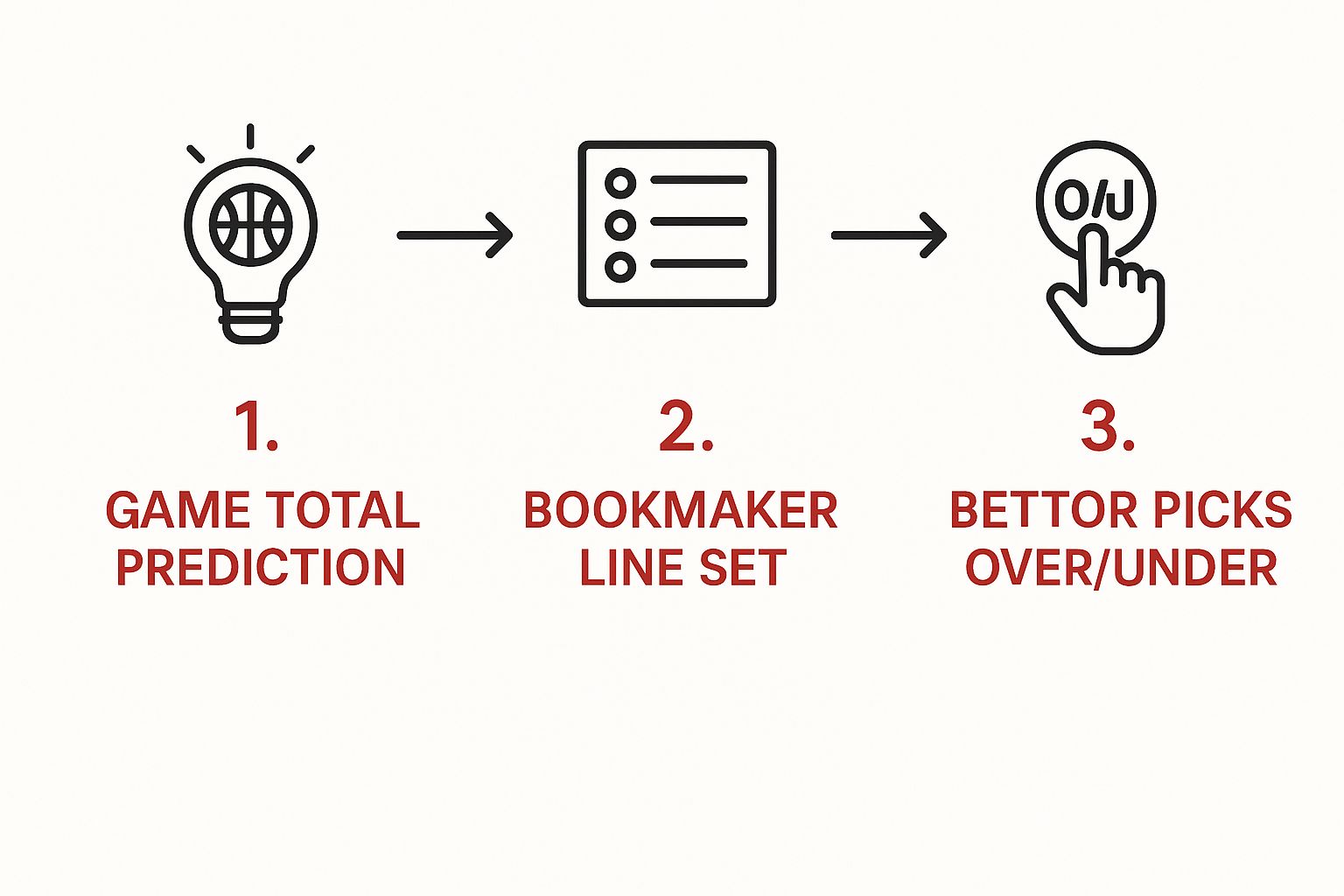
Understanding this flow gives you a huge advantage. You can start to read between the lines, figuring out why a total is set where it is and what might be causing it to shift before kickoff.
Reading Over Under Odds and Payouts
When you first glance at an over/under line, it can look a bit like code. A typical listing on an offshore site like Xbet or BetAnything might show something like this: O/U 48.5 (-110). Don't worry, it’s actually pretty simple once you know what you're looking at.
Let’s start with the first number, 48.5. This is the "total" set by the sportsbook—their prediction for the combined final score of both teams. Oddsmakers love using that half-point (.5) for a very specific reason: it kills the possibility of a tie, or what bettors call a "push." This way, the final score is guaranteed to be either over or under their number. Someone wins, someone loses, and the sportsbook avoids having to refund all the bets.
Understanding the -110 Odds
Now for the number in the parentheses: (-110). This tells you the odds and how much you stand to win. You'll see -110 on over/under bets more than any other number. It represents the sportsbook's commission for handling your wager, known in the industry as the "vig" or "juice."
In plain English, -110 odds mean you need to risk $110 to win a $100 profit. That extra $10 is the house's built-in edge, which is how offshore sportsbooks like MyBookie and Bovada stay profitable no matter which side wins.
Let's say you bet $110 on the over, and the final score is 28-24, for a total of 52 points. You won! The sportsbook will pay you back your original $110 stake plus your $100 in profit, for a total payout of $210. Getting a handle on this basic math is key to smart betting. If you want to dig a little deeper, our guide on how to read sports betting odds covers this in more detail.
This ratio works for any amount you want to bet. A $55 wager at -110 odds would win $50, and a $22 bet would win $20.
Understanding Over/Under Bet Payouts (at -110 Odds)
To make it even clearer, here’s a quick breakdown of potential payouts for different bet amounts at the standard -110 odds.
| Bet Amount | Potential Profit | Total Return (Stake + Profit) |
|---|---|---|
| $11 | $10 | $21 |
| $22 | $20 | $42 |
| $55 | $50 | $105 |
| $110 | $100 | $210 |
| $220 | $200 | $420 |
Once you understand this simple relationship between your stake and the payout, you can look at any line on offshore platforms like BetUS or Sportsbetting.ag and immediately know exactly what's on the line—both the risk and the potential reward.
Real-World Examples of Over Under Bets
Theory is great, but let's put some money on the line to see how this really works. Let’s head to the gridiron.
Imagine the Kansas City Chiefs and the Buffalo Bills are squaring off—a classic matchup between two high-flying offenses. An offshore sportsbook like MyBookie or BetUS knows points are coming and sets the game total at O/U 52.5 points.
Your job is simple: decide if the final combined score will be more or less than that number.
- You Bet the Over: The game ends 31-24, for a combined total of 55 points. You win!
- You Bet the Under: The final is a tighter-than-expected 27-24, totaling 51 points. You cash your ticket.
It's that straightforward. This same logic is why totals are such a popular bet across all fast-paced sports at offshore books like Bovada and Xbet.
From the Hardwood to the Global Pitch
The concept translates perfectly to other sports, though the numbers change drastically.
Switching gears to an NBA game, say the Los Angeles Lakers vs. the Boston Celtics. The scoring here is much faster, so an offshore sportsbook like Sportsbetting.ag or BetAnything might post a much higher total, something like O/U 225.5 points. A final score of 115-112 (227 total) makes over bettors happy, while a 110-105 final (215 total) is a win for the under.
But the real beauty of totals betting is its versatility. It’s not just about points. In a big boxing match, you can bet on whether the fight goes over or under 9.5 rounds. In soccer, where goals are precious, the line is often set at a low O/U 2.5 goals.
This adaptability is what makes it a universal and exciting way to get in on the action, no matter the contest. If you want to see just how deep this market goes, you can explore the variety of totals betting at sites like BookmakersReview.com.
Actionable Strategies for Totals Betting
Ready to move beyond just guessing on over/under bets? To make smarter wagers on offshore sites like MyBookie or Bovada, you need to start thinking like the oddsmakers themselves. It's all about finding an analytical edge.
A fantastic place to start is a team's pace of play. Think about basketball—teams that love to run the floor and jack up quick shots are constantly creating more possessions. More possessions mean more chances to score, which naturally pushes the total towards the over. On the flip side, teams that are methodical and bleed the shot clock are often a good starting point for an under bet.
Digging Deeper into the Data
Pace is just one piece of the puzzle. The real magic happens when you look at offensive and defensive efficiency ratings. These stats cut through the noise and show you exactly how many points a team scores (or gives up) per 100 possessions. A game pitting a high-powered offense against a porous defense can be a goldmine for an over bet, especially if the line on BetUS looks a little soft.
Don't forget the intangibles that can completely change a game's flow:
- Key Injuries: A star quarterback or a team's best defender sitting out? That’s going to have a massive impact on scoring potential.
- Weather Conditions: This is a huge one for outdoor sports. Trying to throw a deep pass in 30 mph winds or driving rain is a recipe for a low-scoring slugfest, making the under very attractive.
- Recent Trends: Check out a team's last 5-10 games. Is there a pattern? Are their games consistently flying over the total, or are they grinding out low-scoring wins?
Smart totals betting is all about finding an edge the market may have missed. It’s not just about predicting a high or low score but identifying when a sportsbook's line is slightly off based on your research.
It also pays to know where the public money is going. Over/under betting is simply a wager on whether the final combined score will be higher or lower than the sportsbook's number. And historically, the public loves to bet the over.
Because of this, books sometimes shade their lines a little high. In the NFL, unders have hit roughly 51.8% of the time since 2016. The NBA is closer to a coin flip, with unders cashing around 50.01%. Offshore sportsbooks like Sportsbetting.ag, Xbet, and BetAnything are well aware of the public's love for points and may adjust their numbers accordingly. You can learn more about these totals betting trends and use them to your advantage.
Got Questions About Over/Under Bets? We've Got Answers.
As you start getting the hang of totals betting, you'll inevitably run into some quirky situations. Knowing the house rules ahead of time is the difference between a confident bet and a frustrating surprise, especially when you're playing at offshore sportsbooks like MyBookie and Bovada. Let’s tackle some of the most common questions that trip up new bettors.
So, what happens if the final score lands exactly on the number? This is called a push, and it’s basically a tie.
Imagine the total is set at 48 points, and the game ends with a 27-21 final. That adds up to exactly 48, so your bet is a push. When this happens, the sportsbook simply refunds your original stake. No win, no loss. This is the exact reason you’ll see so many totals with a half-point attached (like 48.5)—it makes a push impossible.
Another classic question is about extra time. Do those points count?
Yes, absolutely. Any points scored in overtime or extra innings are included in the final score for your over/under bet. A game heading into OT is a huge win for "over" bettors, giving them extra time to rack up more points and cash their ticket.
This rule holds true for every major sport, whether you're betting on the NFL at BetUS or an NBA game over at Sportsbetting.ag.
Can You Mix Totals Into a Parlay?
You sure can. In fact, it’s a really popular strategy. A parlay is just a single bet that links two or more individual wagers together, juicing up the potential payout. You could, for instance, bet on the Dallas Cowboys to win their game and for the total to go over 51.5 points.
The catch is that you have to win every single "leg" of the parlay for it to pay out. Get one wrong, and the whole ticket is a bust. Offshore sites like Xbet and BetAnything make it incredibly simple to build parlays that mix totals with moneylines and point spreads, opening up a ton of creative ways to bet.
Think you've got a handle on over/under betting? Put your skills to the test. USASportsbookList is your go-to source for the best odds and lines on every single game. We've got in-depth reviews and exclusive bonuses from the top-rated offshore sportsbooks in the US, including MyBookie, BetUS, Bovada, Sportsbetting.ag, Xbet, and BetAnything.