Let's get right to it. An over/under bet is really just a simple question: will the total combined score of a game be higher or lower than a number set by a sportsbook? That's it. Instead of worrying about who wins or loses, you're just betting on the game's overall vibe.
Think of it this way: are you expecting a high-scoring shootout or a gritty defensive grind?
Top Offshore Sportsbook Bonuses for September 2026

$250 + 100 Free Spins
All new players receive $250 in Free Bets and 100 Casino Spins. Join today and enter the promo code WELCOME in the cashier when you deposit $50 or more.

Get a 50% deposit bonus up to $1,000 with the code: CRYPTO1K. Valid on crypto deposits.


How to Make Sense of an Over/Under Bet
If you’re just getting into sports betting, "over/under" might sound like insider lingo, but it’s honestly one of the most straightforward bets you can make. It's a staple at popular offshore sportsbooks like Bovada and BetUS because it takes the pressure off picking an outright winner.
Your only job is to get a feel for the game. Do you see both offenses clicking and putting up big numbers? Or do you think the defenses are going to clamp down and keep things low-scoring? That’s the heart of the bet.
This simplicity is why bettors everywhere love it. The "over/under," also known as a totals bet, is all about wagering on the combined final score. Oddsmakers set a number, and you decide if the actual total will go over or stay under. It’s a huge market, especially for fast-paced sports like football and basketball. You can learn more about how betting lines are structured in our detailed guide.
The Two Pieces of the Puzzle
When you’re ready to place a totals bet at a site like MyBookie or Sportsbetting.ag, you really only need to understand two things:
- The Total (or Line): This is the magic number set by the sportsbook. For an NFL game, you might see a total of 48.5 points. For an NBA matchup, it could be something like 220.5 points.
- The Odds (or Juice): This tells you how much you’ll get paid if you win. Most of the time, the odds for both the over and the under are set right around -110. That little extra is the sportsbook's commission, often called the vig. It’s how they keep the lights on.
Here’s a quick breakdown of what these terms mean in practice.
Key Components of an Over Under Bet
A quick summary of the basic terms you need to know for any totals bet.
| Term | What It Means | Example (Line = 48.5 points) |
|---|---|---|
| The Total | The combined score prediction set by the sportsbook. | The key number is 48.5. |
| The Over | Your bet that the final combined score will be higher than the total. | You need 49 or more total points to win. |
| The Under | Your bet that the final combined score will be lower than the total. | You need 48 or fewer total points to win. |
| The Odds | The payout for a winning bet, typically -110 for totals. | You'd bet $110 to win $100. |
With these simple components, you're ready to tackle any over/under market.
As online sports betting has taken off, totals bets have become even more popular. Their simple nature makes them perfect for live, in-play betting, where you can react as the game develops. According to market analysis from Grand View Research, this kind of engaging, straightforward wager is a big reason for the industry's growth. It makes every single point matter, keeping you locked in from the opening whistle to the final buzzer.
Ever wonder where that over/under number comes from? It's not just some random figure pulled out of a hat. At offshore sportsbooks like MyBookie and BetOnline, a team of expert oddsmakers uses a blend of art and science to create the perfect line, also known as the "total."
Their main goal is to land on a number that attracts an equal amount of betting action on both the over and the under. To pull that off, they have to analyze a mountain of data.
The Factors Behind the Number
Oddsmakers dig deep into all sorts of stats to build an accurate picture of how a game might play out. Their process involves looking at a few key things:
- Offensive and Defensive Strength: They start with the basics—how many points each team typically scores and how many they give up. A matchup between two high-powered offenses is naturally going to have a higher total.
- Pace of Play: In sports like basketball, the speed at which teams play is a huge factor. Faster teams get more possessions, which almost always leads to more points and a higher total.
- Historical Matchups: How have these two teams fared against each other in the past? Sometimes, one team's style just completely stifles the other's, resulting in lower-scoring games than you might expect.
- External Factors: You can't ignore the wild cards. Things like weather (especially wind or rain in football) and key player injuries can dramatically shift the expected point total.
This whole intricate process is what leads to that simple number you see on the screen.
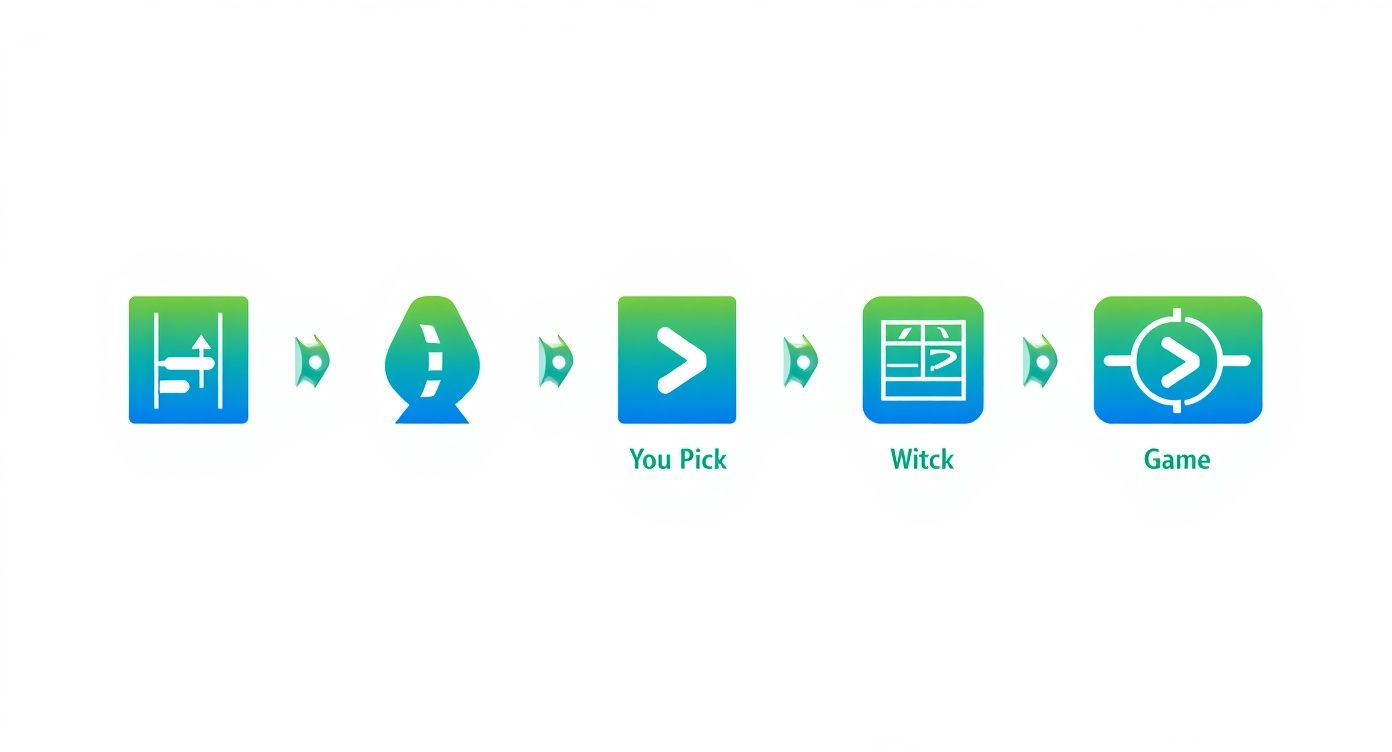
This graphic really breaks down the journey of a totals bet, from the moment the sportsbook creates the line to your final pick. If you want to go even deeper, you can learn more about the experts who set these numbers in our guide on who creates NFL betting lines.
Understanding the Odds and the Juice
Once the total is set, you'll see odds attached to it—usually -110 for both the over and the under. This is a crucial piece of the puzzle. That -110 tells you that you need to bet $110 to win $100.
So what's that extra $10? It's the sportsbook’s commission, better known as the "juice" or "vig" (short for vigorish). It's how platforms like Bovada and Xbet guarantee a profit margin, no matter which side wins.
Think of it as a small service fee for placing your wager. This built-in commission is exactly why the oddsmakers work so hard to set a balanced line. If too much money comes pouring in on the "over," the sportsbook might move the total up a point to encourage more "under" bets and balance their risk.
Seeing Over/Under Bets in Action Across Sports
Theory is one thing, but the best way to really get a feel for over/under betting is to see it applied to actual games. The core concept is the same everywhere, but the strategy and the key numbers you need to know can change drastically from one sport to another. Let's break down how totals bets look on popular offshore sportsbooks for the NFL, NBA, and soccer.
NFL Totals at Sportsbetting.ag
In football, every single point is earned the hard way, and some numbers are just more important than others. Thanks to the common scoring plays like touchdowns (7 points) and field goals (3 points), you'll often see final combined scores landing on key numbers like 41, 44, 48, and 51.
Let's say the Kansas City Chiefs are squaring off against the Baltimore Ravens, and a sportsbook like Sportsbetting.ag sets the total at 48.5 points. That little half-point is huge because it guarantees a winner—no pushes. If you bet the "over," you need the teams to score a combined 49 points or more. If you're on the "under," you need them to finish with 48 or fewer.
A bettor might hammer the over if they're expecting a shootout between two high-powered offenses. On the flip side, they might take the under if they predict a gritty, defensive slugfest where field position is king.
NBA Totals at Xbet
Basketball is all about one thing: pace. A fast-break, run-and-gun game between two teams that love to push the ball up the court will naturally have a much higher total than a slow, methodical, half-court matchup. Oddsmakers at sportsbooks like Xbet are masters at digging into pace, offensive efficiency, and defensive ratings to set these lines.
Take a game between the Sacramento Kings and the Indiana Pacers, two of the quickest teams in the league. The total might be set at a sky-high 242.5 points. Contrast that with a game featuring two elite defensive squads like the Minnesota Timberwolves and the New York Knicks, where the total could be closer to 208.5.
Here’s a quick look at what this looks like on the MyBookie interface for an NBA game.
As you can see, the "Total" column is right there with the over (o) and under (u) options, sitting next to the point spread and moneyline. It makes jumping on a total incredibly simple.
Soccer Totals at Bookmaker.eu
Soccer totals operate on a completely different scale. Goals are scarce, so the standard total you'll see almost everywhere is 2.5 goals. This is the bread-and-butter line you’ll find at sites from Bookmaker.eu to Bet105.
Betting the over means you're banking on the teams to combine for three or more goals (think 2-1 or 3-0). Betting the under is a wager on two or fewer total goals (like 1-1, 1-0, or the classic 0-0 draw).
Of course, oddsmakers will offer alternate totals like 1.5 or 3.5, but 2.5 is the benchmark. For soccer, you really have to pay attention to team form, defensive setups, and whether any key strikers are out with an injury. These factors will tell you whether a match is shaping up to be a low-scoring tactical grind or an open, free-flowing contest. Whether you’re betting on Bovada or BetUS, getting these sport-specific details right is what it's all about.
Why Smart Bettors Focus on Totals
Ask any seasoned bettor, and many will tell you they prefer wagering on totals over trying to pick a winner. There’s a good reason for that. Over/under betting offers a completely different strategic angle by shifting your focus from the final outcome to the overall flow and pace of the game itself.
This approach lets you cash in on your specific knowledge of the teams. If you know two teams have lockdown defenses or play at a snail's pace, you can confidently bet the under without sweating which side will eke out a win.
More Ways to Win
On the flip side, if you're expecting a high-scoring shootout between two offensive powerhouses, you can bet the over and cheer for every single point, no matter who scores. Suddenly, every possession is exciting. This flexibility is a huge reason why totals are a go-to market at offshore sportsbooks like BUSR and BetAnything.
You can attack the lines with all sorts of insights, such as:
- Offensive or Defensive Mismatches: One team’s weakness plays directly into another’s strength, which can create a lopsided scoring environment perfect for a totals bet.
- Pace of Play: Fast-paced teams naturally create more scoring chances, making the over much more appealing.
- External Factors: Never underestimate Mother Nature. Bad weather, like strong winds in an NFL game, can kill the passing game and create fantastic value on the under.
The real beauty of betting totals is that you're not betting against a team; you're betting on a specific game script. It opens up a new way to analyze matchups and find an edge.
And this isn't some niche market. Over/under betting is a massive piece of the global sports betting industry, which was valued at over USD 100 billion. While Europe currently holds the largest share, the Asia-Pacific region is catching up fast thanks to expanding legalization and digital access. For a deeper dive into these market trends and their economic impact, check out this in-depth industry analysis.
Actionable Tips for Making Smarter Totals Bets
Knowing what an over/under bet is just gets you in the door. Making money with them? That requires a real strategy. Moving from simply understanding the bet to consistently winning involves research, discipline, and a sharp eye for value.
Before you even think about placing a totals bet, you need to do your homework. A simple checklist can give you a massive edge. Look at recent scoring trends for both teams—are their offenses on a hot streak or have they gone cold? Dig into the defensive stats. A team that bleeds points is often a prime candidate for an over bet. And never, ever forget to check the injury report. A missing star quarterback or an elite defensive stopper can completely change a game's scoring dynamic.
Finding the Best Line
Once you've done your research, the single most important thing you can do is shop for the best line. I can't stress this enough. That half-point difference might look tiny, but it's often the very thing that separates a winning ticket from a frustrating loss.
Let's say you want to bet the over in a game where the total is hovering around 48.
- Cosmobet might offer the line at 48.0.
- Bet105, on the other hand, could have the same game listed at 47.5.
By placing your bet at Bet105, you gain a huge advantage. If the final combined score is exactly 48, your over 47.5 bet cashes. The person who bet over 48.0 just gets their money back with a push. This is where the pros make their money—in those tiny margins.
Always compare odds across multiple offshore sportsbooks like MyBookie, BUSR, and Bookmaker.eu. The best bettors don't just pick a side; they hunt for the best possible number to maximize their chances of winning.
This process, known as line shopping, is a fundamental skill for anyone serious about sports betting. To help you get the hang of it, you can learn more about the tools and techniques with our complete guide on sports betting odds comparison. When you combine solid research on things like weather and historical matchups with the discipline to always secure the best line, you're building a powerful foundation for a winning totals strategy.
Once you start digging into totals, you'll inevitably run into a few tricky situations. Let's walk through some of the most common questions that pop up when you're betting at offshore sportsbooks like MyBookie or BetUS.
What Happens if the Score Lands Exactly on the Number?
It's a classic scenario. The over/under for a game is set at 48, and the final score is a nail-biting 28-20. The combined score? Exactly 48. So, what happens to your bet?
This is called a push. When the final total lands exactly on the betting line, nobody wins, and nobody loses. Sportsbooks like BetOnline or Xbet will simply refund your original stake in full. It’s as if the bet never happened.
This is exactly why you'll often see lines with a half-point (like 48.5). Oddsmakers use these ".5" hooks to make a push impossible, guaranteeing a clear winner and loser on every bet.
Do Overtime Points Count Toward the Total?
You bet they do. Unless a specific market says otherwise (like a "regulation time only" bet common in soccer), every single point scored in overtime or extra innings counts towards the final total.
This can lead to some wild swings. If you bet the under, you might be celebrating what looks like a sure win, only to watch the game go to overtime and turn into a shootout. Suddenly, your winning ticket is worthless. On the flip side, an overtime period can be a miracle for over bettors. When you place a totals bet at a site like Sportsbetting.ag or Bovada, you're betting on the final, complete score—no matter how long it takes to get there.
Can I Bet Over/Under on Anything Besides the Final Score?
Absolutely. This is where totals betting gets really interesting. The over/under concept is way more flexible than just predicting the final score of a game. Offshore sportsbooks like BUSR, Bookmaker.eu, and Cosmobet offer a massive menu of prop bets that all use the same basic logic.
The core idea of predicting whether a specific statistic will go over or under a set number can be applied to almost anything. It's one of the most creative ways to find betting value.
You'll find all sorts of totals markets, including:
- Team Totals: Isolate one team and bet on whether they'll score over or under their specific point total.
- Player Props: Wager on an individual player's performance. Think over/under 25.5 points for a star basketball player or over/under 89.5 rushing yards for a running back.
- Quarter/Half Totals: Narrow your focus to a specific period of the game, like the combined score in just the first half or the third quarter.
These alternative totals, which you can find at places like Bet105 and BetAnything, allow you to get super specific with your predictions and find an edge based on how you think the game will flow.
At USASportsbookList, we provide detailed reviews and comparisons to help you find the perfect sportsbook for your betting style. Explore our expert guides and find the best bonuses available today at https://usasportsbooklist.com.