Ever placed a bet that wasn't a win… but also wasn't a loss? If so, you've probably encountered a push.
So, what is a push in betting? Think of it as a tie between you and the sportsbook. It's a neutral outcome, a complete do-over where your original stake is simply returned to your account. No harm, no foul.
The Basics of a Betting Push
At its core, a push is a draw. It happens when the final outcome of a game lands exactly on the number you bet on, meaning neither you nor the house wins. Your wager is just refunded, and you're free to bet another day.
It’s like making a friendly wager with a buddy on a coin flip. If, by some miracle, the coin lands perfectly on its edge, what would you do? You’d call it a wash and both take your money back. That’s a push in a nutshell—it just happens a lot more often in sports betting.

This scenario is most common with bets involving whole numbers, like point spreads and totals. You'll see these lines all the time at popular offshore sportsbooks like MyBookie and BetUS.
Why Pushes Happen More in Certain Sports
Pushes are especially common in American sports like the NFL and NBA, where oddsmakers frequently set lines using whole numbers.
Take the NFL, for example. Final scoring margins often cluster around key numbers like 3 and 7. If a team is favored by -3 and they win by exactly three points, any bet on that spread is a push. Historical data shows this happens in about 5-8% of NFL point spread bets when the line is a whole number. Oddsmakers aren't trying to create pushes, but it's an inevitable result of setting a balanced line.
Key Characteristics of a Push
To really get it, just remember these three things:
- Stake Refunded: You get your original wager back, down to the last cent.
- No Win, No Loss: The bet is graded as a "push" or "void." It doesn’t affect your bankroll one way or the other.
- Common with Whole Numbers: Pushes are impossible with half-point lines (like -7.5), as those are designed to guarantee a winner and a loser.
Once you have this down, you’ll be in a much better position to understand how your bets are settled and navigate more complex wagers. For a deeper dive into how these lines are set, check out our guide on understanding point spreads.
How Pushes Play Out Across Different Bet Types
To really get a handle on what a push is in betting, you have to see it in the wild. The basic idea is always the same—you get your stake back—but what actually triggers that refund changes depending on how you laid your money down.
Let's walk through the most common scenarios you'll run into at your favorite offshore sportsbooks.
Point Spread Pushes
Point spreads are the natural habitat of the push, especially when you're betting on football and basketball. The spread is just a handicap the sportsbook applies to even things out. When the final score lands exactly on that number, you've got yourself a push.
Picture this: the Dallas Cowboys are -7 point favorites against the New York Giants over at a site like Bookmaker.eu. You bet on the Cowboys to cover. For your ticket to cash, Dallas has to win by more than seven points. If they win by six or less (or lose the game), your bet is a loser.
So what happens if the final score is Cowboys 24, Giants 17? Dallas won by exactly seven. That's a textbook push. The outcome landed right on the spread, so your bet isn't a win or a loss. Bookmaker.eu just credits your original stake right back into your account. No harm, no foul.
Totals Pushes
Totals bets, which you'll often hear called Over/Unders, follow the same logic. Here, you're not picking a winner. You're just betting on whether the combined score of both teams will go over or under a specific number. A push happens when the final tally hits that number right on the nose.
Let's say you're checking the lines at Heritage Sports for an NBA game. You see the Los Angeles Lakers vs. the Boston Celtics, and the total is set at 220 points. You take the Over, thinking it’s going to be a shootout.
Here are the possible results:
- You Win: The game ends 115-106. The total is 221, so your Over cashes.
- You Lose: The final is 110-108. The total is 218, and your Over loses.
- It's a Push: The final score is exactly 112-108. The combined total is 220 points. Since it matches the line perfectly, the bet is a push. Your stake comes back to you.
This is exactly why you'll see sportsbooks post totals with a half-point (like 220.5). It’s a simple trick to make a push impossible. If you want a deeper dive, our team put together a detailed guide on Over/Under betting.
Moneyline Pushes
Seeing a push on a moneyline bet is pretty rare in most American sports. Think about it—football, basketball, and baseball almost always play until someone wins, even if it takes extra innings or overtime.
Where you do see them all the time is in sports where a tie is a regular outcome.
Soccer is the classic example. The standard soccer bet is a "3-way" moneyline: Team A wins, Team B wins, or it's a draw. If you bet on a team to win and the game ends in a tie, you lose. Simple as that.
But, many sportsbooks also offer a "2-way" moneyline, which is often called "Draw No Bet." This market takes the draw option completely off the table. If you bet on Team A and the match ends in a tie, the bet is graded as a push, and your money is refunded. It’s a great little safety net that the standard 3-way line doesn't give you.
How a Push Changes Your Parlay Payout
A push on a single bet is simple enough—you get your money back. But what happens when one pops up right in the middle of your multi-leg parlay? It’s a common point of confusion for bettors, but the good news is a push doesn't automatically wreck your entire ticket.
Instead, it just changes the math.
When one leg of your parlay results in a push, that specific game is treated as if it never existed on your bet slip. The sportsbook simply removes it, and your parlay’s odds are recalculated based on the legs that are still live.
Essentially, your bigger parlay just shrinks. A four-teamer with one push becomes a three-teamer. A three-legger becomes a two-team bet. This is standard procedure at top offshore books, ensuring your ticket stays in the game even when a final score lands exactly on the number.
A Real-World Parlay Push Example
Let's say you've put together a four-team NFL parlay at BetAnything, risking $100 for a potential payout of around $1228.
Your ticket might look something like this:
- Green Bay Packers -3
- Kansas City Chiefs -7
- Baltimore Ravens +4.5
- Miami Dolphins / Los Angeles Chargers Over 51
The games play out. The Packers win by 10, the Ravens pull off an upset, and the Dolphins-Chargers game turns into a 55-point shootout. Three of your legs hit. Fantastic. But the Chiefs game ends with a final score of 27-20, a seven-point victory.
That Chiefs -7 bet is a push. Instead of your entire parlay going up in smoke, BetAnything just voids that leg. Your original four-team wager is now graded as a winning three-team parlay. The payout gets recalculated at the new, lower odds, but hey, it's still a solid win.
This is how pushes typically get triggered across different bet types.
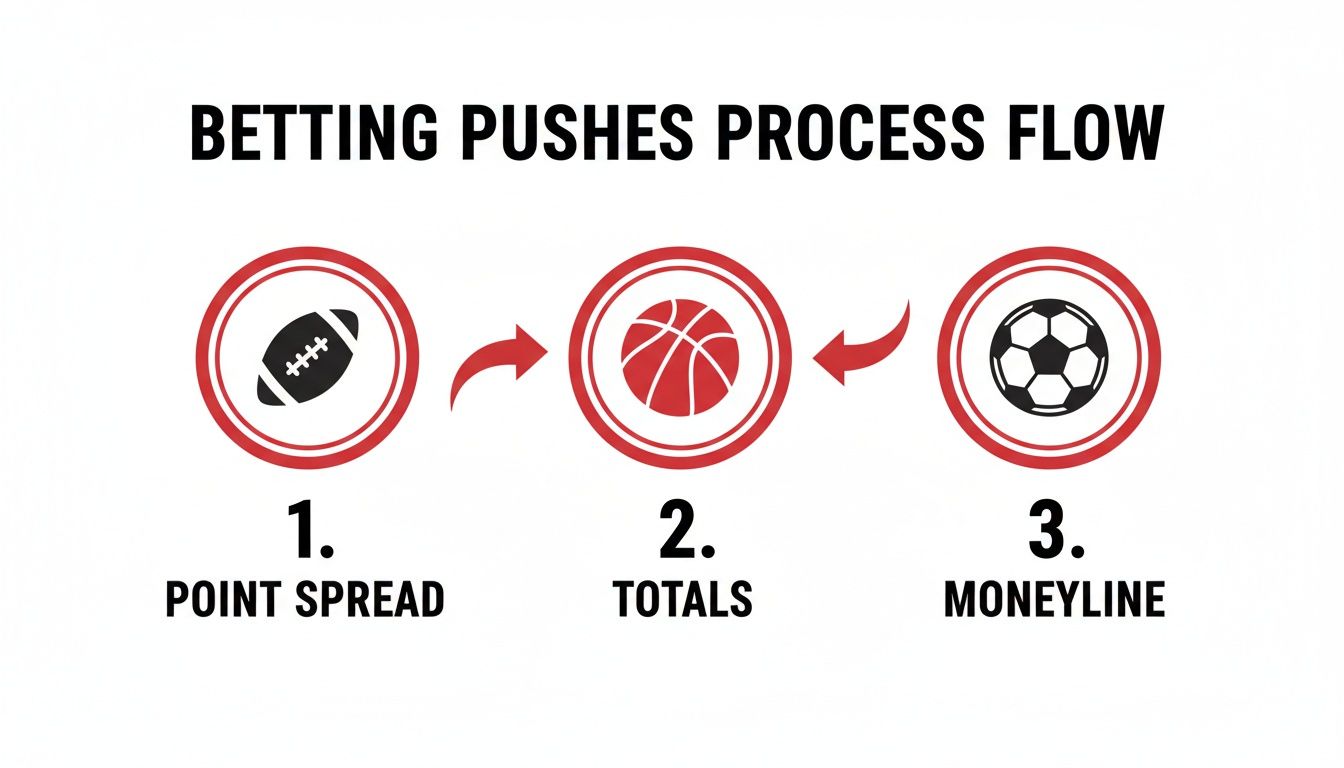
As you can see, a push happens whenever the outcome lands precisely on the betting line—something that happens more often than you might think in high-scoring sports.
The Financial Impact of a Parlay Push
A push can dramatically change the final payout of a parlay, turning a potential lottery ticket into a more modest, but still profitable, win. While every other leg has to be a winner, a push just gets taken out of the equation without killing the whole ticket.
Industry stats show pushes happen in about 2-4% of parlay legs in sports like the NBA. That might not sound like much, but it leads to around 15% of all multi-leg bets getting their payouts adjusted each season.
Books handle this uniformly. If you have a 4-leg college football parlay at a site like Cosmobet and one game pushes, it just becomes a 3-leg parlay with recalculated odds. It’s a rule that preserves the bet's value and keeps sharp bettors in the action.
Getting a handle on how parlays work is key to navigating these situations. For a full breakdown, check out our guide on parlay betting explained. Knowing the rules ahead of time means you'll never be caught off guard by a revised payout.
Why Sportsbooks Use Half-Point Spreads
If you've spent any time at all scrolling through betting lines on sites like Xbet or BUSR, you've definitely seen them: spreads like -3.5 or totals like Over 52.5. These aren't just random numbers; they’re the sportsbook’s secret weapon against the very thing we’ve been talking about—the push.
That little half-point, known in the industry as "the hook," is a bookmaker's way of making sure every single bet has a clear winner and a clear loser. Let's be real: a football team can't score half a point, and a basketball game isn't going to end with a total of 221.5. By adding that .5 to the line, the sportsbook completely removes any gray area and guarantees a decisive outcome.
The Power of the Hook
From a bookmaker's point of view, the gap between a whole-number spread and one with a half-point is massive. A line set at -7 leaves the door open for three possible results: the favorite covers, the underdog covers, or the game ends on that exact seven-point margin, forcing a push.
Now, change that line to -7.5. Suddenly, there are only two outcomes. Either the favorite wins by eight or more (a win for their backers), or they don't (a loss). The push is completely off the table. This is exactly why you'll see half-points plastered all over the major markets, especially on offshore platforms.
When a push happens, a sportsbook has to refund every single wager on both sides of that bet. Using half-points ensures they collect the juice from the losing side of every wager, protecting their business model and creating a predictable cash flow.
This tiny adjustment is everything to a sportsbook's bottom line. Every push is a missed chance to collect the vig, which is the small commission they build into the odds. By using the hook, they keep the action flowing and ensure every bet resolves with a win or a loss.
Pushes By the Numbers
The statistical difference is staggering. Bookmakers slash the number of pushes by over 75% just by adding the hook. For instance, a line like Chiefs -10 is just asking for a push. But shift it to -10.5, and you force a clear result since teams can only score in whole numbers.
NFL data reveals that whole-number spreads result in a push 6.2% of the time. For half-point lines? That number drops to 0%. This small change has reportedly saved sportsbooks an estimated $2.4 billion in refunds over the last two decades. For a deeper dive, you can check out the full breakdown on Action Network.
Understanding why sportsbooks lean so heavily on the hook is a huge piece of the puzzle. It shows that setting lines isn't just about predicting an outcome; it's about managing risk and guaranteeing a result for the house.
Using Pushes in Your Betting Strategy
Knowing what a push is is one thing. Actually factoring the possibility of a push into your game plan? That's where savvy bettors separate themselves from the crowd. Pros don't just react to pushes when they happen; they anticipate them. It's all about looking at a line and deciding if the risk of a tie is worth it, or if you should make a move to eliminate it completely.
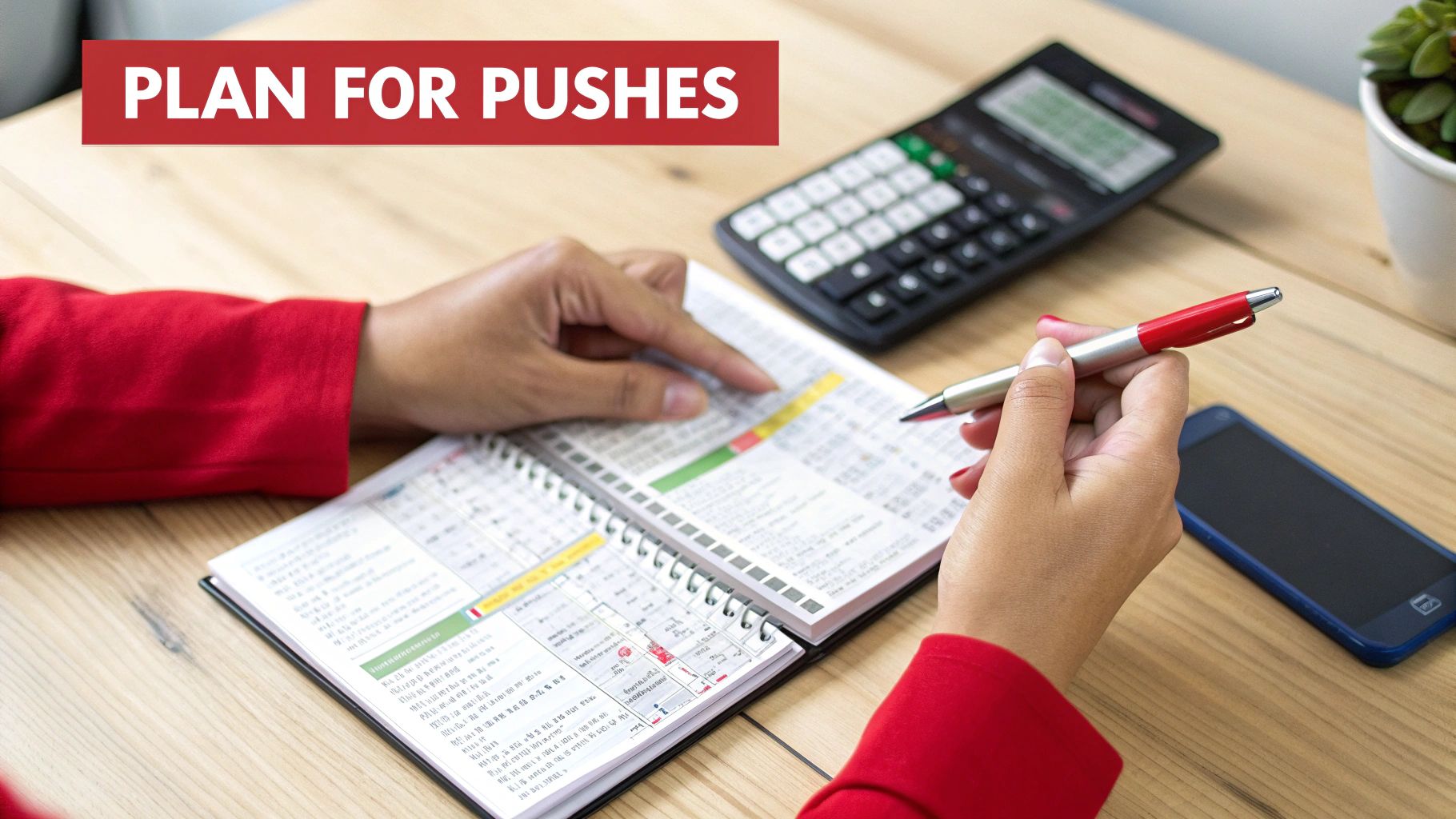
This proactive mindset often leads to a tactic called "buying points." Instead of just accepting a team at -3, you might pay a little extra vig to get them at -2.5, turning a potential push into a solid win. On the flip side, you could buy a half-point on an underdog, bumping them from +7 to +7.5.
When to Buy Points and Avoid the Push
The decision to buy points always boils down to a simple question: is the extra cost worth the security? The answer almost always lies in what we call key numbers—the most frequent margins of victory in a particular sport.
In the NFL, the holy grail of key numbers are 3 and 7. An enormous number of games end with one of those two exact margins. Because of this, buying a half-point to get off a -3 or +7 line can be an incredibly sharp move.
- A Sharp Play: You might see a favorite at -3 for -110 odds. At a sportsbook like Bet105, buying a half-point to move that line to -2.5 could shift your odds to -125. If the team wins by three, your original bet pushes, but your new one cashes.
- A Sucker's Bet: Buying a half-point to move a line from -4 to -3.5 is usually a poor use of your money. A four-point margin is far less common, meaning you're paying for insurance you probably don't need.
Think of it this way: strategically buying points is like paying a small premium to insure your bet against a push. It's a calculated risk that can seriously pay off on the right numbers, but it will bleed your profits dry if you do it on every bet.
Pushes and Bankroll Management
Getting your stake back on a push might feel like a neutral outcome, but it has a real, tangible effect on your betting strategy. A push effectively locks up a piece of your bankroll for the entire game, keeping you from using those funds on other wagers.
Your bankroll is your working capital. When you place a bet, that money is tied up. A win grows your capital and a loss shrinks it, but a push just puts it on hold before giving it back. While you don't lose any cash, you do lose the opportunity cost—what that money could have been doing for you elsewhere.
Thankfully, most top-tier offshore books like BUSR and Bookmaker.eu are great about processing push refunds almost instantly. Your funds are usually back in your account and ready for the next slate of games. Factoring in this temporary hold is a key part of smart bankroll management, ensuring you always have enough capital freed up for your next sharp play.
Answering Your Questions About Betting Pushes
Once you get the hang of what a push is, a few more specific questions always seem to come up. Let's tackle the most common ones bettors ask so you can handle these neutral outcomes like a seasoned pro at your favorite offshore sportsbooks.
Do I Lose the Juice on a Push?
Absolutely not. You never lose the juice—also known as the vig or commission—when your bet results in a push. The sportsbook returns your entire wager right back into your account.
Think of it this way: if you bet $110 to win $100 on a standard -110 line and it pushes, you get the full $110 back. The book only collects the juice when you lose. A push is simply "no action," a universal rule you'll find at top sites like MyBookie and BetUS.
What Happens When a Player Prop Bet Pushes?
Player proposition bets, or "props," work just like game spreads and totals. A push on a player prop happens when the final stat lands exactly on the whole number the oddsmaker set.
Let's say you're browsing Xbet and bet on a running back's touchdown total, set at Over/Under 1.0. If he punches in exactly one TD, that's a push. To avoid this, sportsbooks like BUSR often use half-points (like O/U 1.5 touchdowns) to make sure there’s always a clear winner and loser.
A push is a legitimate betting outcome where the final number ties the line. A void bet, however, is a totally different beast—it's the cancellation of a wager due to outside circumstances.
How Is a Push Different from a Void Bet?
While both a push and a void bet put your original stake back in your wallet, the reasons they happen are night and day.
- Push: A valid betting result that ties the spread, total, or prop line.
- Void Bet: The bet is canceled entirely for an external reason.
For example, Heritage Sports will void all wagers on an MLB game that gets rained out and moved to another day. Similarly, if you bet on a quarterback to throw for over 2.5 touchdowns but he sits out the game, that bet is voided. A push is a tie; a void is a do-over.
This is where things can get a little tricky. The rules for pushes in teaser bets can vary from one sportsbook to another, which is why you should always check the house rules at sites like Bookmaker.eu before locking in a teaser.
Generally, here's how it breaks down:
- Multi-Leg Teasers: In a teaser with three or more teams, a push on one leg typically just removes that leg from the ticket. A 4-team teaser with one push simply becomes a 3-team teaser with a reduced payout, just like a parlay.
- Two-Team Teasers: This is the big variable. In a 2-team teaser, a push on one leg and a win on the other will often result in the entire bet being declared a push. You get your money back.
- The Critical Exception: Be warned—some sportsbooks will grade a push combined with a loss in a 2-team teaser as a total loss. Because of this, confirming the specific house rules is a non-negotiable step for any serious bettor.
Finding the right sportsbook is just as important as understanding the rules of the game. USASportsbookList offers detailed reviews and comparisons to help you choose the best offshore platform for your betting style. Explore our expert guides and find exclusive bonuses today at https://usasportsbooklist.com.