Forget trying to just pick a winner. The point spread throws a much more interesting question into the mix: by how much will a team win? It's the most popular way to bet on sports for a reason—it can turn a potential blowout into a nail-biter, at least from a betting perspective.
What a Point Spread Is and How It Works
Think of the point spread as a handicap designed to level the playing field. Offshore sportsbooks like MyBookie, Bovada, and BetOnline assign a number to each team, essentially giving the underdog a head start before the game even begins. This creates two balanced betting options, each with roughly even odds.

$250 + 100 Free Spins
All new players receive $250 in Free Bets and 100 Casino Spins. Join today and enter the promo code WELCOME in the cashier when you deposit $50 or more.

Get a 50% deposit bonus up to $1,000 with the code: CRYPTO1K. Valid on crypto deposits.


It's all about creating a fair fight. Here’s how the two sides of a point spread bet break down:
- The Favorite: This is the team everyone expects to win. You'll see their spread marked with a minus sign (-), like -7. For your bet to cash, they have to win the game by more than that number.
- The Underdog: This is the team expected to lose. Their spread gets a plus sign (+), like +7. A bet on the underdog wins if they win the game outright or if they lose by less than that number.
Essentially, the spread creates a new finish line for each team that's completely separate from the actual final score. The favorite has a tougher hill to climb, while the underdog gets a nice cushion to work with.
Visualizing the Point Spread
Seeing it on a betting line makes it all click. Here's a real-world example of an NFL point spread you'd find at an offshore sportsbook like MyBookie. The New Orleans Saints are listed as -3 point favorites, meaning they need to win by more than 3 points for a bet on them to win.

On the other side, the Tampa Bay Buccaneers are the +3 underdogs. If you bet on the Bucs, you win if they pull off the upset or if they lose by just 1 or 2 points. The whole goal for oddsmakers at sites like BetUS, Xbet, and Sportsbetting.ag is to pick a number that gets people betting evenly on both sides.
Key Takeaway: The point spread isn't about predicting the winner. It’s about predicting how a team will perform against expectations. You’re not just betting against the opponent; you're betting against the sportsbook's number.
Why Sportsbooks Use Point Spreads
So why go through all this trouble? It's simple: to balance the action.
If betting was only about picking winners, everyone would just throw their money on the heavy favorite. That's a recipe for disaster for offshore sportsbooks like Bookmaker.eu and BUSR. By giving points to the underdog, oddsmakers create a compelling reason to bet on either team.
This balance is what lets the sportsbook make its money on the commission it charges (the "vig" or "juice"), no matter which team actually covers the spread. It’s the engine that drives the entire sports betting industry, from BetAnything to Cosmobet and Bet105.
How to Read Point Spread Odds and Payouts
Figuring out the point spread is just step one. To really understand the wager, you have to get a handle on the numbers that ride alongside it—the odds. This is where you see how offshore sportsbooks like BetOnline and Bovada turn a profit, and it's much simpler than it looks.
When you see a point spread, you'll almost always notice another number next to it, typically -110. This is the price of admission for your bet, known in the industry as the juice or vigorish (vig). Think of it as the sportsbook's small commission for taking your action.
That -110 is standard American odds, and it tells you exactly what you need to risk to win a certain amount.
The -110 Rule: To win $100, you must bet $110. A winning ticket gets you back $210—your original $110 stake plus the $100 in profit.
This built-in fee is how the house guarantees it makes money. Even if the bets are split perfectly on both sides of a game, the sportsbook comes out ahead. If one person bets $110 on the favorite and another bets $110 on the underdog, the book collects $220 but only pays the winner $210, pocketing the $10 difference.
Calculating Your Payouts
You don't have to bet in increments of $110, of course. The -110 odds are just a ratio that scales up or down for any bet size. Whether you're putting down $11 or throwing down $550, the math stays the same.
Here’s how potential payouts look at standard -110 odds:
- Bet $11 to win $10 (for a total return of $21)
- Bet $55 to win $50 (for a total return of $105)
- Bet $220 to win $200 (for a total return of $420)
This pricing model is the bedrock of sports betting, so getting comfortable with it is a must. If you want to go deeper, our guide on how to read betting odds breaks down all the different formats you'll encounter.
The Break-Even Point
Because of that built-in commission, you can't just win half your bets and expect to make money. To actually turn a profit betting at -110 odds, you need to win 52.38% of your wagers over the long haul. This structure has been the key to balancing action since modern sports betting began, especially in the NFL and NBA where spreads are king. It's a razor-thin margin that separates casual players from sharps.
Buying Points for a Better Number
Ever look at a line and wish you had just a little more cushion? Sometimes you love a team but hate the number. This is where "buying points" comes in, an option offered at many offshore sportsbooks like Xbet and Bookmaker.eu.
This lets you tweak the point spread in your favor, but it'll cost you. Let's say you want to bet on a favorite at -7.5. You could buy a half-point to move the line down to -7, a critical number in football. Getting off that hook can be the difference between cashing a ticket and tearing it up.
Of course, nothing is free. Instead of the standard -110, buying that half-point might shift your odds to -120 or -125. You're risking more to win the same amount, but you're also getting a much better number. Sometimes, that trade-off is absolutely worth it.
Analyzing Real-World Point Spread Examples
Theory is one thing, but seeing how point spreads play out in actual games is where it all starts to click. Let's move past the basics and look at some real-world examples you’d find on offshore sites like Sportsbetting.ag or BetUS. Watching the numbers in action is what really builds confidence.
This infographic does a great job of breaking down how a single game can end in a win, loss, or push for either side of a spread bet.
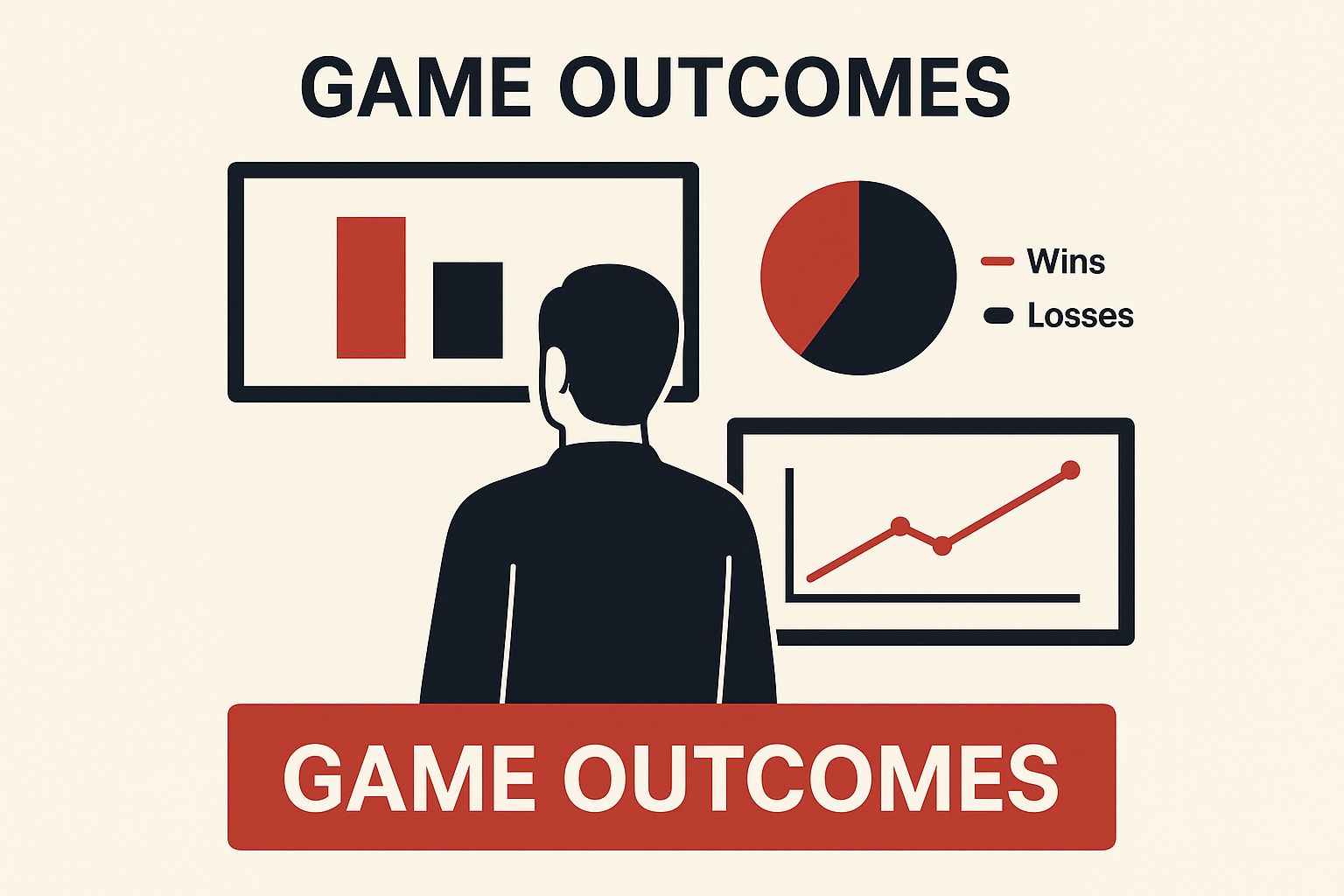
As you can see, the final score's relationship to the spread is everything. It determines who cashes their ticket.
An NFL Point Spread in Action
Football is the undisputed king of point spread betting. Imagine you’re looking at the lines on MyBookie for a classic NFC North rivalry: the Green Bay Packers are listed as -6.5 favorites against the Chicago Bears at +6.5.
That little half-point (0.5) is crucial. It means there's no way for the bet to end in a tie, or what we call a "push." Every bet will either win or lose.
Let's break down the possible outcomes:
- Scenario 1: The Favorite Covers. The Packers dominate and win the game 30-20. Their margin of victory is 10 points, which easily clears the 6.5-point spread. Anyone who bet on the Packers (-6.5) is a winner.
- Scenario 2: The Underdog Covers. The Packers still win, but it's a much closer game, with a final score of 24-21. Their victory margin is only 3 points. This is less than the 6.5-point spread, so bettors who took the Bears (+6.5) win their wagers, even though Chicago lost the game.
- Scenario 3: The Push (Tie). Now, let's pretend the spread was a whole number, like Packers -7. If the final score was 28-21, Green Bay’s margin of victory is exactly 7 points. In this case, it’s a tie against the spread. All bets on both the Packers and the Bears are refunded.
To make this even clearer, let's look at another common NFL scenario.
Point Spread Bet Outcomes Explained
This table shows the three possible outcomes using a hypothetical game where the Kansas City Chiefs are -7 point favorites over the Denver Broncos.
| Scenario (Final Score) | Chiefs (-7) Bet Outcome | Broncos (+7) Bet Outcome | Explanation |
|---|---|---|---|
| Chiefs 30, Broncos 20 | Win | Loss | The Chiefs won by 10, which is more than the 7-point spread. They covered. |
| Chiefs 27, Broncos 24 | Loss | Win | The Chiefs only won by 3, which is less than the 7-point spread. The Broncos covered. |
| Chiefs 28, Broncos 21 | Push (Tie) | Push (Tie) | The Chiefs won by exactly 7 points. All bets are refunded. |
As you can see, the actual winner of the game doesn't always determine the winner of the bet. It's all about that margin of victory.
NBA Spreads and Higher Scores
The NBA is a different beast entirely. With scores regularly topping 100 points, the point spreads are naturally much larger. It’s not unusual to see a team favored by double digits on an offshore platform like Bovada.
Let's say the Los Angeles Lakers are -11.5 favorites against the Houston Rockets (+11.5).
If the final score is Lakers 125-110, the Lakers won by a comfortable 15 points. Since 15 is greater than 11.5, bets on the Lakers (-11.5) are winners. But if the final was Lakers 120-112, their 8-point victory wouldn't be enough to cover. In that case, Rockets (+11.5) bettors would be the ones cashing their tickets.
For bettors, a deep understanding of point spreads involves recognizing that you are wagering on a team's performance against oddsmakers' expectations, not just against their opponent on the field. The margin of victory is everything.
Spreads in Other Sports: Puck Lines and Run Lines
Point spreads aren't just for football and basketball. They pop up in other sports too, they just go by different names. Head over to offshore sportsbooks like BetOnline and you’ll find these unique variations.
- Baseball's Run Line: In baseball, the spread is almost always fixed at -1.5 for the favorite and +1.5 for the underdog. To cover, the favorite has to win by 2 or more runs. The underdog covers if they win the game outright or lose by just a single run.
- Hockey's Puck Line: Hockey follows the same logic with its "puck line," which is also consistently set at -1.5 / +1.5. The favorite needs to win by at least two goals to cover the spread.
This fixed 1.5-point standard completely changes the betting dynamic. Unlike the fluctuating spreads in football, the odds (the payout) are adjusted much more dramatically here to reflect the skill gap between the two teams. Getting a handle on these variations is a key step toward mastering point spread strategy across the entire sports world.
Why Point Spreads Move and What It Means for You
Think of a point spread as a living, breathing number, not something set in stone. It can—and often does—shift multiple times between the moment it’s released and kickoff. For any serious bettor, understanding point spreads means learning to read these movements. They’re valuable clues that tell a story about how a game is being perceived by everyone from the public to the pros.
At its core, the main reason a line moves is simple: supply and demand. Offshore sportsbooks like BetUS and BUSR aren’t trying to predict the exact outcome of a game; their goal is to attract equal betting money on both sides. If too many people bet on one team, the book is exposed to a massive loss if that team covers.
To protect themselves, they’ll adjust the spread to make the other side look more appealing. For instance, if the public is hammering the Kansas City Chiefs at -6.5, the sportsbook might move that line to -7 or even -7.5. This little nudge encourages more bets on their opponent, helping the house balance its books.
Public Money vs. Sharp Money
In the eyes of an offshore sportsbook, not all money is created equal. Oddsmakers pay very close attention to who is placing the bets, and the money flowing in generally falls into two buckets:
- Public Money: This is the cash coming from casual, recreational bettors. They often wager based on gut feelings, backing popular teams, star players, and favorites without much deep analysis. It adds up to a huge volume of bets, but it’s often considered less informed.
- Sharp Money: This is the big stuff. These are wagers from professional, respected bettors—the "sharps"—who use sophisticated models and deep research to find an edge. A single large bet from a sharp can move a line more than dozens of small public bets combined. You can get a closer look at the experts behind the numbers in our guide on who creates NFL betting lines.
Betting action isn't the only trigger for a line move. New information can cause a sudden shift. A star quarterback being unexpectedly ruled out with an injury, a major change in the weather forecast, or a key player getting suspended can force offshore sportsbooks like Bookmaker.eu and Bovada to adjust the spread immediately.
Expert Insight: Line movement is the market's real-time reaction to money and information. Learning to read these signals is what separates novice bettors from those who can consistently find value.
Decoding Reverse Line Movement
One of the most powerful signals a savvy bettor can spot is reverse line movement. This is when the betting line moves in the opposite direction of where the public is betting.
Let's paint a picture: 80% of the public bets are on the New England Patriots at -3, but the line suddenly moves down to -2.5. It seems backward, right? Why would a sportsbook make it easier for the public to win?
The answer is sharp money. This kind of move is a massive tell that large, respected wagers are pouring in on the underdog, forcing the book to adjust despite the lopsided public action. Spotting this is a huge indicator that you should probably consider betting against the crowd.
The volatility of point spreads has only intensified with the explosion of in-game wagering. Data from thousands of games shows just how much these numbers can dance, revealing that the average NBA pre-game spread shifts by 1.3 points from open to close. In the 2022–2023 NBA season, home favorites only covered the spread 51% of the time, proving that public perception and home-court advantage don't always beat the number. These small adjustments, often driven by sharp money, create golden opportunities for bettors who know what to look for.
Proven Strategies for Betting Point Spreads
Knowing what a point spread is marks the starting line. But if you want to actually make money, you need a disciplined strategy. This is the part that separates the pros from the folks just donating to the offshore sportsbooks.
It’s about moving past the basics and developing a new skill set—one that’s built on solid analysis, market savvy, and situational awareness. Forget gut feelings. We’re talking about a repeatable, research-based approach.
The good news? There are several battle-tested strategies that can give you a real edge. These aren't secrets, but they do require discipline. Mastering them will completely change how you look at the betting board at offshore sportsbooks.
Fading the Public
One of the oldest and most effective tricks in the book is "fading the public." At its core, this means betting against the team getting the vast majority of public action. Your average bettor loves to pile on popular teams, big-name stars, and whoever won big last week. This creates lopsided betting that sharps can pounce on.
When you see a huge percentage of bets—think 75% or more—on one side, offshore sportsbooks like MyBookie and Bovada will often move the line to attract money for the other team. That adjustment creates real value on the less popular side. By going against the grain, you're often siding with the sharper, more calculated money.
Understanding Key Numbers
In a game like football, some numbers are just more important than others. Thanks to the scoring system (3 for a field goal, 7 for a converted touchdown), the most common margins of victory are 3 and 7. These are the "key numbers," and they are absolutely critical in point spread betting.
There's a world of difference between a spread of -2.5 and -3.5. A 3-point win covers the first but loses on the second. Smart bettors are obsessed with whether a spread is on, above, or below a key number. Snagging a line of +7.5 when it could have been +6.5 is the kind of small victory that can drastically boost your win rate over the long haul.
Situational Handicapping
Winning isn't just about comparing stats on a spreadsheet. Situational handicapping is about digging into the context of the game. You're looking for unique circumstances that could throw a team off its game.
- Letdown Spot: A team is coming off a massive, emotional win against their biggest rival. Are they going to be just as fired up for a weaker opponent the next week? Probably not.
- Look-Ahead Spot: A team might be caught looking ahead to a huge showdown next week, completely underestimating the "easy" team they're playing now.
- Travel and Schedule: Is a team playing its third straight road game? Is a West Coast team flying to the East Coast on a short week? These things take a toll.
These factors don't show up in a box score, but they offer a huge edge because most casual bettors ignore them.
Historical betting data consistently shows that point spread betting is the most popular form of sports wagering in major US markets, making up over 60% of the total handle for the NFL. However, English Premier League data from 2010–2020 revealed that favorites cover the spread just 53% of the time, proving that beating the number is a formidable challenge despite its popularity. Discover more insights about these betting trends on OddsPortal.
Always Shop for the Best Line
If you take only one thing from this section, make it this. Shopping for the best line is absolutely non-negotiable. You wouldn't buy a TV without checking the price at a few stores, so why would you place a bet without doing the same? That half-point difference might seem tiny, but it's the difference between a win and a push, or a push and a loss.
This is why you need accounts at multiple offshore sportsbooks, like BetAnything, Sportsbetting.ag, and BetUS. Before you lock in any wager, compare the spreads. One book might have the Chiefs at -6.5 while another has them at -7. Grabbing that -6.5 is a massive advantage that adds up big time.
This single discipline can turn a break-even or losing season into a profitable one. It's a key part of protecting your money, which is why we have a whole guide on sports betting bankroll management.
Common Point Spread Betting Mistakes to Avoid
Winning at sports betting is as much about avoiding unforced errors as it is about picking winners. A few common pitfalls can quickly drain your bankroll, turning what should be a fun hobby into a frustrating grind. Getting a handle on point spreads also means knowing which classic blunders to steer clear of.
The most dangerous mistake, bar none, is chasing losses. After a tough beat, the urge to immediately throw down a bigger, impulsive bet to "win it all back" is a powerful one. This is emotional betting, not strategic wagering, and it's the fastest way to zero out your account. Disciplined bettors you'll find on offshore platforms like Cosmobet and Bet105 know when to walk away and stick to their plan, no matter what happened in the last game.
Overvaluing Trends and Ignoring Context
Another classic trap is putting way too much faith in trends without understanding the why behind them. A team might look great on paper, going 8-2 against the spread in their last ten games, but that stat is totally useless by itself.
You have to ask the right questions. Were those games against bottom-feeder opponents? Did they get lucky with key injuries on the other side? Just blindly following a trend is a recipe for disaster. Real handicapping means digging into why a trend exists and figuring out if those same conditions apply to the game you're looking at now.
A disciplined bettor treats sports wagering like a marathon, not a sprint. The goal isn't to win every single bet but to make smart, calculated decisions over the long term that protect your bankroll and give you an edge.
Betting Too Many Games
It's easy to get carried away and want a piece of the action on every game on the board, especially on a packed NFL Sunday. But this is a surefire way to dilute your focus and end up betting on games where you have no real analytical edge. The pros are incredibly selective, sometimes only betting on a handful of games all week.
Instead of trying to bet the entire slate, narrow your focus. Pour your research into just a few matchups where you can develop a strong, informed opinion. Quality over quantity always wins in this game.
Ignoring Bankroll Management
Finally, we have the cardinal sin of sports betting: terrible bankroll management. This is all about risking way too much of your total funds on a single game. A solid rule of thumb among sharp bettors is to never risk more than 1%-3% of your total bankroll on any one wager.
This conservative approach is your shield. It ensures that a single bad beat or an unlucky losing streak won’t completely wipe you out. Proper bankroll management is the absolute foundation of long-term success, giving you the staying power to ride out the inevitable ups and downs of betting on sports.
Common Questions About Point Spreads
Got a few more questions rattling around? Don't sweat it. Learning the ropes of point spread betting is a journey, and a few key questions always seem to pop up for new bettors. This is where we'll tackle those last few uncertainties to make sure you're ready to bet with confidence at top offshore sportsbooks like MyBookie and Bovada.
Think of this as your final check-in before you start hunting for value.
What Happens if a Game Goes Into Overtime?
This is easily one of the most asked questions, and the answer couldn't be simpler: overtime always counts. Your point spread ticket is graded based on the final score, no matter how long it takes to get there.
So, if you grabbed the Kansas City Chiefs at -3.5 and the game is tied at the end of regulation, you're still in it. If they kick a field goal and win by 3, you lose. But if they score a touchdown to win by 6, your bet is a winner. The same rule applies everywhere, from offshore sportsbooks like BetUS to BetAnything.
The final score is the final score, period. This applies to all point spread bets, including NFL, NBA, and college sports. Any points scored in overtime are included in the official result used for grading your wager.
Is It Better to Bet on Favorites or Underdogs?
There’s no magic formula here. You can make money betting on both favorites and underdogs. New bettors often feel more comfortable backing the favorite, but seasoned pros know that the real value is frequently found with the underdog.
The secret isn't about picking a side; it's about picking a number. Your job is to find spots where the sportsbook's line—whether at Sportsbetting.ag or Xbet—doesn't quite match up with a team's actual chances of covering. Winning bettors don't just pick the better team; they find the better number.
Why Does the Spread Sometimes Have a Half-Point?
Ever seen a spread like -6.5 or +3.5 and wondered what that little half-point is for? It’s there for one critical reason: to eliminate the chance of a "push" (a tie). If the spread is a whole number, like -7, and the favorite wins by exactly 7 points, all bets are refunded. Nobody wins, nobody loses.
By adding that .5, offshore sportsbooks like BetOnline and Bookmaker.eu create a scenario where there has to be a winner and a loser. It takes all the guesswork out of the final result, which is something both bettors and the books appreciate.
Ready to put your knowledge to the test? USASportsbookList has done the homework for you, reviewing the top offshore sportsbooks to help you find the best lines, biggest bonuses, and safest betting experience. Visit us to compare trusted sites and start betting smarter today: https://usasportsbooklist.com