If you’ve ever looked at a moneyline for a heavy favorite and sighed at the terrible odds, you’re ready for the run line. Think of it as baseball’s version of the point spread—a way to add some real stakes and value to games that might otherwise seem lopsided.
Instead of just betting on who wins, you’re betting on how much they win by. It’s a game-changer.

$250 + 100 Free Spins
All new players receive $250 in Free Bets and 100 Casino Spins. Join today and enter the promo code WELCOME in the cashier when you deposit $50 or more.

Get a 50% deposit bonus up to $1,000 with the code: CRYPTO1K. Valid on crypto deposits.


What Is Run Line Betting in Baseball?
The run line works by applying a fixed handicap to both teams, almost always set at 1.5 runs. It’s like giving the underdog a one-and-a-half-run head start before the game even begins, completely changing how you evaluate the matchup.
On offshore sportsbooks like BetOnline, Bovada, or MyBookie, you'll see the run line presented like this:
- Betting on the Favorite (-1.5): Your team doesn't just have to win; they have to win by 2 or more runs. A 5-4 victory won't cut it. They need to win 5-3, 6-4, or by a wider margin for your bet to cash.
- Betting on the Underdog (+1.5): This is where it gets interesting. Your team can either win the game outright OR lose by just one run, and you still win your bet. That +1.5 acts as a cushion.
If you’ve bet point spreads in football or basketball, you’re already familiar with the basic idea. The concept is identical, just tailored for the lower-scoring nature of baseball. For a deeper dive into how point spreads work across different sports, check out our detailed guide to understanding point spreads.
The Power of the 1.5 Run Cushion
The real magic of the run line is the value it unlocks. Let’s say the Yankees are a huge moneyline favorite at -300. That’s a terrible price—you’d have to risk $300 just to win $100.
But if you take the Yankees on the -1.5 run line, those odds might flip to something much more attractive, like +110. Now you’re getting plus-money odds, but you’re taking on the extra risk of needing them to win by at least two runs. It’s a classic risk vs. reward scenario.
This concept map breaks it down visually.
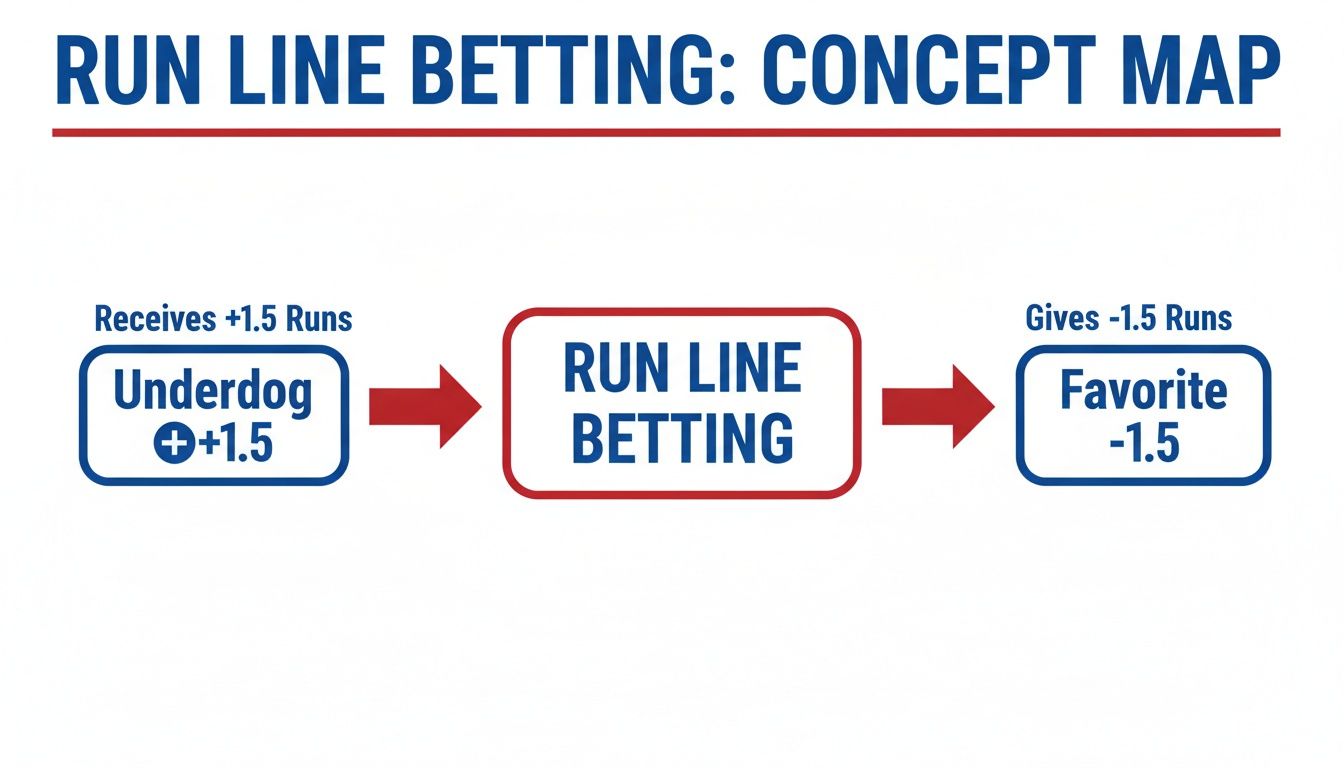
As you can see, the favorite starts in a hole they have to dig out of, while the underdog gets a buffer that gives them two ways to win the bet.
Historically, this has created a fascinating market for bettors. Data consistently shows that underdogs on the +1.5 run line cover the spread somewhere between 58-60% of the time. That statistical edge makes it a popular starting point for new bettors exploring offshore sites like MyBookie and BetUS.
How to Read Run Line Odds and Calculate Payouts
Staring at a run line for the first time on a site like MyBookie or Sportsbetting.ag can feel a bit like trying to crack a code. You'll see a jumble of numbers like -1.5 (+120) next to one team and +1.5 (-140) next to the other.
It looks intimidating, but it's actually pretty simple once you know what you're looking at. Those numbers are your roadmap to figuring out risk and reward.
The numbers inside the parentheses—the (+120) or (-140)—are the American odds. They tell you exactly how much you can win or how much you need to bet to hit a certain profit.
Here’s the key: the plus sign (+) shows your potential profit on a $100 wager. The minus sign (-) shows how much you have to risk to profit $100. It's all based on that hundred-dollar benchmark.
Decoding Plus and Minus Odds
Let's walk through a real-world example. Say you're looking at a game between the Houston Astros and the Texas Rangers on Bookmaker.eu.
- Houston Astros -1.5 (+120): That plus sign is your friend if you're looking for a bigger payout. It means a $100 bet on the Astros to win by 2 or more runs will net you a $120 profit. If you win, you get back $220 ($120 profit + your original $100).
- Texas Rangers +1.5 (-140): The minus sign tells you this is the "safer" bet, at least according to the sportsbook. To win $100, you’d need to risk $140 on the Rangers either winning the game or losing by just one run. A winning ticket pays out $240 ($100 profit + your $140 stake).
Of course, you don't have to bet in $100 increments. A $10 bet at +120 odds wins you $12. A $14 bet at -140 odds wins you $10. The $100 baseline just makes the math easy to follow.
Calculating Your Payout
Once you get the hang of the odds, calculating your potential winnings is a breeze. The good news is that most top offshore sportsbooks like Bovada or Xbet do the heavy lifting for you, showing the exact payout on your bet slip before you ever click "confirm." Still, knowing the math yourself helps you spot good value on the fly.
Key Takeaway: Plus money odds (like +120 or +150) pay out more than your stake—ideal for when you think a favorite will win big. Minus money odds (like -140 or -160) mean you risk more than you stand to win, which is common for the safer bet on the underdog getting runs.
Let's try one more. You see the Dodgers listed at -1.5 (+105) on BetUS. The +105 odds mean you’re getting a little extra juice on your money. A winning $50 bet would profit $52.50. On the other side, if their opponent is +1.5 (-125), you'd need to wager $62.50 just to profit $50.
After you lock in that wager, all the details are recorded. You can learn more about how to interpret a sports betting ticket in our detailed guide, which is a must-read for tracking your bets and understanding your history.
Placing Your First Run Line Bet at BetUS
Theory is great, but let's be real—nothing clicks until you actually see it in action. So, let's walk through placing your first run line wager step-by-step at an offshore sportsbook like BetUS. We'll turn those numbers on the screen into a real-life bet slip with money on the line.
The whole process is refreshingly simple. Head over to the MLB section, and you'll see a list of the day's games. Right next to the familiar moneyline and total, you’ll find the run line, almost always shown as -1.5 for the favorite and +1.5 for the underdog. Your only job is to click the odds you want to back.
Building Your Bet Slip
Once you click your pick, a bet slip instantly appears. This is your command center. Just type in your stake—how much you want to risk—and the site immediately shows you the potential payout. This is where the odds we’ve been talking about come to life, showing you exactly what’s up for grabs.
Here’s a look at the BetUS interface before you’ve made a selection.
As you can see, the layout is clean, making the run line column easy to spot. Once you click a line, say the Dodgers -1.5, the bet slip on the right populates, ready for you to enter your stake.
Pro Tip: Always, always double-check your bet slip before hitting confirm. Make sure you’ve got the right team, the right line (-1.5 or +1.5), and the correct stake. One accidental click can lock in a bet you never meant to make.
A lot of bettors stick with this sportsbook because the interface just works. If you want a deeper dive, you can find everything you need in this comprehensive BetUS review, which really breaks down the experience for US players.
Once you're happy with your pick and the potential win, just hit that "Place Bet" button. And just like that, your first run line bet is officially locked in.
Proven Strategies for Winning Run Line Bets
Knowing how to place a run line bet is one thing; knowing when to place one is how you start thinking like a sharp bettor. Winning at run line betting isn’t a lottery ticket—it’s about spotting value where others don’t and exploiting specific game matchups. The real skill is moving beyond just picking a winner and asking, "By how much?"

Successful bettors on platforms like Bookmaker.eu and BUSR don’t rely on complex formulas. Instead, they build analytical habits that help them find an edge the average fan completely misses. It all comes down to recognizing patterns and understanding the subtle dynamics of a nine-inning game.
Focus on Pitching Mismatches
The most obvious place to find an edge is right on the mound. But this goes way deeper than just comparing two ERAs. You're looking for an absolute ace going up against a struggling, tired, or totally green arm. A truly dominant starter can completely shut down an offense, creating the perfect storm for his team to win by two or more runs.
On the flip side, a team trotting out a shaky starter is a prime candidate for a +1.5 run line bet. Even if that team can hit, a weak pitcher is an open invitation for the opponent to put runs on the board early, making it incredibly tough to build and hold a multi-run lead.
Target Home Underdogs
One of the most powerful and historically profitable trends in run line betting is backing the home underdog at +1.5. It's a simple but potent angle. Home teams always get the last at-bat, which means they can walk it off in the bottom of the ninth without ever giving the other team a chance to respond. This keeps games tight.
The numbers back this up in a big way. One of the most telling stats shows that home underdogs on the +1.5 run line have an incredible 64.3% cover rate over a sample of more than 1,200 games. When you dig into the historical data, you see that while home teams generally cover run lines at 54.1%, that number jumps to 63% for underdogs when the opening lines shift toward even money. That's usually a sign that sharp money is on the pitching matchup.
Analyze Bullpen Strength
A starting pitcher almost never finishes the game in modern baseball. More often than not, the bullpen decides whether a run line bet cashes. A team with a great starter but a dumpster fire of a bullpen is a terrifying -1.5 bet—they can easily blow a lead in the late innings.
Before you lock in a bet on a site like BetAnything or Sportsbetting.ag, take a minute to check out the bullpen stats. Look at:
- Bullpen ERA: How many runs are they coughing up on average?
- WHIP (Walks and Hits per Inning Pitched): How many guys are they letting on base?
- Recent Performance: Has the bullpen been overworked and gassed, or are they lights-out right now?
This quick check can save you from a soul-crushing bad beat in the eighth or ninth inning. A lockdown bullpen is the best insurance policy for both -1.5 and +1.5 wagers.
Strategic Takeaway: Your goal isn't just to pick the winner. It's to predict the game script. Will an ace pitcher dominate for a blowout victory? Or will a feisty home underdog keep things close until the final out? Thinking in these terms is what separates guessing from strategy.
By combining these approaches—evaluating the pitchers, targeting valuable home dogs, and always respecting the bullpen—you start building a solid framework for making smarter bets. This is how you turn run line betting from a game of chance into a calculated edge.
Using Alternate Run Lines and Live Betting
Once you've got the hang of the standard -1.5/+1.5 run line, you're ready to step up to where the sharper bettors really find their edge. This is where we get into alternate run lines and the fast-paced world of live betting.
These more advanced options, which you'll find at offshore sportsbooks like BetAnything and Cosmobet, unlock a completely new level of strategy.
Exploring Alternate Run Lines
Think of alternate lines as a way to customize your bet. You're not stuck with the standard -1.5 spread. Instead, you can adjust it to better match how you see the game playing out, which in turn changes the odds you get.
Let's say you're absolutely convinced a heavy favorite is going to crush their opponent. The standard -1.5 run line might not offer the kind of payout you're looking for.
This is where books like Bet105 come in handy, letting you move the needle yourself.
- Taking a Favorite at -2.5: If the standard line is -1.5 (+110), you could slide it to -2.5. The odds might jump to +180 or even higher. It's a riskier play, for sure, but perfect for when an ace pitcher is on the mound against a struggling lineup.
- Taking an Underdog at +2.5: On the flip side, maybe you like an underdog to keep the game tight but aren't confident they'll win outright or lose by just one run. You can "buy" an extra run of insurance. The standard +1.5 (-130) line could become +2.5 at -200, giving you a much safer, albeit less profitable, wager.
This flexibility is huge. Top offshore sportsbooks like Bovada and MyBookie are well-known for offering a deep menu of alternate run line options for just about every MLB game.
Capitalizing on Live Run Line Betting
For a lot of seasoned bettors, the real action doesn't start until after the first pitch. Live betting, also called in-game wagering, lets you place run line bets as the game unfolds, with odds that shift in real-time.
This is your chance to react to the story of the game. Did the heavy favorite just give up two runs in the top of the first? Suddenly, their live run line might have flipped from -1.5 to +1.5. If you believe they have the firepower to come back, that's a massive value opportunity.
Momentum is a real thing in baseball. By watching the game, you can often feel these shifts before the odds have fully caught up. A starting pitcher suddenly losing control, a key player getting injured—these moments can completely alter a game's trajectory.
This is what creates live betting value that simply wasn't there before the game started. Sportsbooks with solid live platforms, like BetOnline and Xbet, are perfect for jumping on these in-game swings.
Common Run Line Betting Mistakes to Avoid
The fastest way to get better at run line betting is to learn what not to do. I’ve seen countless bettors—new and old—drain their bankrolls by making the same unforced errors over and over again. Turning a smart wager into a frustrating loss is painful, but steering clear of these common pitfalls is the first step to betting smarter.

One of the biggest leaks I see is blindly betting every favorite at -1.5. It's tempting, I get it. You see a powerhouse team and assume they'll win by a landslide. But the reality is, even the league's best teams only cover that spread about 50-55% of the time. That makes it a losing strategy in the long run, because plenty of those "wins" will be by a single run, and your ticket will be worthless.
Ignoring the Bullpen and Chasing Losses
Another massive oversight is ignoring the bullpen. A team can have an ace on the mound dominating for six innings, but that means nothing if their relief pitching is a dumpster fire. That comfortable three-run lead can evaporate in the top of the eighth before you can blink. Before you lock in a bet on a site like Bovada or BetOnline, always check the bullpen ERA and how they've performed recently.
A strong bullpen is the best insurance policy you can have for a run line bet. A shaky one is just a bad beat waiting to happen, turning a sure thing into a last-minute heartbreaker that a minute of research could have helped you avoid.
Finally, you have to resist the urge to chase losses with desperate live bets. Let’s say your pre-game -1.5 bet is on life support with your team only up by one run in the ninth. Don't throw good money after bad with a reckless live wager. That kind of emotional decision-making is the quickest way to an empty account. Trust your original analysis and live to bet another day.
Here are the three mistakes you need to avoid at all costs:
- Overvaluing Favorites: Don't just assume a great team will cover the -1.5. Baseball is a game of high variance, and one-run nail-biters are incredibly common.
- Forgetting the Late Innings: The game doesn't end when the starter heads to the showers. A team's bullpen is just as critical, a factor that sharp bettors on offshore sportsbooks like BUSR and Xbet always factor in.
- Chasing Bad Bets: Never let a losing bet dictate your next move. Chasing a bad bet with an even worse one is the fastest way to zero out your bankroll. Stay disciplined.
Got Questions About Run Line Betting? We’ve Got Answers.
Jumping into run line betting can bring up a few questions, even for seasoned bettors. It’s a bit different from a simple moneyline wager, after all. Here are the most common questions I hear, broken down with straightforward answers to get you betting with confidence.
Is the Run Line a Better Bet Than the Moneyline?
Honestly, one isn't universally "better" than the other—they're just different tools for different jobs.
Think of the run line as your go-to for finding value. It’s perfect when you see a heavy favorite with terrible moneyline odds, like -250. Betting them at -1.5 can flip those odds to something much more attractive, often into plus-money territory like +110. It also works as a safety net for underdogs; you can bet a team at +1.5 and still cash your ticket even if they lose by a single run.
The moneyline is all about simplicity. It’s the right call when you’re convinced an underdog is going to win the whole thing outright, or if a favorite's price on an offshore site like BetUS is already solid enough that you don't need the extra risk of the spread.
What Exactly Does a -1.5 Run Line Mean?
Simple. When you bet a team at -1.5, you're betting on them to win the game by 2 or more runs.
If they win by just one run, or if they lose the game, your bet is a loss. This is the classic spread you'll see on every baseball game at major offshore sportsbooks, from MyBookie to BetOnline. It's the standard for a reason.
Can the Run Line Move Before a Game?
Yes and no. The spread itself—the -1.5/+1.5—is usually set in stone. What does change are the odds attached to it.
The payout, or "juice," can shift quite a bit based on how people are betting, a last-minute pitching change, or a star player getting scratched from the lineup. For example, a favorite's -1.5 line might open at +120, but if a flood of money comes in on them, you could see it drop to +105 or even lower.
The key takeaway here is to act when you see a number you like. If you wait around, that value could disappear. A good price on an offshore platform like Sportsbetting.ag won't last forever if the market starts moving.
Which Sportsbooks Are the Best for Run Line Bets?
For me, the best books for run lines do three things well: they offer competitive odds, they provide alternate lines (like -2.5 or +2.5), and their interface doesn't make my eyes glaze over.
Offshore sites like Bovada, BetOnline, and Xbet are consistently my top picks for US bettors. They nail all three of those points and are great for MLB run line markets, especially when you want to get into live betting. Plus, their bonuses can usually be applied to these bets, which is always a nice perk.
Ready to put this into practice? USASportsbookList is where we review and rank the top offshore sportsbooks. We'll help you find the sharpest odds and the best bonuses for your run line action. Find the right book for you and start placing smarter bets today at https://usasportsbooklist.com.