Let’s get right to it: what is the vig in sports betting?
Think of it like a tiny commission or a service fee that's already baked into the price of a bet. You might hear it called the 'juice,' but it's all the same thing—it's how offshore sportsbooks like MyBookie or BetUS guarantee they make money. This built-in edge is their secret sauce for staying in business.
Top Offshore Sportsbook Bonuses for October 2026

$2,500 Use code - PROMOBUCK2 to get a 125% First Deposit Bonus at the BetNow sportsbook when you deposit with Crypto.


$2,750
200% Crypto Bonus PLUS 10% Gamblers Insurance with a minimum $100 deposit and a maximum of $1,500. Use Code: JOIN200 in the Cashier.

The Vig: A Sportsbook's Built-In Advantage
The vig isn't some extra charge you pay at the end. It's cleverly worked directly into the odds you see for every game. It’s the reason a coin-flip bet, which should theoretically be even money (+100), is almost always priced at -110 instead.
For example, when you see that standard -110 line, it means you have to risk $110 just to win $100. That extra $10 you're putting on the line doesn't go into your potential winnings; it’s the sportsbook’s commission for taking your action.
To make this crystal clear, let's break down how that standard -110 line works for both you and the house.
How the Vig Works With a Standard -110 Bet
| Scenario | Your Bet | Potential Win | Potential Payout | The Vig (House Cut) |
|---|---|---|---|---|
| You bet on Team A | $110 | $100 | $210 (if you win) | $10 (from the loser) |
| Someone else bets on Team B | $110 | $100 | $210 (if they win) | $10 (from the loser) |
No matter who wins, the sportsbook collects $220 in total wagers but only pays out $210 to the winner. That leftover $10 is their guaranteed profit, all thanks to the vig.
The Math Behind the Margin
This commission, whose full name is vigorish, ensures that sportsbooks like BUSR and Bookmaker.eu can turn a profit, as long as they get roughly the same amount of money bet on both sides. On a standard -110 American odds line, the sportsbook creates a house edge of about 4.55%. This means for every dollar wagered, they expect to keep a little over four and a half cents.
You can learn more about how betting markets operate at BettorEdge.
The vig is the invisible opponent every bettor faces. It’s not just a fee; it's the mathematical hurdle you must overcome to become a profitable player. Beating the vig is more important than picking winners.
Getting a handle on this concept is the first real step any bettor can take toward thinking like a pro. It forces you to shift your focus from simply picking winners to finding true value in the odds, which is the key to long-term success. Understanding the vig is a core part of the game, just like knowing the other lingo. You can brush up on the basics in our complete guide to sports betting lingo.
Calculating the Vig in Real-World Betting Odds
Alright, so you get that the vig is the sportsbook's cut. But let's pull back the curtain and see exactly how much you're paying on any given bet. Knowing how to calculate the vig yourself is a game-changer—it turns you from just another bettor into someone who truly understands the market. The math is way simpler than you might think, and it gives you the power to see the true cost of your wagers.
We'll use a classic NFL matchup to walk through this. Picture this: the Dallas Cowboys are playing the Philadelphia Eagles. You're browsing the odds on an offshore site like Bookmaker.eu, and you see both teams are listed at -110 on the point spread. This is the perfect, most common example to start with.
The Step-by-Step Calculation Method
The whole process boils down to one core idea: converting the American odds for each side into an implied probability. That's just a fancy term for the chances of an outcome happening, according to the bookie. Once you have the probability for both sides, you add them up. Anything over 100% is the sportsbook’s vig. It's their built-in edge.
This graphic gives you a clean visual of how the vig works from start to finish.
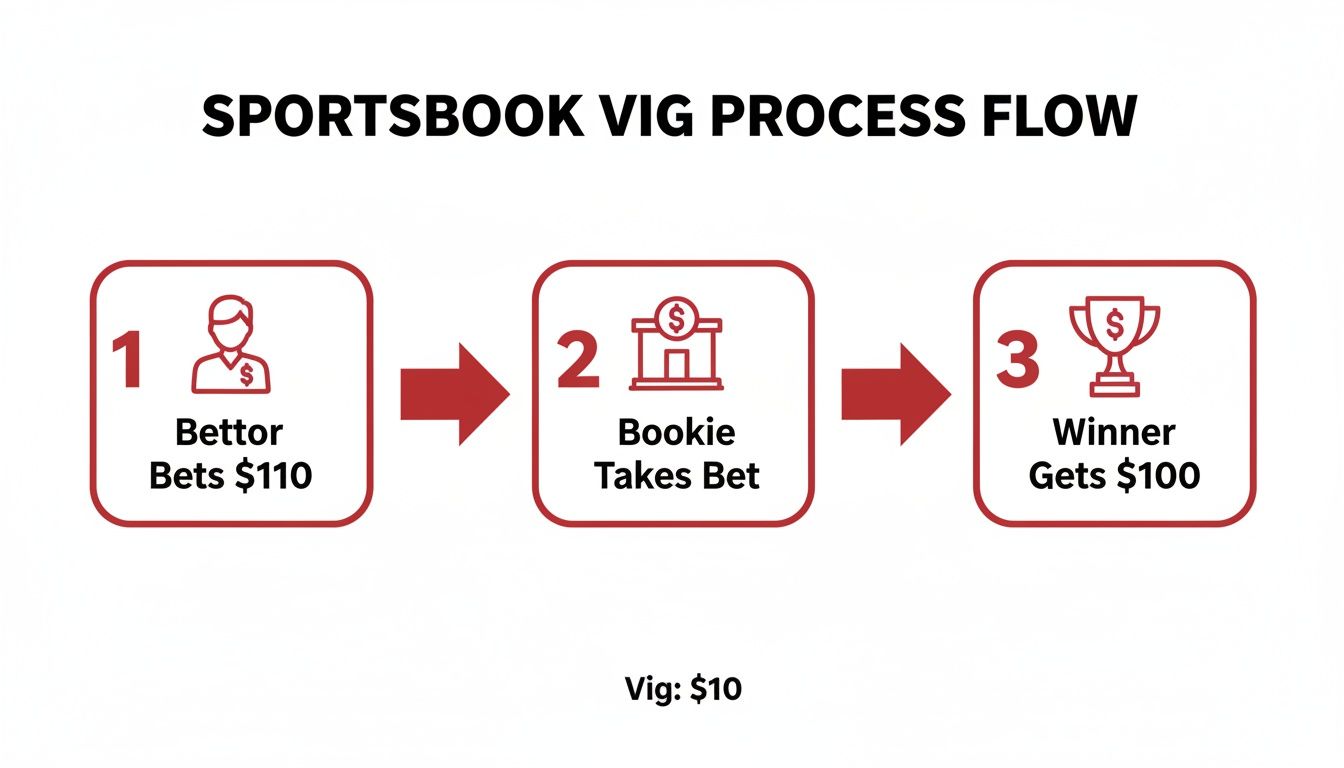
As you can see, the sportsbook is happy to take money from bettors on both sides of a game. They know they only have to pay out one set of winners, and they get to pocket the difference. That's their guaranteed profit.
Breaking Down the Formulas
To get to that implied probability, you just need two simple formulas—one for negative odds (which you see on favorites) and one for positive odds (for the underdogs).
For negative odds (-) like our -110 example:
Implied Probability = (Odds) / (Odds + 100)
For positive odds (+), the formula is just a little different:
Implied Probability = 100 / (Odds + 100)
Let's plug the numbers from our Cowboys vs. Eagles example into the negative odds formula. A quick tip: always drop the minus sign when you do the math.
Calculate Implied Probability for Team A (-110):
- 110 / (110 + 100) = 110 / 210 = 0.5238, or 52.38%
Calculate Implied Probability for Team B (-110):
- 110 / (110 + 100) = 110 / 210 = 0.5238, or 52.38%
Now, we just add those two percentages together to see the sportsbook's total "market."
- Find the Total Market Percentage:
- 52.38% + 52.38% = 104.76%
See how it's over 100%? That extra bit is the vig. The last step is to isolate it.
- Calculate the Vig:
- 104.76% – 100% = 4.76%
So, on this standard -110 line, the vig is 4.76%. This means that for every $100 the sportsbook handles on this game, it's banking on keeping $4.76 as profit, no matter who wins.
Getting this calculation down is a huge first step. If you want to dive deeper, our guide on how sports betting odds work covers all the fundamentals. Once you know how to spot the vig, you can start line shopping more effectively at books like MyBookie, BetUS, and Xbet to find the best possible price for your bets.
Why the Vig Is Your Biggest Betting Opponent
It’s easy to dismiss the vig as just a small, harmless fee. A little tax on your action. But in reality, it's the invisible opponent you're up against on every single wager you place. This constant, grinding pressure is what separates casual bettors from sharps, and getting a handle on its impact is absolutely critical for your long-term success.
The vig is the entire reason you can't just break even by picking winners 50% of the time. You have to win often enough to overcome the house's built-in commission. This is where the real battle is won or lost.
The Breakeven Point: Where the Vig Shows Its True Power
Let's look at the actual math. On a standard -110 line—the bread and butter of most sportsbooks—your goal isn't just a 50% win rate. To actually turn a profit, you have to win 52.38% of your bets. That extra 2.38% might not sound like much, but over hundreds or thousands of bets, it's a massive mountain to climb.
This is exactly why experienced bettors are obsessed with hunting for better prices. Finding a reduced juice line of -105 at an offshore sportsbook like Heritage Sports or Bookmaker.eu might feel like a minor win, but its effect is enormous. A -105 line completely changes the game.
At -105 odds, your required breakeven win rate drops from 52.38% all the way down to 51.22%. You're lowering the bar for success on every single bet, giving yourself a much better shot at actually building your bankroll.
That tiny difference is the entire strategy. You are actively shrinking the edge the house holds over you.
Why Line Shopping Is a Non-Negotiable Habit
Think about the long-term impact here. A bettor who consistently finds -105 lines needs to win less often to be profitable than someone who just accepts -110 as the standard. This subtle advantage compounds massively over an entire season.
- Standard Bettor (-110 odds): Needs to hit 52.38% of their bets just to avoid losing money.
- Sharp Bettor (-105 odds): Only needs to win 51.22% of the time to start stacking profits.
This is the core reason why holding accounts at multiple offshore sites like MyBookie, BetUS, and BUSR isn't just a suggestion—it's a fundamental practice for anyone serious about this. It gives you the power to shop for the best price, which is just another way of saying you're lowering the vig you pay.
The single most effective thing you can do to protect your bankroll is to stop giving sportsbooks a bigger edge than they already have. Tirelessly hunting for the lowest vig is how you do it.
How Offshore Sportsbooks Use the Vig to Compete
In the cutthroat world of online sports betting, offshore sportsbooks have a secret weapon to attract sharp, experienced bettors: the vig. While many books are happy to stick with the standard -110 lines, savvy operators like Xbet, BetAnything, and Cosmobet know that offering better prices is the fastest way to build a loyal following. For them, the vig isn't just a fee—it's a marketing tool.
How can they afford to do this? It often comes down to their business structure. With lower overhead and regulatory costs than many of their regulated counterparts, these books can operate on slimmer margins. They pass those savings straight to you, the bettor, through better odds and, crucially, lower juice.
This isn't just some gimmick. It's a calculated strategy designed to pull in high-volume players who understand that every percentage point matters in the long run.
The Power of Reduced Juice Lines
The most common and powerful example of this strategy is the "reduced juice" model. A handful of highly respected offshore books, including industry stalwarts Heritage Sports and Bookmaker.eu, built their entire reputation on offering -105 lines for major markets like NFL and NBA point spreads. This means that instead of having to risk $110 to win $100, you only need to risk $105.
That might not sound like a huge deal at first glance, but it completely changes the math for a bettor. Remember, a standard -110 line forces you to win 52.38% of your bets just to break even.
By simply finding a book that offers -105 lines, that breakeven point plummets to just 51.22%. You are making it significantly easier to become a profitable bettor over the long haul, one bet at a time.
This is exactly why professional bettors are so obsessed with line shopping. They know that paying less in juice is just as critical as picking the right side of a game. Over an entire season, the difference in your bankroll can be massive.
Standard Vig vs Reduced Juice: The Long-Term Impact
Let's put some hard numbers to this to really drive the point home. Imagine a solid bettor who places 200 wagers of $100 each over the course of a season, hitting a respectable 54% win rate. Here’s how their results would differ based purely on the juice they paid.
| Metric | Standard Vig (-110 Lines) | Reduced Juice Vig (-105 Lines) | Advantage |
|---|---|---|---|
| Total Wagered | $20,000 | $20,000 | – |
| Total Wins | 108 Bets | 108 Bets | – |
| Total Losses | 92 Bets | 92 Bets | – |
| Profit per Win | $90.91 | $95.24 | +$4.33 per win |
| Loss per Bet | $100 | $100 | – |
| Season Net Profit | $618.28 | $1,085.92 | +$467.64 |
The results are stark. By betting exclusively at a reduced juice sportsbook like Heritage Sports, our bettor increased their season-long profits by over 75%. This wasn't because they got luckier or made better picks—it was purely a result of paying a smaller commission to the house.
This simple comparison makes a powerful case for why any serious bettor needs to have accounts at offshore books like MyBookie, BetUS, and BUSR. Having access to these options is essential for consistently finding the best price and maximizing your bottom line.
Practical Strategies to Minimize the Vig
Knowing what the vig is in betting is one thing. Actively fighting back against it is how you actually start to win. It's time to put that knowledge into action with some street-smart strategies that will cut down the commission you pay and beef up your bankroll. You don't have to just sit there and accept the standard -110 line on every single bet you make.
The single most powerful weapon in your arsenal is line shopping. This isn't some complex, secret tactic reserved for the pros; it's simply the habit of holding accounts at multiple offshore sportsbooks. By having options like MyBookie, BetUS, and BUSR at your fingertips, you empower yourself to compare prices and lock in the best possible number for every single wager.
Think about it like buying a car. You'd never just walk into the first dealership you see and pay their sticker price without checking what other dealers are offering. Betting is no different. A few minutes of comparison shopping can save you a shocking amount of money over a full season.
Building an Effective Line Shopping Routine
To make line shopping a natural part of your betting rhythm, you need a system. The whole point is to quickly spot which sportsbook is giving you the most bang for your buck on the specific bet you want to place. This simple shift turns you from a price-taker into a price-shopper.
Here’s a simple routine to get into:
- Identify Your Bet: First, lock in the game and the side you want to put your money on.
- Open Multiple Tabs: Log into your accounts at a few different books, like MyBookie, BetUS, and Bookmaker.eu.
- Directly Compare Odds: Jump to the exact same betting market on each site and look at the lines side-by-side. You might see -110 on one book, -108 on another, and maybe even a beautiful -105 somewhere else.
- Place Your Bet: Always, always place your wager with the sportsbook offering the lowest vig. That means the most favorable odds for you.
This disciplined little process ensures you are consistently chipping away at the house's built-in advantage.
Leveraging Tools and Promotions
Beyond just opening a few tabs, you can use online tools to make this process even quicker. There are plenty of free sports betting odds comparison websites that pull in lines from dozens of sportsbooks, including offshore leaders like Heritage Sports and Xbet, and point you to the best price in seconds. A good odds comparison tool can completely streamline your workflow.
The goal isn't just to find winning bets. It's to find them at the best possible price. Shaving off even a small percentage of the vig you pay can be the difference between a winning and a losing season.
Finally, keep your eyes peeled for promotions specifically designed to cut the juice. A lot of offshore books run "reduced juice" specials on certain days or for particular leagues. For example, Heritage Sports is well-known for offering these kinds of deals for the NFL. These promos are a direct assault on the vig and offer massive value. Making it a point to take advantage of these offers should be a core part of your strategy to pay less and win more.
Your Top Questions About the Vig, Answered
Let's wrap things up by hitting some of the most common questions I hear from bettors about the vig. Think of this as a quick-hitter section to clear up any final confusion and make sure these concepts stick.
Is It Possible to Bet Without Paying Any Vig?
In the world of traditional sports betting, the short answer is no. The vig is the business model for sportsbooks like Bet105 and MyBookie; it's how they keep the lights on and guarantee a profit. The real game isn’t about eliminating the vig, but about paying as little of it as humanly possible.
Now, there are platforms called betting exchanges where you bet against other people, not the house. The exchange just takes a small commission, which is much lower than standard vig. But these are less common and operate differently. For most of us using standard offshore sportsbooks, the path to lower juice is simple: relentless line shopping.
Does The Vig Change for Different Kinds of Bets?
You better believe it. The amount of vig you're paying can swing wildly depending on what you're betting on. The big, popular markets—think NFL or NBA point spreads at a place like BetUS—almost always have the lowest juice. Your standard -110 lines work out to about 4.5%, which is the industry benchmark.
But once you wander off the beaten path into props, futures, or especially parlays, the vig gets much, much steeper. A simple three-team parlay doesn't just add up the vig from each bet; it compounds it, creating a massive edge for the book. This is exactly why you see pros sticking to the main markets where they can get the best price and pay the lowest commission.
What's The Fastest Way to Find The Lowest Vig?
By a country mile, the most powerful tool in your arsenal is "line shopping." This just means having accounts at several solid offshore sportsbooks—like Bookmaker.eu, Heritage Sports, and BUSR—and comparing their odds for the same game side-by-side.
It’s not uncommon to see one book hanging a -110, another offering -108, and if you’re lucky, a third posting a beautiful -105. That difference is pure profit in your pocket over the long run. You can speed this up by using free online odds comparison tools and vig calculators, which do the heavy lifting for you and instantly point you to the best price on the market.
The core discipline of a sharp bettor isn't just picking winners; it's finding the best price. Paying a lower vig is the most consistent way to boost your long-term profitability, regardless of your win-loss record.
Are No-Vig Betting Promotions Actually a Good Deal?
When books like Xbet or BetAnything roll out "no vig" or "reduced juice" specials, you should definitely pay attention. These promos can be incredibly valuable, but you have to read the fine print. Often, they’re tied to specific sports, certain bet types, or have a cap on how much you can wager.
Don't get me wrong, they're great marketing tools that offer real, tangible value, and you should absolutely jump on them when they fit what you're already trying to do. But they aren't a replacement for the daily grind of line shopping. That discipline remains the number one way to consistently slash the juice you pay on every single bet. Combine smart shopping with these promos, and you're giving yourself the best possible shot to come out ahead.
At USASportsbookList, we live and breathe this stuff. We provide detailed reviews and breakdowns of the top offshore sportsbooks to help you find the best odds and the lowest vig. Check out our guides to make sharper decisions and improve your betting game. Find your next winning sportsbook at https://usasportsbooklist.com.