You're usually looking for the meaning of fade at the exact moment a game feels too obvious.
It's Sunday night. The favorite is on every parlay. Social media is full of confident picks. Every group chat has the same side circled. You open MyBookie, BetUS, Bookmaker.eu, or Heritage Sports and start wondering whether the smartest move is the one nobody wants to make.
Top Offshore Sportsbook Bonuses for September 2026


$1000 + $10 Casino Chip
New customer offer. First Deposit Bonus Up To $1,000 + $10 Casino Chip.


$750
Get a 150% Sport Free Play bonus up to $750 on your first Deposit up to $500. The minimum deposit is $50.
That's where fading comes in.
A fade isn't a random contrarian stunt. Good bettors use it when price, perception, and timing line up. The public falls in love with brands, hot streaks, revenge angles, and star players. The sharper move is often stepping back, asking whether the number already accounts for all that hype, then betting the other side at MyBookie, BetUS, Xbet, Bet105, Cosmobet, BetAnything, BUSR, Bookmaker.eu, or Heritage Sports if the market gives you a reason.
Why Great Bettors Sometimes Bet Against Everyone
Most new bettors think good betting means finding the better team.
That's only part of it. The main job is finding the better price.
A primetime NFL game is the cleanest example. One team has the star quarterback, the louder fan base, the TV hype, and a recent highlight everybody remembers. Casual bettors pile in because backing the favorite feels comfortable. Offshore books like MyBookie and BetUS know those games attract public action, and that's exactly why experienced bettors slow down instead of rushing in.
The crowd is often reacting to the story
The public usually bets the headline, not the number. They remember the blowout win from last week. They remember the superstar interview. They remember the analyst desk picking one side almost unanimously.
Sharp bettors ask a different question. If everyone already sees the same thing, is there still value left on that side?
Practical rule: If a bet feels easy, stop and check whether the line is charging you for that comfort.
That's the heart of a fade. You're not betting against people just to be stubborn. You're betting against a market opinion that may have gone too far.
This idea isn't unique to sports. Traders use similar logic when markets get one-sided, which is why resources like Colibri Trader on contrarian insights are useful reading if you want to understand how crowd behavior can distort price in any market.
What works and what doesn't
What works:
- Fading hype at the right number when a team is overpriced
- Fading public narratives when the market overreacts to recent results
- Waiting for the best line instead of forcing action early
What doesn't:
- Blindly betting every unpopular side
- Assuming public support automatically creates value
- Treating contrarian betting like a personality trait instead of a pricing strategy
A fade works best when you can explain why the line is inflated, not just why the crowd is loud.
What Fading Means and Where It Comes From
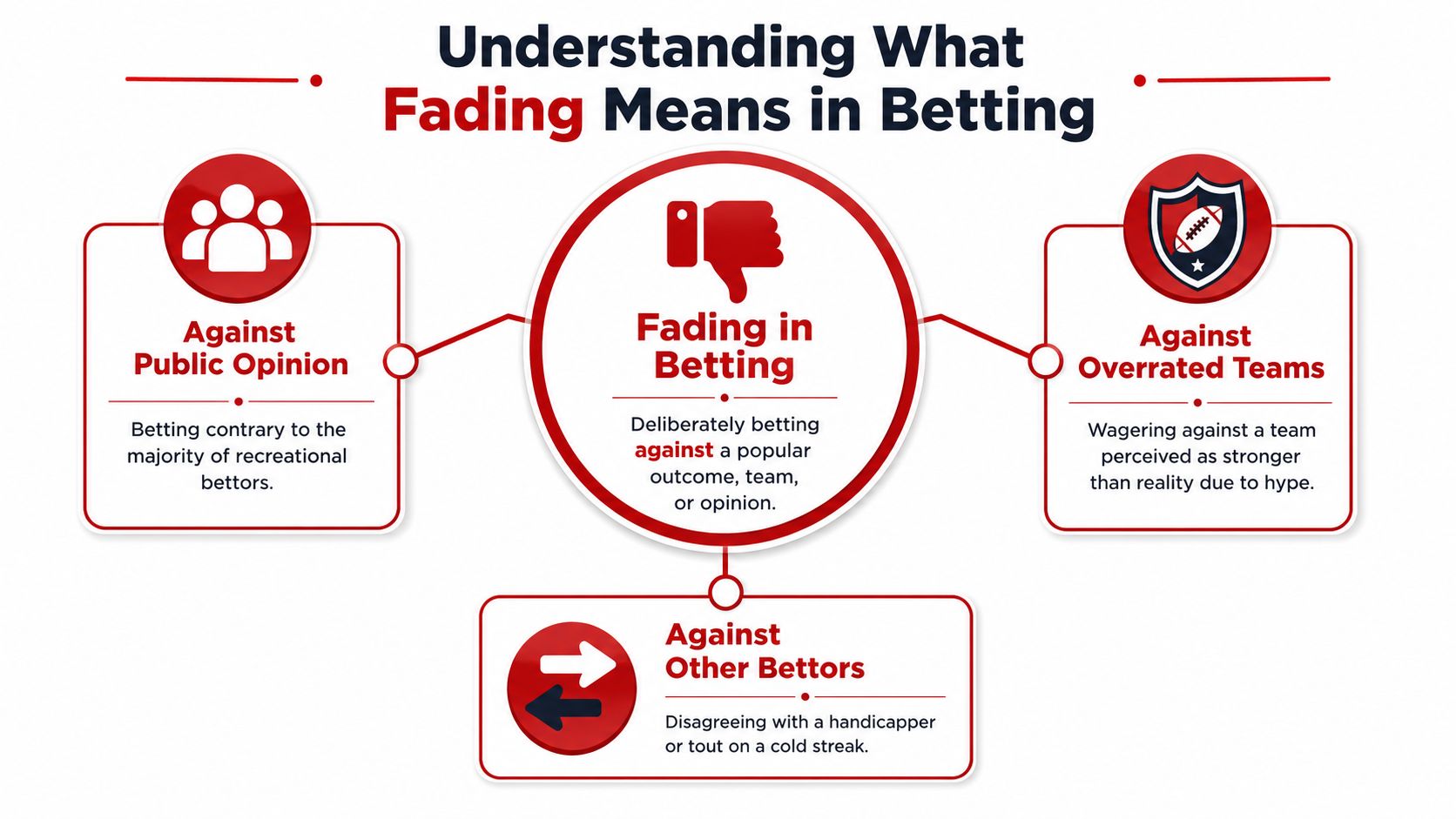
In sports betting, a fade means betting against a team, athlete, or bettor rather than backing them. Major sportsbook education sources describe it as the opposite of “tailing,” and they note that the most common use is “fading the public,” where bettors take the other side because the majority is heavily favoring one outcome, as explained in PlayCA's breakdown of fade betting.
The simplest way to understand it
If your friend says, “I'm all over the Lakers tonight,” and you decide to bet the other side, you're fading that pick.
If an entire betting market is loading up on the Chiefs, Yankees, or Celtics and you bet against them because you think the line is too expensive, you're fading the public.
If a handicapper keeps posting plays and you consistently bet the opposite side, you're fading that bettor.
The common thread is simple. You're taking the adverse outcome. You're not riding the popular opinion. You're stepping in against it.
The craps analogy makes it stick
The term also shows up in casino gambling. In craps, fade means betting against the shooter by taking the opposite side of the Pass Line, typically through Don't Pass or Don't Come bets, as described in PokerNews' casino terms guide.
That matters because it shows the term has always carried the same basic logic. A fade is an against bet.
In both sports and craps, the bettor isn't chasing the exciting outcome. The bettor is choosing the outcome that hurts the side everyone else is emotionally attached to.
That's why the word feels a little uncomfortable at first. Most bettors want to cheer with the room. A fade usually puts you in the opposite position.
Sports betting use is broader than most people think
A lot of beginners hear “fade” and immediately think of public-betting percentages. That's a common use, but it's not the only one.
You can fade:
- A team that the market may be overrating
- An athlete whose reputation is stronger than the current form
- A bettor or handicapper whose picks you don't trust
- A public angle such as revenge, momentum, or a media-driven narrative
If you also bet golf or racing, it helps to understand that betting formats can shape how “fading” feels in practice. A useful side read is Live Tourney's guide to pari mutuel, because it highlights how different markets price opinion differently.
Fade is the opposite of tail
That's the cleanest memory hook.
- Tailing means following a pick
- Fading means betting against it
Once you get that, the rest of the strategy becomes a question of timing, line value, and discipline.
How to Spot and Place a Fade Bet
A practical fade usually starts with one question. Why is this number where it is?
Let's use an NBA example because it shows the process clearly. A public favorite is on a long winning streak. Sports media is all over them. Recreational bettors love backing hot teams, especially when that team has a star everybody recognizes. You log into Xbet or Bookmaker.eu and notice the market has pushed that team into a price that feels a little rich.
A basic NBA walkthrough
Say the public darling is playing on the road against a solid but less glamorous home team. The casual bettor sees the win streak and clicks the favorite. The disciplined bettor checks a few things first.
- Recent opponents. Were those wins impressive, or did they come against weak competition?
- Schedule spot. Is this a travel game or a flat scheduling spot?
- Line movement. Did the market move because of public pressure, or because respected money pushed it?
- Matchup fit. Does the underdog do something that can bother the favorite?
If the favorite is being priced like a machine but the matchup says “closer game,” the fade starts to make sense.
What the bet slip actually looks like
Beginners often overcomplicate things. A fade bet doesn't need a special ticket type. You're just betting the other side.
On Bookmaker.eu, Heritage Sports, or Bet105, that could mean:
- Taking the underdog spread
- Betting the underdog moneyline
- Playing the under if the hype points toward an inflated total
The click is simple. The thinking behind it is the hard part.
Don't tell yourself you're “fading the public” unless you can also say what the public may be pricing in too aggressively.
For readers who want a cleaner read on market shifts before placing that bet, it helps to review a betting line movement tracker and compare how numbers move across offshore books like Bookmaker.eu, Heritage Sports, MyBookie, and BUSR.
A cleaner NFL example
Monday Night Football is where bad fades and good fades both show up.
A trendy favorite gets nonstop attention all day. The public wants the superior quarterback and the logo they trust. Meanwhile, the underdog is at home, the matchup is tougher than people think, and the market may be shading the favorite because sportsbooks know what the average bettor wants to click.
That's the spot where many experienced bettors grab the ugly side and live with the discomfort.
Here's a quick comparison:
| Market read | Weak fade | Smart fade |
|---|---|---|
| Favorite is popular | Bet the dog just because it's unpopular | Bet the dog because the number looks inflated |
| Team is on a streak | Assume the streak must end | Ask whether the streak has changed the price too much |
| Social media loves one side | Bet opposite out of ego | Use market clues and matchup logic first |
The sharp version is never “bet ugly teams because ugly teams win.” It's “bet mispriced teams because mispriced teams offer value.”
Key Indicators for a Smart Fade
Most beginner guides stop too early. They tell you that fading means betting against the public, then leave you hanging on the core question. When is that worth doing?
That gap matters. As noted in VegasOdds' explanation of fade betting, most explanations define fade only as betting against the public, but they rarely answer when that intuition is supported by market behavior. They do not provide data-driven thresholds for when a fade is justified, which leaves beginners guessing.
Start with market behavior, not emotion
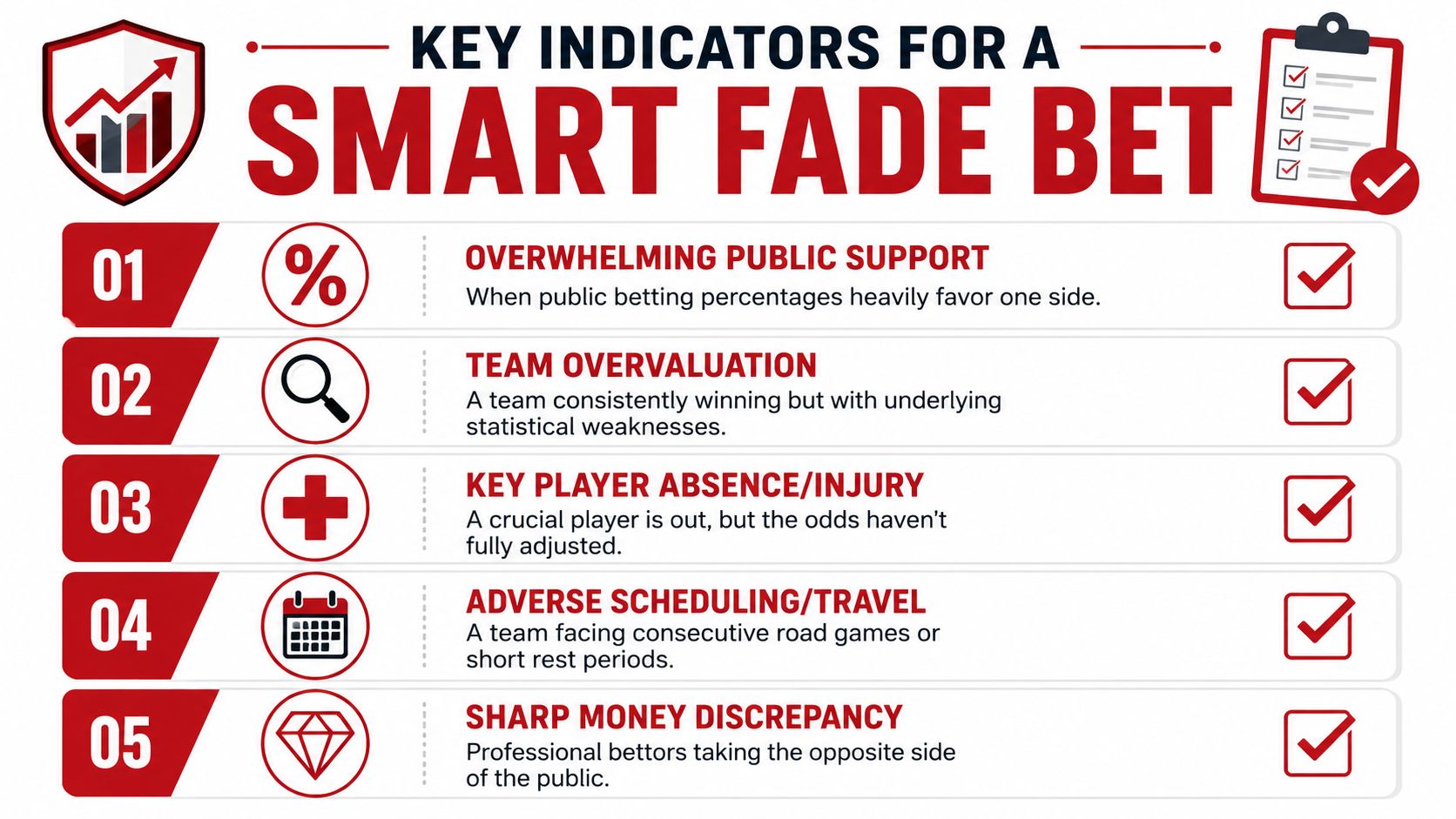
A good fade begins with evidence that the market may be leaning too hard in one direction.
The most useful signals on books like Heritage Sports, Bookmaker.eu, BUSR, and BetAnything tend to be practical, not flashy.
- Lopsided public attention. One side is clearly the popular click.
- A number that looks stretched. The line feels built for demand, not just for team strength.
- A bad schedule spot for the popular side. Travel, short rest, or emotional letdown can matter.
- Injury context. The market may be pricing the headline name, not the actual rotation impact.
A lot of bettors lose money because they fade too early in the thought process. They see public love and stop there.
Reverse line movement matters
One of the strongest clues is when the market acts differently than the public conversation.
If everybody seems to be on one side, but the line moves in a way that benefits the less popular side, you should pay attention. That can suggest more respected money disagrees with the crowd. It doesn't guarantee the fade is right, but it tells you the market isn't confirming the public opinion.
This is also where understanding betting for value helps. A fade is only worth making when the number gives you a better long-term proposition than the popular side.
To see how experienced bettors think through these market reads in real game contexts, this breakdown is worth a watch:
Situational fades can be stronger than public fades
Sometimes the cleanest fade has less to do with public percentages and more to do with the game spot itself.
A few examples I trust more than generic contrarian talk:
Fatigue and travel
An NBA team can look great on paper and still be overpriced if it's in a rough travel spot. A team on short rest or bouncing between cities is easier to fade than a fresh home underdog.
Letdown games
College football and the NFL both produce letdown spots. A team comes off a rivalry win or a statement game, gets praised all week, then lands in a flatter setup against an opponent nobody respects.
Name-brand inflation
Big franchises draw public money even when they aren't playing their best ball. Bettors often pay a tax to back famous teams.
The best fades usually feel uncomfortable because you're betting against reputation, not just against a roster.
A smart fade checklist
Use this before you click anything at Cosmobet, Xbet, or Heritage Sports:
| Check | What you want to see |
|---|---|
| Public narrative | One side is getting obvious mainstream love |
| Price | The line looks more expensive than the matchup suggests |
| Spot | The popular side may be in a weak schedule or motivation spot |
| Market clue | Movement doesn't fully confirm the crowd's side |
| Your reason | You can explain the wager without saying “everybody likes them” |
If you can't fill in more than one of those boxes, you probably don't have a strong fade. You just have a hunch.
Advanced Fading Strategies and Risk Management
The term fade doesn't stop with teams. Bettors also use it when they bet against a specific picker, capper, or social media tout.
That part gets less useful coverage than it should. Existing content often does not clearly separate fading a team from fading a bettor or handicapper, giving little practical guidance on how to judge whether a handicapper should be faded based on their track record or performance, as noted in this explanation of fading a bettor or handicapper.

When fading a handicapper makes sense
Don't fade a bettor because they lost yesterday. That's lazy.
Fade a handicapper when the process looks bad. Maybe the picks are always the same kind of public favorite. Maybe the reasoning is shallow. Maybe every card is built around hype teams and emotional angles. Maybe there's no discipline around price at all.
A few warning signs:
- They sell certainty instead of process
- They chase steam after the value is gone
- They only post wins and hide context
- They make picks based on team popularity, not number quality
If you keep seeing someone release square sides at bad prices, fading them can be more reasonable than tailing them.
Risk management decides whether the strategy survives
A lot of decent bettors sabotage themselves. They finally find a good contrarian angle, then they bet it too big because it feels sharp.
That's backwards.
A fade is still just a bet. It belongs inside the same unit structure as the rest of your card. If you use standard staking, keep using standard staking. If you need a refresher, review a solid guide to sports betting bankroll management and build your fade strategy around that instead of around emotion.
A sharp idea with bad bankroll discipline still loses in the long run.
Offshore books can help with execution, not with discipline
Using multiple offshore sportsbooks such as BetUS, BUSR, Bookmaker.eu, Heritage Sports, and MyBookie can help you shop for a better number. That part matters. A better line makes every strategy stronger.
Bonus offers can also give you more room to operate if you understand rollover terms and keep your staking sane. But no bonus fixes poor judgment. Don't turn a fade into an all-in statement about how much smarter you are than the crowd.
The best advanced bettors I know treat fades as one tool. Not an identity. Not a crusade.
Putting Fading Into Action Responsibly
If you've been asking what does fade mean in betting, the short answer is simple. It means betting against a team, athlete, bettor, or public opinion instead of backing it.
The useful answer is a little tighter. A good fade is a price-driven contrarian bet, not an automatic bet against whatever's popular.
Start small. Track your fade bets separately. See whether your strongest reads come from line inflation, matchup edges, schedule spots, or bad handicappers. You'll learn fast which kind of fade you understand and which kind you were forcing.
A simple routine works well:
- Check multiple offshore books like MyBookie, BetAnything, Cosmobet, Xbet, Bet105, Heritage Sports, and Bookmaker.eu
- Compare the number to the story around the game
- Write down your reason before placing the bet
- Keep your stake standard so variance doesn't knock you off course
You don't need to fade every public side. You need to fade the right public side.
And always keep the obvious rule in front of you. Bet only what you can afford to lose. Use limits, take breaks, and don't chase because a contrarian pick felt “smart” and lost anyway. Good betting strategy and responsible gambling always go together.
If you want a practical place to compare offshore sportsbooks, bonuses, features, and betting tools before you place your next fade, visit USASportsbookList. It's a useful starting point for checking books, comparing options, and finding resources that help you bet with more discipline.