A betting line movement tracker is your eyes and ears on the betting market. In simple terms, it shows you how sports betting odds change from the moment a sportsbook releases them until the game starts. Think of it like a stock market ticker for sports; it tracks where the money is going at major offshore sportsbooks like BetOnline, Bovada, and MyBookie, giving you a direct look into what the market really thinks.
Why Tracking Line Movement Is a Bettor's Secret Weapon
Ever look at a betting line and wonder why it moved for no obvious reason? Maybe a team opened as a 3-point favorite, but by game time, they're suddenly favored by 4.5 points. That shift isn't just random—it's the market speaking.

$250 + 100 Free Spins
All new players receive $250 in Free Bets and 100 Casino Spins. Join today and enter the promo code WELCOME in the cashier when you deposit $50 or more.

Get a 50% deposit bonus up to $1,000 with the code: CRYPTO1K. Valid on crypto deposits.


This movement happens because money is flowing in, forcing oddsmakers at sites like Sportsbetting.ag and Xbet to adjust their numbers. They have to balance the action to avoid taking a huge loss on one side. A line movement tracker is your window into this constant tug-of-war.
Every little shift tells a piece of a story. But to really understand it, you need to know that not all money is created equal in sports betting. There's a world of difference between a casual fan's bet and a wager placed by a seasoned pro, often called a "sharp."
The Public vs The Sharps
Most people—the "public"—bet with their gut. They're influenced by media hype, star players, or just plain old team loyalty. This can lead to lopsided betting on popular teams, creating lines that don't reflect the true probability of an outcome.
Sharps are the opposite. They're disciplined professionals who use sophisticated models and deep analysis to find value. They place large, calculated bets that can move an entire market on their own.
Using a betting line movement tracker helps you see the difference between these two forces. You can start to spot patterns:
- Public Sentiment: When you see a huge percentage of bets flooding one side of a game, that's usually the public piling on.
- Sharp Action: When a line moves against the public's money, that's a massive red flag. It's a classic sign that sharp, respected bettors are hitting the other side hard.
A line shift isn’t just a change in numbers; it’s a reflection of market confidence. Understanding whether that confidence comes from casual fans or professional syndicates is the key to unlocking hidden value and making smarter, data-driven decisions.
This is the kind of insight that separates casual betting from a serious strategy. You stop just guessing who will win and start understanding the why behind the odds. For a deeper dive, check out our guide on sports betting odds comparison to see how these movements look across different platforms like Bookmaker.eu and BetUS.
Ultimately, tracking line movement gives you an edge by showing you what the smartest people in the room are doing, helping you find value that most bettors completely miss.
Key Insights Gained from Tracking Line Movement
Here's a quick breakdown of the core advantages you gain by keeping a close eye on line shifts at offshore sportsbooks. It turns raw numbers into actionable intelligence.
| Benefit | What It Reveals | How It Helps Your Betting |
|---|---|---|
| Spotting Sharp Money | Identifies when respected pros are betting against the public. | Helps you bet with the "smart money" and avoid overhyped public favorites. |
| Understanding Public Bias | Shows which teams are popular with casual bettors. | Allows you to find value by "fading the public" on inflated lines. |
| Timing Your Bets | Pinpoints when a line is likely to move for or against you. | You can lock in a better number before the rest of the market catches on. |
| Injury & News Impact | Shows how fast the market reacts to breaking news like a key player's injury. | Helps you gauge the true market impact of news beyond the initial headlines. |
| Confirming Your Analysis | Validates your own handicapping when sharp action aligns with your pick. | Gives you more confidence in your wagers before you place them. |
By translating these market signals, you move beyond simple predictions and start betting with a much deeper understanding of the forces shaping the odds.
Decoding the Language of Line Movement
To really get the hang of a betting line movement tracker, you have to learn to speak its language. Every little shift in the odds is telling a story. Learning to read those signals is what separates bettors who make informed plays from those who are just guessing.
Let's break down the key terms you'll run into on sites like BetUS and Bovada.
It all kicks off with the opening line. This is the sportsbook's first crack at setting the odds for a game. Think of it as their initial take on the matchup—a starting point that's almost guaranteed to shift once the money starts pouring in.
The process is pretty straightforward. Market data comes in, the line moves, and that movement reveals where the value is.
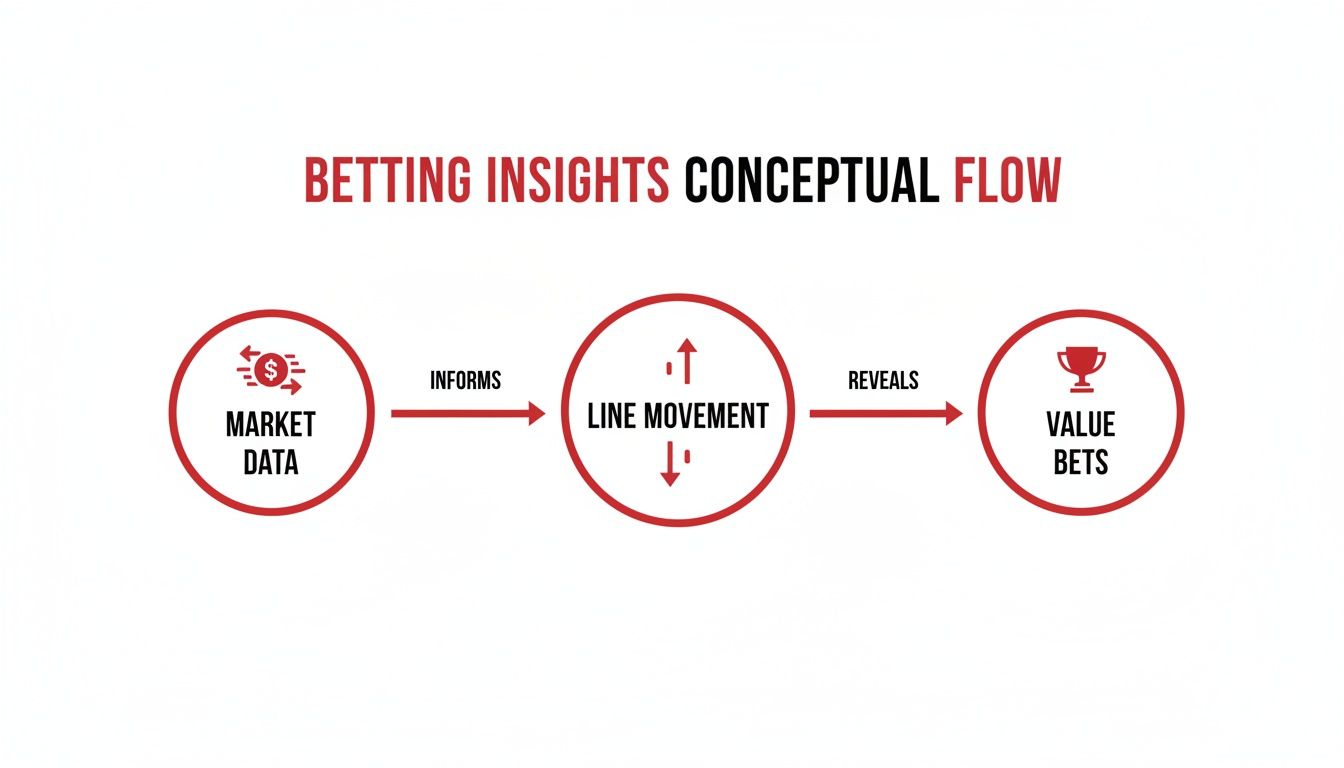
This flow shows exactly how sharp bettors use the raw data from sportsbooks to find an edge and make smarter wagers.
Key Line Movement Signals
Once that opening line is live, the real fun begins. You'll see a few types of movement that are absolutely critical to spot. Getting a grip on these is a must for anyone serious about betting. If you're new to this, our guide to sports betting lingo can help get you up to speed.
One of the loudest signals you'll ever see is a steam move. Picture this: you're watching the NFL lines on Sportsbetting.ag, and a point spread suddenly jumps three points in a matter of minutes—not just there, but across almost every book. That’s no accident. It’s a steam move, and it's almost always caused by a flood of huge bets from professional betting syndicates all pounding the same side at the same time.
But then there's the opposite signal, which can be even more powerful.
The Power of Reverse Line Movement
The holy grail for sharp bettors is Reverse Line Movement (RLM). This is when the betting line moves in the opposite direction of where the public money is going. It’s the ultimate tell-tale sign that the big, respected money is going against the grain.
Let's say 80% of the public bets at Bookmaker.eu are on the Kansas City Chiefs -7. Logically, you'd expect the line to move to -7.5 or even -8 to encourage some bets on the other side. But if that line suddenly drops to -6.5? That’s classic RLM. It's a massive red flag that the sharp money is hammering the underdog.
And the data backs this up. A deep dive into betting trends from 2015-2024 showed that when the public was overwhelmingly betting on NBA overs, sharp money often triggered steam on the under. The result? Those popular overs cashed only 49% of the time.
Research consistently shows that bettors who beat the closing line by just one point hit their bets against the spread at a 57% clip. It's proof that following these sharp money indicators pays off, and it’s the foundation for getting the most out of any line movement tracker.
How to Spot Sharp Money Versus Public Opinion
If you want to win long-term, you have to learn to think differently than the average fan. The secret isn't just picking the team you think will win; it's about understanding where the money is going. A betting line movement tracker pulls back the curtain on the constant battle between two groups: the betting public and the "sharps."
The public bets with their heart. They're driven by gut feelings, media hype, and loyalty to big-name teams and star players. This is why you'll see lines at offshore sportsbooks like MyBookie and Bovada get inflated—a flood of small bets from casual fans pushes the numbers. Sharps, on the other hand, are the pros. They treat betting like a stock portfolio, using sophisticated models and deep analysis to find value. Their large, calculated wagers are what truly move the market.
Your edge lies in learning to tell these two forces apart. When you see a huge percentage of bets on one side, that's the public talking. But when the line moves against that wave of public opinion? That’s a massive red flag that sharp money is pouring in on the other side.
Reading the Market Signals
To consistently spot where the pros are betting, you need to compare the percentage of bets (the number of individual tickets) with the percentage of money (the total handle). When these two numbers are way out of whack, you've found a huge clue.
Here’s a classic NFL scenario you might find at offshore sportsbooks like BetUS or BetOnline:
- Public Side: The Green Bay Packers are getting 75% of all the bets placed.
- Sharp Side: The underdog Chicago Bears are only getting 25% of the bets, but those few bets make up 60% of the total money wagered on the game.
This is a textbook example of sharp action. It tells you that while tons of casual bettors are placing small wagers on the Packers, a handful of high-rollers are dropping huge sums on the Bears. Oddsmakers at Xbet and Sportsbetting.ag don't care about the number of betting slips; they follow the big money.
When the percentage of money wagered on a team is significantly higher than the percentage of bets placed, you are looking at a clear indicator of professional action. This mismatch is one of the most reliable signals a line movement tracker can provide.
The Significance of Timing and Splits
Timing is everything in this game. Moves that happen early in the week are often made by sharps trying to lock in the best number before the public gets involved over the weekend. On the flip side, line movement an hour before kickoff is almost always driven by last-minute public money.
Ever wonder why a line doesn't budge even when everyone is betting one side? It often means sharps already hit the other side hard enough to create a balanced position for the sportsbook. For a deeper look at this, check out our guide on why an NFL line might stay unchanged.
By using betting splits—that breakdown of bets vs. money—you can confirm what the line movement is telling you. This transforms you from someone who just places bets into someone who reads the market, ready to find real value created by public bias at offshore sportsbooks like BUSR, Cosmobet, Bookmaker.eu, and Bet105.
Applying Line Movement Insights to NFL Betting
Alright, let's put this theory into practice where the rubber meets the road: the NFL. This is the biggest betting market in the US, and using a line movement tracker for football is a whole different ballgame. Factors unique to the sport can send lines swinging wildly at offshore sportsbooks like Bovada and BetOnline.
The NFL’s weekly schedule gives the market a ton of time to digest information and react. News about a star quarterback's tweaked ankle or a sudden blizzard forecast in Green Bay can ripple through the betting lines, causing them to jump multiple points in a heartbeat.
Why NFL Key Numbers Are Critical
When it comes to football betting, you have to understand that not all point movements are created equal. The concept of "key numbers" is everything. Thanks to the game's scoring structure—touchdowns with extra points (7) and field goals (3)—the most common margins of victory cluster around 3, 7, and 10 points.
This is a huge deal. A line moving across one of these numbers is way more significant than any other shift.
- High-Impact Move: A line shifting from -3.5 to -2.5 is a monumental change. Why? It crosses the key number of 3. A team can now win by a field goal and still cover the spread. You better believe sharp bettors at places like MyBookie or BetUS are all over that kind of value.
- Low-Impact Move: On the flip side, a line moving from -5 to -4 doesn't carry nearly the same weight. Sure, it’s still a full point, but it doesn't cross a critical scoring threshold that fundamentally changes the outcome for bettors.
Getting this distinction is non-negotiable. A true sharp money indicator is one that's strong enough to force a bookie like Sportsbetting.ag to move a line off of 3 or 7.
A betting line moving from +2.5 to +3.5 might look like a small tweak, but it completely changes the game for bettors. The difference between cashing your ticket on a last-second field goal versus ripping it up in disgust is precisely why sharps hunt for these key number movements.
Finding an Edge on Spreads and Totals
The historical data backs this up, and it’s not even close. An analysis of NFL games from 2003 to 2024 shows that teams with favorable closing line value (CLV)—meaning the final line was better than the one they bet—cover the spread about 58% of the time. That blows the general against-the-spread (ATS) average of 52.4% out of the water and shows you just how much influence the pros have. You can dig deeper into historical line movement trends on BettorEdge.com.
Let's say you see the Dallas Cowboys open at -7 on Bookmaker.eu. By Saturday, the line has been hammered down to -6. That's a massive red flag that the smart money is on the underdog.
This is where a betting line movement tracker becomes your best friend. It helps you turn abstract data into a real, tangible edge for your weekly NFL wagers at offshore sportsbooks like Xbet, Cosmobet, BUSR, and Bet105, letting you translate those market signals into winning bets.
Mastering Line Movement for MLB and Other Sports
While the NFL has its famous key numbers, the core principles of using a betting line movement tracker are universal. The classic tug-of-war between sharp money and the betting public happens every day, in every major sport. You just need to know what to look for. Let’s break down how these concepts play out on the baseball diamond, the basketball court, and everywhere in between.
In baseball, it's all about the moneyline and the run line. Unlike football’s obsession with point spreads, MLB bettors are mostly focused on who wins the game outright or if they can cover a 1.5-run spread. A last-minute change to the starting pitcher, a key player getting scratched from the lineup, or even the assignment of a particular home plate umpire can send lines shifting in a hurry at offshore sportsbooks like BUSR and BetAnything.
Picture this: a hugely popular team like the New York Yankees opens at -200 on the moneyline at a book like Cosmobet. The public, as expected, hammers the Yankees. But instead of the line going up, it drops to -185. That's a textbook case of reverse line movement, and it’s screaming that sharp bettors have found value on the underdog.
Reading the Run Line in Baseball
Run lines can tell an even more interesting story. An MLB line movement tracker might show a favorite like the Dodgers opening at -1.5 runs and pulling in 70% of the public wagers. But if that line suddenly steams down to -0.5, it’s a massive red flag. It tells you that oddsmakers at places like MyBookie are scrambling to attract money on the other side to balance out the heavy, respected action from the pros.
This isn’t just a hunch; the data backs it up. When an MLB run line moves by 0.5 runs or more toward the underdog between the opening and closing numbers, those underdogs cover the spread a remarkable 56.3% of the time. This scenario pops up in about 22% of all games, giving savvy bettors a consistent edge to exploit. You can dig deeper into how sportsbooks balance MLB action on BetQL.co.
Applying Concepts to NBA and College Sports
The breakneck pace of the NBA and college sports opens up even more chances to spot sharp action. Totals (over/under) are especially reactive, moving in a flash based on injury reports or lineup changes that drop just minutes before tip-off at offshore sportsbooks like Bet105 and Bookmaker.eu.
In basketball, a line moving just two points on the total might seem small, but it’s often a massive indicator. When the public is all over an 'over' bet but the total drops, it’s a clear sign that sharps have identified an edge on the 'under', forcing books like Bovada and BetOnline to adjust.
At the end of the day, it doesn't matter if you're looking at an MLB run line, an NBA total, or a college football spread. The underlying truth is the same. A betting line movement tracker is your best weapon for cutting through the public noise and following the silent, powerful language of sharp money.
Your Weekly Betting Line Movement Checklist
Knowing the theory is one thing, but having a repeatable process is what separates the pros from the Joes. Let's be clear: analyzing line movement isn't about blindly chasing steam plays. It's about using the data to back up your own handicapping and find real value.
Think of this simple checklist as your weekly game plan. It’ll help you build a routine that gets the most out of any betting line movement tracker and helps you make smarter plays at offshore sportsbooks like Bookmaker.eu, Bet105, and MyBookie.
Step 1: Early Week Recon (Monday-Tuesday)
Your work starts the moment the opening lines drop at offshore books like BetOnline and Bovada. The goal right now is simple: get a baseline reading of the market and spot where the sharps are placing their initial bets before the public has even had its morning coffee.
- Log the Opener: Jot down the initial point spread and total for every single game on your radar. This is your anchor point for the entire week.
- Spot the First Movers: Did a line jump a full point or more in the first 24 hours? Pay attention. These early shifts are almost always the work of sharp bettors at places like BetUS who pounced on a weak number.
- Form Your Own Number: This is crucial. Before you get influenced by what the market is doing, handicap the game yourself. What do you think the line should be? Without this, you'll have no way of knowing if a line has value later in the week.
Step 2: Mid-Week Monitoring (Wednesday-Friday)
By the time Wednesday rolls around, the public is starting to weigh in, and their betting percentages become a key piece of the puzzle. This is your prime opportunity to see if the early sharp money is holding strong or if public opinion is starting to push the line. You're trying to separate the signal from the noise at offshore books such as Xbet and Sportsbetting.ag.
Pro Tip: This is prime time for Reverse Line Movement (RLM). If you see a team getting over 70% of the bets from the public, but the line is moving away from them, that’s a massive red flag. It’s a tell-tale sign that big, respected money from players at BUSR or Cosmobet is hitting the other side hard.
Step 3: Gameday Confirmation (Saturday-Sunday)
The final hours before kickoff are when the casual bettors—the public—dump their money into the market. Your job isn't to get swept up in the frenzy. It's to stay disciplined, trust your week-long analysis, and look for one last signal to confirm your play.
- Final Line Check (1-2 Hours Before Kickoff): Pull up the current line and compare it to the opening number you wrote down on Monday. Did the market move toward your handicapped number or away from it?
- Confirm with the Splits: Take one last look at the bet vs. money percentages. Does the final line position make sense with where the big money is flowing, or is it just reacting to public hype?
- Pull the Trigger: Now you can make your move. If the week of line movement data has confirmed what your own research told you, you can place your wager at a site like BetAnything with genuine confidence. This disciplined approach is how you build a real, sustainable edge.
Common Questions on Line Movement
Let's break down some of the questions that come up all the time when you first start digging into line movement trackers. Nailing these concepts is the first step toward betting with more confidence and data on your side.
What Is the Best Time to Bet Based on Line Movement?
Honestly, there's no single magic moment to place your bet; it all comes down to your strategy and what you're trying to accomplish.
Betting early in the week, maybe right when lines open at an offshore book like Bovada, can be a great way to lock in a fantastic number before the public money starts pushing it around. On the other hand, waiting until just an hour or so before kickoff reveals where the sharp, respected money has made its final stand.
A pro-level approach is to keep an eye on the lines all week. When you see a significant move that aligns with your own research and confirms your hunch, that's your cue to jump in.
Can a Betting Line Movement Tracker Guarantee Wins?
Absolutely not, and anyone who tells you otherwise is selling you a fantasy. No tool can guarantee a win.
Think of a line movement tracker less like a crystal ball and more like a high-powered radar. It gives you incredible insights into what the market is thinking and, more importantly, what the pros are doing at offshore sportsbooks like BetUS and BetOnline. It helps you spot value where others might not see it.
Ultimately, a tracker is just one piece of the puzzle. It should always complement your own analysis and a smart, disciplined bankroll management plan.
What Is Reverse Line Movement and Why Is It So Important?
This is one of the biggest tells in the sports betting world. Reverse Line Movement (RLM) happens when the vast majority of the bets—the public money—is on one side, but the line actually moves in the opposite direction.
Let's say 75% of the bets at a site like MyBookie are on the Patriots at -7. But instead of the line moving to -7.5 or -8 to attract action on the other side, it drops to -6.5. That's a classic RLM situation.
RLM is a massive red flag. It’s a sign that even though the public is hammering one side, huge, respected "sharp" bets are coming in on the other, forcing the sportsbook to adjust the line against the public's opinion. It’s one of the most reliable indicators of where the professional money from sharp bettors at places like Bookmaker.eu and Xbet is landing.
Ready to gain an edge with smarter, data-driven betting? Explore the top offshore sportsbooks and expert reviews at USASportsbookList. Find the best bonuses and start betting like a pro today. Visit https://usaspsortsbooklist.com to get started