You open a World Cup betting page at MyBookie or BetUS, see a wall of numbers, and immediately hit the same question almost everyone asks at first. What am I looking at?
That confusion is normal. Soccer betting boards are busier than most NFL or NBA screens because you're usually dealing with three-way outcomes, tournament futures, knockout rules, and a lot of live movement once the match starts.
Top Offshore Sportsbook Bonuses for September 2026

$250 + 100 Free Spins
All new players receive $250 in Free Bets and 100 Casino Spins. Join today and enter the promo code WELCOME in the cashier when you deposit $50 or more.

Get a 50% deposit bonus up to $1,000 with the code: CRYPTO1K. Valid on crypto deposits.


The good news is that world cup betting odds aren't hard once you know what each number is trying to tell you. Read them the right way, and they stop looking like random code. They start looking like price tags. That's the mindset you want whether you're checking a futures market at Bookmaker.eu, comparing match lines at BUSR, or looking for a live number at Heritage Sports.
Decoding the Numbers and Understanding Odds Formats
You're comparing World Cup prices at MyBookie and BetUS, and one screen shows +420, another article shows 2.50, and a third lists 5/1. It looks messy at first, but all three numbers are doing the same job. They're quoting a price on an outcome.
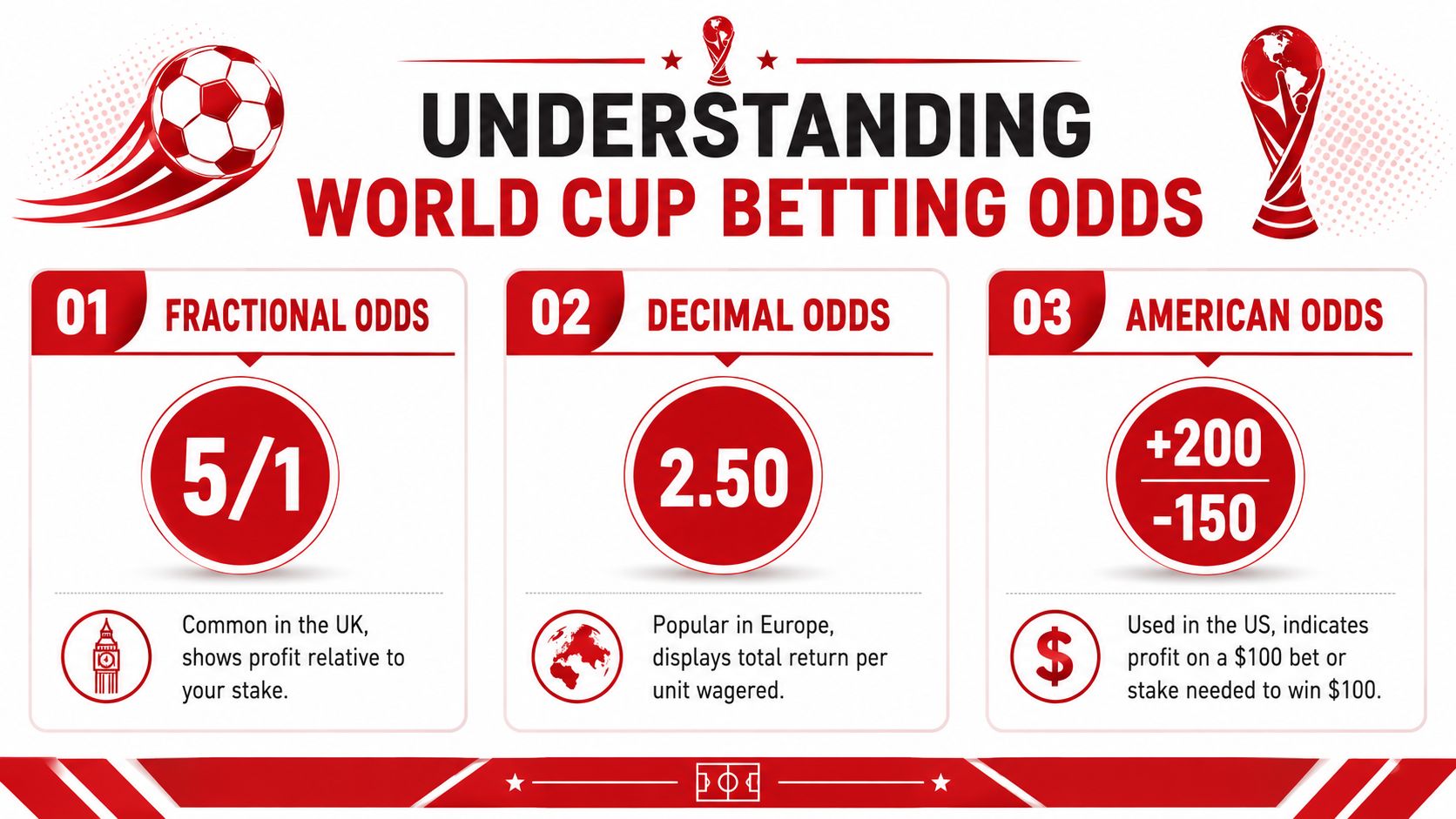
A useful way to read odds is to treat them like tags in a store. The team or market is the product. The odds are the price. Your job is not to ask, “Who wins?” Your job is to ask, “Is this price better than the true chance?”
That distinction matters more in the World Cup than in a typical league match. Tournament pricing shifts for reasons casual bettors miss, especially in group-stage markets where draws, tiebreakers, and format changes can distort the board.
American odds
If you bet at offshore books like MyBookie, BetUS, Xbet, BetAnything, Bet105, Cosmobet, BUSR, Bookmaker.eu, and Heritage Sports, you'll usually see American odds first.
Here's the clean version:
- Positive odds show how much profit you'd make on a $100 bet.
- Negative odds show how much you need to risk to make $100 profit.
So if France is +420, a $100 bet wins $420 in profit. If England is +600, that same $100 stake wins $600 in profit.
The bigger number is not automatically the smarter bet. It's a longer price. The sportsbook is pricing England as less likely than France.
Decimal and fractional odds
Decimal odds show your total return, including stake. So 2.50 means every $1 wagered returns $2.50 total, not $2.50 in profit.
Fractional odds show profit relative to stake. A 5/1 line means you win 5 units for every 1 unit staked, plus your original stake back.
Here's the practical translation:
- American answers, “What do I profit, or what must I risk?”
- Decimal answers, “What do I get back in total per unit?”
- Fractional answers, “How much profit do I make compared with stake?”
You do not need to memorize every conversion. You do need one home base. For US bettors using offshore books, American odds are usually the easiest format for fast line shopping. If you want the formulas for implied probability and conversions in one place, keep this guide to calculating betting odds and implied probability handy.
A quick payout and probability cheat sheet
The table below gives you a fast reference point. Payout examples assume a $100 stake.
| Odds Type | Example | Implied Probability | $100 Bet Payout |
|---|---|---|---|
| American | +420 | Lower than a favorite, higher than +600 | $420 profit |
| American | +500 | Lower than +420, higher than +600 | $500 profit |
| American | +600 | Lower than +500 | $600 profit |
| Decimal | 2.50 | Depends on exact conversion | $250 total return |
| Fractional | 5/1 | Depends on exact conversion | $500 profit |
One point trips up newer soccer bettors. Payout and value are not the same thing.
A draw at a tempting plus price can still be a bad bet if the number is too short. A favorite can still be a strong bet if the market has shaded too far toward the underdog. That's why experienced bettors convert odds into implied chance first, then compare that number to their own estimate.
Where beginners usually get tripped up
The biggest mistake with odds is treating them like fixed predictions. They are prices shaped by bookmaker opinion, market demand, team news, and tournament context.
The second mistake is staring only at the return. Bigger payout does not mean better bet.
Airline pricing works the same way. A ticket might be expensive because demand is high, or cheap because the route is inconvenient. Betting odds work like that. The number itself is only half the story. The key question is whether the market priced the outcome correctly.
That mindset becomes especially useful in the 2026 World Cup. With the expanded format affecting group strategy, some books will be slower than others to adjust draw prices and group-stage futures. Bettors who read odds as prices, not predictions, will spot those gaps faster.
Futures vs Match Betting The Core World Cup Markets
Two bettors can both be right about a team and still choose very different bets.
Say you rate France as a serious title threat. You can back them to win the whole tournament before the first whistle, or you can wait and pick your spots match by match. Those are different bets with different risks, different timelines, and different ways to find value.
Futures betting
A future is a bet on an outcome that takes days or weeks to settle. The headline market is the outright winner, but group winners, teams to reach the quarterfinals, and top goalscorer also fall into this category.
Outright futures are simple to understand and easy to misuse. The mistake newer bettors make is treating a long price like hidden value. In World Cup betting, champions usually come from the part of the board the market already trusts. A team at the top of the odds list may feel expensive, but that does not mean the number is bad. It means the market sees a realistic path through the bracket.
That matters even more in 2026 because the tournament structure creates a second layer to futures betting. The expanded field changes group-stage incentives. More teams arrive with a credible path to advancing, which can distort group winner and to qualify from the group prices if a book is slow to adjust. An outright future asks, "Who can survive the full month?" A group future asks, "Who benefits most from this specific format?" Those are not the same question.
A practical way to build a futures card at MyBookie or BetUS is to separate teams into tiers:
- Title-tier teams for outright winner bets
- Format-friendly teams for group qualification or group winner bets
- Teams with favorable early paths for quarterfinal or semifinal markets
That approach keeps you from paying a premium for the wrong thing. A strong team can be overpriced to win the Cup and still be fairly priced to win its group. The reverse can also happen.
Match betting
Match betting is the short-term version. You are pricing one game, one tactical battle, one lineup decision, and one game state.
Many experienced offshore bettors do most of their work in this manner. You do not need to predict the entire tournament correctly. You only need to decide whether the number on tonight's match is off.
The core match markets are straightforward:
- Three-way moneyline, Team A, Draw, or Team B
- Goal spreads, usually listed as a favorite needing to win by more than one goal
- Totals, over or under a set number of goals
- Live betting, where prices move after kickoff
Match betting gives you more chances to react to information. A suspended fullback, a rotated midfield, bad weather, or a must-not-lose spot can all create value for a single game without changing your long-range opinion of the team.
For the 2026 World Cup, that point gets sharper. The expanded format should make some group-stage matches more cautious, especially when a draw helps both sides stay on track. That makes draw bets and unders more interesting than casual bettors often assume. A lot of World Cup guides treat draw prices like background noise. In this tournament, they deserve much more attention.
Which one fits your style
Futures work better if you are comfortable tying up bankroll and waiting for your read to play out.
Match betting works better if you prefer to compare prices daily and react to team news.
Many smart bettors use both, but with different jobs in mind. They might use MyBookie or BetUS for a small futures position before the tournament, then keep more of their bankroll free for group-stage matches where offshore books can differ on draw prices, alternate lines, and live markets.
A useful rule is simple. Use futures for your broad opinion. Use match bets for your sharper opinion.
If you believe a powerhouse is overrated across the full tournament, fade them in the outright market. If you believe that same team is vulnerable in a specific opener because the matchup is tighter than the odds suggest, attack the match line instead. That split keeps your betting card organized and helps you spot value instead of just collecting opinions.
How to Read and Analyze Lines at Offshore Sportsbooks
You open a World Cup match page at MyBookie, see three prices on the moneyline, a goal spread, a total, and a stack of alternate markets, and it can feel like reading a menu in a language you only half know. The board gets easier once you know what question each number is asking.
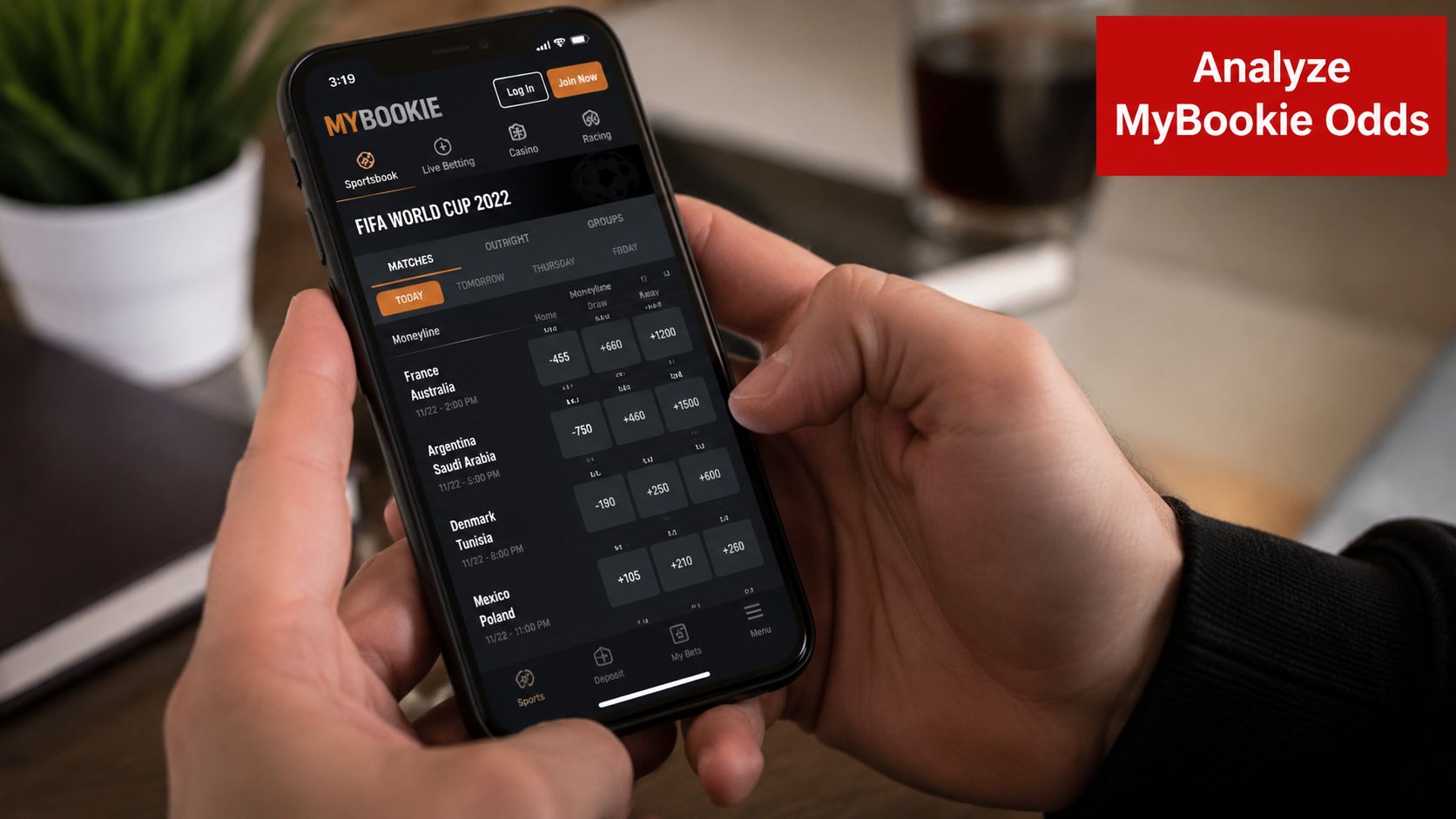
The three-way moneyline
Start with the standard soccer moneyline. It has three outcomes:
- Team A wins in regulation
- The match finishes level
- Team B wins in regulation
That third line is the one newer bettors often misread. In football or basketball, the market usually asks you to pick one side against another. In World Cup soccer, the draw is a full betting option, and in 2026 it should matter even more because more group-stage situations are likely to reward caution.
Here is the practical way to read it. If a team is only a moderate favorite, the draw price is not background noise. It is part of the actual risk. A favorite can be the better team and still fail to win because soccer has low scoring and long stretches where one bounce changes everything. That is why a number like -160 says something very different from a heavy favorite price. The shorter favorite still lives closer to draw territory than many casual bettors realize.
A good habit is to read the draw price as the market's warning label. If the draw is priced tightly, the book is telling you this match has real stalemate potential.
Goal spreads and why they feel different
A goal spread changes the question. Instead of asking, “Who wins?” it asks, “By how much?”
The common example is -1.5. If you back the favorite at -1.5, they need to win by at least two goals. Winning 1-0 is not enough. Winning 2-1 is not enough either.
That matters because soccer favorites do not always press for margin once they get ahead. A team can control the game, take the lead, then spend the last half hour protecting energy, possessions, and tournament position. In league play that is common. In the World Cup it can be even more pronounced, especially in a group stage where goal difference, scheduling, and qualification math all shape incentives.
That is one reason spread betting in soccer feels different from point spreads in higher-scoring sports. A better team can be right on the side and still wrong on the spread.
Before betting a favorite on the goal spread, ask a more specific question. If they score first, are they built to chase a second and third goal, or are they likely to manage the match?
A short explainer on reading soccer boards helps here:
A simple offshore screen reading routine
When I scan a match at MyBookie, BetAnything, or Bookmaker.eu, I use the same order every time because it keeps me from forcing a bet.
- Moneyline first. How strong is the favorite, and is the draw priced close enough to make the straight win less attractive?
- Spread second. Is the book asking the favorite to do more than the matchup supports?
- Totals third. Does the goals total match the story suggested by the side markets?
- Market comparison fourth. Are other books dealing a meaningfully better number on the same match? A quick check with a sports betting odds comparison page for offshore books helps you spot whether MyBookie or BetUS is hanging the stronger price.
- Line movement last. Did the market shift because of lineup news, injury news, or because bettors pushed one side early?
That sequence works like checking a weather forecast before a flight. You want the broad conditions first, then the details that affect the trip.
For the 2026 World Cup, this routine matters more in group-stage matches. The expanded format should create more spots where a draw is useful, acceptable, or tacitly preferred by both teams. Offshore books do not always adjust those incentives perfectly at the same speed across every market. If the moneyline says “careful match” but the draw price still looks generous, that is the kind of mismatch worth circling.
Your job is not to predict every move on the board. Your job is to decide whether the number in front of you still offers value after you understand the story the market is telling.
Finding Your Edge How to Secure the Best Odds
If you only take the first number you see, you're making betting harder than it needs to be. The difference between winning and losing long term often starts before the match does. It starts when you compare prices.
Why line shopping matters
Line shopping means checking the same market across several offshore books and taking the best available number. That could be BetUS, Xbet, Bookmaker.eu, BUSR, Bet105, or Heritage Sports. The point isn't brand loyalty. The point is price.

A better line gives you more room for error. It also gives you better closing value if the market moves your way later.
For a practical comparison workflow, this sports betting odds comparison page is a solid starting point when you want to track which offshore shops tend to hang stronger soccer prices.
What to compare besides the number
Price is the first thing to compare, but it's not the only thing.
- Market depth: Some books post more World Cup props, group futures, and live options than others.
- Bet limits: If you like to scale into a position, limits matter.
- Live interface: Some mobile apps handle in-game updates better than others.
- Deposit style: Crypto-friendly players often care about that before anything else.
Books operate with distinct strengths. One book may have a sharper three-way moneyline. Another may be stronger for exact score props or team-to-qualify markets.
Bonuses are useful, but only if you use them correctly
Offshore books love sign-up bonuses, reload offers, and crypto promos. Those can help, but only if you read the rollover terms and know which markets count fully.
A bonus isn't free money in the practical sense. It's more like a store credit with rules attached. If the rollover is awkward and you're forcing bad bets just to clear it, the promo loses its value fast.
Bankroll note: Treat bonuses as a tool, not a reason to bet more than your plan allows.
Hedging during the tournament
Hedging matters most with futures. Say you grabbed a team early at a strong number on BetUS and they reach the knockout stage looking live. At that point, another offshore book may post an opponent or a related market that lets you reduce risk.
You don't need to hedge every future. Sometimes the original ticket is still the best position. But keeping multiple sportsbook accounts gives you options, and options are valuable once the tournament starts moving quickly.
The 2026 Advantage How the New Format Changes Everything
Most World Cup betting guides talk as if the tournament format is fixed. It isn't. That matters because betting value changes when the structure changes.
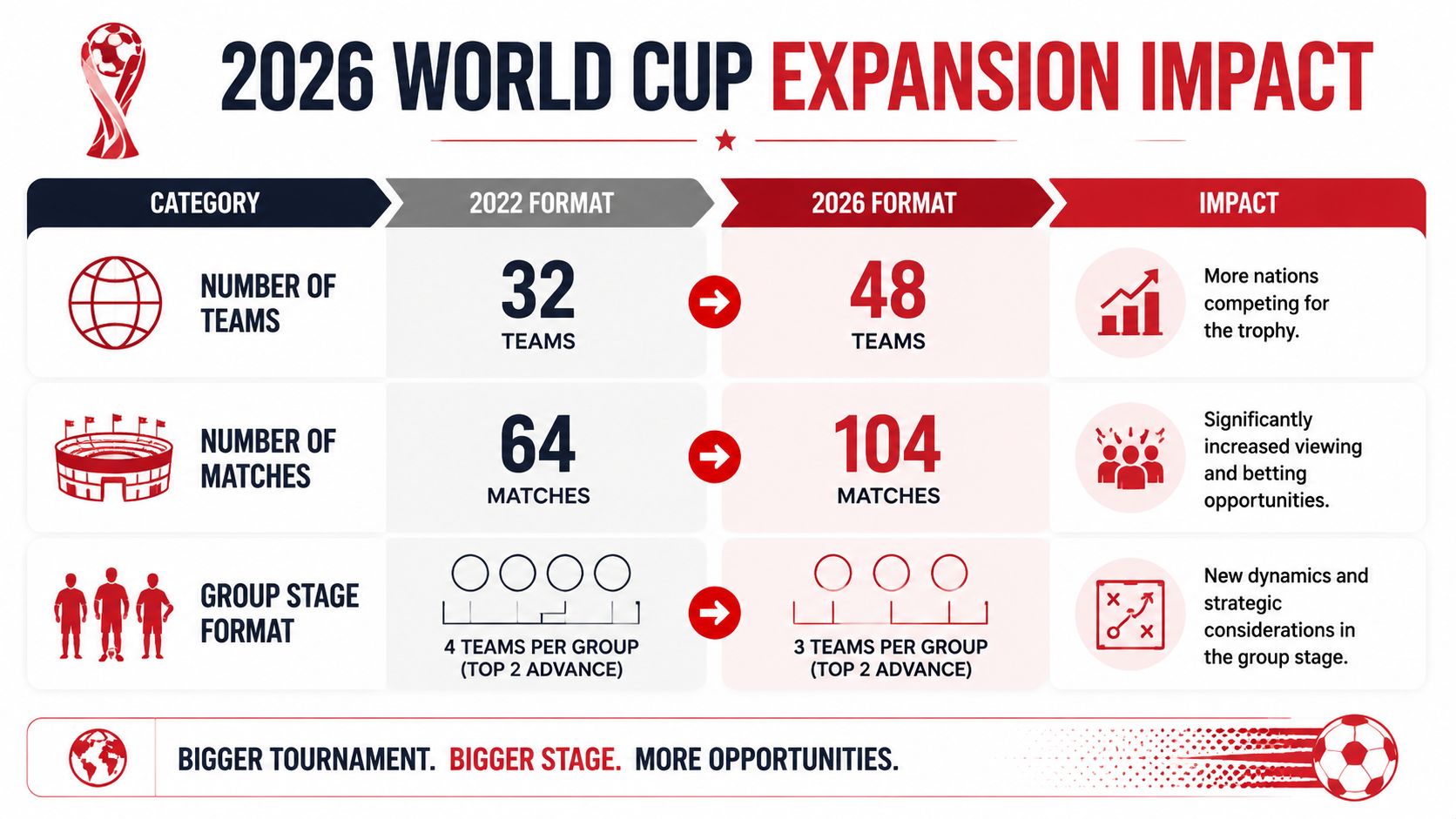
More teams changes how you price uncertainty
The 2026 tournament is set to expand from 32 teams in 2022 to 48 teams in 2026, with 64 matches in 2022 and 104 matches in 2026, and a shift from 4 teams per group to 3 teams per group with the top 2 advancing, as shown in the infographic specification provided for this article.
That kind of expansion changes how bettors should think about group-stage markets. The provided betting brief notes an underserved angle: with more teams advancing than in the previous setup, draw bets and group-stage futures deserve a different pricing lens because heavy favorites become less reliable in those early-stage environments.
In plain English, the bigger and less familiar the field gets, the harder it is to blindly trust brand-name teams every match.
Why draw bets deserve a second look
A lot of casual bettors hate the draw because it feels passive. But in a tournament with more teams, altered incentives, and more pressure to avoid an opening loss, the draw can become a very practical tool.
Books know recreational money prefers favorites. That creates spots where the draw is the price most bettors skip over.
Three situations are worth watching at MyBookie, BetAnything, or BUSR:
- Opening group matches: Teams often protect the point if the match is balanced.
- Favorites facing compact underdogs: If the favorite struggles to break the game open, draw value can hold longer than expected.
- Qualification math spots: Late group matches can produce cautious game states.
Live betting gets sharper after an early underdog goal
The other underused angle is live volatility. The provided brief notes that early goals can create sharp in-game swings, especially when an underdog scores quickly and pushes a favorite into a plus-money range that may be more attractive than the pregame number.
Soccer doesn't behave like a sport with constant scoring. A single early goal can flip the live board, but it doesn't always change the balance of play as much as the odds suggest.
If a strong favorite concedes early, don't bet the comeback automatically. Check whether the match state changed or only the scoreboard changed.
That's where experienced live bettors at Heritage Sports, Cosmobet, and Xbet can find useful moments. Not every early goal creates value. Some do. The edge comes from being ready before kickoff, not improvising after the market jolts.
US-based bettors usually ask the same practical questions. Which offshore site should I trust? How do I avoid sloppy account issues? What habits keep this fun instead of chaotic?
What to check before you deposit
Start with reputation and usability. If you're considering Heritage Sports, Bet105, MyBookie, BUSR, Bookmaker.eu, or BetUS, check whether the site has a clean mobile experience, responsive support, and clear house rules for soccer markets.
Read the rules on these points before you fund anything:
- Settlement rules: Some books grade soccer bets on regulation only. Others have separate markets for extra time and penalties.
- Payout methods: Choose a method you understand and are comfortable using.
- Verification process: Know what documents the book may ask for before your first withdrawal.
- Country restrictions and account rules: Don't assume every feature works the same way for every user.
If you access betting sites while traveling or switching networks often, it also helps to understand how websites flag suspicious access patterns. A practical explanation of that problem appears in Sota Proxy's IP ban guide, which walks through common triggers in plain language.
A sensible process for choosing a book
A flashy homepage doesn't tell you much. A boring but reliable withdrawal process tells you a lot.
Here's a stronger checklist than “Who has the biggest bonus?”:
- Check soccer market range. You want more than just basic moneylines.
- Review the rules page. That's where grading disputes usually start.
- Test support. Ask a simple question before depositing.
- Start small. Use the site before you trust it with a bigger tournament bankroll.
For a broader look at reputable options, this guide to safe offshore sportsbooks is a good comparison point.
Keep the betting under control
Responsible gambling isn't filler advice. World Cup betting runs for weeks, and the schedule makes it easy to overbet if you're firing on every match.
A few habits help:
- Set a tournament bankroll: Keep it separate from everyday money.
- Use fixed unit sizing: Don't double your stake because one match feels “certain.”
- Don't chase: Soccer is full of low-scoring variance.
- Take breaks from live betting: Fast-moving markets can push bad decisions.
If betting stops feeling entertaining and starts feeling like pressure, step back. The best move on some days is no bet at all.
World Cup Betting Odds FAQ
What's the difference between a push and a voided bet in soccer
A push usually means the result landed exactly on a number where the sportsbook returns your stake. That comes up more often on certain handicap or total lines.
A voided bet is different. The book cancels the wager under its house rules. That can happen because of a match interruption, a major market error, or a player-specific condition in prop betting. Always check the soccer rules page at books like Cosmobet, BetAnything, or Bookmaker.eu because grading policies can differ.
Do World Cup bets include extra time and penalties
Usually, the standard soccer moneyline is graded on regulation time only unless the market clearly says otherwise. That means a knockout match that is tied after regulation may still cash the draw in a three-way market, even if one team wins later in extra time or penalties.
Books often separate these into different markets, such as to qualify, lift the trophy, or advance. That distinction matters a lot in knockout betting because a team can fail to win in regulation and still move on.
Read the market name word for word. “To win match” and “to qualify” are not the same bet in tournament soccer.
What is the vig, or juice, and why should you care
The vig is the bookmaker's built-in edge. It's the reason the prices on both sides of a market don't line up as a perfect fair split.
For bettors, the important point is practical. The more juice you pay, the harder it is to win over time. That's why line shopping across MyBookie, BetUS, Xbet, BUSR, and Heritage Sports matters so much. A slightly better price doesn't feel dramatic on one bet, but over a long tournament it keeps more value in your pocket.
The sharp habit isn't finding one magical lock. It's consistently taking better numbers, understanding the rules, and choosing markets that fit the way soccer plays.
If you want help comparing offshore books, checking bonus terms, and finding sportsbook guides built for US bettors, USASportsbookList is a useful place to start before the World Cup board gets crowded.