The vig, short for vigorish, is the commission a sportsbook charges for taking your bet. It's the hidden fee built directly into the odds that guarantees sportsbooks like MyBookie and BetUS make money, no matter which side of a game wins.
The Hidden Fee in Every Bet You Make
Ever stared at a point spread for an NFL game and wondered what that "-110" number is all about? It's not just some random figure—it’s the entire business model of a sportsbook in a nutshell.
Think of the vig as a service fee. When you place a wager at an offshore sportsbook like BetOnline or Bovada, you're paying them a tiny cut for the convenience of hosting and facilitating that bet.
This built-in house edge is precisely why you have to win more than 50% of your bets just to break even over the long haul. It's a fundamental concept every bettor needs to wrap their head around before placing that first wager.
The term "vig" is just one piece of the puzzle. Getting comfortable with the full range of betting terms is essential, and you can get up to speed by exploring a complete glossary of common sports betting lingo.
Why Standard Odds Are -110
The most common odds you'll see for point spreads and totals are -110. This is the industry standard you’ll find at nearly every major offshore book, from Sportsbetting.ag to Bookmaker.eu. So, what does that mean in practice?
It means that to win $100, you have to risk $110. That extra $10 is the sportsbook’s cut—the vig.
Understanding the Standard -110 Vig
Here's a quick breakdown of what the vig means for a standard bet you'd find at a sportsbook like Bovada.
| Concept | What It Means for You |
|---|---|
| The Bet | To win $100 on a game total or point spread. |
| The Risk | You must wager $110. |
| The Vig | That extra $10 you risk is the sportsbook's commission. |
| The Outcome | If you win, you get your $110 stake back plus $100 in profit. If you lose, the sportsbook keeps your $110. |
At its core, the vig allows a bookmaker to create a balanced market where they are guaranteed to pay out less than they take in, as long as they attract roughly equal betting volume on both sides of a game.
This small, consistent fee, applied across thousands of daily bets at sites like Xbet and BUSR, is their primary engine for revenue. Grasping this simple fact is the first step toward making smarter bets and truly understanding what you're seeing on the odds board.
How Sportsbooks Use the Vig to Guarantee Profit
Ever wonder how sportsbooks like Xbet and Sportsbetting.ag stay in business, regardless of who wins the Super Bowl? It’s not because they have a crystal ball. Their secret is a carefully built business model designed to lock in profit on every game, and it all comes down to the vig.
The main goal for a sportsbook isn't really to pick winners or outsmart bettors. What they're actually trying to do is create a "balanced book." This is their ideal scenario, where they get a roughly equal amount of cash wagered on both sides of a bet. When that happens, the final score becomes almost irrelevant to their bottom line.
The Power of a Balanced Book
Let's walk through a simple, real-world example using a standard NFL point spread. Say the Green Bay Packers are playing the Chicago Bears, and a popular book like MyBookie sets the odds at -110 for both teams.
To see how the vig works its magic, just imagine this plays out:
- Total Wagers on the Packers: Bettors put down a combined $110,000 on Green Bay to cover the spread.
- Total Wagers on the Bears: On the other side, bettors wager a total of $110,000 on Chicago to cover.
Before the game even kicks off, the sportsbook has collected a cool $220,000 in bets. For them, this is a perfect setup.
Key Takeaway: In a perfect world, a sportsbook wants equal money on both sides of a game. This balance wipes out their risk and guarantees them a profit, all thanks to the small fee—the vig—they build into the odds.
Now, let's fast-forward to the end of the game. It doesn’t matter if the Packers or the Bears cover the spread; the sportsbook’s math works out the same either way. Let’s say the Packers win and cover. The book has to pay out $100,000 in winnings to those who bet on Green Bay, plus give them back their original $110,000 stake.
- Total Money Collected: $220,000
- Total Money Paid Out (Winnings + Stakes): $210,000
- Guaranteed Sportsbook Profit: $10,000
That $10,000 difference is pure profit for the house. It came directly from the 10% vig charged on the losing bets. This is why you'll often see sportsbooks adjusting their lines—it's not always just about predicting the outcome, but also about encouraging more bets on one side to balance things out.
This core concept of creating a market and profiting from the spread isn't just a sports betting thing. It's a fundamental principle in many financial markets. For instance, looking into crypto market making strategies shows how firms make money by facilitating trades and managing spreads, much like a bookie. It all boils down to managing risk and making sure you get your commission.
How to Calculate the Vig on Any Bet
You don't need to be a math whiz to figure out the house edge. While the "vig" might sound a little complex, the actual calculation is surprisingly simple once you know the steps. Let's walk through how to find the sportsbook’s commission on any bet you make.
We'll start with the most common line you'll see pretty much everywhere, especially at offshore mainstays like Bookmaker.eu: the standard -110. Getting a handle on this is the key to calculating the vig on anything. To peek behind the curtain, we need to convert these American odds into implied probabilities. If you're not familiar with how odds work, it's a good idea to understand the different types of betting odds first.
This simple flowchart breaks down exactly how a sportsbook makes its money when it gets balanced action on a game.
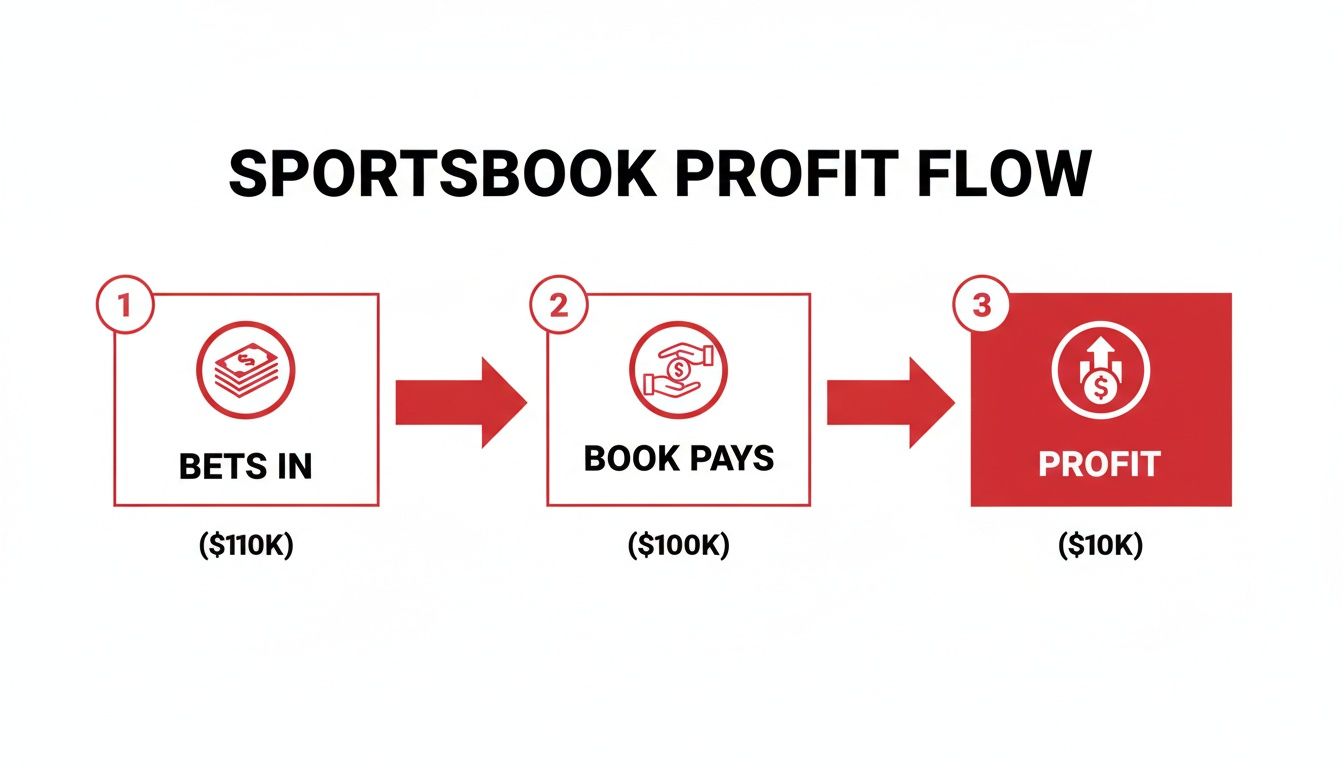
As you can see, the book’s profit is simply the difference between all the money that comes in and what it has to pay out to the winners.
The Basic Vig Calculation Formula
Calculating the vig shows you exactly how sportsbooks bake their profit margin right into the odds, which usually lands somewhere between 3% and 10%, depending on the market and how competitive the book is. The formula is easy: convert the American odds into their implied probabilities, add them up, and then subtract 100%. Whatever is left over is the vig.
For a standard -110 line on both sides of a bet, here’s how it shakes out:
- Calculate implied probability for Side A (-110): For negative odds, the formula is
Odds / (Odds + 100). So,110 / (110 + 100) = 0.5238, or 52.38%. - Calculate implied probability for Side B (-110): It's the exact same math, giving you another 52.38%.
- Add them together:
52.38% + 52.38% = 104.76%. - Find the vig: That amount over 100% is the sportsbook’s cut.
104.76% - 100% = 4.76%.
So, on a standard -110 bet, the vig is 4.76%. It doesn't sound like much, but that small percentage, taken from millions of dollars in wagers, is precisely how sportsbooks build their business.
Calculating Vig on More Complex Odds
The same logic applies to any betting line, even moneylines with a clear favorite and underdog. Let's take a look at a hypothetical UFC fight you might find on BetUS, where the favorite is -140 and the underdog is +120.
- Favorite's Implied Probability (-140): Using the same formula for negative odds, we get
140 / (140 + 100) = 0.5833, or 58.33%. - Underdog's Implied Probability (+120): For positive odds, the formula changes slightly to
100 / (Odds + 100). That gives us100 / (120 + 100) = 0.4545, or 45.45%.
By adding those two probabilities together (
58.33% + 45.45% = 103.78%), we can see the total comes out to more than 100%. The vig here is 3.78%. That's the fee BetUS is charging you to take your action on this fight.
Once you have this down, you can figure out exactly how much you're paying to place any bet, whether it’s a simple point spread at Bovada or a complex prop bet at a newer shop like Cosmobet.
Why the Vig Varies Across Different Bet Types
Think of it this way: not all bets are created equal, and neither is the vig. While the standard -110 line on spreads and totals is the most common price you'll see, the sportsbook’s commission can change dramatically depending on what you’re betting on. Understanding this variation is a huge step in figuring out how the juice really impacts your bottom line.
A sportsbook like BUSR or BetAnything isn’t just some monolith; it's a marketplace with different products. Some of these products, like NFL point spreads, are incredibly popular and efficient. They attract huge betting volume, allowing the book to set a low, standardized vig (typically 4-5%) and still make a killing.
Spreads and Totals: The Standard Vig
For major sports like the NFL and NBA, point spreads and totals are the bread and butter. Books like BetOnline and Bovada are extremely confident in their ability to set sharp lines and attract balanced action on these wagers.
Because these markets are so liquid and predictable for the sportsbook, they can get away with offering the lowest vig. The standard -110 line is their way of offering a competitive price on their most popular product, knowing the sheer volume of bets will secure their profit. It's their loss leader, designed to get you in the door.
Moneylines: Where Vig Gets Tricky
Moneylines are a different beast entirely. Here, the vig is often higher and a lot less transparent. When one team is a massive favorite—say, -400 at MyBookie—the book has to balance its risk. The implied probability is high, but the payout is tiny.
To compensate for the lopsided action that almost always comes in on heavy favorites, sportsbooks will bake a higher vig right into the moneyline odds. It's not uncommon for the total vig on a lopsided moneyline to climb into the 6-8% range or even higher.
The less predictable or balanced a market is, the more a sportsbook will charge in vig to protect itself. This is why exotic bets almost always come with a steeper price tag than a simple point spread.
The Hidden Vig in Props and Parlays
This is where the house edge really shines. Player props and parlays are incredibly popular, but they often carry the highest vig in the entire sportsbook. Why? Simple: these are less efficient markets and are much harder for sportsbooks to price perfectly.
Let's say you're looking at a player touchdown prop at Xbet. The odds for "Yes" and "No" might be something like -125 and -105. A quick calculation reveals the vig on that single prop bet is over 8%. That's a steep price to pay.
Parlays just compound the issue. Since each "leg" of your parlay has a vig built into it, the total commission you're paying multiplies with every team you add. While the potential payout is huge, the hidden cost is also significantly larger than on a straight bet. Knowing this helps you spot which wagers at sportsbooks like Sportsbetting.ag or Bookmaker.eu offer better long-term value.
Offshore books, in particular, have a pretty wide range of vig depending on what you're betting. Here's a quick look at what you can generally expect.
Typical Vig You'll Find at Offshore Sportsbooks
| Bet Type | Example Odds | Typical Vig Percentage |
|---|---|---|
| Spreads & Totals | -110 / -110 | 4.55% |
| Moneylines (Close) | -125 / +105 | 4.36% |
| Moneylines (Lopsided) | -500 / +350 | 7.14% |
| Props (Even) | -120 / -110 | 6.68% |
| Futures | Varies Widely | 15-40%+ |
As you can see, the price you pay changes dramatically. Standard spreads are your cheapest option, but as you move into less predictable markets like props and especially futures, the bookmaker's built-in edge gets much, much bigger. Keep this in mind as you're building your betting strategy.
Smart Strategies to Lower the Vig's Impact
Knowing what the vig is is half the battle. Learning how to fight back is how you actually protect your bankroll. Think of the vig as a constant, slow drain on your funds, but with the right approach, you can plug the leak and give yourself a real shot at long-term profit. You don’t have to just accept the standard -110 line on every single bet.
The single most powerful weapon in any bettor’s arsenal is line shopping. It's a simple but absolutely critical strategy that involves having accounts at multiple sportsbooks and comparing their odds before you lock in a wager. Honestly, it's just like shopping for a car—you wouldn't buy from the first dealership you visit without seeing what the others are offering, right?

Holding accounts at a few different sites like Bovada, MyBookie, and Bet105 lets you quickly scan the market for the best possible price. One book might be dealing a standard -110, but another could have the very same line at -105. That tiny difference has a massive impact over time.
The Power of Reduced Juice
Finding a -105 line instead of the usual -110 effectively cuts the vig you're paying in half, taking it from roughly 4.55% all the way down to just 2.38%. This move drastically lowers the breakeven point you need to hit. Instead of needing to win 52.38% of your bets just to stay afloat, that number drops to a much more manageable 51.22%.
Key Insight: Line shopping isn't just about finding a slightly better number; it's about fundamentally changing the math in your favor. Over hundreds or thousands of bets, consistently getting the best price is the difference between being a winning or losing bettor.
Some sportsbooks make this easy on you by offering "reduced juice" specials. A book like Cosmobet, for example, might feature specific games or even entire leagues with better-than-standard odds to attract savvy bettors. Keep your eyes peeled for these deals.
Finding Arbitrage Opportunities
On rare occasions, diligent line shopping can uncover a golden ticket: an arbitrage opportunity. This happens when different sportsbooks post such conflicting odds on the same game that you can bet on both sides and guarantee a small, risk-free profit, no matter who wins.
For instance, you might find this scenario:
By placing precisely calculated bets on both sides, you can lock in a profit. These windows are rare and close fast, but they represent the ultimate way to completely beat the vig. Bettors often use special tools to spot these situations. You can get a feel for how the math works by playing around with an arbitrage sports betting calculator.
At the end of the day, it's all about being strategic. Whether you're hunting for reduced juice lines at BetAnything or just comparing standard prices between Sportsbetting.ag and Xbet, the mission is the same. Actively seek out the lowest vig possible to give your bankroll its best chance to grow.
Why Understanding the Vig Is Key to Your Long-Term Success
This is where it all comes together. The vig isn't just some technical detail buried in the odds at Bovada or MyBookie. It's the single most important factor that will make or break you as a sports bettor over the long haul.
Think of it this way: you're not just betting against the house; you're also betting against this invisible opponent. The vig is a slow, methodical drain on your bankroll. With every single bet you place, this small fee chips away at your funds, which is why disciplined betting is everything.
The Sobering Math of Breaking Even
The most critical lesson about the vig boils down to one simple number. When you see those standard -110 odds—the kind plastered on almost every NFL spread at sites like BetOnline or Bookmaker.eu—your break-even point is not 50%.
To overcome the house edge and just keep your head above water, you have to win 52.38% of your bets. This is the fundamental, non-negotiable math of sports betting that every serious player has to burn into their brain.
Ignoring this reality is a fast track to a busted bankroll. Even a sharp bettor who consistently picks winners at a 51% or 52% clip will slowly bleed money over time if they aren't actively fighting the vig's impact.
This is exactly why strategies like line shopping between sportsbooks such as BetUS and Xbet aren't just helpful—they're mandatory for anyone who actually wants to win. A bettor who blindly accepts high-vig lines or doesn't bother to hunt for the best price is basically giving the house a bigger head start.
Truly understanding the vig changes your entire perspective. It shifts the goal from just picking winners to picking winners at the right price. Accepting this simple truth is the final, most crucial step toward betting smart and building a strategy that can actually last.
Common Questions About the Vig in Sports Betting
To wrap things up, let's tackle a few of the most common questions I hear from bettors about the vig and how it all works in the real world. These quick answers should help lock in the key concepts we've covered.
Can You Ever Place a Bet with No Vig?
Believe it or not, yes—but it's rare. Some offshore books like BetOnline will occasionally run "no-juice" or "reduced vig" specials on major games. This usually means setting the odds at +100 instead of the standard -110, giving you a true even-money shot.
The other route is through arbitrage betting. This is where you hunt for mismatched odds across different books, like MyBookie and Bovada. If you find the right discrepancy, you can bet on both sides and lock in a tiny profit, no matter who wins. You've essentially created your own vig-free bet.
Why Do Some Sportsbooks Have a Lower Vig?
It almost always comes down to competition. A book like Bookmaker.eu, which is known for catering to sharp, high-volume players, might offer reduced juice lines as a way to pull that valuable action away from their rivals. It's their way of saying, "Bet here, and you'll get more for your money."
Other factors come into play, too, like the book's confidence in their numbers or the specific market you're betting on. You'll often find a much higher vig on niche prop bets at a site like Xbet, simply because the book is taking on more risk with a less predictable outcome.
A Quick Word on Live Betting: The vig on in-play wagers is almost always higher. The action is moving so fast, and odds are constantly flying around. To protect themselves from sudden line shifts and data lags, books like Sportsbetting.ag and BUSR build in a bigger safety cushion. That's why you'll see much wider gaps between the odds on live markets.
Ready to put this knowledge into practice and start hunting for the best lines? USASportsbookList is your home base for comparing the top offshore sportsbooks, grabbing exclusive bonuses, and making sharper, more informed bets.
Check out our in-depth reviews and expert guides to take your betting game to the next level at https://usasportsbooklist.com.