Let's talk about the single most important skill in sports betting. It's not picking winners, it's not finding value, and it's not some secret algorithm. It’s bankroll management.
This is the bedrock of any successful betting strategy. It's the art of setting aside a specific chunk of cash only for betting and then using a disciplined system to decide how much to stake on each wager. This is what separates the pros who stay in the game for years from the casual bettors who tap out after one bad weekend.
What Is Bankroll Management in Sports Betting?

Think of it like this: you wouldn't start a business without knowing how much capital you have to work with, right? It would be pure chaos. Your betting bankroll is your startup capital—it's the fuel that keeps your entire operation running.
Winning at sports betting isn't just about cashing tickets. It’s about having a system that lets you survive the inevitable cold streaks. And trust me, even the sharpest bettors on the planet hit brutal losing skids. Good bankroll management is the structure that keeps you afloat when the tide goes out.
Before we dive deeper, let's break down exactly why this concept is so crucial. It’s not just about "being responsible"; it's a strategic weapon.
Why Bankroll Management Is Non-Negotiable
| Core Principle | Impact on Your Betting | What It Prevents |
|---|---|---|
| Financial Discipline | Forces you to treat betting like a long-term investment, not a lottery ticket. | Emotional, panicked decisions after a few bad losses. |
| Risk Mitigation | Ensures no single bet or bad run can wipe you out completely. | The catastrophic "risk of ruin" that ends most betting careers. |
| Longevity | Keeps you in the game long enough for your edge to materialize over time. | Tapping out before you can profit from your winning strategies. |
| Emotional Control | Separates your betting money from your life money, reducing stress and anxiety. | "Chasing" losses by making bigger, more desperate bets. |
Ultimately, bankroll management is your defense. It protects your capital from your own worst instincts and the natural variance of sports betting.
The Core Concept of a Dedicated Bankroll
It all starts with one simple, non-negotiable rule: set aside a dedicated fund for betting. This money needs to be completely walled off from your personal finances—rent, bills, groceries, you name it.
This separation does two incredibly important things:
- It kills the emotion. When your rent money is on the line, every loss feels like a gut punch. That pressure leads to terrible decisions, like trying to win it all back on one desperate bet. That's the fastest way to go broke.
- It defines your total risk. Your bankroll is the absolute maximum you're willing to lose. Period. Having that clear line in the sand stops you from dipping into savings and turning a hobby into a real financial problem.
Whether you're starting with a crisp $100 at a site like MyBookie or funding a $2,000 bankroll at BetUS, this rule is universal. It’s your financial fortress.
Why Small, Consistent Bets Are Key
Okay, you've got your bankroll set up. Now what? The next step is deciding how much to bet. The golden rule here is to keep your wagers small in relation to your total bankroll. Most pros and sharp bettors stick to a 1-5% rule, meaning no single bet is for more than 5% of their total funds.
This is all about surviving variance.
Let's play it out. Say you have a $1,000 bankroll. A conservative 2% bet is just $20. If you hit a nasty 10-game losing streak, you're down $200. It stings, for sure, but you've only lost 20% of your bankroll. You can easily weather that storm and keep betting.
Without that discipline, a few emotional, oversized bets could have wiped you out completely.
This strategy isn't about being timid; it’s about being smart. It ensures you stay in the action long enough for your skills to actually pay off. It doesn't matter if you're placing your wagers at Bovada, Sportsbetting.ag, Xbet, or BetAnything—this disciplined approach is what allows you to absorb losses and bet another day. It turns gambling into a calculated, long-term endeavor.
How to Build Your First Betting Bankroll
Alright, let's talk about the first real step you'll take toward becoming a disciplined bettor: setting up your bankroll. The question everyone asks is, "How much do I need?" but that’s completely backward. The real question you should be asking is, "How much can I afford to lose without it messing with my life?"
This isn’t about pessimism; it's about pure, unfiltered realism. Your starting bankroll is your risk capital, simple as that. Whether you’re dipping a toe in the water with $100 or getting serious with $2,000, that money has to be completely disposable. Think of it like buying equipment for a new hobby—once you've spent it, it's dedicated solely to that purpose.
Determining Your Starting Amount
The size of your bankroll is going to dictate your entire strategy and, of course, your potential for profit. A smaller bankroll demands patience and a slow-and-steady approach, while a bigger one gives you more breathing room to operate.
- For Beginners ($100 – $500): This is the perfect range to learn the ropes. If you're working with a $200 bankroll, a conservative 2% bet is just $4. This forces you to focus on making smart picks instead of chasing lottery-ticket payouts. It’s an awesome, low-risk way to get a feel for bankroll management.
- For Intermediate Bettors ($500 – $2,000): Once you're in this zone, your unit size starts to have a bit more heft. A $1,500 bankroll with a 2% unit means you’re firing off $30 bets. That’s enough to start stacking up some meaningful profit over time.
- For Experienced Players ($2,000+): Bigger bankrolls give you the firepower to absorb losing streaks (variance) and jump on more opportunities. But here's the kicker: the core principles don't change one bit.
No matter which category you fall into, the golden rule is non-negotiable: your bankroll must be completely separate from your everyday finances.
The Logistics of Setting Up Your Fund
Once you have your number, the next move is to create a clear separation for that money. This isn't just about accounting; it's a psychological wall that stops you from making emotional, panicked decisions. Never, ever bet directly from your main checking account.
The act of moving money into a dedicated betting account reinforces the idea that this is investment capital, not grocery money. It creates a clear line in the sand, protecting your financial well-being from the natural ups and downs of sports betting.
A lot of sharp bettors use an e-wallet or even open a separate bank account just for betting. It makes tracking your wins and losses incredibly straightforward. When you're ready to make your first deposit, sportsbooks like MyBookie, Sportsbetting.ag, and BetAnything have plenty of options to get you started. The key is to treat that initial deposit like you're funding your own small business.
This entire process is about building the discipline you need to succeed in the long run. To get a better handle on the first few moves you should be making, you can learn more about how to start sports betting with our detailed guide.
Alright, you've set aside a dedicated bankroll. Now what? You need a playbook—a set of rules that governs every single bet you make. This isn't about the thrill of picking a winner; it's about ditching the guesswork and emotion for a cold, hard process.
The right strategy really comes down to you: your personality, your goals, and how much risk you're willing to stomach. We're going to break down the three most effective and battle-tested approaches that pros and newcomers alike rely on.
The Flat-Betting Model
This is ground zero for disciplined betting. If you're just starting, this is your strategy. The Flat-Betting model is brutally simple: you bet the exact same amount—your "unit"—on every single wager. It doesn't matter what the odds are or how good you feel about the pick. It's all about consistency.
Let's say you have a $1,000 bankroll sitting in your Xbet account. You decide your standard unit will be 1% of your bankroll, making it a clean $10.
- Chiefs -7 on Sunday? $10.
- Lakers moneyline on a Tuesday night? $10.
- That gut-feeling, longshot parlay? You guessed it, still $10.
The real power here is that it stops you from doing dumb stuff. You can't chase a loss with a desperate, oversized bet, and you can't get cocky after a big win and throw too much cash at the next game. It forces you to live and die by the quality of your handicapping, not the size of your stake.
Key Takeaway: Flat-betting is your best defense against your own emotions. By keeping every bet the same size, it smooths out the inevitable peaks and valleys of sports betting and protects you when a cold streak hits.
Think of it as the foundation of smart betting. It's a straightforward approach that works whether you're playing at Bovada or BetUS.
The Percentage Model
Ready for something a bit more dynamic? The Percentage model takes the flat-betting concept and gives it a twist. Instead of a fixed dollar amount, your unit is a fixed percentage of your bankroll at that moment. This means your bet size ebbs and flows with your balance.
Let's stick with that $1,000 bankroll at Xbet, but this time you decide to risk 2% on every play.
- Your first bet is $20 (2% of $1,000).
- Say you win, and your bankroll climbs to $1,020. Your next bet is now $20.40 (2% of $1,020).
- But if you lose that first bet and drop to $980, your next wager shrinks to $19.60 (2% of $980).
This method does two things beautifully. On a hot streak, it naturally compounds your winnings by increasing your bet size. When things go south, it acts as a brake, reducing your stake and making it much harder to bust your entire bankroll. It's a self-correcting system that scales with your performance.
The Percentage model requires a quick calculation before each bet, but it's a much more responsive way to manage your money. It's a favorite among intermediate bettors on platforms like Sportsbetting.ag.
Before you jump in, it’s a good idea to actually write down your staking plan. Seeing it on paper (or a screen) makes you more likely to stick to it when the pressure is on.
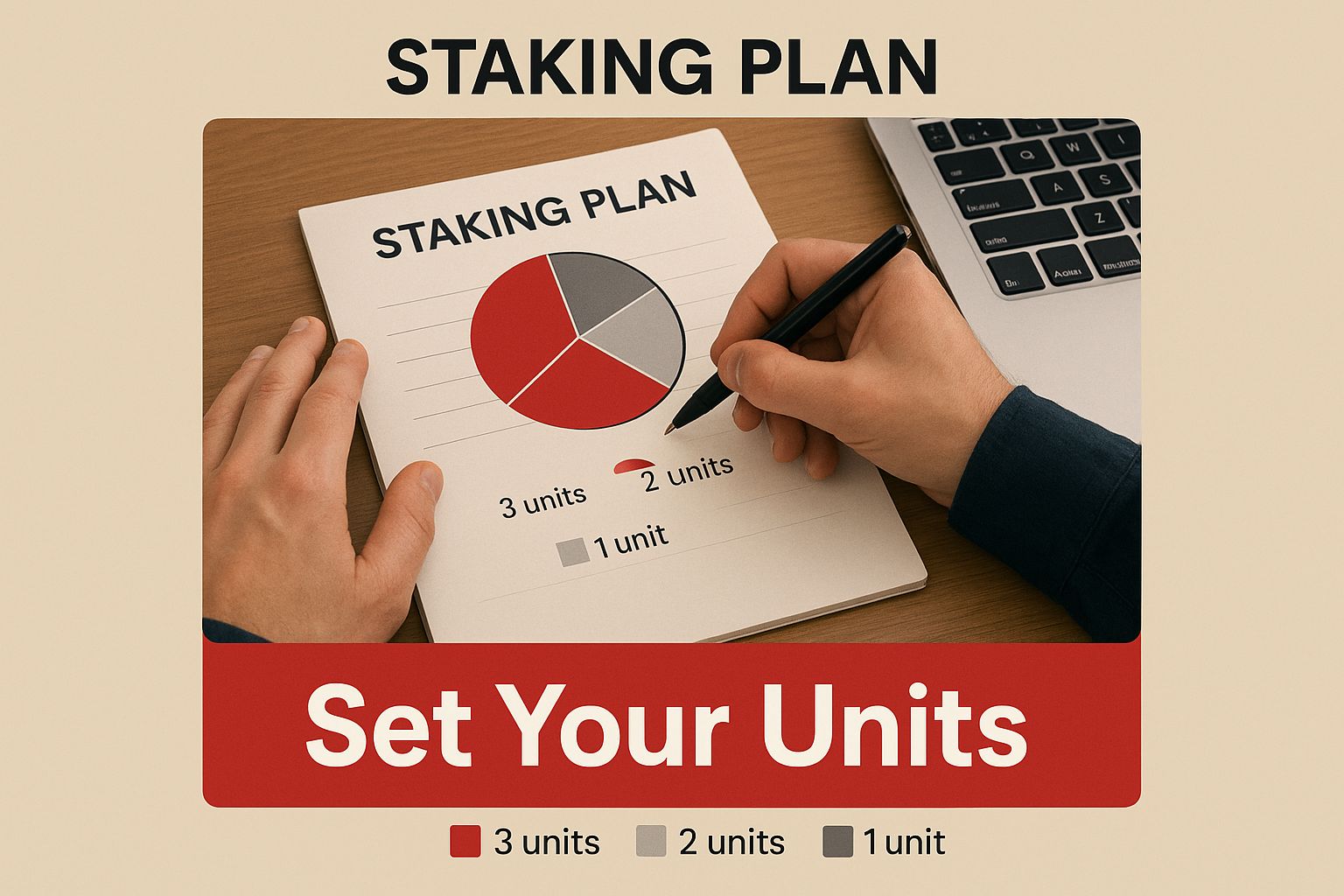
This graphic really nails the core idea: setting your units and staying disciplined is the absolute cornerstone of any successful bankroll strategy.
The Confidence Model
This is the advanced class. The Confidence model—sometimes called variable staking—is where you let your bet size reflect how big you think your edge is. It's a powerful tool, but it's reserved for experienced bettors who can honestly and accurately gauge the value in a line.
Here, you rate your plays on a scale, usually from 1 to 5 units.
- 1 Unit: Your standard, everyday bet where you see a small edge.
- 3 Units: A strong play. Your research and models are screaming that there's serious value.
- 5 Units: The "get out of the way" bet. This is a rare, max-confidence play you should use very, very sparingly.
If your base unit is $10 (1% of a $1,000 bankroll), your bets could range from $10 on a standard play up to $50 on your strongest conviction. The goal is simple: capitalize big on your best reads. The danger? It requires total self-awareness. If you start letting ego dictate your confidence levels, you'll drain your bankroll in a hurry.
This isn't a new idea. The concept of sizing bets to your advantage goes way back. The most famous example is the Kelly Criterion, a formula developed in 1956 to determine the optimal stake. Most modern applications of Kelly-style thinking in sports betting still land you in that 1-2% range for a typical bet. If you want to go down the rabbit hole, you can dig into the history of how these ideas evolved by mastering bankroll management in sports betting.
Comparison of Bankroll Management Strategies
To help you decide which approach fits you best, we've broken down the three core models in this side-by-side comparison.
| Strategy | How It Works | Best For | Risk Level |
|---|---|---|---|
| Flat-Betting | Wager the same fixed dollar amount (e.g., $10) on every single bet. | Beginners or anyone seeking maximum discipline. | Low |
| Percentage | Wager a fixed percentage (e.g., 2%) of your current bankroll on every bet. | Intermediate bettors looking to compound wins. | Moderate |
| Confidence | Wager a variable number of units (e.g., 1-5 units) based on your confidence. | Experienced bettors who can accurately assess value. | High |
Ultimately, there's no single "best" strategy—only the one that's best for you. Beginners should almost always start with flat-betting to build good habits. As you gain experience, you might find the Percentage or Confidence models better suit your style.
Defining Your Unit Size for Consistent Wagers
Okay, you've got a strategy in mind. Now it's time to lock in the single most important part of your entire betting system: the unit.
Think of a unit as the standard currency for your sports betting. It’s a fixed, consistent amount you’ll risk on your wagers, and it’s the absolute bedrock of disciplined bankroll management. When you stop thinking in random dollar amounts and start thinking in units, you immediately strip the emotion out of the equation. A one-unit bet is your standard play, period. It doesn't matter if it's your "lock of the century" or just a casual Tuesday night game—the amount stays the same.
This is the kind of consistency that protects your money and gives your edge a fighting chance to win out over the long run.
Calculating Your Standard Unit
For most bettors, the best way to define your unit is to set it as a small, fixed percentage of your total bankroll. The industry standard, and what I strongly recommend, is somewhere between 1% and 3% of your total funds.
That might sound tiny, but its real power is in shielding you from the losing streaks that every single bettor goes through.
Let's walk through a real-world example:
- You've set aside a $2,000 bankroll on a site like BetAnything.
- You decide to play it safe and go with a 1% unit size.
- Your standard one-unit bet is now $20 ($2,000 x 0.01).
That's it. Every standard bet you make—whether it's on the NFL at Bovada or an NBA game at Xbet—will be for $20. This small, consistent stake is your greatest defense against bad luck and variance.
The Power of Sticking to Your Units
The true test of a bettor isn't just picking winners; it's keeping your head when things go south. It’s no secret that inexperienced bettors, who usually just bet whatever amount "feels right," often blow through their entire bankroll within their first 20 to 30 bets. Why? Overbetting.
Contrast that with bettors who stick to a 1-2% unit size. They can typically survive losing streaks of 7 to 10 bets without doing any catastrophic damage. If our bettor with the $2,000 bankroll hits a nasty 8-bet losing streak, they’re down $160. That's just 8% of their starting funds, leaving them with plenty of capital to stay in the game. You can learn more about building a resilient bankroll by exploring these key sports betting success strategies.
The discipline to stick to your unit size is what separates profitable bettors from casual gamblers. It means resisting the temptation to double down after a bad beat or get overly aggressive after a big win. Your unit is your anchor—it keeps you grounded in your strategy.
This unwavering consistency is completely non-negotiable. Without it, even the best handicapping in the world is totally useless.
Why Unit Sizing Is Your Best Defense
Think of unit sizing as your financial shock absorber. It smooths out the wild ride of a sports betting season, turning what could be a rollercoaster of huge wins and gut-wrenching losses into a much more manageable, steady climb. This whole approach forces you to focus on the quality of your bets, not the size of your wagers.
It guarantees that no single loss can ever cripple your operation. When your standard bet at MyBookie or BetUS is just 1% of your total bankroll, you can take a rough Sunday on the chin and come back ready for the next slate of games without feeling panicked or desperate. Of course, making quality bets also means understanding what you're looking at, so be sure to check out our guide on how to read sports betting odds to sharpen those skills.
Ultimately, your success hinges on this one simple principle. Defining and sticking to a strict unit size is the single most effective tool you have for preserving your capital and giving yourself a real shot at long-term profitability.
Why Tracking Every Bet Is Essential for Growth

Alright, you've got your bankroll sectioned off and you know your staking strategy. Now for the part that really separates the pros from the hobbyists: tracking every single bet. It’s a simple truth in any business, and betting is no different: you can't manage what you don't measure. Your betting record is the ultimate source of truth.
Without it, you're just flying blind. It's easy to let the big wins cloud your memory while conveniently forgetting that slow, painful bleed from a string of small losses. Keeping meticulous records elevates you from someone who just wins or loses to an analyst of your own performance. Think of it less as a chore and more as your secret weapon.
This is the kind of data-driven mindset that helps you make sharp, informed decisions on platforms like BetUS or MyBookie, turning your wagers into calculated investments instead of hopeful guesses.
Moving Beyond Simple Wins and Losses
A basic win-loss record tells you next to nothing. To really get a handle on your performance, you have to dig deeper. Tracking isn't just about the final score; it's about recording the context around every single wager to spot the patterns you'd otherwise miss. This is how you find your edge and, just as importantly, plug the leaks sinking your strategy.
Your mission is to build a rich, detailed history of your betting. Over time, this data becomes an invaluable asset, showing you your strengths, weaknesses, and biases with cold, hard numbers. A business owner wouldn't run a company without looking at sales data, and you shouldn't be managing your bankroll without looking at your betting data.
What Data Points Should You Track?
You don't need a supercomputer or a complex software suite to get this done. A simple spreadsheet is all you need to capture the essentials. Each entry should act like a detailed receipt for every bet you place, whether it's on Bovada or Sportsbetting.ag.
Here are the absolute must-haves for every bet you log:
- Date: When you placed the bet.
- Sport & League: Get specific (e.g., NFL, NBA, English Premier League).
- Bet Type: Moneyline, point spread, over/under, player prop, etc.
- Stake (in Units): How much you risked based on your unit system (1 unit, 1.5 units).
- Odds: The price you got.
- Sportsbook: Which book you used (e.g., Xbet, BetAnything).
- Result: Win, Loss, or Push.
- Profit/Loss (in Units): The final outcome for your bankroll.
By diligently tracking these details, you create a powerful feedback loop. This is what allows you to look back objectively at your decisions, learn from your blunders, and double down on what’s actually working. It's the bedrock of solid sports betting bankroll management.
Unlocking Your Strengths and Weaknesses
Once you’ve logged a decent sample size—say, a hundred bets or more—the real fun begins. Now you can start slicing and dicing your data to answer some crucial questions.
- Are you absolutely crushing NFL point spreads but consistently losing your shirt on NBA moneylines?
- Do you have a better return when betting on underdogs versus favorites?
- Are you noticing that one sportsbook, like MyBookie, consistently gives you better lines on the types of bets you win most often?
This is where all that tracking pays off in spades. It gives you the concrete evidence you need to fine-tune your approach. You can start steering clear of markets where you're bleeding money and instead focus your capital on the spots where you have a proven edge. This data-backed decision-making is what transforms a casual bettor into a sharp, profitable one.
And if spreadsheets aren't your thing, there are plenty of dedicated bet-tracking apps out there that can sync with your sportsbooks and do most of the heavy lifting for you.
Advanced Tactics and Common Mistakes to Avoid
Once you've got the fundamentals of bankroll management locked down, it's time to start refining your approach. Mastering the basics is all about protecting your capital, but the advanced stuff? That's how you make it grow. These aren't complicated formulas, just disciplined adjustments that keep your strategy sharp and profitable.
One of the most important things to get right is knowing when to adjust your unit size. Your unit should be a fixed percentage, but the actual dollar amount can't stay the same forever. A great rule of thumb is to take a fresh look at your unit value after your bankroll has grown by a healthy amount, say 25%.
Let's walk through an example. You start with a $1,000 bankroll and a 1% unit, which is $10. You should stick with that $10 unit until your bankroll climbs to $1,250. At that point, you can recalculate. Now, your 1% unit is worth $12.50. This lets you responsibly scale up your wins without making rash, emotional decisions after every single victory.
The Discipline of Cashing Out Profits
Here's another discipline that separates the pros from the amateurs: actually cashing out your profits from time to time. It’s incredibly tempting to just let your account balance grow and grow, but you have to treat this like a business. Taking profits off the table and moving that money to your personal bank account is a massive psychological win.
This simple action makes your gains real and protects them from the inevitable swings of sports betting. It also guarantees you're actually enjoying the financial rewards of your hard work. A lot of sharp bettors set a clear goal—like doubling their initial bankroll—and then withdraw their original stake. From that point on, they're playing entirely with house money.
Common Mistakes That Sabotage Bettors
Even the most seasoned bettors can fall into common psychological traps. The sheer volume of betting options on offshore sites like Bovada and Xbet is designed to test your discipline. Knowing these pitfalls is the first step to avoiding them.
The most destructive mistakes are almost always emotional:
- Chasing Losses: This is the cardinal sin of sports betting. After a tough loss, the urge to immediately win it all back with a bigger, dumber bet is overwhelming. Don't do it. It's a purely emotional reaction that almost always digs a deeper hole.
- Emotional Betting: Wagering on your favorite team just because you love them? Or firing off a bet out of pure boredom? Both are guaranteed ways to drain your bankroll. Every single wager needs to be backed by your strategy, not your feelings.
- Ignoring Your Strategy: A hot streak can breed overconfidence. You might feel tempted to jack up your unit size or bet on sports you haven't researched. Abandoning the very system that got you there is a recipe for disaster.
Recognizing these common errors helps you build the mental toughness required for long-term success. Bankroll management is as much about psychological discipline as it is about math. It’s about sticking to your plan, especially when every emotion is screaming at you to do the exact opposite.
Getting a handle on these psychological hurdles is a huge part of developing a real winning edge. For a deeper dive into building a profitable mindset, check out our complete guide to advanced sportsbook strategies and tactics. This level of discipline is what separates casual players from those who treat sports betting as a serious investment at sites like MyBookie, BetUS, and Sportsbetting.ag.
Frequently Asked Questions
Even the sharpest bettors run into questions on the ground. Having a solid bankroll strategy is one thing, but knowing how to handle real-world scenarios is what separates the pros from the pack. This section tackles some of the most common questions I hear about managing your money day-to-day.
Think of this as your field guide for the tricky spots. These answers will help you stick to the plan when a bad run tests your discipline or a hot streak tempts you to get reckless.
How Should I Handle a Long Losing Streak?
First off, take a breath. Don't panic. Losing streaks happen to everyone—and I mean everyone. The absolute worst thing you can do is abandon your strategy. The whole point of bankroll management is to weather these storms.
This is not the time to double down and chase your losses. Instead, stick to your guns and trust your process and stick to your unit size. Pull up your bet tracking spreadsheet and take an honest look. Are you making bad reads, or is it just the ugly side of variance? Sticking to your 1-2% unit at books like MyBookie or BetUS is what will keep you in the game long enough for things to even out.
When Is the Right Time to Increase My Unit Size?
This needs to be a cold, hard calculation, not a gut feeling after a big win. The best practice is to set a clear milestone for when you'll reassess your unit size. A great rule of thumb is to do it after your bankroll grows by a set amount, like 25% or 50%.
Let’s walk through it. Say you started with a $1,000 bankroll, making your 1% unit $10. You stick with that $10 unit until your total bankroll hits $1,250. Then, and only then, do you recalculate. Your new 1% unit becomes $12.50. This keeps your bet size growing in lockstep with your actual success.
This systematic approach ensures your growth is sustainable. It prevents overconfidence from derailing a successful strategy by tying your stake directly to your proven performance, not your feelings.
Should I Have Separate Bankrolls for Different Sportsbooks?
For most casual bettors, it's not a must-have. But if you're serious about long-term profit, it's an incredibly smart move. Splitting your capital across several sportsbooks like Bovada, Sportsbetting.ag, Xbet, and BetAnything gives you a few key advantages.
For one, it makes line shopping dead simple. You can quickly grab the best odds for every single bet, which adds up massively over time. It also lets you cash in on different bonuses and promos from each site. Finally, it spreads your risk—if one book limits you or has an issue, you've still got money in play elsewhere. While one master spreadsheet is fine to start, separating your funds is a true pro-level tactic.
At USASportsbookList, we provide the insights and reviews you need to find the perfect sportsbooks for your strategy. Explore our expert guides and curated lists to make smarter, more informed betting decisions today. Discover top-rated sportsbooks on USASportsbookList.