Learning how to read a betting line is way simpler than it looks once you get the hang of its three core parts. In a nutshell, a betting line tells you who the favorite and underdog are, the book's best guess on the margin of victory (the spread), and the projected total score for the game (the total).
Nailing these fundamentals is the first real step toward placing smarter, more confident wagers.
Decoding Your First Betting Line
Jumping into sports betting for the first time can feel like trying to learn a new language. You log into a site like MyBookie or BetUS, and you're hit with rows of numbers, pluses, and minuses. It looks intimidating, but those symbols are just telling a story about the matchup, and your job is to learn how to read it.
Every betting line you see is a snapshot of what the oddsmakers think will happen.
At its core, a standard betting line is built on three pillars:
- The Point Spread: This is the number that levels the playing field, indicating the expected margin of victory. It's designed to get roughly half the money bet on either side.
- The Moneyline: This one's as straightforward as it gets. You're just picking which team will win the game, straight up. The odds simply reflect how likely each team is to pull it off.
- The Total (Over/Under): This is a bet on the combined final score of both teams. You’re wagering on whether the game will be a high-scoring shootout or a defensive grind.
Understanding the Layout
Let's break down a typical NFL line you'd find on a popular offshore sportsbook. This layout is pretty standard across the board, whether you're on BetOnline or Bovada.
Here’s a great example of what you'll actually see on a sportsbook like BetOnline.
As you can see, the lines for each game clearly lay out the point spread, the total, and the moneyline. These are the building blocks for just about every bet you can make.
Key Betting Line Components at a Glance
To make it even clearer, this table breaks down exactly what each part of the line means. Think of it as your quick-reference cheat sheet.
| Betting Line Component | What It Tells You | Example |
|---|---|---|
| Point Spread | The expected margin of victory for the favorite, designed to even the odds. | -7.5 means the favorite must win by 8 or more points to cover. |
| Moneyline | The direct odds for a team to win the game outright, no spread involved. | -150 means you must bet $150 to win $100 on the favorite. |
| Total (Over/Under) | The projected combined score of both teams in the game. | O/U 48.5 lets you bet if the final score will be 49 or more (Over) or 48 or less (Under). |
Understanding these three pieces is the key to unlocking the betting board and finding wagers that make sense to you.
These numbers aren't just pulled out of thin air. They're carefully calculated to create a balanced market and ensure the sportsbook turns a profit, which is known as the vig or hold.
Grasping these three components is the absolute foundation of sports betting. Before you even think about placing a wager on Bookmaker.eu or Sportsbetting.ag, you need to know exactly what those numbers are telling you about how the game is expected to play out.
While these three parts are universal, there's always more to learn. For a complete walkthrough with more examples, check out our full guide on how to read sports betting odds. Building this knowledge gives you the confidence to look at any line and instantly understand the betting landscape.
Mastering Point Spreads and Game Totals
Alright, you've got the basics of a betting line down. Now it's time to dig into the two most popular ways to bet: point spreads and game totals. This is where you move beyond just picking a winner and start finding more interesting angles on the action. Sportsbooks like BetOnline and Bovada use the point spread to level the playing field, creating a balanced market that gets people betting on both sides of a game.
Think of the spread as a handicap for the underdog. The favorite has to win by more than the spread for you to cash your ticket. The underdog, on the other hand, can either win the game outright or just lose by less than the spread. It completely changes how you look at a matchup between two teams that might seem lopsided on paper.
How Point Spreads Work in Practice
Let's use a real-world example from college football. Imagine a big game on MyBookie between Ohio State and Michigan. You might see a line that looks like this: Ohio State -6.5 (-110).
That "-6.5" means Ohio State is the favorite. For a bet on the Buckeyes to win, they have to beat Michigan by 7 points or more. A six-point win won't cut it.
On the flip side, Michigan is the underdog at +6.5 (-110). If you bet on them, you win if they pull off the upset or if they lose by 6 points or less. The spread makes the final margin of victory just as crucial as who actually wins the game.
Here’s a typical NFL betting board you might see on MyBookie, showing the spread for each game.
As you can see, the point spread is right there next to each team, making it crystal clear who the favorite is and by how much before you lay down any cash.
In football, some numbers are way more important than others because of how scoring works. Spreads of 3 and 7 are called "key numbers" for a reason—so many games are decided by a field goal or a touchdown. Lines often settle around these numbers, and even a half-point shift can completely change the value of a bet. If you want to get into the weeds on this, you can learn more by understanding point spreads in more detail.
Analyzing Game Totals or Over/Under
The other monster of the betting world is the total, which you’ll almost always hear called the Over/Under. This one has nothing to do with who wins. You’re simply betting on the combined final score of both teams. The sportsbook sets a number, and you just have to decide if the actual score will be higher (Over) or lower (Under).
For instance, an NBA game on a site like Cosmobet between the Lakers and Warriors might have a total set at 225.5.
- If you bet the Over, you need the teams to combine for 226 points or more to win.
- If you bet the Under, you're rooting for a final score of 225 points or less.
The beauty of totals betting is that you don't need to have a strong opinion on who will win. Your analysis focuses entirely on the pace of the game, offensive efficiency, and defensive strength.
Totals are perfect for those games where you expect a track meet or a defensive slugfest but can't quite pick a winner. It’s a totally different lens for reading a betting line and finding an edge.
Finding Value with Moneylines and Implied Probability
The moneyline is as straightforward as it gets: just pick a winner. But don't let that simplicity fool you. Those little plus and minus signs next to each team tell a deep story about risk, reward, and probability. Learning to read a betting line on sites like Sportsbetting.ag or Bookmaker.eu is the first step. The real skill—the one that separates casual bettors from sharps—is translating those numbers into genuine insight.
At its core, a moneyline uses American odds to tell you two crucial things: who’s expected to win and how much you stand to make.
- The Favorite (Minus Sign): The number with the – sign shows you how much you need to risk to win $100. For example, -150 means a $150 bet wins you $100.
- The Underdog (Plus Sign): The number with the + sign shows you how much you win for every $100 you bet. A +220 line means a $100 bet wins you $220.
Crunching the Numbers on Your Payouts
Let’s put this into practice. Imagine you're browsing Xbet and see an NFL game between the Green Bay Packers at -150 and the Chicago Bears at +130.
If you're backing the favored Packers, you'd have to lay down $150 to see a $100 profit. But if you think the underdog Bears can pull off an upset, a $100 wager would net you a cool $130 profit. It's a classic risk-versus-reward decision every bettor has to make.
While the concept is simple, seeing the numbers in a table can make it click.
American Odds and Payout Examples
Here's a quick reference table breaking down how potential profits and total payouts look for both favorites and underdogs, all based on a standard $100 bet.
| Odds | Bet Amount | Potential Profit | Total Payout |
|---|---|---|---|
| -110 | $110.00 | $100.00 | $210.00 |
| -150 | $150.00 | $100.00 | $250.00 |
| -200 | $200.00 | $100.00 | $300.00 |
| +120 | $100.00 | $120.00 | $220.00 |
| +180 | $100.00 | $180.00 | $280.00 |
| +250 | $100.00 | $250.00 | $350.00 |
This table is a great starting point, but if you want to dig deeper, you can learn more about what moneyline betting is and see even more examples in action.
The real power in understanding moneyline odds isn’t just calculating payouts. It’s converting them into implied probability—the likelihood of an outcome as suggested by the odds. This is the skill pros use to find value.
Unlocking Value with Implied Probability
This is where the magic happens. Implied probability is just a fancy way of turning the odds into a percentage. It shows you what the sportsbook thinks a team's chances of winning are.
Your job is to compare the book's number to your own assessment. If you believe a team's actual chance of winning is higher than what the odds imply, you've just found a value bet.
Here’s the simple math you need:
- For Favorites (-): (Risk / (Risk + Win)) * 100
- Example (-150): (150 / (150 + 100)) * 100 = 60% implied probability.
- For Underdogs (+): (100 / (Winnings + 100)) * 100
- Example (+130): (100 / (130 + 100)) * 100 = 43.5% implied probability.
Let's go back to our Packers-Bears game. The +130 odds on the Bears imply they have just a 43.5% chance of winning. But what if your research, stats, and gut feeling tell you their real chances are closer to 50%? That 6.5% difference is your edge. That's a value bet.
Mastering this single skill is how you graduate from just betting on teams to betting on numbers—and that’s the secret to long-term success on platforms like BetUS and Cosmobet.
Using Line Movement to Your Advantage
Think of betting lines as living, breathing numbers. They don't just get posted and sit there; they shift and evolve from the moment they're released right up until game time. Understanding why a line moves is one of the most powerful skills you can develop, and it'll give you a serious edge.
Offshore sportsbooks like BetUS and Xbet don't just set a line and hope for the best. They are constantly tweaking it to manage their own risk and, ideally, to get an equal amount of money wagered on both sides of a game. When they have balanced action, they can just sit back and collect the vig, guaranteeing a profit.
So what makes these lines move? A few key things. A flood of bets from the general public can push a line, as can breaking news like a star quarterback suddenly being ruled out with an injury. But the real mover and shaker is often "sharp money"—big-time wagers from professional bettors whose opinions the sportsbooks deeply respect. One of those bets can force a book to adjust its numbers immediately to avoid getting exposed.
Interpreting Public vs. Sharp Money
This is where the real magic happens. Learning to spot the difference between where the public is betting versus where the pros are putting their cash is invaluable. The general public, or the "squares," typically loves betting on favorites, popular franchises (think the Cowboys or the Lakers), and hammering the "over" on game totals. When sportsbooks like MyBookie and BetAnything see a lopsided percentage of bets coming in on one side, they’ll often move the line to make the other side look more attractive.
Sharp money is the complete opposite. These are bets from seasoned, professional gamblers who make a living doing this. Their wagers carry a lot more weight.
The biggest tell is a phenomenon called "reverse line movement." This is when you see the vast majority of bets on one team, but the line actually moves in the opposite direction. That’s a massive red flag. It’s a strong signal that the sharps have hit the other side hard, and the sportsbooks are adjusting based on their respected action, not the public's volume.
For instance, here's a look at the betting interface on a popular site like Bovada. This is where you can watch the lines in real-time.
A clean layout like this makes it easy to track odds across dozens of games, which is crucial for spotting those subtle shifts that tell you where the smart money might be flowing.
Actionable Tips for Tracking Line Movement
Learning to read the market is a fundamental skill. By tracking both the opening and closing lines at books like Bet105 or BUSR, you can spot value. If you see a line move significantly for no obvious reason (like an injury), it’s a good bet that sharp money is the culprit. You can learn more by checking out these historical line movement trends explained on BettorEdge.com.
Tracking line movement isn’t about predicting the future. It’s about understanding the story the market is telling you. A line moving against the public is the market screaming that there's something you need to look at more closely.
Here are a few practical ways to put this knowledge to work:
- Fade the Public: It's a classic for a reason. If you see that 80% or more of the bets are on one side, yet the line isn't moving—or worse, is moving the other way—betting against the public is a solid long-term strategy.
- Identify Steam Moves: A "steam move" is a sudden, dramatic line change that happens almost simultaneously across multiple sportsbooks like Sportsbetting.ag and Bookmaker.eu. This isn't just one pro placing a bet; it's almost always a coordinated attack by a betting syndicate. Following the steam can be very profitable.
- Time Your Bets: Use line movement to your advantage by timing your wagers. If you're leaning toward a favorite, it often pays to bet them early in the week before the public money pours in and inflates the spread. If you like an underdog, patience is key. Waiting until closer to game time can often get you a better number, as public pressure on the favorite might add a half-point or more of value to your side.
Understanding the Vig and How It Affects Your Winnings
Ever wonder how sportsbooks like MyBookie or BetUS stay in business no matter who wins or loses? The secret isn't some crystal ball for picking winners. It's a small, built-in commission on every single wager, known in the industry as the vig or "juice."
Getting a handle on this concept is absolutely essential. It's the key to truly understanding how a betting line works and, more importantly, how you can manage your bankroll for long-term success. Think of the vig as the sportsbook's service fee—it's the price you pay to place a bet, and it guarantees them a slice of the pie over the long haul.
It's the reason why, when you bet on a point spread or a total, you never get a true even-money payout.
The Standard -110 Line
The most common place you'll see the vig in action is with the -110 odds attached to point spreads and totals. When you see -110, it means you have to risk $110 just to win $100. That extra $10 is the sportsbook's juice.
Let's walk through a quick scenario on a site like BetAnything.
- You bet $110 on the Dallas Cowboys -7 (-110).
- Your friend bets $110 on the Philadelphia Eagles +7 (-110).
The sportsbook has now collected a total of $220 in wagers. No matter which team covers the spread, the book only has to pay out $210 to the winner—that’s their $100 in profit plus their original $110 stake back. That leftover $10 is the sportsbook's guaranteed profit. It’s this built-in edge that keeps the lights on.
This is exactly why simply being a .500 bettor won't cut it. To overcome that standard -110 juice, you actually need to win 52.38% of your bets just to break even. Anything less, and you're slowly bleeding your bankroll dry.
Finding Reduced Juice Lines
This is where sharp bettors can gain a real, tangible advantage. While -110 is the industry standard, some sportsbooks, like BUSR or Bet105, are known for offering "reduced juice" lines. Instead of the standard -110, you might find lines at -105.
It might not sound like a game-changer, but trust me, it adds up significantly over a season.
- At -110 odds, you risk $110 to win $100.
- At -105 odds, you only have to risk $105 to win that same $100.
That $5 savings on every single bet might seem small, but for anyone betting regularly, it can be the difference between a winning season and a losing one. Shopping for the best line at various offshore books like Bookmaker.eu and Cosmobet is a non-negotiable part of any winning strategy.
Finding a line at -105 instead of -110 effectively cuts the sportsbook's commission in half, giving you a much better shot at long-term profitability.
Your Checklist for Analyzing Any Betting Line
Knowing all the pieces is one thing, but putting them together is how you build a repeatable, profitable process. Developing a consistent checklist for analyzing a betting line is what separates disciplined bettors from the ones who are just guessing.
Think of this as your toolkit. It's a clear process to run through every time you log into an offshore sportsbook like MyBookie, BetOnline, or Bovada, and it’s designed to help you make more calculated decisions.
First things first: always shop for the best line. Never just accept the first odds you see.
I can't stress this enough. Check multiple sites—flip between Bookmaker.eu and Sportsbetting.ag—to find even a half-point difference on a spread or better juice on a moneyline. This simple habit is one of the easiest ways to pad your bankroll over the long run.
Fine-Tuning Your Analysis
Next, you have to think about timing. Are you placing your bet early in the week or waiting until just before kickoff?
If you’re leaning toward a favorite, betting early often locks in a better number before the public money comes pouring in and inflates the line. On the flip side, if you're eyeing an underdog, waiting can sometimes add extra points to your side as the market reacts. It's a cat-and-mouse game.
Before you ever click "place bet," ask yourself these questions:
- Where is the public money going? Heavy action from the general public on one side can create fantastic value on the other. Fading the public isn't a blind strategy, but it's a great starting point.
- Has there been any reverse line movement? This is a huge tell. If the line moves against the public money (e.g., 80% of bets are on the Chiefs, but the line moves in the opponent's favor), it's a massive signal that sharp, respected money is on the other side.
- What does the historical data suggest? Past performance isn't everything, but it provides crucial context. Don't ignore it.
This infographic breaks down exactly how the sportsbook’s vig works, showing the commission they bake into every standard bet.
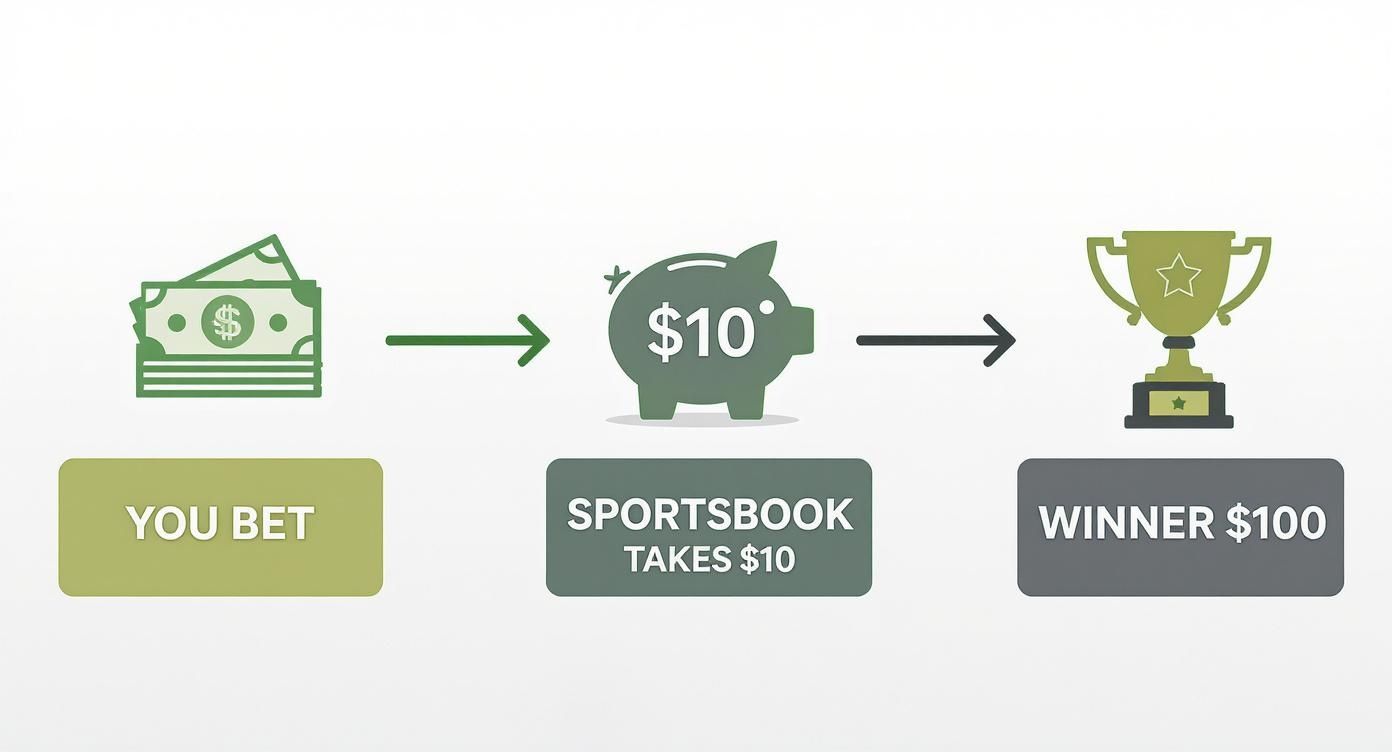
Seeing it visually makes it obvious: your entire goal is to make picks sharp enough to overcome that built-in house edge.
Leveraging Data and Avoiding Common Pitfalls
The availability of historical data has completely changed the game for sharp bettors. This isn't just surface-level stuff. We're talking granular information, with snapshots taken every few minutes, showing exactly how lines react to news. See a key player get injured? You can watch the line make a 2-3 point shift in an NFL game in real-time. Bettors who know how to read these patterns can spot inefficiencies and avoid getting suckered by public overreactions. If you want to dive deeper, you can learn more about historical odds data and its impact from SportsData.io.
Finally, don't make the rookie mistakes that drain bankrolls. Don't chase your losses, never bet more than you are truly comfortable losing, and please, don't bet on a game just because it’s on TV. Stick to your process, trust your analysis, and stay disciplined.
Your goal isn't to win every single bet. It's to make consistently smart decisions based on a solid analytical process. This checklist helps you do just that, turning the complex story of a betting line into a clear opportunity.
At USASportsbookList, we provide in-depth reviews and comparisons of the top offshore sportsbooks to help you find the best lines, bonuses, and features. Explore our expert guides to make smarter, more informed betting decisions today at https://usasportsbooklist.com.