Ever stared at a betting line on a site like MyBookie or BetUS and felt like you were trying to crack a secret code? You’re not alone. But here’s the thing: odds are just the sportsbook’s way of telling you two things: the chance of something happening and how much you’ll get paid if you’re right.
Think of them as the price tag on a bet. That price tells you everything about the risk you're taking and the potential reward waiting for you.
Your First Look At How Betting Odds Work
Sportsbooks set up odds to balance their own risk and make sure they can turn a profit, no matter who wins. It's a system that's been fine-tuned for centuries.
This whole idea of putting a price on different outcomes isn't new. The roots of modern odds-making go all the way back to the 1700s in the UK, when a bookie named Harry Ogden changed the game. Before him, betting was just picking a winner. Ogden was the first to introduce a mathematical framework, and things have never been the same since.
The Role of Favorites and Underdogs
Every single betting line tells a story, and that story always has two main characters: the favorite and the underdog.
-
The Favorite: This is the team everyone expects to win. Because they're the safer bet, you won't win as much money. Their odds will have a minus sign (-) in front of them, like -150.
-
The Underdog: This is the long shot, the team expected to lose. Betting on them is a bigger gamble, but if they pull off the upset, the payout is much sweeter. Their odds get a plus sign (+), like +130.
This back-and-forth is the heart of sports betting. To get a real feel for how the bookies arrive at these numbers, it helps to peek behind the curtain at the data they use. Digging into some football analytics for beginners can give you a great head start.
To help you get started, here's a quick rundown of the main ideas you'll need to know.
Key Betting Odds Concepts At A Glance
| Concept | What It Tells You | Example |
|---|---|---|
| Favorite | The team or player expected to win; lower payout. | Indicated by a minus sign, e.g., -150. |
| Underdog | The team or player expected to lose; higher payout. | Indicated by a plus sign, e.g., +130. |
| American Odds | US standard, based on a $100 bet. | -150 means you risk $150 to win $100. |
| Decimal Odds | Popular in Europe, shows total return per $1. | 2.50 means you get $2.50 back on a $1 bet. |
| Fractional Odds | Traditional UK style, shows profit to stake. | 5/1 means you win $5 for every $1 you bet. |
These are the building blocks. Once you get these down, you're well on your way to reading any betting board like a pro.
The Three Languages of Odds
Just like money comes in different currencies, betting odds come in different formats. They all mean the same thing, but they look different on the screen. On offshore sites from BetAnything to Bookmaker.eu, you’ll mainly run into three types.
American Odds: This is what you’ll see most in the US. It uses those plus (+) and minus (-) signs to show how much you stand to win based on a $100 wager.
Decimal Odds: The standard across Europe. This format simply shows you the total you’ll get back (your original bet plus your profit) for every $1 you put down.
Fractional Odds: The old-school UK format. It looks like a fraction (e.g., 5/1) and tells you the potential profit relative to what you bet.
Getting comfortable with these formats is your first real step to becoming a smarter bettor. Next up, we'll break down exactly how to read and use each one.
Decoding The Three Main Types Of Betting Odds
To really get a handle on sports betting, you first need to learn the three "languages" that sportsbooks use to talk about odds. Think of it like knowing dollars, euros, and yen—they all represent value, just in different ways. On top offshore sites like Xbet and Bookmaker.eu, you’ll see American, Decimal, and Fractional odds, and they almost always let you toggle between them with a single click.
Once you’re comfortable with these formats, you can instantly see the story a line is telling. The goal here is to get you so dialed in that you can calculate payouts and understand the risk at a glance, no matter how the odds are displayed. Let's break down each one.
American Odds: The Plus And Minus System
American odds are the default you’ll find on nearly every sportsbook that caters to US bettors, from MyBookie to BetUS. You can't miss them—they're the ones with the plus (+) and minus (-) signs right in front of the numbers. The whole system is built around the idea of a $100 bet, which makes it super simple to figure out your potential risk and reward.
The signs tell you two completely different stories:
-
The Minus Sign (-): The Favorite. The number next to the minus sign is how much you have to bet to win $100. If you see the Los Angeles Lakers at -150, it means you need to risk $150 to walk away with a $100 profit. A winning ticket gets you your $150 back plus the $100 in winnings, for a total of $250.
-
The Plus Sign (+): The Underdog. This number is how much you win if you risk $100. If the Kansas City Chiefs are listed at +130, a winning $100 bet gets you $130 in pure profit. Your total payout would be $230—your original $100 stake plus your $130 win.
This format is great because it immediately shows you the financial dynamic of backing a favorite versus taking a shot on an underdog.
Key Takeaway: American odds are all about the $100 benchmark. A minus sign shows you how much to risk to win $100. A plus sign shows you how much you win for risking $100.
Decimal Odds: The Simplest Payout Calculation
While American odds are the standard in the US, a lot of bettors—myself included—often switch to Decimal odds for their sheer simplicity. They're huge in Europe and Canada, and for good reason: they tell you the total payout (your original bet plus your profit) for every $1 you wager.
There are no plus or minus signs to worry about, just a straightforward number like 1.91 or 3.50. Calculating your total return is just one easy multiplication.
Total Payout = Stake x Decimal Odds
Let's say you're looking at a game on an offshore book like BUSR or Heritage Sports. The Golden State Warriors are playing the Boston Celtics.
- Warriors Odds: 2.50
- Celtics Odds: 1.65
If you bet $100 on the Warriors at 2.50, your total return on a win is $100 x 2.50 = $250. That $250 is your $100 stake back plus $150 in profit. Bet $100 on the Celtics at 1.65, and your return is $100 x 1.65 = $165 (your $100 stake plus $65 profit). Because the payout is already baked into the number, many people find it's the fastest way to compare lines.
Fractional Odds: The Classic Profit Ratio
Fractional odds are the old-school format, the kind you'd see scrawled on chalkboards at UK horse racing tracks. They tell you the potential profit you'll make in relation to your stake. You’ll see them written as a fraction, like 5/1 or 2/7.
The math is simple:
- The first number (the numerator) is how much you win.
- The second number (the denominator) is how much you bet.
Odds of 5/1 (read "five-to-one") mean you'll win $5 for every $1 you stake. A $100 bet would earn you $500 in profit. You'd also get your original $100 stake back, for a total payout of $600.
When the fraction is "top-heavy" (like 5/1), you're looking at an underdog. When it's "bottom-heavy" (like 2/7), you're betting on a heavy favorite. At 2/7 odds, you have to bet $7 just to win $2. While you won't see them as often on US-focused sites like Bet105 or Cosmobet, understanding them is key to having a complete picture of how the odds game works.
Turning Odds Into Actionable Insights
Knowing how to read American, Decimal, and Fractional odds is just the starting line. The real skill is learning to turn those numbers into meaningful insights. This is where you graduate from simply seeing the prices to truly understanding what they represent: the sportsbook's opinion on how a game is likely to play out. It's how sharp bettors find their edge.
The single most powerful tool for this is implied probability. Think of it as a simple translation that converts the odds into a percentage, revealing the win chance a sportsbook like BetAnything is assigning to a team. Once you see that number, you can compare the book's assessment to your own, which is the cornerstone of finding value.
This flowchart breaks down how each odds format gets converted into its implied probability percentage.
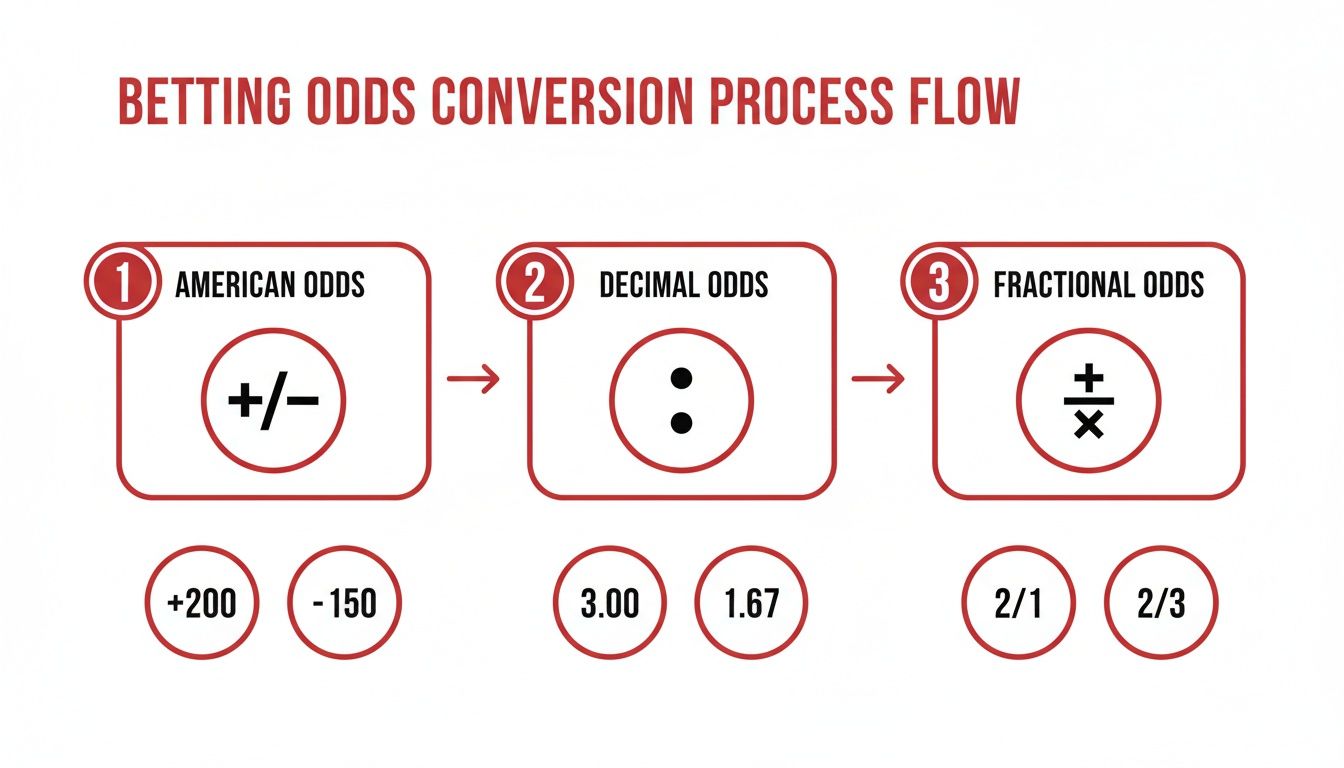
As you can see, it doesn't matter if you're looking at -150, 1.67, or 2/3. They all funnel down into a single, comparable number—a percentage. This is what allows you to evaluate opportunities across different sportsbooks and betting styles with total clarity.
Calculating Implied Probability
Translating odds into a percentage is way easier than it sounds. Each format has its own simple formula, and once you get the hang of them, you'll be able to quickly size up any line you see, whether it's at BUSR or Bookmaker.eu.
Here are the formulas you'll want to remember:
- For Negative American Odds (-):
Risk / (Risk + Win) x 100- Example for -150 odds:
150 / (150 + 100) x 100 = **60%**
- Example for -150 odds:
- For Positive American Odds (+):
100 / (Odds + 100) x 100- Example for +130 odds:
100 / (130 + 100) x 100 = **43.48%**
- Example for +130 odds:
- For Decimal Odds:
(1 / Odds) x 100- Example for 2.30 odds:
(1 / 2.30) x 100 = **43.48%**
- Example for 2.30 odds:
- For Fractional Odds:
Denominator / (Denominator + Numerator) x 100- Example for 13/10 odds:
10 / (10 + 13) x 100 = **43.48%**
- Example for 13/10 odds:
These formulas are your keys to unlocking the story hidden inside the numbers. For a deeper look at putting this into practice, you can check out our guide on how to read betting odds for more examples and strategies.
From Percentages To Payouts
While understanding implied probability is crucial for your analysis, every bettor ultimately cares about the potential payout. The standard examples always use a $100 bet for simplicity, but you need to know how to calculate your return for any amount you stake.
Let's use a real Super Bowl line you might find on BetAnything. Imagine the San Francisco 49ers are the favorites at -120 and the Kansas City Chiefs are underdogs at +100.
Calculating a payout for a favorite (-120):
The formula is (Stake / (Odds / 100)) = Potential Profit. So if you bet $40 on the 49ers:
($40 / (120 / 100)) = **$33.33 profit**- Your total return would be $73.33 (your $40 stake + $33.33 profit).
Calculating a payout for an underdog (+100):
The formula is Stake * (Odds / 100) = Potential Profit. If you bet $40 on the Chiefs:
$40 * (100 / 100) = **$40 profit**- Your total return would be $80 (your $40 stake + $40 profit).
For a quick reference, here's a table that summarizes these key formulas.
Odds Conversion And Payout Formulas
| Odds Type | Implied Probability Formula | Payout Calculation |
|---|---|---|
| American (-) | Risk / (Risk + Win) x 100 |
(Stake / (Odds / 100)) |
| American (+) | 100 / (Odds + 100) x 100 |
Stake x (Odds / 100) |
| Decimal | (1 / Odds) x 100 |
(Stake x Odds) - Stake |
| Fractional | Denom. / (Denom. + Num.) x 100 |
Stake x (Num. / Denom.) |
Keep this handy, and you'll never be guessing about what the odds mean or what you stand to win.
By mastering these simple calculations, you gain complete control over your betting. You can instantly assess the risk, the reward, and the sportsbook's implied belief for any wager, on any platform.
Once you can decode odds on sight, the next critical step is learning how to perform an effective football odds comparison to find the best value across different bookmakers. This skill, combined with your understanding of probability and payouts, is what separates casual bettors from those who approach it with a winning strategy.
Understanding The Vigorish: The Sportsbook's Built-In Edge
Ever wonder how sportsbooks like Cosmobet and Heritage Sports manage to stay in business, even when bettors score huge wins? The secret sauce is a built-in advantage known as the vigorish, often just called "the vig" or "juice." It's a small commission they bake directly into the odds, guaranteeing they have a mathematical edge on every single bet placed.
Think of it as their service fee for taking your action. This fee is the cost of doing business, and it's the invisible force that makes sportsbooks profitable over the long haul. If you want to really understand how sports betting odds work, you have to get a handle on the vig—it shapes every line you see.
The Classic Coin Toss Analogy
Let's break down the vig with a perfect, 50/50 proposition: a simple coin toss. In a completely fair world, if you bet $10 on heads and your buddy bets $10 on tails, the winner simply collects $10. The odds would be even money (+100), reflecting the true 50% probability of each outcome.
But a sportsbook isn't your buddy—it's a business. Instead of offering +100 odds, a bookmaker will post something like -110 on both heads and tails.
This tweak means you now have to risk $110 just to win $100. Imagine one person bets $110 on heads and another bets $110 on tails. The sportsbook collects $220 in wagers. No matter how the coin lands, the book only pays out $210 (the winner gets their $110 stake back, plus their $100 profit). That leftover $10 is the sportsbook's guaranteed cut. That's the vig.
The vig is the reason the implied probabilities for all outcomes of a bet will always add up to more than 100%. That "extra" percentage is the sportsbook's profit margin, skimmed off the top regardless of who wins or loses.
Spotting The Vig in Real NFL Odds
This isn't just a hypothetical concept; it plays out on every betting board. Take a look at a standard NFL point spread you'd find on an offshore site like BUSR:
- Dallas Cowboys -7.5 (-110)
- Philadelphia Eagles +7.5 (-110)
Both sides are priced at -110. If we plug that into our implied probability formula, the chances of the Cowboys covering the spread is 52.38%. And guess what? The chance of the Eagles covering is also 52.38%.
Add those two probabilities together, and you get 104.76%. That extra 4.76% hovering over 100% is the sportsbook’s built-in advantage. For a deeper dive into how this works, our guide on what is a vig in sports betting has you covered.
Why Shopping For "Reduced Juice" Is A Game-Changer
Here’s a pro tip: not all sportsbooks charge the same amount of juice. While -110 is the industry standard for point spreads and totals, some books—particularly offshore sportsbooks—are known for offering better prices. This is called offering "reduced juice."
For example, a shop like Heritage Sports might post -105 odds on that same NFL game.
- Standard Line (-110): You risk $110 to win $100.
- Reduced Juice Line (-105): You only risk $105 to win $100.
That $5 difference might not sound like a big deal on a single bet, but over hundreds or thousands of wagers, it adds up to a massive difference in your bottom line. Consistently getting a better price means you risk less to win the same amount, which directly boosts your long-term profitability. This is exactly why sharp bettors always have accounts at multiple sportsbooks like BUSR, Bookmaker.eu, and Heritage Sports. It lets them shop around for the best possible price on every bet they make.
How Live Betting Odds Fluctuate In Real Time
The second a game starts, all those carefully set pre-game odds are ancient history. Welcome to the world of live betting, where the numbers never stop moving. This is where the real action is, especially on offshore sportsbooks like MyBookie and BetUS. Odds are no longer static; they’re fluid, shifting with every single play, score, and momentum swing.
Understanding how sports betting odds work in this dynamic environment is a game-changer. A team that was a heavy pre-game favorite can suddenly offer underdog value after falling behind early. This volatility isn't random—it's driven by powerful, automated systems that crunch data faster than any human ever could.

The Algorithms Behind The Action
So, what's causing these rapid-fire adjustments? At the heart of it are sophisticated algorithms that sportsbooks like Bet105 and Cosmobet use to recalculate probabilities in an instant. Think of these systems as the high-tech engines of modern sports betting, constantly fed a stream of real-time data.
Several key factors trigger these automated odds shifts:
- Score Changes: This is the most obvious driver. A touchdown in football or a three-pointer in basketball will cause an immediate, significant change to the live moneyline, spread, and totals.
- Game Clock: As time winds down, the chances of a comeback shrink. You'll see the odds for the leading team shorten dramatically with every passing minute.
- Key Plays: It’s not just about scoring. A turnover, a red card, a power play, or even a critical foul can completely swing the projected outcome and, therefore, the odds.
- Injuries: If a star player limps off the field, the algorithms instantly adjust their team's chances of winning to reflect their weakened lineup.
This constant recalculation is what in-play wagering is all about. For a deeper dive into the mechanics, check out our complete guide on what is live betting and how to tackle it.
Pre-Game Odds Vs. Live Odds: An NBA Example
To really see the difference, let’s walk through a hypothetical NBA matchup you might find on a site like Bookmaker.eu.
Pre-Game Odds:
- Los Angeles Lakers: -200 (Implied Probability: 66.7%)
- Boston Celtics: +170 (Implied Probability: 37.0%)
Before tip-off, the Lakers are the clear favorites. But then the game starts. The Celtics come out firing on all cylinders, hitting their first few shots and jumping out to a 15-4 lead by the end of the first quarter. The live betting algorithm sees this, processes it, and spits out brand-new odds.
Live Odds (End of 1st Quarter):
- Los Angeles Lakers: +110 (Implied Probability: 47.6%)
- Boston Celtics: -130 (Implied Probability: 56.5%)
In just 12 minutes of game time, the entire script has flipped. The Celtics are now the favorites, and suddenly the Lakers offer plus-money value. This is the essence of live betting—it creates opportunities that simply didn't exist before the game started.
This whole experience is powered by the digital revolution, with mobile betting now accounting for over 80% of wagers in some markets. This tech boom has made odds more competitive than ever, especially in live scenarios. Learning to read these in-game shifts is one of the most valuable skills a modern bettor can have.
Alright, theory is great, but let's get our hands dirty. This is where the concepts really click. We're going to walk through a real-world example, step-by-step, using a classic NFL rivalry to show you how this all works in practice.
Think of this as your first real rep: analyzing the odds, comparing books, and sniffing out the best value on the board.
For this exercise, let's say the Green Bay Packers are facing the Chicago Bears. Your first move, always, is to shop for the best line. Don't even think about placing a bet until you've checked the prices.
Comparing Odds Across Offshore Sportsbooks
Any serious bettor will tell you: never marry one sportsbook. You have to play the field. A few points of difference in the odds might seem small, but over a season, they're the difference between winning and losing money.
Let's check the moneyline odds for our game at three of the top offshore books: MyBookie, BetUS, and Bookmaker.eu.
- MyBookie: Packers -140 / Bears +120
- BetUS: Packers -145 / Bears +125
- Bookmaker.eu: Packers -135 / Bears +115
See that? The numbers are all over the place. If you're backing the favored Packers, Bookmaker.eu gives you the best price at -135. You have to risk less to win the same amount.
But if you're smelling an upset from the underdog Bears, BetUS is where you want to be, offering a sweet +125 payout. This is exactly why line shopping is non-negotiable.
Analyzing The Odds And Calculating Payouts
Let's say you're feeling good about the Packers and want to put down $50. By taking that -135 line at Bookmaker.eu, you’re instantly maximizing your potential profit.
First, what does -135 really mean? Let's translate it into implied probability.
- Formula for negative odds:
Risk / (Risk + Win) x 100 - Calculation:
135 / (135 + 100) x 100 = **57.45%**
So, Bookmaker's odds are telling us they think the Packers have a 57.45% shot at winning this game.
Now, let's figure out what a winning $50 ticket would get you.
- Formula:
(Stake / (Odds / 100)) = Potential Profit - Calculation:
($50 / (135 / 100)) = **$37.04 profit**
A Packers win means you get your $50 back, plus $37.04 in profit. Your total payout would be $87.04.
Spotting The Vig And Making The Smart Bet
To see the full picture, let's calculate the implied probability for the other side of that same bet at Bookmaker.eu—the Bears at +115.
- Implied Probability for Bears (+115):
100 / (115 + 100) x 100 = **46.51%**
Now for the magic trick. Add the two probabilities together: 57.45% (Packers) + 46.51% (Bears) = 103.96%.
Wait, that's more than 100%. That extra 3.96% is the sportsbook's built-in profit margin. It’s the vig, or "juice," that ensures the house has an edge.
This whole exercise is the bread and butter of smart betting. You compare lines, translate them into probabilities, calculate your potential payout, and see exactly what the book is charging you. By always hunting for the best price, you are chipping away at that house edge and giving yourself a real fighting chance.
This is how you move from just guessing who will win to making calculated decisions based on actual value. Every single bet you consider should get this same treatment.
Common Questions About Betting Odds
Even once you get the hang of the basics, looking at a full betting board can still bring up a few questions. Let's tackle some of the most common ones that trip up new bettors, so you can feel more confident when you're browsing sites like MyBookie or BetUS.
What Does -110 Mean In Sports Betting?
That -110 number you see everywhere is the standard price for point spread and totals bets. Think of it as the cost of doing business. It simply means you have to risk $110 to win $100.
So where does that extra $10 go? Straight to the sportsbook. It's their commission, which is known in the industry as the "vig" or "juice." If you win your bet, you get your original $110 back, plus your $100 profit. You'll see this line on almost every major sporting event at pretty much every offshore sportsbook.
How Do I Find The Best Odds For A Game?
The single most important habit for any serious bettor is to "line shop." This just means you compare the odds for the exact same game across a few different sportsbooks before you place your wager.
For example, Xbet might have the Patriots at -150, but you see that BetAnything has them at -145. Betting at -145 is a no-brainer—it gives you a better payout for the same amount of risk. This is precisely why sharp bettors keep active accounts at several offshore books like Bookmaker.eu and BUSR.
Are Sportsbook Odds Always A Fair Reflection Of Probability?
Not quite. Sportsbook odds aren't a pure reflection of a team's chances. They're priced to include the sportsbook's commission (the vig), which is how they guarantee a profit over the long haul.
This is why if you calculate the implied probability for every outcome in a game, the total will always be more than 100%. The odds start with the bookmaker's expert opinion, but they're constantly adjusted to balance the money on both sides. Ultimately, their job is to create a profitable market, not to give you a perfectly fair probability.
Can Betting Odds Change Before A Game Starts?
Absolutely, and they often do. Pre-game odds are anything but static; they can shift right up until kickoff.
Lines move for all sorts of reasons: a flood of money comes in on one side, a key player gets injured, the weather forecast suddenly changes, or some other piece of breaking news drops. If a star quarterback is unexpectedly ruled out, you'll see a massive and immediate shift in the odds. That's why it's always a good idea to keep an eye on the lines at books like Heritage Sports or Cosmobet before you lock in your bet.
At USASportsbookList, we provide detailed reviews and comparisons to help you navigate the world of sports betting. Find trusted sportsbooks with the best odds and bonuses by visiting us at https://usasportsbooklist.com.