You open a World Cup odds page, see France at +400, another team at +700, a draw price sitting off to the side, and maybe a “to qualify” market that doesn't match the regular match line. Most new bettors freeze right there. The numbers look familiar enough to tempt you into a bet, but not clear enough to trust your read.
That's where most mistakes start.
Top Offshore Sportsbook Bonuses for September 2026

$250 + 100 Free Spins
All new players receive $250 in Free Bets and 100 Casino Spins. Join today and enter the promo code WELCOME in the cashier when you deposit $50 or more.

Get a 50% deposit bonus up to $1,000 with the code: CRYPTO1K. Valid on crypto deposits.


World Cup betting gets more confusing because soccer has its own logic. Draws matter. Group tiebreakers matter. A team can lose the match and still leave bettors with the right long-term read. And for the 2026 tournament, the jump to 48 teams changes the board in a big way, creating a deeper futures market and more group-stage angles than many casual bettors are used to seeing, as noted by Vegas Insider's World Cup odds coverage.
If you're betting through offshore books like MyBookie, BetUS, BetAnything, Xbet, Bet105, Cosmobet, BUSR, Bookmaker.eu, Heritage Sports, or BUSR, the menu can be even broader. That's a good thing if you know what you're looking at. It's expensive if you don't.
A smart bettor doesn't start by hunting a giant payout. A smart bettor starts by learning how to read the market, how to compare prices, and how tournament structure changes the meaning of those prices. Once that clicks, betting odds for World Cup matches stop looking random. They start looking like a map.
Introduction Your Guide to World Cup Betting
Many bettors new to soccer approach the World Cup with habits from American sports. They scan for the biggest-name team, assume talent wins out, and bet the favorite before they have worked out what the price is really buying. The tournament punishes that shortcut because World Cup betting is less like picking the better team on a Sunday and more like pricing a six-week bracket where format matters at every step.
The 2026 World Cup changes that calculation even more. With 48 teams in the field, offshore sportsbooks such as BetUS, MyBookie, and Bookmaker.eu can post a wider futures board, more group-stage qualifiers, and more matchup prices on lesser-known nations. That creates more ways to bet, but it also creates more room for bad numbers to sit on the board before the market catches up. Mainstream guides often focus on the favorites. Smart bettors spend time on the extra teams, the weaker groups, and the path each contender has to survive.
A newcomer usually asks, “Who will win the World Cup?” An experienced bettor asks a better question. “Does this number give me enough margin for the risk?”
That difference matters because a World Cup future is not a prediction contest. It works like shopping for insurance or airline tickets. Two people can want the same outcome, but the one who paid the better price made the stronger decision. On offshore books like BetUS and MyBookie, that mindset helps you compare a title price, a group qualification price, and a “to advance” market without treating them as the same bet.
Tournament structure also changes what “good team” means. In the group stage, scoreline and tiebreak pressure can matter as much as the result itself. In the knockout rounds, you have to separate bets that grade after 90 minutes from bets that pay on who advances. In a 48-team event, those details become more important because there are more uneven matchups early and more chances for books to shade prices toward public teams.
Practical rule: Start with the format, then judge the odds. If you skip the format, you are guessing at the price instead of evaluating it.
That is the foundation for betting odds for World Cup matches the right way. The goal is not to chase the team you like most. The goal is to use books like Bookmaker.eu, BetUS, and MyBookie to find spots where the market has not fully priced in the new 48-team structure.
Decoding the Numbers How to Read World Cup Odds
A World Cup line is a price first, a prediction second. If you learn to read that price correctly, you stop betting by team name and start betting by number. That matters even more for the 2026 tournament, because a 48-team field will create more mismatches, more public overreaction, and more spots where offshore books like BetUS and MyBookie hang numbers that deserve a closer look.
American odds
If you bet on BetUS, MyBookie, BUSR, or Bookmaker.eu, you will usually see American odds by default.
The sign tells you what kind of team you are looking at.
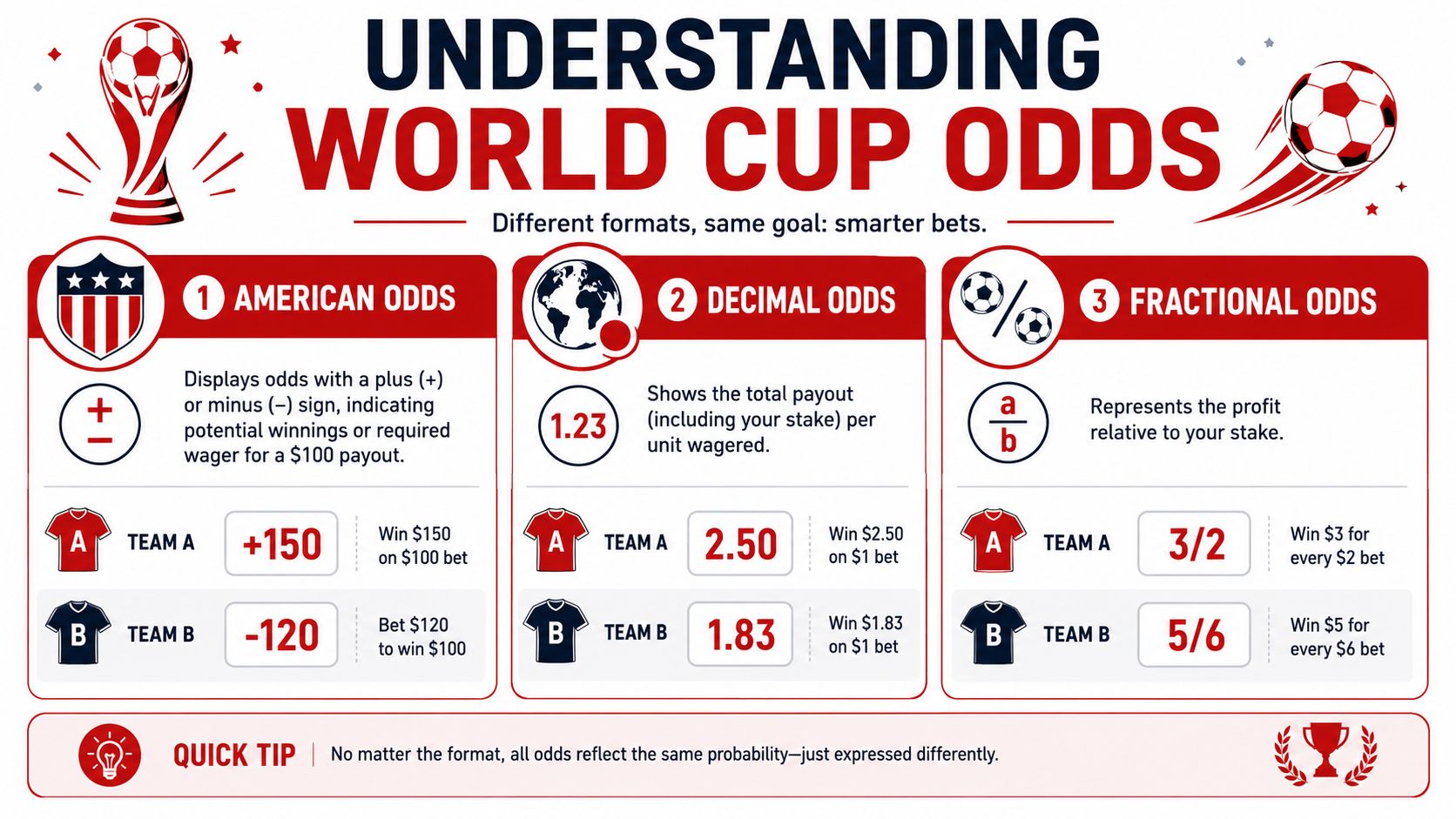
A plus number shows how much profit you win on a $100 stake. If a team is +150, a $100 bet wins $150 in profit.
A minus number shows how much you need to risk to win $100 in profit. If a team is -120, you risk $120 to win $100.
That quick read helps in soccer because the board can get crowded fast. During the World Cup, especially in early matches involving stronger nations and weaker qualifiers, you may scroll through dozens of prices in one session on BetUS or Bookmaker.eu. Reading the sign correctly lets you sort favorites from underdogs in seconds.
Decimal and fractional odds
Some sportsbooks let you switch the display to decimal or fractional odds.
Decimal odds show your full return, including stake, for each $1 wagered. At 2.50, a $100 bet returns $250 total.
Fractional odds show profit relative to stake. At 3/2, you win $3 for every $2 bet.
These formats are different ways of expressing the same underlying value. A team listed at +150, 2.50, or 3/2 is priced the same way. Books such as Xbet and BetAnything may let you choose whichever format is easier for you to read, but the job stays the same. You are comparing prices, not chasing the format that looks friendlier.
| Format | Example Odd | What It Means | Profit on $100 Bet | Total Payout |
|---|---|---|---|---|
| American | +150 | Underdog price | $150 | $250 |
| American | -120 | Favorite price | $100 | $220 |
| Decimal | 2.50 | Same value as +150 | $150 | $250 |
| Fractional | 3/2 | Same value as +150 | $150 | $250 |
Implied probability is the part that matters
The next step is where new bettors often get stuck. Odds do not only show payout. They also show the sportsbook's estimate of how likely an outcome is, before the book's margin is removed.
For example, -500 converts to an implied probability of 83.3% before vig. That is useful because it turns a betting line into a question you can evaluate. Does this team win often enough to justify paying that price?
The 2026 format changes your thinking. In an expanded tournament, some group-stage favorites will be priced as if the gap is enormous because the public sees a famous badge against a smaller nation. On offshore sportsbooks like BetUS and MyBookie, that can push favorites too high and leave more value on alternate markets or on the underdog side if your estimate of the true win rate is higher than the book suggests.
Sharp bettors study the implied probability, then compare it with their own number. If the sportsbook implies a team has a lower chance than your research suggests, the bet may be worth making. If the market price is too expensive, you pass and wait.
If you want a simple formula reference, this guide on how to calculate betting odds is useful for checking conversions while you compare World Cup prices across books.
Exploring Popular World Cup Betting Markets
A new World Cup bettor usually clicks the match winner market first. That is a good starting point, but it only shows one part of the board. On offshore sportsbooks such as MyBookie and BetUS, the better approach is to learn which market matches the question you are trying to answer.
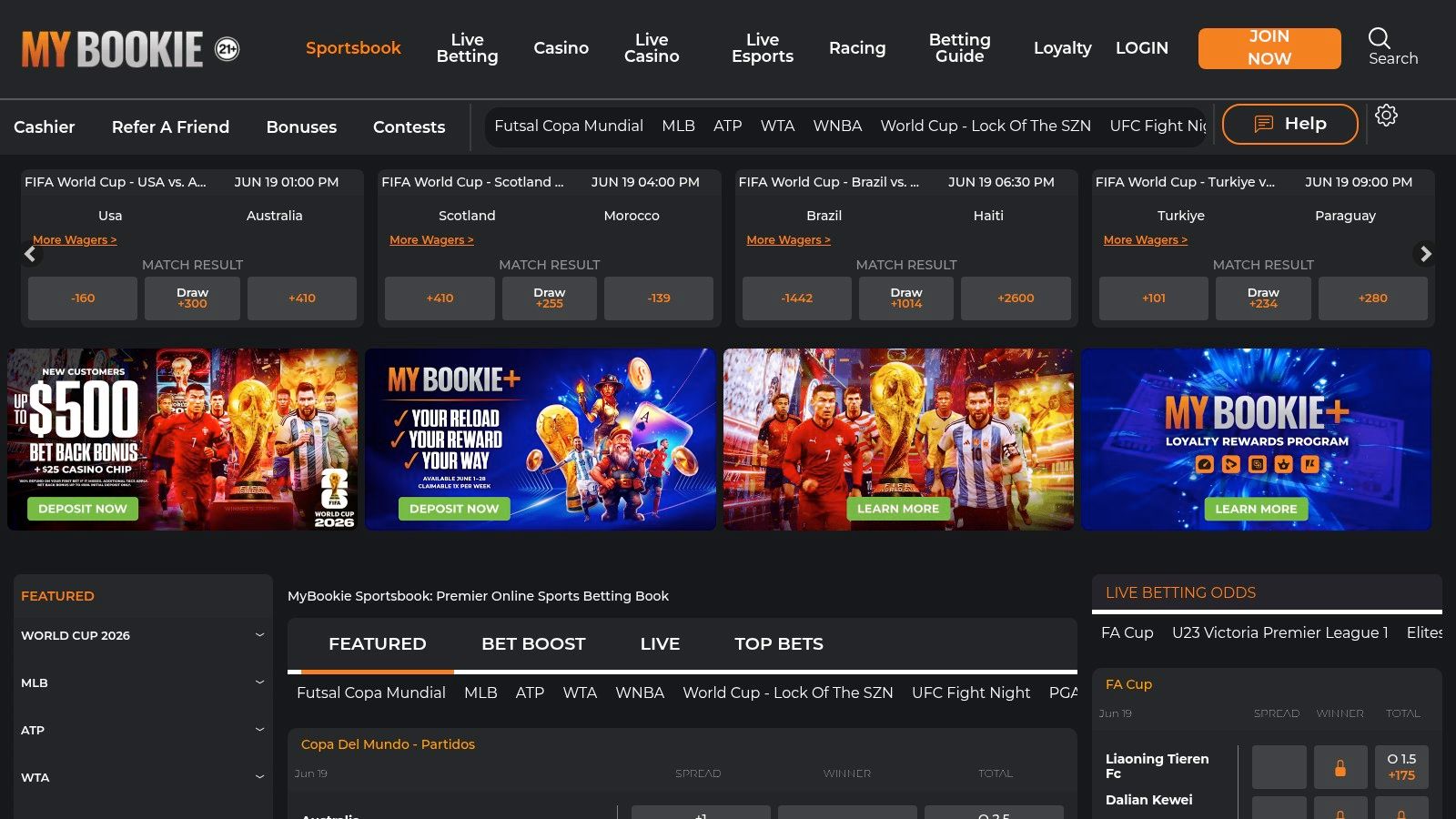
The 2026 tournament format makes that even more important. With 48 teams, you will see more mismatches early, more unfamiliar national sides, and more prices shaped by public perception. That creates spots where the obvious bet is expensive, while a related market offers a cleaner path to value at BetUS or Bookmaker.eu.
The three-way moneyline
Soccer's basic market is the three-way moneyline. You are picking one result in regulation time only:
- Home team win: Your team must win within 90 minutes plus stoppage time.
- Draw: The match must finish level in regulation.
- Away team win: Your team must win within 90 minutes plus stoppage time.
New bettors often miss the draw because they come from football or basketball, where a tied score does not survive to grading. In World Cup betting, the draw is part of the main menu. Leave it out, and you are reading the board with one eye closed.
This market matters even more in the expanded 2026 group stage. Some underdogs will enter matches with one realistic goal: stay compact, slow the pace, and reach halftime level. In those spots, a draw ticket can make more sense than paying a heavy favorite price on a brand-name team at MyBookie or BetUS.
Totals and props
Totals ask a simpler question. How many goals will be scored?
If the posted total is 2.5, the over needs three or more goals, and the under needs two or fewer. It sounds basic, but it forces you to judge match rhythm rather than just team strength. A superior team can still produce an under if it controls the game, scores once, and spends the final half hour protecting space instead of attacking.
Props go a step further. Common World Cup props include both teams to score, first goalscorer, clean sheet, exact score, and method of qualification.
A good habit is to trace each prop back to what must happen on the field. Both teams to score depends on chance creation from each side. First goalscorer depends on role, minutes, and set-piece or penalty duty. Clean sheet bets depend on game script and defensive discipline, not just the favorite being stronger on paper.
That simple filter saves bankroll. Offshore books such as BetUS and MyBookie offer a long list of props during major tournaments, and a long menu can tempt beginners into random action.
Group-stage markets deserve extra attention in 2026
The expanded format changes how bettors should look at group markets. With more nations in the tournament, there will be more groups where one power is expected to cruise and another spot is wide open. Mainstream guides often stop at "pick the best team." That misses where the betting value often sits.
For example, a mid-tier nation can become far more interesting in a group qualification market than in a single-match moneyline. A team that is disciplined, hard to break down, and good on set pieces may not win many headlines, but it can still finish above a more talented side that drops points in a tense opener.
FIFA explains its tournament tiebreaker process in its official competition rules and tournament materials, and those details matter for bettors. Goal difference, goals scored, and head-to-head results can shape who advances. A 3-0 win and a 1-0 win both cash a standard moneyline ticket, but they do not carry the same weight when you are betting a team's path through the group.
In group betting, margin can matter almost as much as the result.
That is one reason offshore sportsbooks can leave openings on alternate group markets. At Bookmaker.eu or BetUS, a favorite may be priced correctly to win one match but still be overpriced to dominate the whole group if its style does not produce multi-goal wins.
A quick visual example helps if you're still learning the menu layout and common soccer markets:
Regulation win versus to qualify
This is one of the easiest World Cup betting mistakes to make.
If you bet a team to win the match, that wager usually applies to regulation only. A 1-1 draw after 90 minutes means your match-winner ticket loses or pushes based on the exact market, even if your team survives extra time and advances on penalties.
If you bet to qualify, the sportsbook includes the full path to advancement. Extra time counts. Penalties count.
Use a simple mental check before placing any knockout bet. Ask, "Do I need this team to lead after 90 minutes, or do I just need it to advance?" That one question prevents a lot of bad tickets on BetUS, MyBookie, and Bookmaker.eu.
For newcomers, that is the key lesson for this whole section. Pick the market that matches the story you believe about the match. In a 48-team World Cup, where public betting often floods toward famous teams, the best value is often not on the headline side. It is on the market that prices the game more precisely.
The Bookmakers Playbook Why World Cup Odds Change
You check BetUS on Monday and see one price for a team to win its group. By Wednesday, the number is gone. Same team, same tournament, different cost.
That happens because odds are a market price, not a label. Bookmaker.eu, MyBookie, and BetUS open a number based on power ratings, matchup models, and the kind of action they expect to take. After that, the price keeps adjusting as new information arrives and bettors place money.
A good way to understand it is to treat the opening line like the first asking price on a house. It reflects an opinion. Once buyers react, the price can rise or fall fast.
News changes the number first
Team news is the clearest driver. Injuries, squad selection, rest patterns, travel concerns, and tactical changes all affect how a sportsbook prices a match or a futures market. Pre-tournament odds can also shift after friendlies or qualifying results because books are constantly updating how strong each team looks.
The 2026 format makes this even more important. With 48 teams instead of 32, traders have to price more uneven matchups, more unfamiliar squads, and more paths out of the group stage. That creates more room for early mistakes, especially on offshore books that post broad menus well before public attention fully catches up.
For bettors, that means timing matters. If you wait to bet at Bookmaker.eu or BetUS, you are not only choosing a team. You are choosing whether today's number is still worth paying.
Money moves lines too
Sportsbooks also react to betting pressure. If public money pours in on a popular national team, the book may shorten that side and make the other side more attractive. The goal is simple. Manage risk and avoid taking too much exposure at one bad price.
That is common during the World Cup because casual bettors tend to back famous shirts, not always the best number.
The expanded tournament should make that pattern stronger in 2026. More teams means more casual attention on brand names to advance from softer groups. If a well-known country lands in a section with two weaker opponents, the public may rush to bet it to win the group or qualify. Sometimes that support is deserved. Sometimes the number gets inflated, and value shifts to a lesser-known team, a draw-based angle, or an alternative market at MyBookie or BetUS.
What a line move actually tells you
A move tells you that the market changed. It does not tell you the new price is good.
That distinction matters. Early bettors may have grabbed value before the market corrected. Late bettors often end up paying a premium created by hype, headlines, or one burst of public money.
Use a simple checklist before you follow any move:
- Did real news break? If a key player is out or a lineup changes, the move may be justified.
- Did several offshore books move together? If Bookmaker.eu, BetUS, and MyBookie all shift, the market is probably reacting to something meaningful.
- Did only one book move? That can signal a slower book elsewhere and give you a better number if you shop around.
- Did the public pile onto a famous team? In that case, the move may reflect demand more than true probability.
For a newcomer, the takeaway is simple. Do not chase every price move. Read the reason behind it.
In a 48-team World Cup, that habit becomes even more useful because there are more teams to price, more soft openers, and more chances for offshore sportsbooks to disagree with each other for a short window. That is where careful bettors often find value, not by predicting every winner, but by spotting when BetUS, MyBookie, or Bookmaker.eu is still hanging a number that has not fully caught up.
Pre-Tournament Futures vs In-Play Live Betting
You lock in a World Cup winner ticket at BetUS in June. Three months later, your team is still alive, but now one bad half can wreck the position. Then the tournament starts, MyBookie posts live odds after an early goal, and the same match suddenly offers a very different entry point. That is the core choice here. Do you want to bet the full month-long story, or react to one scene at a time?
Those are different jobs.
Futures are long-range bets
A futures bet asks you to be right about the shape of the tournament before it fully forms. You might bet a team to win the Cup, win its group, or reach a certain stage. The upside is a bigger price if you bet early. The trade-off is simple. Your bankroll is tied up, and the market can move against you long before your ticket has any chance to cash.
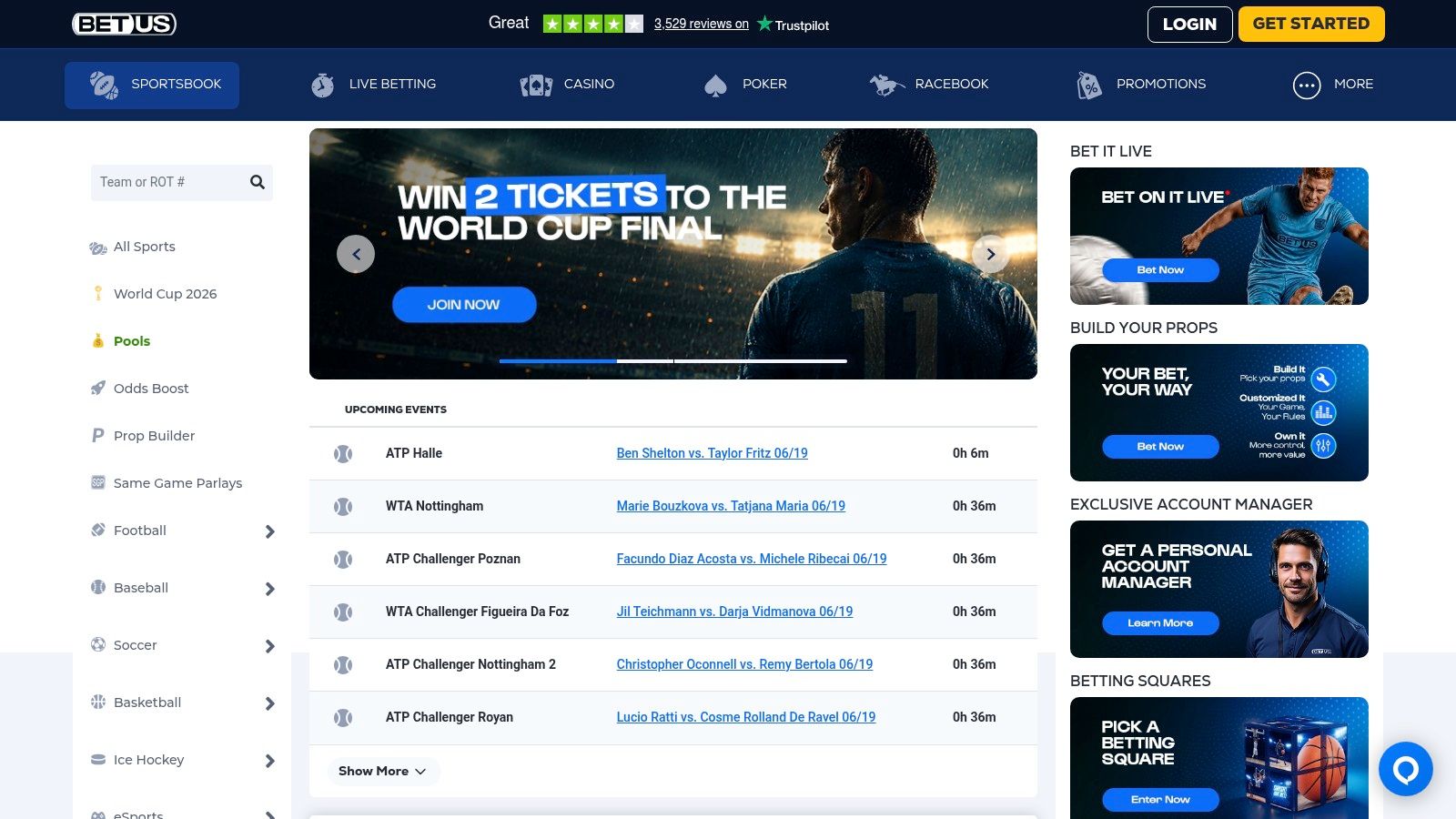
The 2026 tournament makes that decision more interesting because the field expands to 48 teams. More teams means more uneven pricing early, especially outside the handful of famous contenders. Offshore books such as BetUS and Bookmaker.eu often post a wide menu of futures before the public has sorted out which second-tier teams are live long shots and which are just filler.
That creates a useful habit for newcomers. Instead of forcing a winner pick at the top of the board, compare several paths. A strong regional team might offer more value in a group market or a "to reach quarterfinals" market than in the outright winner market. If you want a snapshot of how books frame those options, this page on World Cup winner betting odds gives you a solid starting point.
A futures card works like reserving a hotel room months before a major event. The early price can be attractive, but your money is committed, and new information can make the booking look better or worse.
Live betting is short-range pricing
Live betting is different because you are buying information as the match unfolds.
A pre-match line is built on expected team strength, likely tactics, and public opinion. A live line adds game state. Score, time remaining, red cards, injuries, and momentum all get priced in fast at MyBookie, BetUS, and Bookmaker.eu.
That speed creates mistakes.
In World Cup matches, one early goal can make the market swing harder than the match itself deserves, especially when a favorite falls behind. Soccer is low scoring, so bettors often panic when they see a big team down 1-0 after 12 minutes. Sometimes that panic is justified. Sometimes the favorite is still controlling possession, creating chances, and now available at a much better number than before kickoff.
The 48-team format adds another layer. Group-stage matches will include more talent gaps than past tournaments, and bettors may overreact to fast starts by underdogs from smaller nations. That can open live spots on favorites with deeper benches, or on totals if the match settles after an early burst.
How to decide which style fits the bet
Use futures when your edge is tournament-level. Use live betting when your edge is reading the match better than the market in real time.
A simple way to separate them:
| Type | Best for | Main risk | Best offshore use |
|---|---|---|---|
| Futures | Strong opinions about group draws, bracket paths, and teams built for tournament depth | Bankroll gets tied up and early prices can age badly | Shop outrights, group winners, and advancement markets at BetUS, Bookmaker.eu, and MyBookie |
| Live betting | Match states that create overreactions after goals, cards, or missed chances | Chasing action and taking worse numbers in a rush | Wait for a better entry on sides, draw prices, totals, or qualification markets |
One practical rule helps a lot. Do not use live betting to rescue a weak pre-match bet. Use it only when the new price is better than the old one and your original read still makes sense.
For 2026, many bettors will focus on the biggest brands in the futures market and ignore the extra value created by a larger field. That is where experienced players often separate the two tools. They use futures at BetUS or Bookmaker.eu to target mispriced paths before the tournament, then use live betting at MyBookie to attack overreactions once the matches start.
Advanced Strategies for Finding World Cup Betting Value
A bettor opens the futures board at BetUS in early 2026 and sees a familiar trap. The blue-blood teams pull all the attention, while a much larger field creates prices on group qualifiers, advancement markets, and mid-tier nations that the market has not sorted out as cleanly yet. That is where value hunting starts in this World Cup.
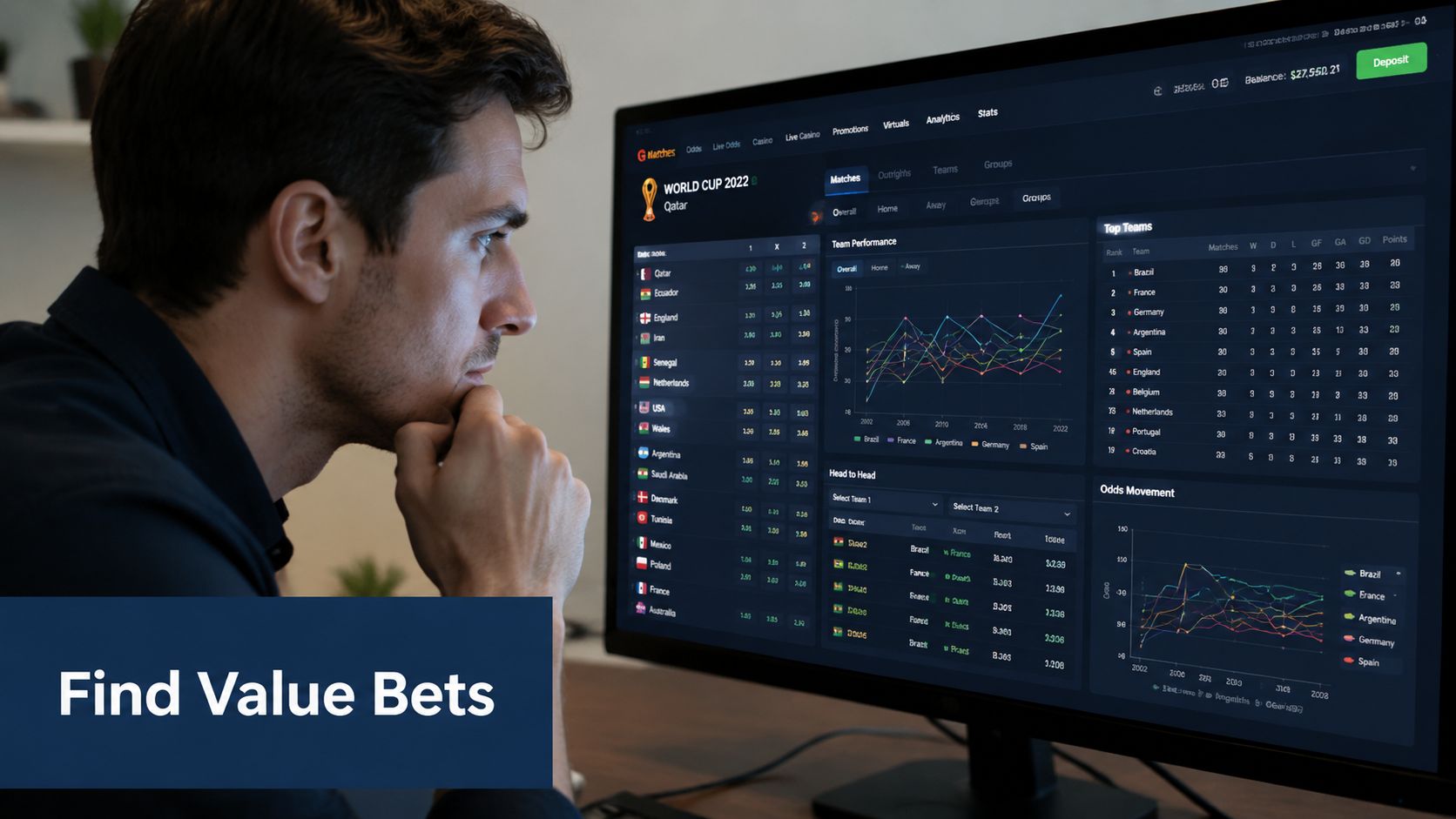
Start with the format, because 2026 changes the board
The 48-team World Cup does more than add matches. It adds uncertainty in the places casual bettors often ignore.
A larger tournament field works like a supermarket with more shelves. The headline items still sit in front, but the pricing mistakes often show up in the side aisles. For World Cup betting, those side aisles are markets such as group advancement, exact group finish, and match lines involving teams the public knows less about.
That changes strategy in a practical way. Instead of spending all your time asking who will win the whole tournament, spend more time asking which teams are priced too low or too high to survive their section of the bracket. On offshore books like Bookmaker.eu, BetUS, and MyBookie, those secondary markets can offer better betting value than the outright winner board because the public money is not as concentrated there.
Line shopping matters even more in a 48-team tournament
Line shopping is still the easiest edge. In 2026, it matters more because there are more teams, more markets, and more spots where books disagree.
If BetUS hangs one number on a group qualification market and Bookmaker.eu posts a better return, the better price is your starting point. If BUSR, Bet105, or Cosmobet is higher still, take the highest number that fits the same market rules. Over a long tournament, those small gains add up the same way a lower tax bill adds up over many purchases.
This matters most in futures-style markets tied to the expanded field. Books often vary more on teams outside the top tier because they attract less public action and less confident pricing. That is one reason experienced bettors keep multiple offshore accounts instead of staying loyal to one screen.
Build your own true-probability habit
Value betting starts with one question. What do you think the true chance is?
You do not need a complicated model to answer that. You need a repeatable process that keeps you from betting on reputation alone.
Try this:
- Rate the team, not the jersey. Big names can carry inflated prices. Smaller nations can be undervalued if they are organized, defend well, or match up well within their group.
- Separate the market types. Winning in regulation, advancing after extra time, and finishing top two in a group are different problems with different probabilities.
- Convert the odds into implied probability. That gives you the book's estimate.
- Compare your estimate to the market's estimate. If the gap is small, pass.
- Record the bet and closing line. Over time, that shows whether your numbers are beating the market or just guessing.
A newcomer often gets stuck on step three. Keep it simple. If a price implies a team needs to advance more often than you believe it should, there is no value, even if you still expect that team to get through.
Good favorites can still be overpriced
Many new bettors treat strong favorites as safe bets. Price is what matters.
A favorite at a fair number can be a smart play. The same team at an inflated number becomes a bad bet. A useful habit is to pay close attention to favorites in the moderate range, where the team is strong but the price has not yet become too expensive to justify. That takes discipline, because the goal is not to bet the team most likely to win. The goal is to bet the number that underestimates how often that team should win.
That idea matters even more in the 2026 format. Some established nations will be priced off brand power and expected comfort against weaker opposition. Offshore books such as BetUS and MyBookie may still differ enough on those matchups to create a playable edge if your number is stronger than the market's.
Focus on middle-tier teams, not only long shots
The expanded field will tempt many bettors into spraying small bets on outsiders to win the tournament. That usually burns bankroll.
The more useful target is the middle tier. These are teams good enough to get out of a group, hard enough to beat in a one-off match, but not famous enough to draw heavy public support. In a 48-team event, that profile shows up more often because there are more nations from more confederations and more uneven levels of public familiarity.
That creates a cleaner path to value on offshore sportsbooks. Instead of betting a mid-tier team to win the World Cup, you may get a better angle by betting that team to advance, finish in a certain group position, or hold value in an early knockout match. Bookmaker.eu and BetUS are especially useful here because they tend to post deeper tournament menus.
Arbitrage exists, but it is not the first skill to build
Arbitrage means covering every outcome across different books for a small guaranteed profit. It can happen when menus at BetAnything, Xbet, BUSR, and Bookmaker.eu drift far enough apart.
Beginners should still be careful.
The hard part is not spotting two prices that look different. The hard part is checking that the rules match, the market timing matches, and the stakes available let you complete the trade before the numbers move. For World Cup betting, your time is usually better spent on line shopping, cleaner probability estimates, and selective bets tied to the expanded 2026 structure.
A simple advanced approach for 2026
Here is a practical way to hunt for value without overcomplicating it:
- Scan the outright and advancement boards at BetUS and Bookmaker.eu.
- Mark middle-tier teams whose path looks better than the market assumes.
- Compare prices across books before placing anything.
- Use MyBookie during the tournament to watch for live prices that overreact to an early goal or red card.
- Pass on bets where your edge is unclear.
That process keeps the 48-team format at the center of your thinking. More teams do not just mean more bets. They mean more ways for the market to misprice teams outside the spotlight, and that is often where the best World Cup betting value lives.
Choosing Your Sportsbook and Responsible Gaming
You are ready to place a World Cup bet. Argentina is about to kick off, the live board is flashing, and two books are showing slightly different prices. The sportsbook you chose now matters as much as the team you picked.
For World Cup betting, your book shapes almost everything. It affects how many markets you can bet, how quickly lines refresh during live play, and whether you can compare enough prices to spot a bad number. That matters even more in 2026, because the expanded field creates more group-stage matches, more unfamiliar teams, and more chances for offshore books to disagree with each other.
What different offshore books do well
MyBookie is often the easiest place for a newer bettor to start. The interface is simple, and that helps on crowded match days when you are trying to find a moneyline, total, or next-goal market without fumbling through menus.
BetUS is a strong option if you want a wider board. The extra match props and live markets matter in a tournament with more teams, because niche games often create the softest prices. A match between two mid-tier nations may not get the same attention as Brazil or France, and that can leave more room for value.
Bookmaker.eu usually appeals to bettors who care about sharper pricing and deeper menus. If you are comparing futures like group qualification, advancement, or surprise-run candidates in the 48-team setup, that depth helps.
Other books can still play a role. Heritage Sports, BetAnything, Xbet, Bet105, Cosmobet, and BUSR are useful for line shopping. You do not need loyalty to one platform if your goal is getting the best number.
A simple way to view it is this: MyBookie helps with ease of use, BetUS helps with market variety, and Bookmaker.eu helps with pricing. New bettors usually benefit from having one primary book and one or two backup books for comparison. If you want a broader side-by-side look at offshore options, this guide to World Cup betting sites for U.S. bettors is a practical place to start.
The 2026 format changes the shopping process, too. More teams means more matches that casual bettors know less about. Sportsbooks know that public money will still flood into the headline nations. That can leave softer prices on second-tier teams, lower-profile groups, and advancement markets that get less attention. Offshore books like BetUS and Bookmaker.eu are often the best places to check those angles because they tend to post broader tournament menus than smaller books.
Responsible gaming matters more during a month-long tournament
The World Cup can wear you down. There are matches nearly every day, and the schedule makes it easy to place bets out of boredom, frustration, or national-team loyalty.
Treat your bankroll like travel money for a long trip. If you spend half of it on day one, the rest of the tournament becomes stressful and rushed.
A few habits keep that from happening:
- Set a tournament bankroll before the first match. Pick an amount you can afford to lose and keep it separate.
- Use the same stake size for most bets. That keeps one bad loss from pushing you into reckless recovery bets.
- Separate your fan opinion from your betting opinion. Supporting the United States, Mexico, England, or Brazil does not mean every match offers value.
- Take breaks during heavy match windows. Live betting is easiest to misuse when games are stacked back to back.
- Track every wager. A simple note with the book, price, stake, and reason for the bet helps you catch patterns fast.
That last point matters more than many beginners expect. If you keep betting the same types of markets at MyBookie or BetUS and losing, your record will usually show why. Maybe you chase live overs after early goals. Maybe you overpay for favorites in the group stage. A short betting log turns vague frustration into something you can fix.
Good sportsbooks give you options. Discipline has to come from you.
The strongest World Cup bettors at BetUS, MyBookie, Bookmaker.eu, or BUSR are usually the ones who pass on weak prices, protect their bankroll, and stay patient long enough to use the extra opportunities the 48-team tournament creates.