You're probably doing what most bettors do the first time they look at the World Cup futures board. You open MyBookie or BetUS, scroll through the teams, and see a wall of plus signs, big payouts, and prices that don't seem to tell you much on their own. France is near the top. Spain and England are close. A few long shots look tempting. The problem isn't finding a team. It's knowing whether the number next to that team is worth betting.
That's where most mainstream guides fall short. They tell you who the favorites are, then stop. That doesn't help if you're betting through offshore books like Bookmaker.eu, Heritage Sports, BUSR, Xbet, Bet105, Cosmobet, or BetAnything, where prices can vary enough to change whether a futures ticket is sharp or lazy.
Top Offshore Sportsbook Bonuses for September 2026

$2,500 Use code - PROMOBUCK2 to get a 125% First Deposit Bonus at the BetNow sportsbook when you deposit with Crypto.


$2,750
200% Crypto Bonus PLUS 10% Gamblers Insurance with a minimum $100 deposit and a maximum of $1,500. Use Code: JOIN200 in the Cashier.

World Cup winner betting odds aren't just predictions. They're prices. And prices move. They move before the tournament, after the draw, after lineup news, and especially after early matches. If you're betting outright winners, your edge usually doesn't come from picking the most obvious team. It comes from understanding the market better than the average bettor and getting the best number before everyone else reacts.
Your Guide to World Cup Futures Betting
A World Cup futures bet is simple on the surface. You pick the team you think will lift the trophy and lock in a price that won't settle until the tournament ends. That simplicity is exactly why new bettors misplay it.
Many bettors enter this market with fan logic. They know which squads look strongest, which stars are in form, and which countries always attract public money. Then they click the first number they see. That's not how sharp futures betting works, especially on offshore sportsbooks where one book may hang a meaningfully different line from another.
The better way to approach it is to treat the futures board like a marketplace. MyBookie might post one number. BetUS might shade another. Bookmaker.eu might be tighter. BUSR or Heritage Sports might offer a better hold on one contender but a worse one on another. If you only have one funded account, you lose flexibility before you even place the bet.
For US bettors using offshore sites, that matters more than people realize. Outright markets sit on your bankroll for a long time. A bad entry price can't be fixed later. A good one can become useful even if your original team isn't the clear best side in the field.
If you're still sorting through where to bet, this overview of World Cup betting sites for US players is a practical starting point for comparing offshore options before you even look at the board.
Practical rule: Don't ask “Who will win?” first. Ask “Which team is mispriced, and where is the best number?”
That shift in mindset changes everything. It turns a fan's guess into a bettor's decision.
Decoding World Cup Winner Odds Formats
Before you can judge value, you need to read the number correctly. Offshore books may let you toggle odds formats, but if you're betting from the US, you'll usually work with American odds, also called moneyline odds.
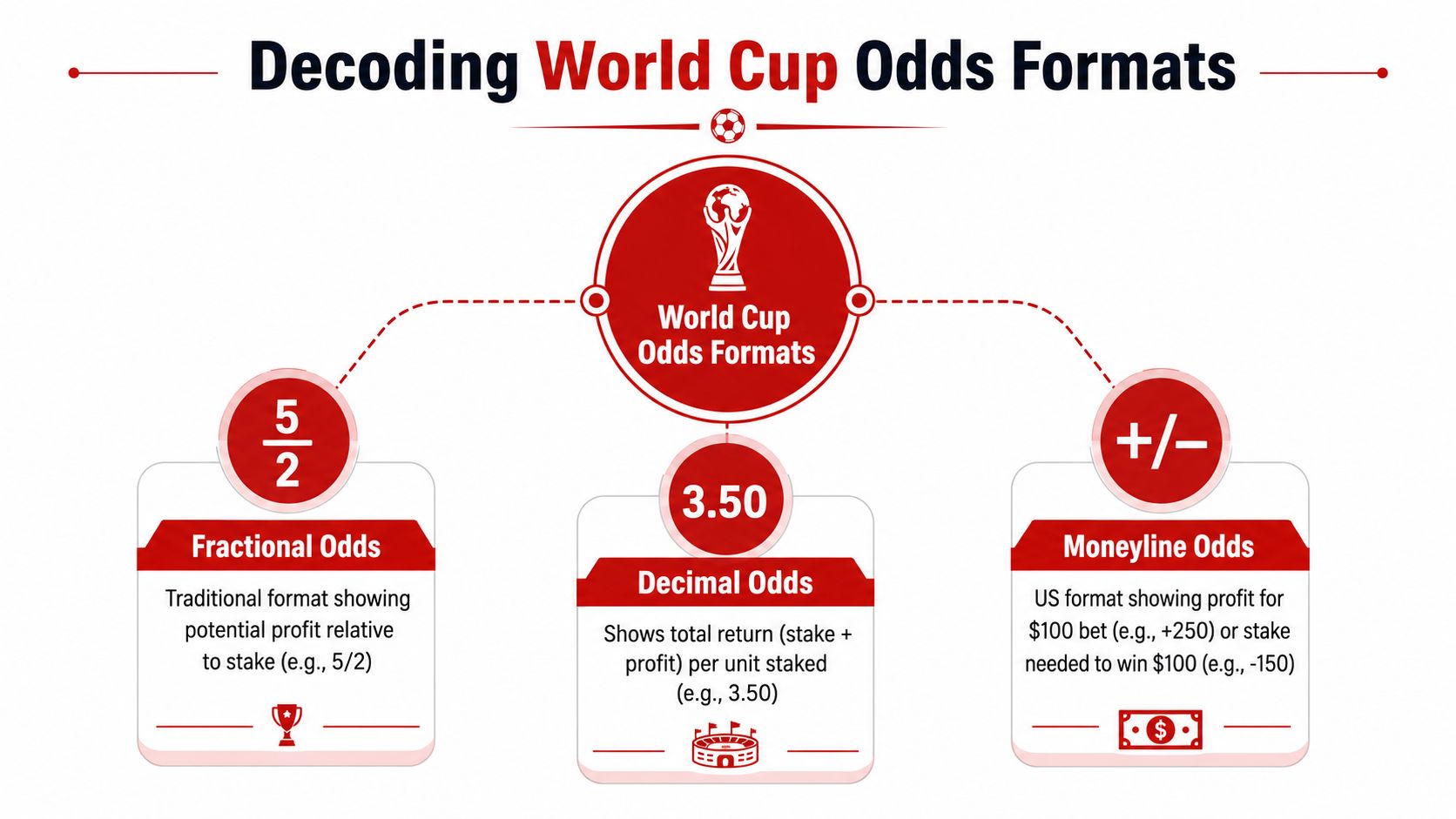
The three formats you'll see
Using one contender across all formats makes this easier.
Moneyline odds
If Spain is listed at +500, a winning $100 bet returns $500 in profit. You also get your original stake back.Decimal odds
The same price would appear as 6.00. That means every unit staked returns six units total, including stake.Fractional odds
That same team could be listed at 5/1. You win five units for every one unit staked.
On offshore sites like BetUS, MyBookie, Bookmaker.eu, and Heritage Sports, moneyline is usually the cleanest format for quick comparisons, especially if you're line shopping multiple books in one session.
Why implied probability matters
Odds are a price, but they also imply a chance of winning. That implied probability is what lets you compare the book's opinion with your own.
A useful benchmark comes from the top of the current-style futures market. Odds near +430 imply roughly 18.9%, +500 implies 16.7%, and +700 implies 12.5%, which shows why even a modest move matters in a futures market according to FanDuel's World Cup odds reference.
If you think a team's real title chance is stronger than the implied probability in the number you're being offered, you may have value. If the market price asks you to pay more than you think the team is worth, you pass.
A quick reference table
| American Odds | Implied Probability |
|---|---|
| +430 | 18.9% |
| +500 | 16.7% |
| +700 | 12.5% |
That small table is more useful than most futures writeups. It reminds you that the gap between contenders near the top of the board is often tighter than it looks.
If you want to get faster at these conversions, this guide on how to calculate betting odds is worth keeping open in another tab while comparing prices.
A futures ticket can be a good pick and still be a bad bet if the number is wrong.
That's the core lesson. Sharp bettors don't just read odds. They translate them.
How Futures Markets Move Before and During the Tournament
World Cup futures don't sit still. They trade more like a live market than most newcomers expect, and offshore books react quickly when public money and new information hit the board.
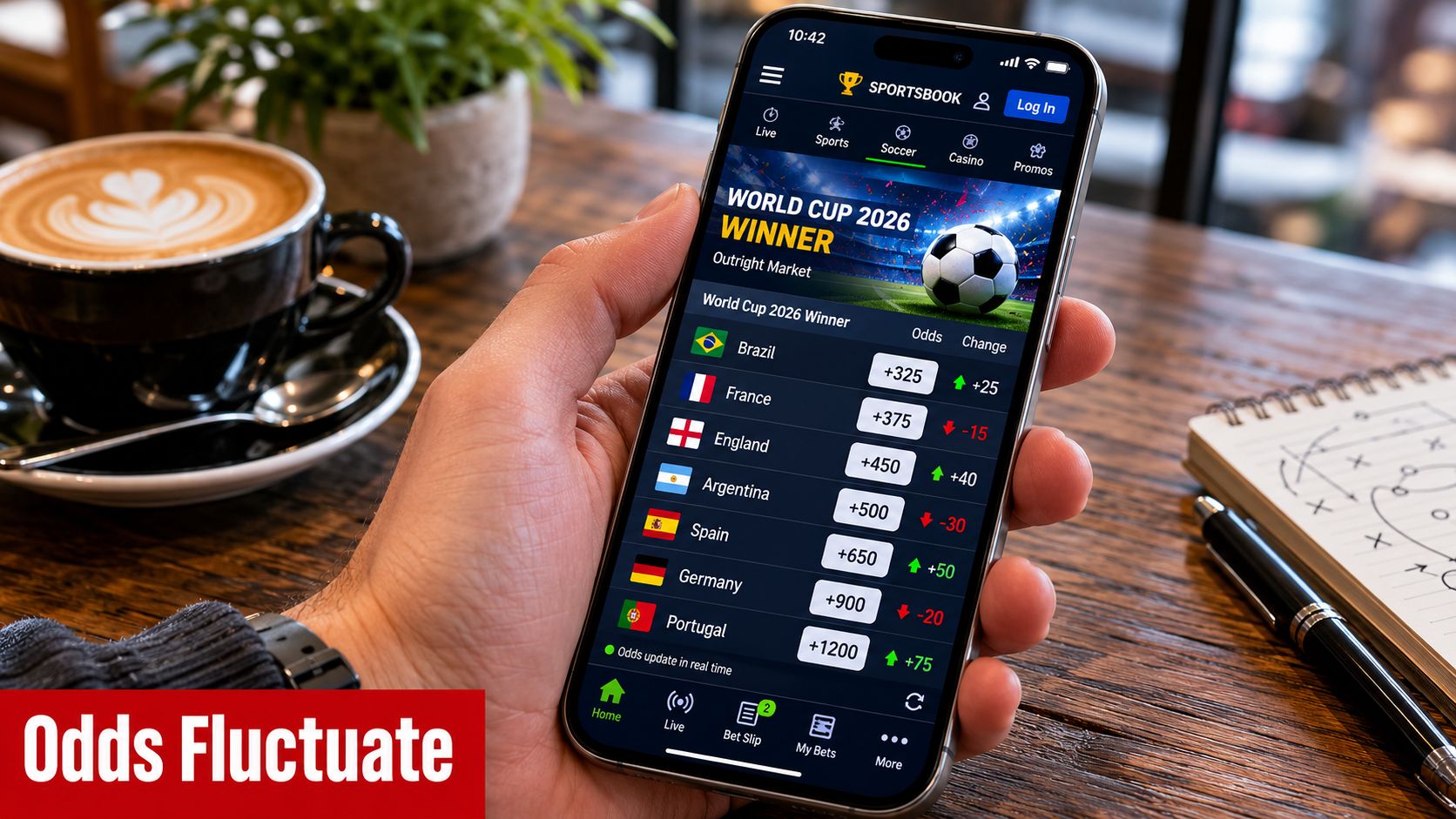
What moves the number before kickoff
Before the tournament starts, books adjust outright prices for reasons that have nothing to do with a completed World Cup match. Squad availability matters. So does the draw. A favorable path can support a shorter price. A brutal knockout route can keep a talented team from getting steamed too aggressively.
Offshore books also respond differently. Bookmaker.eu may move fast and force the market to catch up. MyBookie or BUSR may lag on a team for a little longer. That lag is where some of the best early futures entries come from.
How fast the board can reprice
Futures boards can move sharply on tiny samples. Vegas Insider noted that it's common to see a co-favorite move from +450 to +400 after one strong qualifying result, which shows how quickly the board can react even well before the tournament itself on the Vegas Insider World Cup odds board.
That should change how you think about timing. If you like a team because of underlying depth, structure, and path, waiting for a “better spot” can backfire if the market confirms your read early. But if you're chasing a public favorite after a flashy result, you're often paying peak tax.
Timing decisions that actually matter
A practical way to think about futures timing:
Bet early when your edge is path-based
If your read depends on the draw, squad balance, or a price that looks stale across one or two offshore books, early entry makes sense.Wait when the market is euphoric
Public teams often get overbet after strong early performances. If you missed the opener, don't force a worse number.Track price, not headlines
A team can play well and still become unbettable if the board overreacts.
The goal isn't to predict every move. It's to avoid buying inflated futures after the easiest narrative has already hit the market.
A clear distinction exists between experienced and casual bettors. Casual bettors watch the match and then check the odds. Sharp bettors watch the odds while the rest of the market is still reacting to the match.
Strategies for Finding Value in Outright Winner Bets
A lot of bettors make the same mistake with World Cup futures. They pick the team they expect to lift the trophy, then bet whatever number is sitting on the screen. In outrights, that habit gets expensive fast.
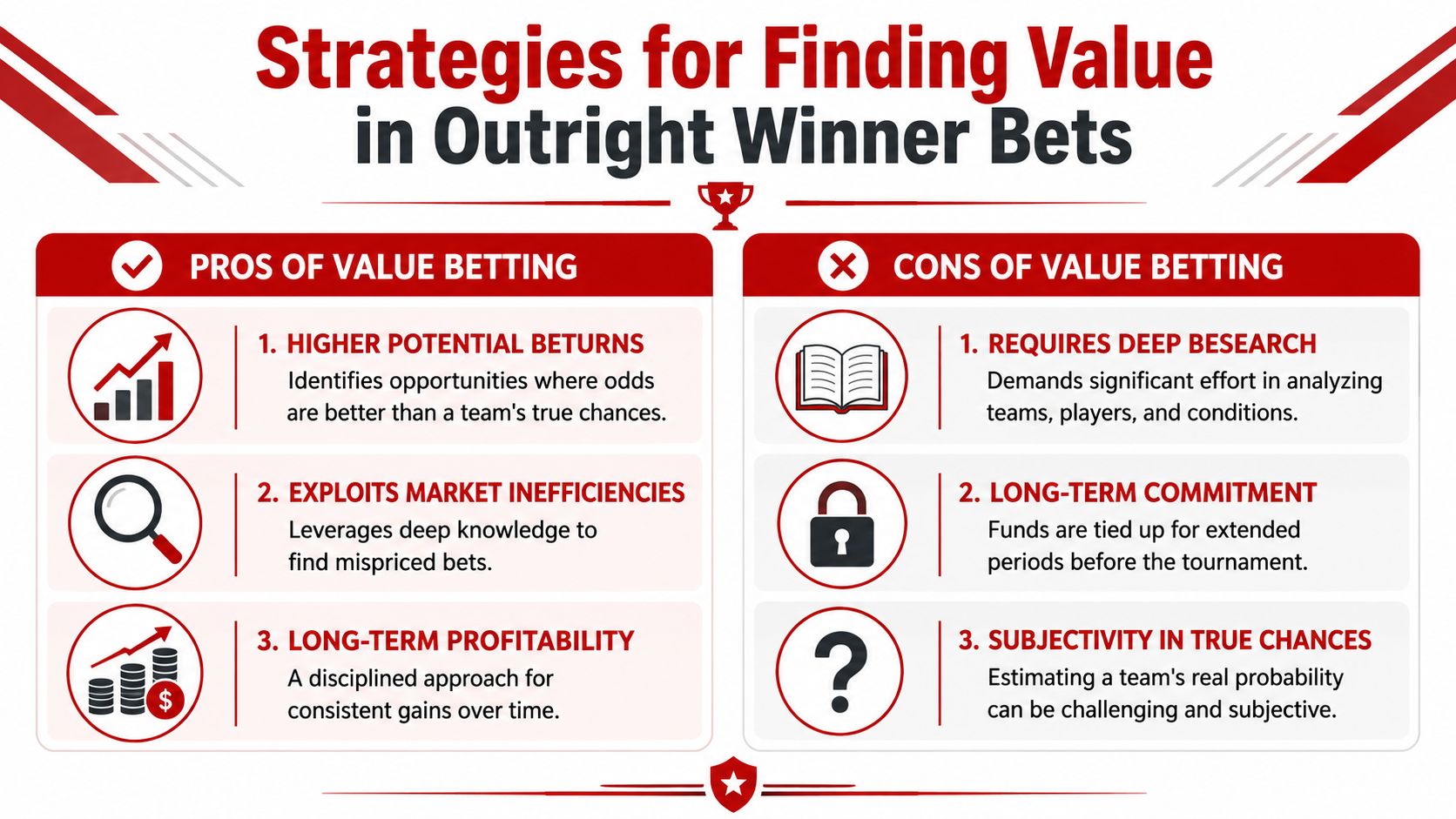
The right question is simpler. Is this price better than the team's true chance to win the tournament?
That matters even more at offshore books, where MyBookie, BetUS, Bookmaker.eu, Heritage Sports, Xbet, and BUSR do not always move together. One book may shade a public team down because it knows recreational money is coming. Another may leave a softer number up for an extra hour. In a futures market, that gap is the edge.
Start with the market shape, not your favorite team
World Cup winner boards are usually crowded at the top. Several legitimate contenders sit in a relatively tight band, and that changes how you should bet them. A small jump in price can turn a fair bet into a strong one, or a strong opinion into a pass.
Treat listed odds as examples, not fixed truths. The exact number on France, Spain, or England will vary by book and by week. What matters is the spread between books. If Spain is available at a meaningfully longer price offshore than at the sharper global number, that is worth attention. If England is short everywhere, calling them a contender does not make the ticket good.
What creates value in an outright market
The best futures bets usually come from a few specific edges:
Path quality
A team can be the fourth-best side in the field and still be a better outright bet than the second-best side if its likely route is cleaner.Depth across seven matches
Futures are unforgiving to thin squads. One suspension, one muscle issue, or one bad rotation spot can wreck a good number.Defensive reliability
Knockout matches often turn into one-goal games. Teams that avoid chaos stay alive long enough to beat their pre-tournament price.Public bias
Brands get taxed. Popular national teams often draw money at numbers that leave little margin for the bettor.
Here is the trade-off sharp bettors accept. The best team is not always the best bet, and the best bet is not always the team you want to hold for a month.
Use the outright market like a price-hunting exercise
When I bet World Cup futures through offshore books, I build the opinion first, then I shop for the weakest number in the market from the bookmaker's side. That usually means keeping multiple outs funded, including at least one crypto-friendly option, so I can strike when a stale price appears.
Crypto helps here because funding speed matters. If BetUS is hanging a number that is clearly better than the rest of the board, waiting on a slow deposit method can cost the bet. If you want the funding side laid out in more detail, this guide to World Cup 2026 Bitcoin betting covers the practical side of using Bitcoin for this market.
A simple filter before you place the bet
Run the ticket through three checks:
Would I still like this team at a slightly worse number?
If the answer is no, your edge may be too thin.Am I betting the team, or am I betting the price?
Those are different decisions.Can I explain why this book is longer than the rest?
Sometimes you found value. Sometimes the market has information you missed.
That last point matters. Offshore books can be slow. They can also be right for reasons the public has not priced in yet. Always check squad news, qualifying form, and likely tournament path before assuming the longest number is automatically the best one.
Price discipline wins in this market. If you already like Spain, get the best Spain number available. If every offshore book is short on England, let it go. A futures card gets stronger when each ticket beats the market you could have taken elsewhere.
Comparing Odds Across Offshore and Crypto Sportsbooks
A World Cup futures number can be gone in minutes. One book hangs Brazil at a playable price, another trims it fast, and the bettor with only one funded account is left taking the worse end of the market.
That is why I split this market into two groups. Offshore books like MyBookie, BetUS, Bookmaker.eu, and Heritage are where I expect a fuller futures board and stronger coverage across tournament markets. Crypto-friendly shops matter for a different reason. They let you get money in quickly, react to stale numbers, and avoid missing a price while a deposit crawls through.
Traditional offshore books versus crypto-focused books
| Sportsbook type | What it does well | Where to be careful |
|---|---|---|
| Traditional offshore books like MyBookie, BetUS, Bookmaker.eu, Heritage Sports, and BUSR | Broad futures menus, more related markets, familiar interfaces | A few books shade public teams aggressively, so the headline number can look worse than the rest of the board |
| Crypto-friendly books like Cosmobet, BetAnything, Xbet, and sometimes Bet105 | Fast funding, easy transfers between books, occasional crypto-specific promos | Limits, menu depth, and pricing consistency can vary a lot from book to book |
The trade-off is simple. Traditional offshore books usually give you more ways to build and manage a World Cup position. Crypto books give you speed.
If you want the funding side explained in more detail, this guide to World Cup 2026 Bitcoin betting covers the practical side of using Bitcoin for this market.
What to compare besides the headline odds
The best outright price is the first check, not the only one. A book can offer the top number on Argentina and still be the wrong place to hold that ticket if the rest of the setup is weak.
Focus on four things:
Related markets
Check whether the book also posts group winners, to qualify, and knockout-round lines. Those markets matter later if you want to reduce exposure without waiting for the final.Limits and acceptance
Some books advertise a strong futures price, then cut the stake down to a number that barely matters. Price only helps if you can get enough down.Deposit and withdrawal speed
This matters more with offshore books than many new bettors expect. Slow funding turns a good number into a missed bet.Hedging options
Look ahead. If your team reaches a semifinal or final, you want a book that offers enough match markets to hedge efficiently, not just a basic moneyline.
I also keep an eye on bankroll friction. If a book is useful for grabbing an early number but awkward for later hedging, I size that bet with that limitation in mind. This is the same discipline behind good sports betting bankroll management principles. Your edge is not just the price. It is also your ability to hold the position, add to it, or hedge it without tying up too much of your roll.
A mixed setup usually works best for U.S. bettors using offshore sportsbooks. Keep core futures positions at books with stronger menus and steadier limits. Keep at least one crypto-friendly out ready for fast deposits and opportunistic entries when the board is slow to adjust.
Bankroll Management and Hedging Your Futures Bet
A futures ticket feels cheap when you place it. It feels expensive when you realize your bankroll is tied up for weeks and you've got no room to react elsewhere. That's why bankroll discipline matters as much as your team selection.
Set a futures budget first
Don't build your World Cup card backward. Start with a dedicated betting bankroll, then decide what portion you're comfortable tying up in outrights. Some bettors keep futures exposure small and save more flexibility for match betting, live markets, and knockout hedges.
The exact split depends on how aggressive you are, but the principle doesn't change. A winner bet is a long-hold position. If you overcommit to it, you lose optionality later.
For a solid primer on structuring your betting funds, this resource on sports betting bankroll management is worth reviewing before the tournament starts.
How hedging works in practice
Hedging is simple in theory. If your futures team reaches the final, you can bet the other side and reduce risk or lock in profit. The key is to think about hedging before you need it.
A practical hedging routine looks like this:
Know your total return
Before the final, calculate exactly what your futures ticket pays if it wins.Check multiple books
Bet105, Bookmaker.eu, and Heritage Sports may not price the final the same way. Your hedge number matters too.Choose your goal
You can hedge to guarantee profit, to reduce downside, or to keep a bigger payout if your original side wins.Avoid emotional over-hedging
Don't erase all the value from a great futures ticket just because the final feels stressful.
When not to hedge
Not every futures position should be hedged. If the final line is poor, if your original team still has value, or if your bankroll can handle the variance, letting the ticket ride can be reasonable.
Some bettors hedge to feel safe. Better bettors hedge because the price justifies it.
That distinction matters. Hedging is a tool, not a ritual. Use it when it improves your position, not just because your team made the last match.
Final Thoughts on US Betting and Sportsbook Selection
For US bettors, offshore books remain one of the most practical ways to attack the World Cup futures market. The advantage isn't just access. It's flexibility. MyBookie, BetUS, Bookmaker.eu, Heritage Sports, BUSR, BetAnything, Xbet, Bet105, and Cosmobet give you multiple ways to compare prices, manage deposits, and react when the market shifts.
The biggest lesson in world cup winner betting odds is that the board is reactive. In a typical futures market, a favorite like France can shorten from +425 to +380, while a contender like Argentina can move from +1000 to +850 after strong early results, which illustrates how quickly in-tournament performance changes the market on Fox Sports' World Cup champion odds page.
That's why sportsbook selection isn't separate from betting strategy. It is betting strategy. If you have only one account, you're taking one opinion and one price. If you have several funded offshore options, you can choose the best number, the cleanest hedge spot, and the easiest funding method for the bet you want to make.
The edge usually isn't hidden in a miracle long shot. It's in disciplined price shopping, patient timing, and avoiding bad entries on popular teams.
If you want a better starting point for comparing offshore books before the World Cup market heats up, USASportsbookList makes it easier to sort through sportsbook features, bonuses, and betting options for US players without wasting time jumping between dozens of sites.