

Most advice on ai nfl predictions gets the main thing wrong. It treats AI like a pick machine. That's why so many bettors end up tailing outputs they don't understand, then blaming the tool when the market snaps back.
The better use is narrower and more profitable in practice. AI helps you sort information faster, compare matchup signals more consistently, and spot disagreement between your model output and the number posted at offshore books like MyBookie, BetUS, BetAnything, Xbet, Bet105, Cosmobet, BUSR, Bookmaker.eu, and Heritage Sports. It doesn't replace judgment. It sharpens it.
Top Offshore Sportsbook Bonuses for September 2026


$1000 + $10 Casino Chip
New customer offer. First Deposit Bonus Up To $1,000 + $10 Casino Chip.


$750
Get a 150% Sport Free Play bonus up to $750 on your first Deposit up to $500. The minimum deposit is $50.
That difference matters. A prediction can sound smart and still be useless for betting. If you're using AI to make smarter decisions on offshore sportsbooks, the fundamental question isn't “Who will win?” It's “Is this line priced wrong enough to bet?”
The Truth About AI in Sports Betting
Most bettors hear “AI” and assume edge. That assumption is expensive.
AI doesn't turn NFL betting into a cheat code. Sportsbooks move fast, injury news hits late, and public markets absorb obvious information quickly. If you use ai nfl predictions as a crystal ball, you'll bet too often, trust weak outputs, and ignore price.
The useful version of AI is much less glamorous. It's a way to process game context faster than a manual handicapper can. It can help organize injuries, weather, team efficiency signals, and market movement into something you can compare against live numbers at MyBookie or BetUS. That's the angle that matters when money is on the line.
A lot of bettors already understand this instinctively. They don't need more hype. They need a workflow. The same way marketers use actionable digital marketing tactics to turn raw data into better execution, bettors need a system for turning AI output into a better betting decision instead of a blind click.
Practical rule: If the AI gives you a pick but can't tell you why the number is off, treat it as entertainment, not analysis.
Another problem is that many AI betting tools are built to look impressive rather than to help you beat a sportsbook. Clean dashboards, confidence meters, auto-generated writeups. None of that matters if the closing number agrees with the book and you never get value.
That's why I judge ai nfl predictions by one standard first. Do they help you compare prices better across offshore shops. If they do, they're useful. If they just repeat consensus, they're noise.
For newer bettors, that mindset shift is more important than any model discussion. Betting has never been just about picking the right team, and this explainer on why sports betting involves more than luck makes the same point from a practical betting angle.
What works and what doesn't
- What works: using AI to flag games worth a second look.
- What doesn't: betting every model output as if all edges are equal.
- What works: comparing AI projections to multiple offshore prices.
- What doesn't: accepting one number from one book and calling it value.
- What works: letting AI narrow the card.
- What doesn't: letting AI override every football-specific judgment you have.
What AI NFL Predictions Really Are
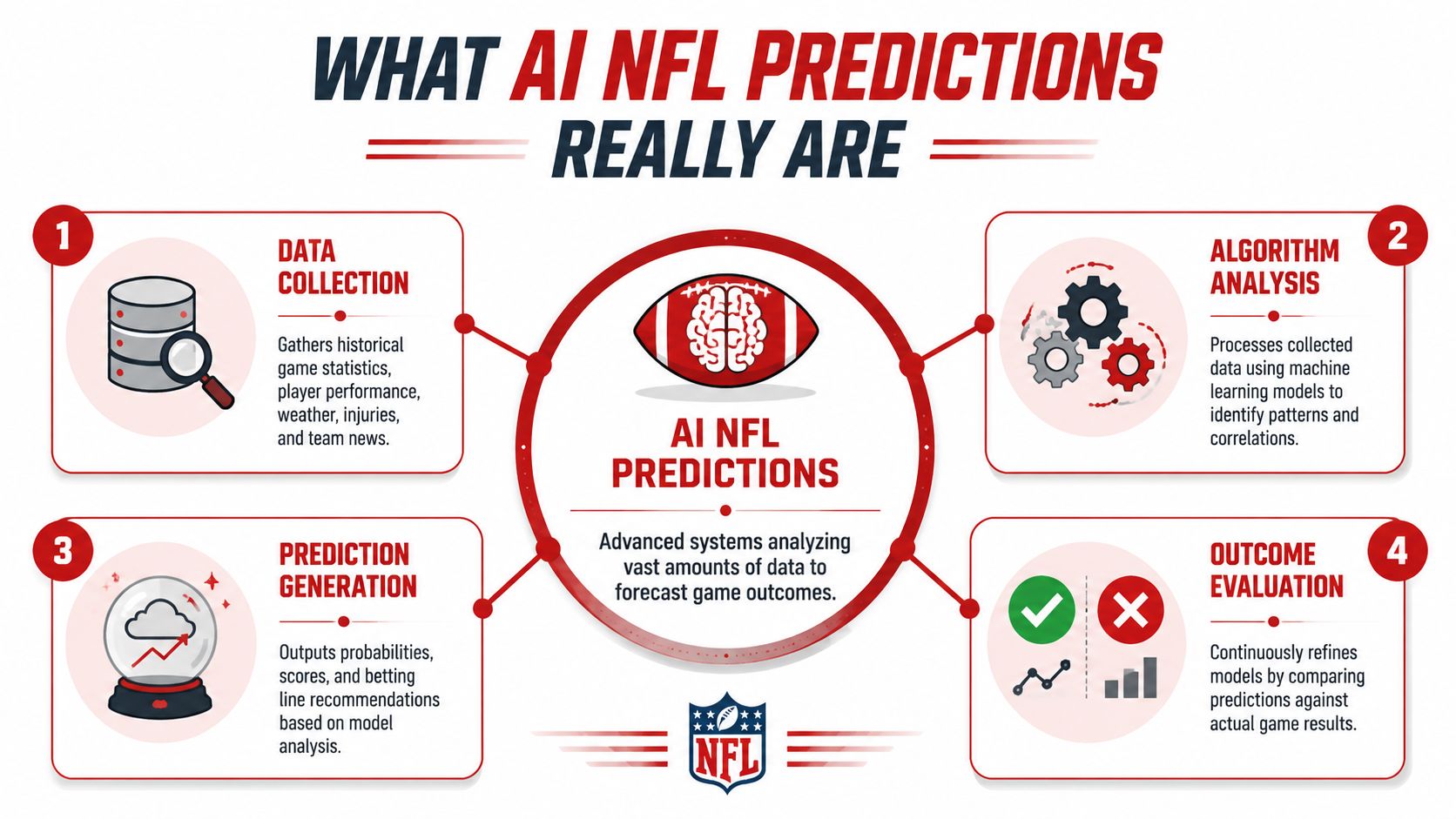
At their core, ai nfl predictions are data models. They pull in football information, organize it, and estimate outcomes. Some estimate who wins outright. Some estimate margin. Others estimate scoring range or season-long performance.
That distinction matters because bettors often lump everything into one bucket. They shouldn't. A model built to project win probability isn't automatically built to beat a spread. A model that handles totals well may be mediocre on sides.
The raw ingredients
Most serious models use some version of the same core inputs:
- Team performance data such as efficiency, red-zone output, turnovers, and down-to-down quality
- Player availability including injuries, quarterback uncertainty, and offensive line status
- Game environment like weather and matchup context
- Market data such as current lines and total movement
- Historical results to calibrate whether a pattern is stable or just a one-week blip
Building a power rating with more moving parts is an accurate comparison. The model isn't “watching football” the way a bettor does. It's assigning weight to inputs and producing a probability or projection.
Not all outputs are equally useful
For betting, there are usually three practical model outputs:
| Output type | What it tries to answer | Betting use |
|---|---|---|
| Moneyline projection | Who is more likely to win | Useful for favorites, underdogs, and parlay filtering |
| ATS projection | By how much a team should win or lose | Useful for spreads, but harder to sustain |
| Totals projection | How many points the game should produce | Useful when pace, weather, and matchup style matter |
One of the clearest real-world patterns is that AI often does better at identifying overall team strength than beating the spread consistently. A SportBot AI review of modern nfl prediction approaches says a RotoWire AI analysis projecting the 2025 season had team-record predictions within half a win for 25 of 32 teams versus Vegas over/unders, while SportBot AI claims 66% to 66.5% outright winner accuracy but only around 49% ATS accuracy. That's a practical distinction bettors should care about.
When a model keeps nailing “good team versus bad team” but struggles against the spread, it's telling you the market already priced in most of the obvious edge.
What that means on betting sites
If you're looking at MyBookie, BetUS, BUSR, or Bookmaker.eu, don't treat every AI output the same way. A season-win projection can help frame how the market views a team. A moneyline projection can help with underdog prices. A totals projection may matter more when weather, pace, and quarterback health are driving the game.
The point isn't to admire the forecast. The point is to know what kind of forecast you're holding before you risk money on it.
How AI Prediction Models Work
Simple betting models act like one coordinator calling every play. More advanced ones work like a staff. One part handles team strength. Another handles momentum and recent form. Another handles context, such as injuries or weather. Then something on top combines those signals into a final betting opinion.
That specialist approach makes a lot more sense for NFL betting because spreads and totals don't move for the same reasons. A side can hinge on turnovers or red-zone execution. A total can swing on pace, pass protection, quarterback mobility, and weather.
Why submodels matter
A deep betting breakdown of nfl model architecture describes advanced systems using parallel models for team efficiency, momentum, and contextual factors like injuries, with a separate model for totals. A weighted voting layer then produces the final pick. That's the kind of structure I trust more than a generic “AI says Team A” dashboard.
Here's why that matters in practice:
- Sides need one set of signals. Turnovers, short fields, and red-zone variance can decide whether a favorite covers.
- Totals need another. Pace, weather, offensive line quality, and quarterback health often matter more there.
- Live betting needs speed. A useful model has to absorb changing conditions quickly enough to matter before a book updates.
If one model claims to dominate every market with one universal process, I get skeptical fast.
Simulation beats one-shot prediction
Another method I like is simulation. Instead of forcing one exact score, the system runs the game many times on a computer and looks at the range of outcomes. That gives a bettor something more actionable than a hot take. You get estimated distributions, not just a single winner.
That's especially useful when you're comparing multiple offshore books. If your model output says the game lands in a tighter band than the market implies, you may find a better number at Heritage Sports, Xbet, or Bet105 before the line settles.
I think of it this way. The best ai nfl predictions aren't trying to sound smart. They're trying to separate tasks cleanly, then translate those tasks into bettable probabilities.
Good models don't just answer “who wins.” They answer “how does this game usually unfold, and which market is pricing that badly?”
There's a similar lesson in other sports model discussions too. This page on college basketball computer predictions is useful because it shows how bettors should think about model-driven edges as probability tools, not certainty machines.
And outside betting, the same principle shows up in search strategy. Teams using SEOBRO® AI search optimization don't rely on one broad signal either. They break the problem into components, then optimize for the result that matters.
Evaluating AI Accuracy and Finding an Edge
Most AI betting content stops at “the model likes this side.” That's where serious bettors should start asking harder questions.
A useful model needs a record that means something in betting terms. Picking outright winners is fine for discussion, but against the spread is the sharper test because the sportsbook has already adjusted for team strength. If a model can't separate itself there, it may just be echoing what everyone already knows.
One benchmark that actually matters
One of the strongest historical benchmarks in this space comes from UNANIMOUS AI's NFL track record. The company reports a 62.5% ATS win-loss record over a four-year study of NFL games against the spread. The same page also reports 65-43-4, 60.2% accuracy, and +102.54 units in winnings, and says that result was 7.5 percentage points better than the 55% benchmark commonly associated with professional handicappers.
That doesn't prove every AI model has an edge. It proves something narrower and more important. Under the right conditions, with disciplined selection and a meaningful sample, AI-driven decision systems can outperform traditional expert picks.
How I judge an AI betting tool
I don't care how polished the interface is. I care whether the tool helps answer these questions:
- Is the record against the spread or just on winners
- Is the sample meaningful or tiny
- Does the model explain where its strength is
- Does the line I can bet still offer value
- Would I still make this bet if the AI label were removed
That last question saves a lot of bankroll. Many bettors get seduced by presentation. If you strip away the confidence meter and generated writeup, the edge often disappears.
Use the sportsbook as a truth test
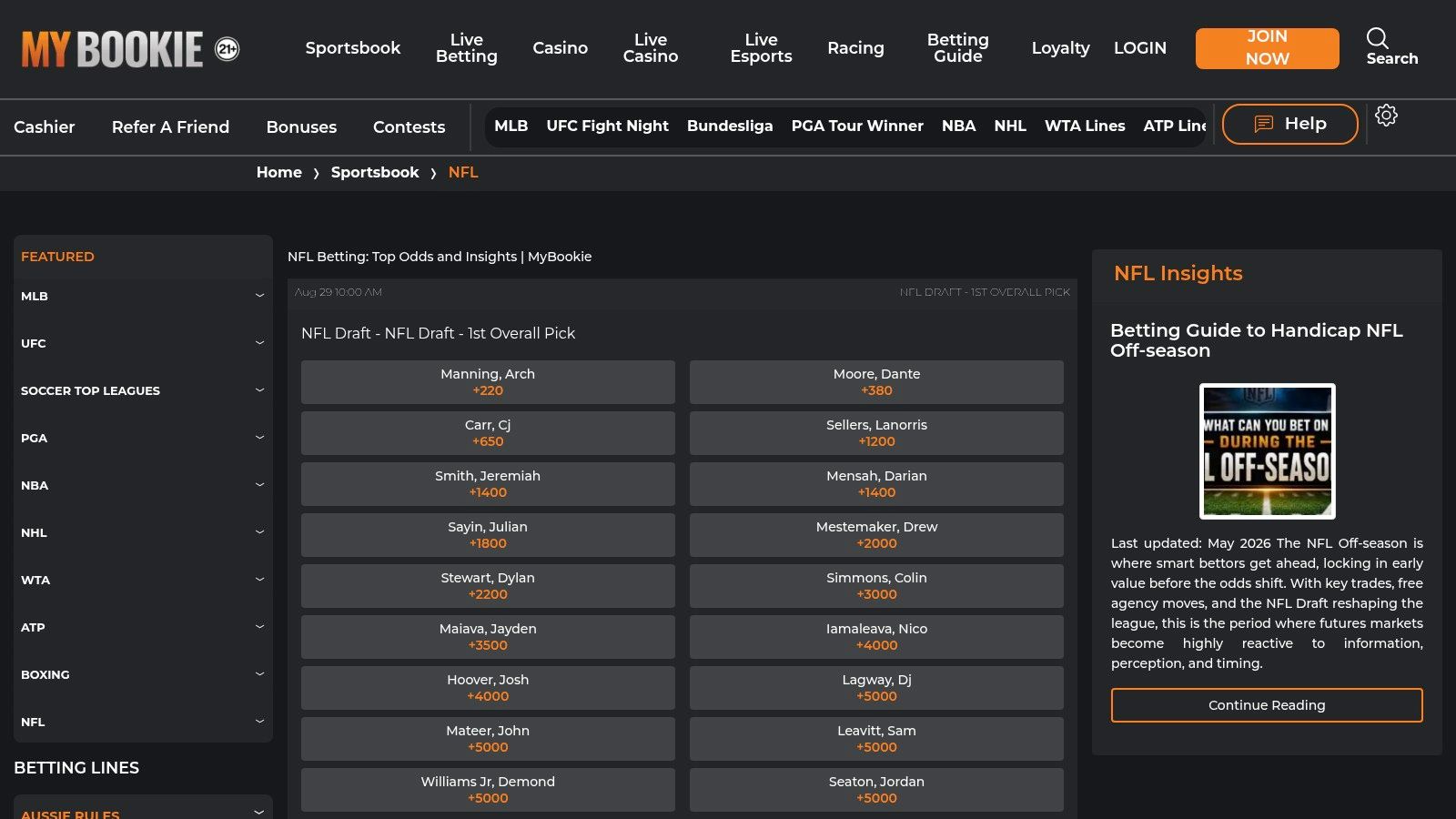
MyBookie is useful here because the board gives you a clean baseline. Pull the AI projection, then compare it to the posted spread, moneyline, and total. You're not asking whether the AI found a winner. You're asking whether it found a number that still looks off at the current price.
A quick screen helps:
| Check | What to look for | Why it matters |
|---|---|---|
| Current spread | Has the line moved toward the AI side | You may have missed the value |
| Moneyline price | Is the implied price still playable | A good pick can still be a bad bet |
| Total movement | Did weather or injury news change the market | Context may have invalidated the model |
| Book-to-book differences | Does another offshore shop hang a better number | Price shopping creates edge |
What I trust most: a model that shows restraint. Fewer bets, cleaner disagreement with the market, and a reason the number is wrong.
If you can't verify any of that, don't pay for the pick. And definitely don't scale it up just because the output sounds technical.
Putting AI Predictions to Work on Offshore Sportsbooks
The best use of ai nfl predictions is operational. Get the projection, compare it across books, and decide whether the price is still worth betting.
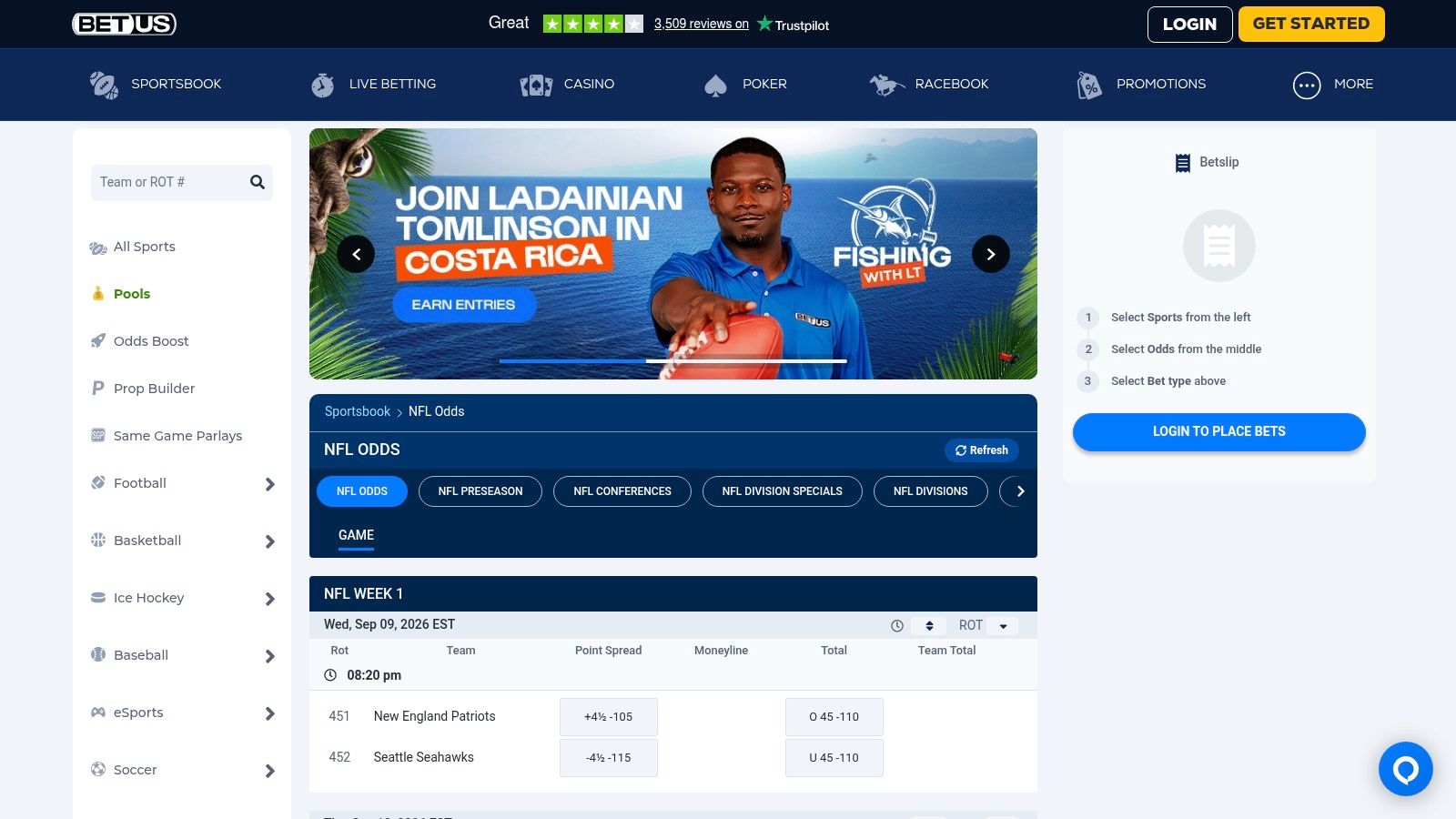
That means you're not betting the AI. You're betting a number. Offshore sportsbooks make that process more interesting because prices can differ enough to matter across BetUS, MyBookie, Xbet, Heritage Sports, Bookmaker.eu, BUSR, BetAnything, Bet105, and Cosmobet.
The workflow I recommend
Start with a short candidate list, not the full slate. If your AI tool throws out picks for every game, that's a warning sign. Strong betting process usually narrows the menu.
Then work through this sequence:
- Pull the model output first. Get the projected side, total, or win probability before you look at too many market opinions.
- Compare at multiple offshore books. Check MyBookie, BetUS, Heritage Sports, BUSR, and Bookmaker.eu. Then see whether Xbet, BetAnything, Bet105, or Cosmobet hangs a better number.
- Note where the disagreement is. The useful spot is where the AI differs from the book enough to justify action.
- Recheck game context. Late quarterback news, weather shifts, and offensive line absences can kill a stale projection.
- Choose the best market, not the most exciting one. Sometimes the side is gone but the total still has value.
Pick the right market for the model
A practical mistake I see all the time is bettors forcing a spread bet because that's the default NFL conversation. That isn't always where the model has the best chance.
A SportBot AI strategy guide on nfl betting with AI makes an important point. While many models focus on spreads, their edge may be better in totals or player props, where weather, pace, and matchup specifics can be quantified more cleanly than the chaos of a bouncing football. Bettors should look for AI systems that identify strengths and weaknesses across spreads, moneylines, totals, and live bets.
That lines up with real betting experience. If your tool handles offensive pace and weather well, totals may be the cleaner path. If it captures team strength but not market nuance, season-long or moneyline opinions may be more reliable than ATS plays.
A lot of bettors also need the legal and practical side clarified before they shop widely, and this guide on how to bet on NFL offshore legally is a solid reference for that.
Bankroll discipline matters more with AI, not less
AI can create false confidence. The output looks polished, so bettors size up too fast. That's backwards.
Use a simple approach:
- Flat bet your standard opinions. Keep routine plays at the same stake.
- Scale only when price and timing line up. Not because the model sounds extra certain.
- Pass more often than you bet. The easiest way to improve an AI-assisted card is to remove marginal bets.
- Track by market type. Separate spreads, totals, props, and live wagers so you know where the tool is helping.
Here's a useful visual if you're thinking through market behavior and line movement in NFL betting:
Where bettors go wrong
The biggest mistakes are repetitive and avoidable.
- Blind tailing: You see “AI pick” and skip the price check.
- Confirmation bias: The model likes the team you already wanted, so you stop analyzing.
- Late chasing: The value is gone, but you bet anyway because the projection still says the same side.
- Market mismatch: The tool is strongest on totals, but you keep forcing spreads.
If you avoid those traps, ai nfl predictions become useful. Not magical, just useful. And in betting, useful beats flashy every time.
Your AI Betting Questions Answered
Are free AI NFL picks good enough
Sometimes, but only for idea generation. Free tools can help you scan the board, catch matchup angles, or build a watchlist for MyBookie, BetUS, or BUSR. The problem is that many free outputs stop at the headline pick and never show whether the number is still worth betting.
Paid tools aren't automatically better. The good ones are transparent about what they do well, update quickly, and make it easier to compare projections with live offshore prices. The bad ones just charge for prettier certainty.
Free can be useful for filtering. Paid becomes worthwhile only when it improves decision quality, not when it simply increases volume.
Can AI help with player props and live betting
Yes, but only if the tool is built for those markets. Props and live betting change too quickly for generic models. If a system doesn't update for role changes, injury news, pace shifts, or game script, the output gets stale fast.
That offshore variety helps. Bookmaker.eu, Cosmobet, Heritage Sports, and Xbet may differ on props and live numbers enough to make shopping worthwhile. But speed matters. If your model reacts slower than the market, it isn't giving you edge. It's giving you an explanation after the move.
Should I trust AI more than the market
No. Trust disagreement, then verify it.
The market is still the strongest summary of public and professional information. AI becomes useful when it spots a reason that summary may be off. If the model and the market agree, there may be no bet. A lot of losing NFL bettors would improve quickly if they got comfortable passing.
What's the biggest mistake bettors make with ai nfl predictions
They confuse prediction quality with betting value. A model can correctly identify the better team and still offer no edge at the current line.
That's why timing, price, and market selection matter more than how impressive the writeup looks. If BetAnything has a weaker number than Heritage Sports, or if Bet105 lags a weather-driven total move, the edge comes from execution. Not from the AI label itself.
How do I know if the AI is actually helping me
Track your decisions, not just your wins and losses. Separate bets by market type and note whether the number moved in your favor after you placed it. Over time, you'll see whether the model is helping you get better prices or just giving you more reasons to bet.
A simple review process works:
- Log the opening opinion. Side, total, prop, or live.
- Record the book and number. MyBookie, BetUS, BUSR, Bookmaker.eu, or another offshore shop.
- Note why you bet it. Model edge, injury adjustment, weather angle, or line-shopping opportunity.
- Review after the market closes. Did your number still look strong compared with the close.
What's the smartest way to start
Start small and narrow. Use one AI tool, one market type, and a short list of offshore books. Totals are often easier to evaluate than forcing a full-card ATS strategy. Once your process is stable, add more books and more market types.
Don't try to automate your entire NFL betting life on day one. The sharpest bettors I know use AI like a research assistant. They don't hand it the bankroll.
If you want a practical place to compare offshore books, bonuses, and betting features before putting ai nfl predictions to work, USASportsbookList is a useful starting point for sorting through options like MyBookie, BetUS, Bookmaker.eu, Heritage Sports, and more.


















I completely agree with the article’s emphasis on simulation over one-shot predictions—especially how submodels matter. I’ve tried a few AI tools that just spit out a single win probability without showing the underlying scenarios, and they consistently failed me when the line moved or injuries hit. The real value comes from seeing how different factors (like weather, late-week injuries, or offensive efficiency trends) shift the outcome across hundreds of simulated games. Last season, I used a model that ran 10,000 simulations for a Week 8 Ravens game and noticed the odds were mispriced by nearly 12% on a sudden-weather line. By betting against the public’s overreaction, I hit four straight +100 spreads. The key, as the article says, is treating AI as a decision-making partner, not a crystal ball.