A lot of bettors start the same way with the World Cup. They pick a team they like, throw a futures bet on it, and hope the month breaks their way. That's fine for casual action, but it's not how sharp World Cup winners betting works.
A better approach is to treat the tournament like a series of connected markets. You can hold an outright winner ticket, pair it with stage-based positions, and stay flexible as prices move. That matters even more in a tournament where one result can change the board fast and where public money tends to pile onto the same handful of teams.
Top Offshore Sportsbook Bonuses for September 2026

$2,500 Use code - PROMOBUCK2 to get a 125% First Deposit Bonus at the BetNow sportsbook when you deposit with Crypto.


$2,750
200% Crypto Bonus PLUS 10% Gamblers Insurance with a minimum $100 deposit and a maximum of $1,500. Use Code: JOIN200 in the Cashier.

If you're already planning your viewing schedule, it's worth checking match access early. For example, if you're looking to watch Ir Iran vs New Zealand, locking in where you'll watch helps because live information and timing often matter as much as the pre-tournament handicap.
Betting Beyond the Bracket
Most bettors don't lose on the World Cup because they know nothing about soccer. They lose because they reduce the whole event to one prediction. Pick the champion. Wait a month. Either cash or tear up the ticket.
That sounds simple, but it usually leaves you with a weak position. You're tying up bankroll in one market, often at one number, with no plan for what happens if your team shortens, drifts, or lands on the wrong side of the draw.
The difference between a pick and a plan
A pick is emotional. A plan is structural.
When I look at World Cup winners betting, I'm not asking only, “Who lifts the trophy?” I'm asking a few more useful questions:
- Which team is priced fairly
- Which team is strong enough to create hedge opportunities later
- Which book is likely to post the best related markets
- How much bankroll should stay free for live and knockout-stage positions
That's how you stop treating the World Cup like a lottery ticket.
Practical rule: If your only World Cup bet is one outright winner ticket, you probably haven't built enough flexibility into your card.
Why offshore books matter for this market
Offshore sportsbooks such as MyBookie, BetUS, BetAnything, Xbet, Bet105, Cosmobet, BUSR, Bookmaker.eu, and Heritage Sports are useful here because futures bettors need more than a homepage winner board. You want broad soccer menus, decent market depth, and the ability to compare numbers across books instead of accepting the first line you see.
Some bettors care most about crypto funding. Others care more about fast updates or niche props. Both are valid. What matters is matching the sportsbook to the way you bet.
For World Cup winners betting, the edge usually comes from process. You want better numbers, better timing, and a betting card that gives you options after the tournament starts. That's a lot stronger than riding one flag for four weeks and hoping everything falls into place.
Understanding World Cup Winner Odds and Markets
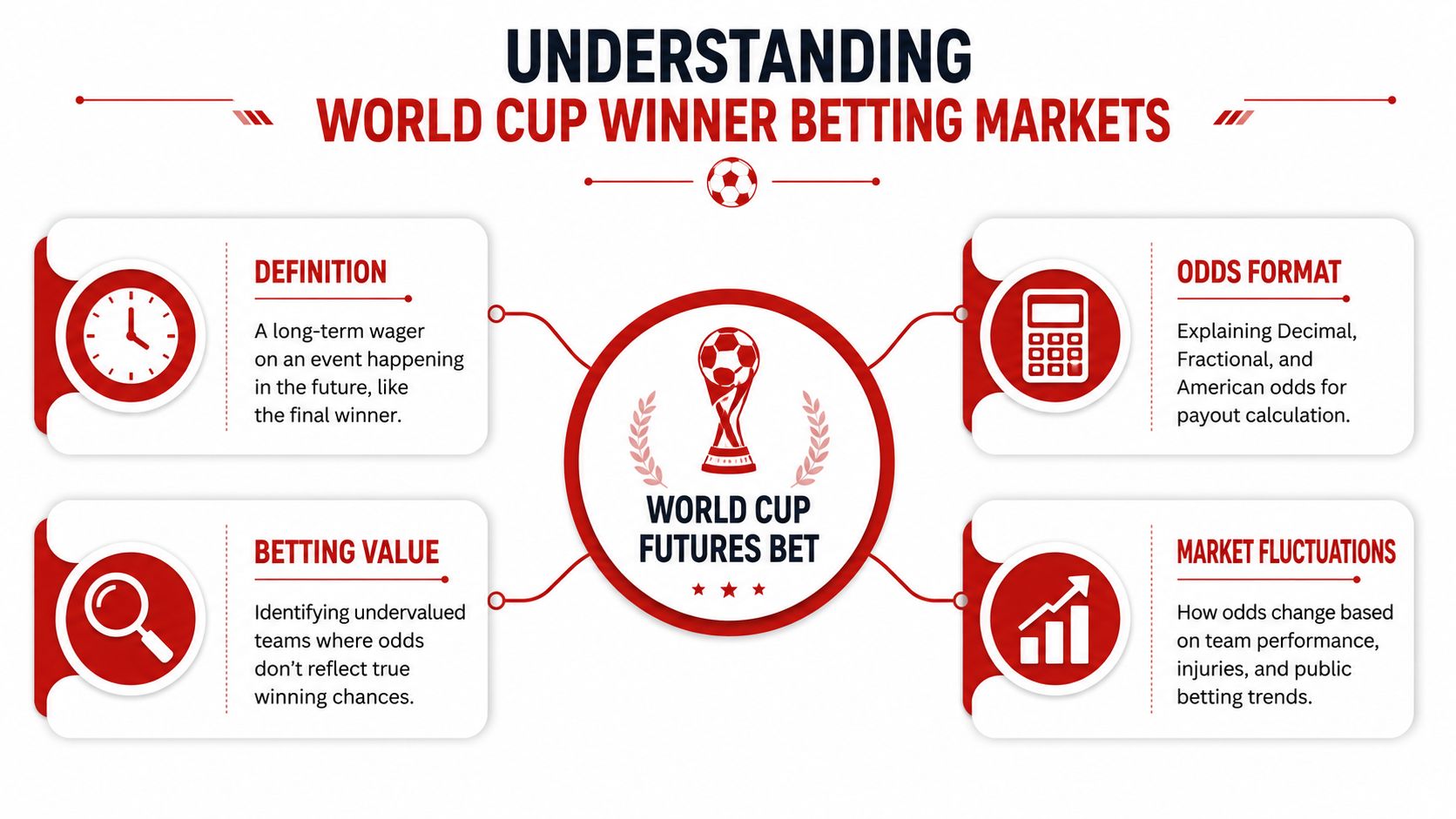
A World Cup winner bet is usually a futures market. You're betting on the team that will win the tournament before the final result is known, often well before kickoff of the opening match. The market is concentrated near the top. In the 2026 board, France was listed at +410, Spain at +500, and England at +700, with public betting interest heavily focused on that small top group according to DraftKings World Cup 2026 odds.
Reading American odds without overthinking it
Most offshore books show soccer futures in American odds. For outright markets, the format is easy once you use it a few times.
- Positive odds tell you how much profit you'd make on a 100-unit stake.
- Negative odds tell you how much you need to risk to make 100 units of profit.
So if Bookmaker.eu or Heritage Sports posts England at +700, a 100-unit bet returns 700 units in profit if England wins, plus your original stake back.
If you need a refresher on the math behind different odds formats, this guide on how to calculate betting odds is useful.
Favorite doesn't always mean best bet
Newer bettors often get stuck. They see the shortest price and assume that's the right side. Sometimes it is. Often it isn't.
A favorite is the team the market thinks is most likely to win. That's not the same as saying the price is attractive. In futures betting, a team can be excellent and still be too expensive.
Here's the better question: if the true path to the title looks harder than the price suggests, are you paying too much for name value?
The best futures bet isn't always the most likely winner. It's the team whose price gives you room to be right.
Why futures prices move so aggressively
World Cup odds don't sit still. They react to injuries, qualification form, bracket expectations, and public sentiment. In a major tournament cycle, even one result can move prices sharply.
That's why a stale board is a problem. If one offshore book reacts slowly while another updates fast, line shopping matters. The bettor who checks only one site gives away value before the tournament even starts.
A practical habit is to track the same teams across MyBookie, BetUS, Xbet, BUSR, Bookmaker.eu, and Heritage Sports for a few days before placing anything. You'll quickly see which books shade favorites more heavily and which ones are better for secondary markets.
Crafting Your Betting Strategy to Find Value
Longshot hunting is where a lot of World Cup bankrolls go to die. It feels smart because the payout looks huge. In practice, the market rarely rewards that style in this tournament. Every champion since 2002 has closed at +1200 or shorter, which is why World Cup winners betting is mostly a top-of-market problem, as noted in Action Network's World Cup historical trends.

Build a portfolio, not a single ticket
Think like an investor, not a fan.
A strong World Cup card usually includes a mix of positions that can survive different tournament paths. Instead of forcing one all-in winner bet, spread exposure across teams and markets that give you optionality later.
For many bettors, that means some combination of:
- One elite contender with a real chance to be alive deep into the tournament
- One mid-range contender that can shorten quickly with a favorable group and knockout draw
- One related market such as reaching a later stage, topping a group, or a player award tied to your main tournament read
That approach won't guarantee a winner, but it gives you more ways to be right.
If you want to sharpen how you think about price versus probability, this page on betting for value is worth reading.
What usually doesn't work
The weakest futures cards tend to have one of three flaws.
| Common mistake | Why it hurts |
|---|---|
| Backing a huge outsider only for payout size | The title market is usually won near the top |
| Loading up on multiple favorites with no price discipline | You can hold good teams and still have a bad card |
| Betting too early with no injury or squad tolerance | Your number might be good, but your information can be stale |
The problem isn't only picking the wrong team. It's building a ticket with no path to adaptation.
Timing matters more than most bettors admit
There's no single perfect time to bet futures. Early prices can be attractive, but later prices come with better information. The right answer depends on your reason for entering.
If you think a team is underrated before public money arrives, early entry makes sense. If your edge depends on squad clarity, health, or tactical setup, patience is stronger.
I usually separate outrights into two buckets:
- Core positions placed earlier when the number is strong enough to matter.
- Add-on positions placed later once the path and form are clearer.
That keeps you from spending the whole bankroll before the market gives you more information.
Market habit: Don't ask whether a team can win. Ask whether the current number pays you enough for the risk you're taking.
Offshore books help here because you can split the portfolio. Maybe Bookmaker.eu has the best outright. Maybe BetUS has the better stage prop. Maybe Cosmobet or Bet105 is stronger on player-related markets. Once you think in portfolios, that kind of separation becomes normal.
Choosing the Right Offshore Sportsbook
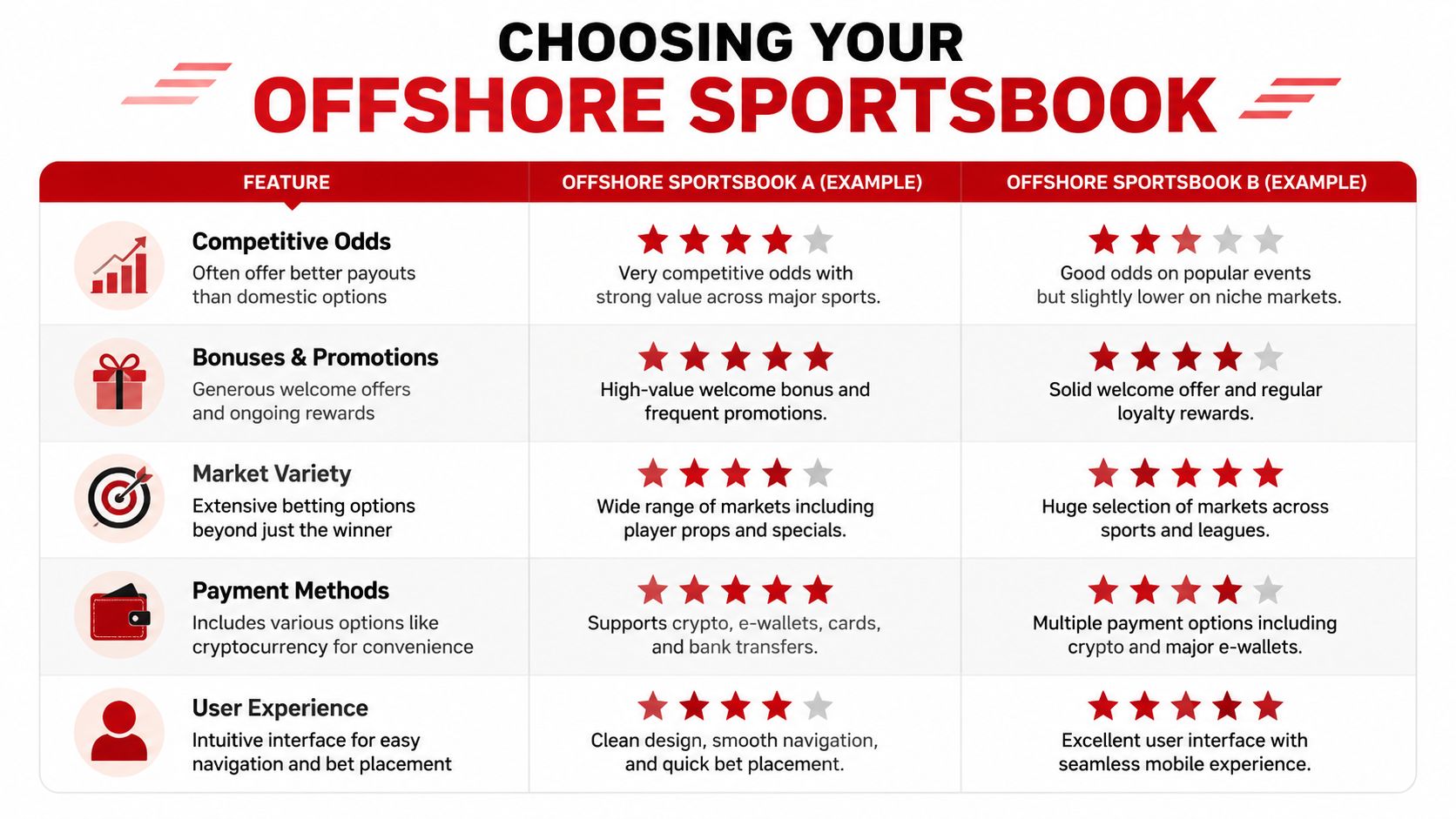
The sportsbook matters almost as much as the handicap. If you're betting a month-long tournament, you need more than a decent homepage. You need clean navigation, solid soccer coverage, useful futures menus, and pricing worth shopping.
An upset can change futures dramatically. ESPN highlighted that kind of volatility with moves such as a team shifting from 250-1 to 150-1 after a single result, which is why responsive books matter in this market according to ESPN's World Cup betting odds analysis.
What to compare first
Most bettors focus too heavily on bonus size. Bonuses matter, but they're only one piece.
Use these criteria first:
- Odds quality. A better price on the same team is the cleanest edge in futures betting.
- Market depth. You want outrights, stage markets, group props, and player awards.
- Update speed. Books that move quickly are better for tournament betting.
- Payment fit. If you prefer crypto, choose a book that handles it smoothly.
- Interface. If finding World Cup outrights is a chore, execution gets sloppy.
For a broader look at the category, this guide to World Cup betting sportsbooks is a practical comparison point.
A short video can also help if you're comparing offshore options and general soccer betting workflow.
Where each offshore book can fit
This isn't about declaring one universal winner. Different books fit different bettors.
| Sportsbook | Best use in a World Cup portfolio |
|---|---|
| MyBookie | Good for bettors who want a familiar interface and broad soccer access |
| BetUS | Worth a look for players who care about crypto-friendly funding and promo-driven bankroll building |
| BetAnything | Useful as an additional out when you want another number in the market |
| Xbet | Convenient for mobile-first bettors who place futures and match bets from the same account |
| Bet105 | Solid as a comparison shop option when you're checking secondary markets |
| Cosmobet | Helpful if you like mixing outrights with player-related or tournament props |
| BUSR | A reasonable choice for bettors who want another offshore menu in rotation |
| Bookmaker.eu | Strong fit for serious price shoppers who care about market movement |
| Heritage Sports | Valuable when fast futures updates matter and you want a responsive board |
The practical side of line shopping
Here's what line shopping looks like in real life.
You decide you want exposure to one top-tier national team and one mid-range side. Don't place both bets at the first book you open. Check Bookmaker.eu, Heritage Sports, MyBookie, and BetUS first. Then compare whether the better number is on the outright, the semifinal market, or even the group market.
That's where offshore books are useful. They let you build the card piece by piece.
A World Cup portfolio built at one sportsbook is usually less efficient than the same portfolio built across several.
Bonuses can still matter. If you fund with crypto and use promotions responsibly, they can increase flexibility. But don't let a bonus push you into a worse number. In futures betting, price is still the main event.
Placing Bets and Managing Your Bankroll
Once you've picked your sportsbook and your targets, execution should be boring. That's good. Boring execution prevents dumb mistakes.
A portfolio approach also makes bankroll discipline easier. FanDuel's strategy analysis noted that a more advanced approach involves mid-range contenders and hedgeable stage markets, and that the favorite's normalized implied probability is only about 14%, which is a reminder that one-team exposure is risky in a flatter field according to FanDuel's World Cup betting strategies.
How to place the bet cleanly
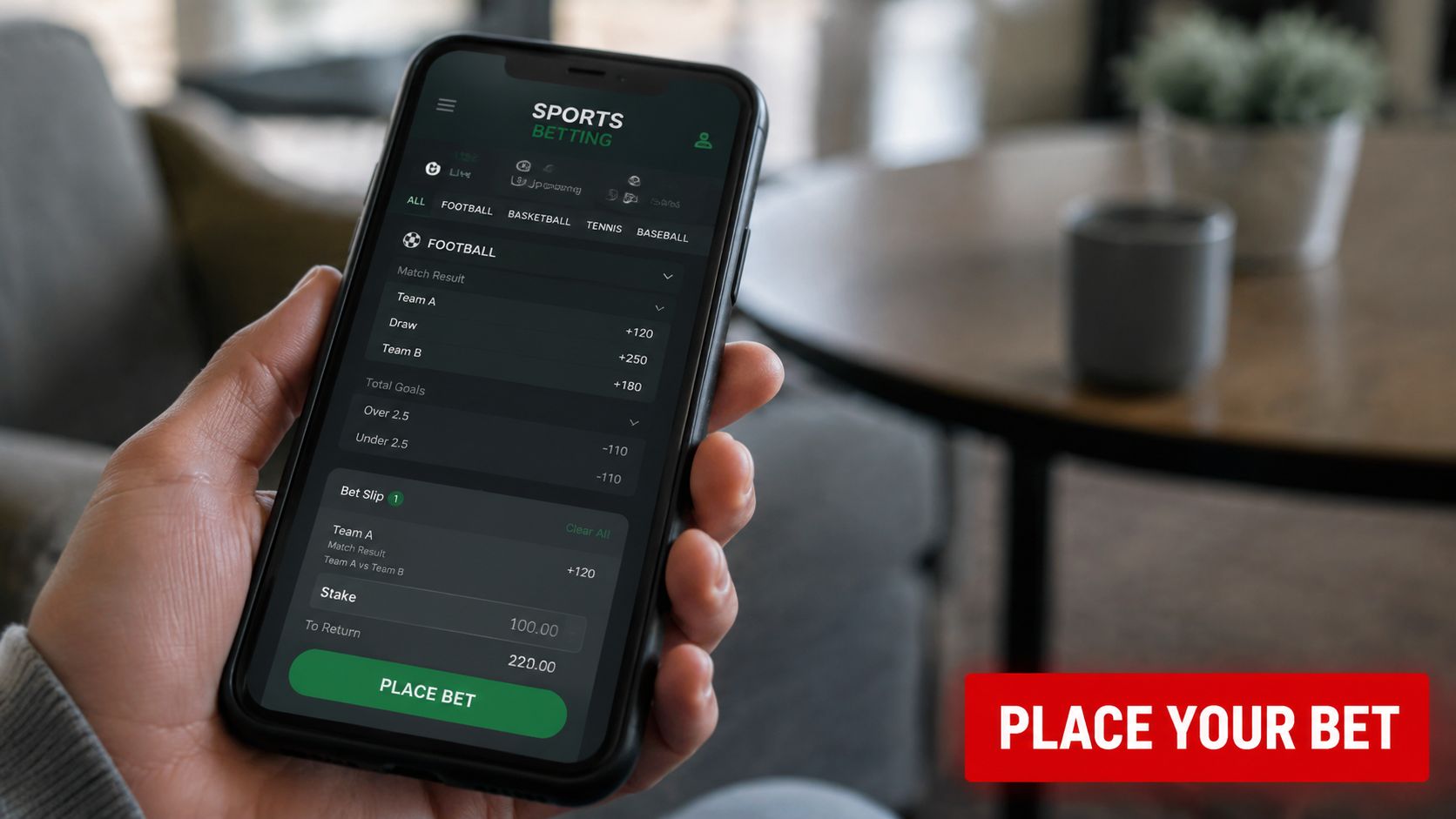
On a sportsbook like Xbet, the workflow is usually straightforward:
- Log in and go to the soccer section.
- Open the World Cup competition page.
- Find the Outrights or To Win Tournament market.
- Select your team and add it to the slip.
- Double-check the odds before confirming.
- Enter your stake and place the wager.
That sounds basic, but two habits matter.
First, always confirm you're betting the correct market. “To win tournament” is not the same as “to reach final” or “to win group.” Second, review the odds one last time before submitting. Futures prices can move while you're still browsing.
Use units, not vibes
The easiest bankroll method is unit sizing. Pick a standard bet size that represents a small portion of your bankroll, then stick to it.
For World Cup winners betting, I prefer this kind of structure:
- Core outright at a larger unit size than the rest of the portfolio
- Secondary outright at a smaller unit size
- Related stage or player positions at smaller sizes still
- Reserve bankroll kept available for knockout-stage hedging or match betting
This does two things. It protects you from overcommitting to a single pre-tournament opinion, and it gives you room to react later.
Keep futures exposure under control
Futures bets tie up bankroll for a long time. That's fine if the positions are selective. It's a problem if you scatter small bets across too many teams and end up with a messy card.
A cleaner approach is to write your positions down before you place them:
- Team
- Market
- Odds
- Stake
- Why you bet it
- What would make you hedge later
That simple note-taking habit helps you avoid duplicate exposure. It also stops you from adding random tickets because a match looked exciting that day.
If you can't explain why a futures ticket belongs in your portfolio, don't add it.
Books like Cosmobet, BUSR, and BetAnything can be useful. You can use one book for your outright, another for a stage market, and leave room elsewhere for live match positions once the tournament starts.
Responsible Gambling and Final Takeaways
The best World Cup betting plan is one you can stick to. That means discipline has to sit next to ambition.
The expanded 2026 format, with 32 teams advancing from the group stage, may shift value toward group-stage draws and unders rather than forcing action only into the winner market, which can be a more responsible way to stay involved according to FanDuel's World Cup format and strategy discussion.
What sustainable betting looks like
A sustainable approach is simple:
- Bet what you can afford to lose. Futures are volatile and slow to settle.
- Don't chase bad results. One ugly day in the group stage shouldn't rewrite your staking plan.
- Keep accounts at more than one book. That gives you better pricing and more control.
- Use lower-risk markets when the outright board feels efficient. You don't need action on the champion every time.
Books such as BUSR and BetAnything can be part of a controlled setup if you use them for shopping and selective exposure, not for impulsive volume.
The core idea to carry forward
World Cup winners betting gets easier once you stop trying to find one magic pick. The sharper move is building a portfolio around strong teams, useful prices, and hedge paths you can use later. Add line shopping through offshore books like MyBookie, BetUS, Xbet, Bookmaker.eu, and Heritage Sports, and your card gets a lot stronger before the tournament even starts.
Responsible betting isn't separate from winning strategy. It is the strategy. The bettors who last are the ones who manage risk, keep flexibility, and don't let the spectacle push them into bad prices.
If you want a practical starting point for comparing offshore books, bonuses, betting features, and sportsbook fit before the tournament begins, visit USASportsbookList. It's a useful resource for narrowing down which sportsbooks match your World Cup betting style.