Ever looked at a betting line on a sportsbook and felt like you were trying to crack some ancient code? You're not alone. At its core, a betting odd is just the 'price tag' for a wager. It tells you two critical things at once: the likelihood of something happening and exactly how much you stand to win.
Your Essential Guide to Understanding Betting Odds
Think of odds as a language. Once you learn to speak it, you can walk into any offshore sportsbook like MyBookie or Bovada and understand the conversation. Whether you see a plus sign, a fraction, or a decimal, they're all just different dialects for expressing the same fundamental information. Get the basics down, and you can stop guessing and start making smarter, more strategic bets.
The whole concept is about turning a probability—the chance of an event happening—into a number that dictates your payout if you get it right. This isn't a new idea; odds have been evolving alongside gambling for centuries, adapting to different cultures and games along the way.
This visual breaks down the simple, logical flow from a team's chances to your potential payout.
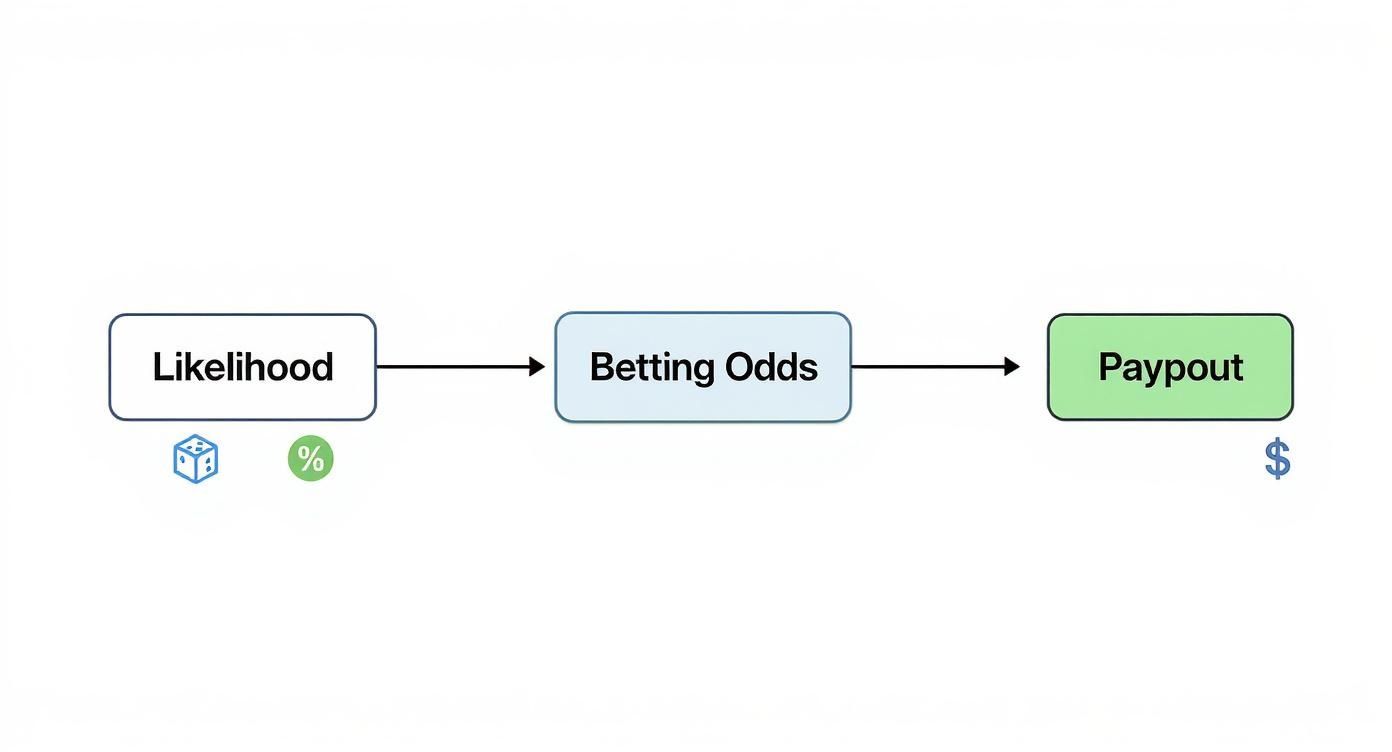
As you can see, a sportsbook like BetUS first figures out an outcome's likelihood, turns that assessment into betting odds, and then uses those odds to calculate what you'll get back if you win. Simple as that.
The Two Pillars of Betting Odds
Every single set of odds you'll ever see, whether it's for an NFL game or a UFC title fight, is built on two simple, powerful ideas:
- Implied Probability: This is just the chance of an outcome happening, as suggested by the odds. A heavy favorite has a high implied probability, while a longshot underdog has a very low one.
- Potential Payout: This is the money you can win compared to what you risk. Longshot odds offer huge payouts because they're not likely to happen. Betting on a heavy favorite, on the other hand, will only net you a small return.
The real skill in betting isn't just picking winners. It's about finding odds that offer good value compared to the actual probability of an outcome.
Getting these two concepts down is the first major step toward becoming a sharper bettor. By learning how to read betting odds correctly, you can glance at any line and instantly understand the risk and reward. Next, we'll break down the three main formats you'll encounter—American, Decimal, and Fractional—so you're ready for anything the betting board throws at you.
Quick Look At The Three Main Odds Formats
To see how different formats represent the same thing, let's look at an example where an outcome has a 25% chance of happening.
| Odds Format | Example | What It Means |
|---|---|---|
| American | +300 | You win $300 for every $100 you wager. |
| Decimal | 4.00 | Your total return is 4x your original stake. |
| Fractional | 3/1 | You win $3 for every $1 you wager (plus stake back). |
See? They all point to the same risk and reward, just presented in slightly different ways. Once you get a feel for them, switching between formats becomes second nature.
Decoding American Odds: The Plus and Minus System
When you log into an offshore sportsbook like BetOnline or BetUS, the first thing you’ll probably see are American odds. This is the default format for pretty much any site catering to a US audience. It's all built around two simple symbols: a plus (+) for the underdog and a minus (–) for the favorite.
Getting a handle on this system is your first step to really understanding how to read the board. Think of the symbols as shortcuts telling you what you stand to win relative to a $100 bet. It's a quick and dirty way to size up risk and reward on the fly.
- The Minus Sign (-): This points to the favorite. The number next to it shows you how much you have to bet to make a $100 profit.
- The Plus Sign (+): This flags the underdog. The number tells you how much profit you'll pocket from a $100 wager.
Just by glancing at the plus and minus, you get an instant snapshot of who the bookmaker expects to win.
The Favorite And The Minus Sign
Let's walk through a real-world example. Imagine you're on Bovada and you're eyeing an NFL game between the Kansas City Chiefs and the Miami Dolphins. You see the Chiefs listed at -150.
That minus sign tells you the Chiefs are the expected winners. The number, 150, is the price you pay. To win $100 in profit, you'd need to put down $150. If they pull off the win, you get your original $150 back, plus the $100 profit, for a total payout of $250.
But you don't have to bet in $100 increments. Say you only want to risk $50 on the Chiefs at -150. The math is still pretty simple.
Payout Calculation (Favorite): (Stake / (Odds / 100)) = Profit
Example: ($50 / (150 / 100)) = $33.33 profit
Your $50 bet would get you a total return of $83.33—your initial $50 stake plus your $33.33 in winnings.
The Underdog And The Plus Sign
Now, let's flip over to the other side of that matchup. On a site like MyBookie, you might see the Miami Dolphins listed at +130.
The plus sign is your immediate signal that they're the underdog. The number, 130, shows the potential reward for taking that bigger risk. A $100 bet on the Dolphins would net you a $130 profit if they upset the Chiefs. More risk, more reward.
If you decided to put $50 on the Dolphins at +130, the calculation is even easier.
Payout Calculation (Underdog): Stake * (Odds / 100) = Profit
Example: $50 * (130 / 100) = $65 profit
A winning $50 bet on Miami would earn you $65 in profit. The sportsbook pays back your $50 stake and your winnings for a total of $115. This straightforward risk-vs-reward structure is exactly why American odds are the go-to format on platforms like Xbet and Bookmaker.eu.
While American odds are the default you'll see on most US-facing offshore sportsbooks, getting a handle on fractional and decimal formats gives you a huge advantage. Many of the big international players, like Sportsbetting.ag, let you toggle between formats. Knowing how to read all three means you can confidently shop for the best lines anywhere in the world.
Think of it as learning different currencies. They all represent the same value, just spoken in a different language. Once you get the hang of it, you’ll never miss out on a great price just because it looks a little weird at first glance.
Cracking the Code on Fractional Odds
Fractional odds are the classic format you'll find all over UK and Irish betting sites. They might look a bit old-school, but the logic is dead simple. You'll see them written with a slash, like 5/1.
Here's the breakdown:
- The first number (the numerator) is your potential profit.
- The second number (the denominator) is what you need to stake to get that profit.
So, a 5/1 odd literally means you win $5 for every $1 you bet. A $20 wager at 5/1 gets you $100 in profit. The book also gives you your original $20 stake back, so you walk away with $120 total. You’ll often find these formats on sites like Bet105 and BUSR, which cater to a crowd familiar with traditional horse racing odds.
The Simplicity of Decimal Odds
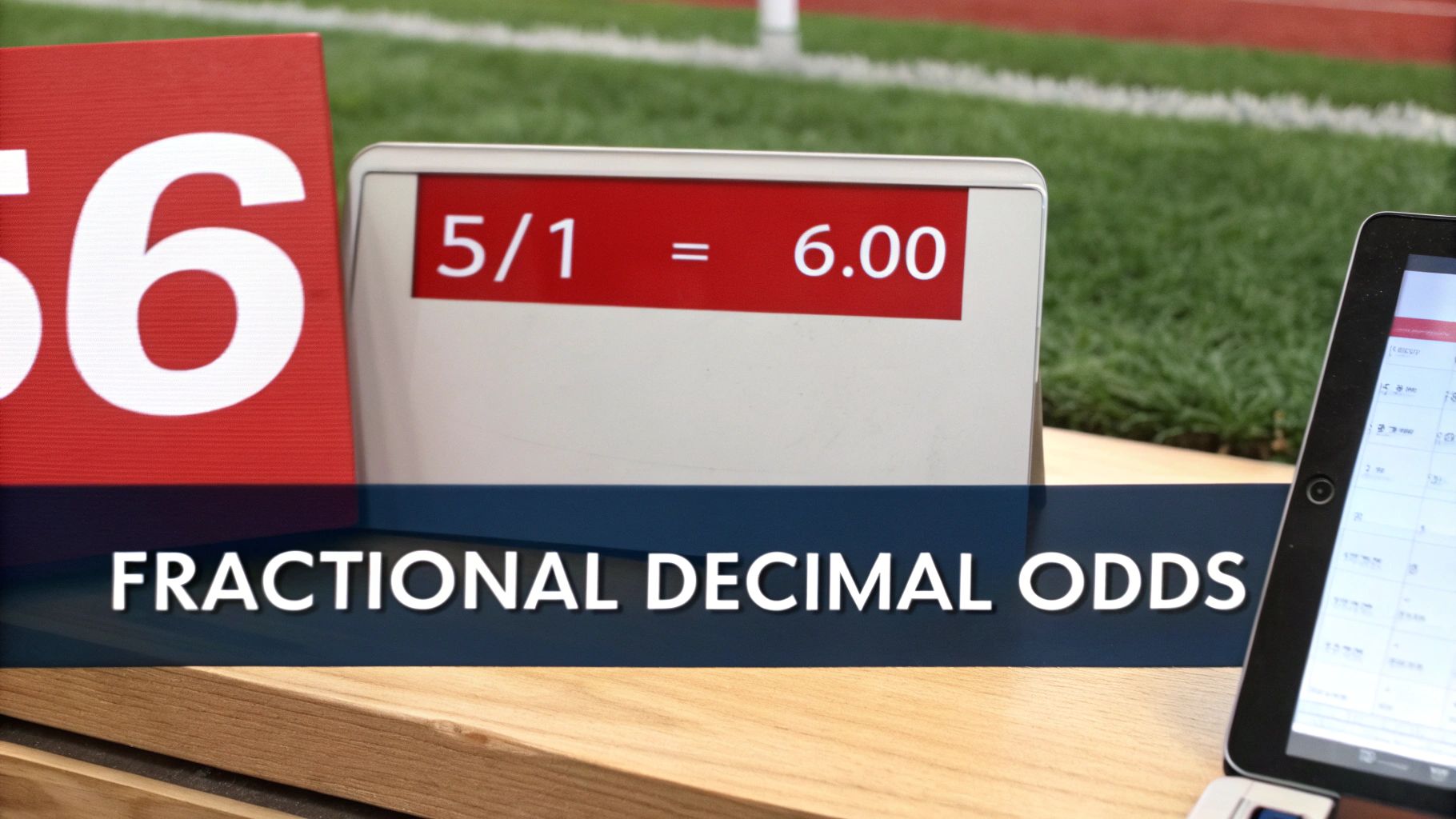
Decimal odds are the go-to format in Europe, Australia, and Canada, and honestly, they're the easiest to understand. It’s just one number, like 6.00, which tells you the total payout for every $1 you wager. That includes your original stake.
Calculation: Stake x Decimal Odds = Total Payout
Let's stick with that $20 bet. At 6.00 odds, your total return is $120 ($20 x 6.00). Easy. To figure out your pure profit, just subtract your initial $20 stake, which leaves you with $100 in winnings. Bettors who frequent sites like Cosmobet and BetAnything often prefer this format because the math is so clean and direct.
Tying All Three Formats Together
So how do these different dialects all say the same thing? Let’s imagine you’re taking a shot on a big underdog listed at +500 American odds. Here’s what that same price looks like across the board:
| Format | Example | The Bottom Line |
|---|---|---|
| American | +500 | A $100 bet wins $500 in profit. |
| Fractional | 5/1 | You win $5 for every $1 wagered. |
| Decimal | 6.00 | Your total return is 6x your stake. |
See? +500, 5/1, and 6.00 are all just different ways of describing the exact same risk and reward. Getting comfortable with these conversions makes you a sharper, more versatile bettor, fully equipped to understand what is odds in betting no matter where you play.
From Odds to True Probability: Finding Your Edge
This is where the pros separate themselves from the amateurs. Betting odds aren't just about how much you can win; they're the sportsbook's opinion on how likely something is to happen. Getting a grip on this concept is what turns you from someone just clicking buttons into a sharp bettor who can actually spot value.
Every line you see on a site like Xbet or BetAnything has a hidden percentage baked right in. This is called the implied probability, and it's basically the breakeven point for a bet. It tells you the minimum percentage of time an outcome needs to hit for that wager to be profitable over the long haul. Learning to see this is the first real step to finding an edge over the house.
Calculating Implied Probability from American Odds
Figuring out the implied probability from American odds is way easier than it sounds. There are just two simple formulas to remember—one for the favorites (negative odds) and another for the underdogs (positive odds). These quick calculations instantly show you what the sportsbook thinks the chances are.
For a favorite with a minus sign, the formula is:
Implied Probability = Odds / (Odds + 100)
Quick tip: Just drop the minus sign when you do the math.
Let's say you see a team at -150 on Bookmaker.eu. The math is just 150 / (150 + 100), which equals 0.60, or 60%. In the book's eyes, this team has a 60% chance to win the game.
For an underdog with a plus sign, the formula flips:
Implied Probability = 100 / (Odds + 100)
If you spot an underdog listed at +150 on MyBookie, the calculation is 100 / (150 + 100). That gives you 0.40, or a 40% chance. The book is telling you they think this team pulls off the upset 4 times out of 10.
Identifying Value Bets and Finding Your Edge
Okay, here's where it all comes together. Once you've turned the odds into a percentage, you compare that number to your own assessment. If you think an outcome is more likely to happen than the odds suggest, you've officially found a value bet.
Think about that +150 underdog. We know the sportsbook is giving them a 40% chance of winning. But maybe you've done your homework. You’ve looked at the matchups, checked the injury reports, and analyzed recent performance. You believe their actual chance to win is closer to 50%.
That 10% gap between your number (50%) and the sportsbook's implied probability (40%) is your edge. This is the entire game for professional bettors. They aren't just trying to pick winners; they're constantly hunting for odds that don't quite match the real-world probability of an outcome.
Of course, the bookmakers build in a margin (the "vig" or "juice") so that the probabilities for all outcomes add up to more than 100%. That’s how they guarantee a profit. Your job is to find the lines where their numbers are off by more than their built-in edge.
Spotting these pricing mistakes across different sportsbooks like BetUS and Bovada is a fundamental skill. For bettors who get really serious about this, using an arbitrage betting calculator can help pinpoint rare situations where odds are so different between books that a guaranteed profit is possible.
Why Betting Odds Constantly Change
Ever notice a betting line move just a few hours before a game kicks off? It’s not random. Betting odds aren't set in stone; they are living, breathing numbers that constantly shift to reflect new information and, most importantly, manage a sportsbook's risk.
The whole process starts with the opening line. This is the first number you see, meticulously crafted by expert oddsmakers at offshore sportsbooks like BUSR and Cosmobet. They use a ton of data, sophisticated algorithms, and statistical models to get their best initial assessment of how a game might play out.
But that line is just the starting point.
Balancing the Action Is the Top Priority
The number one reason odds change is to balance the book. Think of an offshore sportsbook less like a gambler and more like a broker. Their goal is to get a roughly equal amount of money bet on both sides of an outcome. When they achieve this, they guarantee themselves a profit from the commission (the "vig" or "juice") no matter who wins.
Let's say a really popular NFL team is playing, and a flood of bets comes in on them to win. If the sportsbook just sits back and does nothing, they're looking at a massive potential loss if that team actually wins. That's a bad business model.
To protect themselves, they'll adjust the odds. The popular team will become a less attractive bet (moving from -150 to -170, for example), while the underdog suddenly looks a lot more tempting (shifting from +130 to +150). This encourages bettors to put money on the other side, helping to balance the ledger and lock in the house's profit margin.
It’s just like the stock market—prices rise and fall based on buying and selling pressure.
Other Key Factors That Move the Lines
Beyond balancing the money, real-world events can force sportsbooks to change their numbers on a dime. Watching for these variables is what separates casual bettors from the pros.
- Player Injuries and Team News: This is a huge one. A star quarterback being unexpectedly ruled out can send odds into a tailspin. Even last-minute lineup changes or locker room drama can be enough to trigger a shift.
- Weather Conditions: For outdoor sports like football, a sudden forecast for heavy wind or a blizzard can completely change the game's dynamic. Oddsmakers will quickly adjust the totals (Over/Under) lines to reflect the lower scoring potential.
- Public Perception and Betting Volume: Sometimes, a team just captures the public's imagination. The sheer volume of bets from casual fans can force a line to move, even if the "sharps" (professional bettors) don't agree. This is common in major soccer leagues, where association football accounts for nearly 80% of Europe's betting market and public opinion can heavily influence the odds.
Odds are not just a reflection of probability; they are a living number that reacts to money, information, and public opinion.
Understanding what makes the odds tick is a fundamental piece of knowing what is odds in betting. Bettors who can see these shifts coming—or react quickly when they happen—are the ones who find the real value. The people who create these betting lines are using a complex mix of data and market analysis to stay one step ahead. To learn more about this fascinating process, check out our guide on who creates NFL betting lines.
Alright, theory is one thing, but putting it into practice is how you really build confidence at the sportsbook. Let's move from the concepts to a real-world walkthrough. I’ll show you how to break down common bets you'd find on sites like Bookmaker.eu or BetAnything.
Think of this as your repeatable checklist for sizing up any wager. It’s a simple, four-step process that connects all the dots.
- Identify the Odds: First, just find the numbers. Pinpoint the odds for the favorite and the underdog.
- Interpret Their Meaning: What story are the odds telling you? Figure out which team is expected to win and by how much.
- Calculate the Payout: This is the fun part. Determine exactly how much you stand to win for a standard bet.
- Find the Implied Probability: Finally, convert the odds into a percentage to see the "break-even" point for the bet.
Analyzing an NFL Moneyline Bet
Let’s start with the most straightforward bet out there: an NFL moneyline. Imagine you’re browsing MyBookie and see a matchup between the Los Angeles Rams and the Seattle Seahawks.
- Step 1: Identify the Odds: The board shows the Rams at -140 and the Seahawks at +120.
- Step 2: Interpret Their Meaning: That little minus sign next to the Rams (-140) instantly tells you they're the favorite. The plus sign for the Seahawks (+120) pegs them as the underdog. Simple as that.
- Step 3: Calculate the Payout: A winning $100 bet on the favored Rams would net you $71.43 in profit. But if you backed the underdog Seahawks with that same $100 and they pulled off the upset, you’d be looking at a $120 profit.
- Step 4: Find the Implied Probability: The Rams' -140 odds translate to a 58.3% chance of winning. The Seahawks' +120 implies a 45.5% chance.
This is a great moment to put that payout knowledge into practice. Let’s break down exactly what a hypothetical bet would look like for this game.
Sample NFL Bet Payout Calculation
| Team | American Odds | Stake | Potential Profit | Total Return |
|---|---|---|---|---|
| Los Angeles Rams (Favorite) | -140 | $140 | $100 | $240 |
| Seattle Seahawks (Underdog) | +120 | $100 | $120 | $220 |
As you can see, you have to risk more on the favorite to win $100, while a smaller risk on the underdog yields a bigger reward. That’s the core of moneyline betting right there.
Deconstructing an NBA Point Spread
Now for the point spread, which is king in sports like basketball and football. Let's say you're checking out BetUS and see a game between the Boston Celtics and the Miami Heat.
- Step 1: Identify the Odds: The line is Celtics -5.5 (-110) and Heat +5.5 (-110).
- Step 2: Interpret Their Meaning: Boston is the favorite, so they don't just have to win—they have to win by 6 points or more to "cover" the spread. Miami, as the underdog, can either win the game outright or lose by 5 points or fewer for their side of the bet to cash.
- Step 3: Calculate the Payout: Notice both sides are sitting at -110. This is the standard "juice" or "vig." It means you have to risk $110 to win $100, no matter which team you bet on. That extra $10 is the sportsbook's built-in commission.
- Step 4: Find the Implied Probability: Odds of -110 convert to an implied probability of 52.4%. Even though the book has handicapped the game to be a 50/50 proposition with the spread, the vig means you have to be right more than half the time just to break even.
This four-step process is your new toolkit. Seriously, burn it into your brain. Whether you're on Bovada or BetOnline, this framework helps you move beyond just picking winners and start hunting for real value. Once you start seeing what the odds are really telling you, you'll make smarter decisions every single time.
Common Questions About Betting Odds
Even after you get the basics down, a few practical questions always seem to pop up. Let's tackle some of the most common ones I hear to really lock in your understanding and get you betting with confidence.
Key Betting Terminology
What is the 'juice' or 'vig' in betting odds?
You'll hear the terms 'juice' or 'vig' (short for vigorish) thrown around all the time. Think of it as the sportsbook's built-in commission for taking your action. It’s how they guarantee they make money.
The classic example is the -110 line you see on almost every point spread at a book like BetOnline. You have to risk $110 just to win $100. That extra $10 is the juice, and it's the house's edge.
What does it mean when odds are 'even money'?
Even money is exactly what it sounds like: your potential profit is the same as your original stake. It’s a straight-up, one-for-one bet.
You’ll see it written as +100 (American), 1/1 (Fractional), or 2.00 (Decimal). If you bet $50 at even money and win, you get back $100 total—your original $50 stake plus $50 in profit. Simple as that.
Finding the Best Lines
How do I find the best odds for a bet?
This is where smart bettors separate themselves from the crowd. To squeeze every last drop of value out of a wager, you have to 'line shop'—which just means comparing the odds for the same game across different offshore sportsbooks.
For instance, MyBookie might have the Lakers at +120, but a quick check shows Bovada has them at +125. Placing your bet at Bovada means more money in your pocket for the exact same risk. This simple habit is why having accounts at a few different offshore sites is a must for anyone serious about winning long-term.
Ready to put what you've learned into practice? At USASportsbookList, we've done the homework for you, with detailed reviews and bonus info for the best offshore sportsbooks out there. We'll help you find the right site to start placing smarter bets today.
Check out our expert guides and top-rated bookmakers at https://usasportsbooklist.com.