If you've ever glanced at the betting lines for a baseball game, you've probably seen numbers like -1.5 and +1.5 next to the team names and wondered what they meant. That, my friend, is the run line.
Think of it as baseball's version of the point spread you see in football or basketball. It’s a handicap the oddsmakers apply to level the playing field between a heavy favorite and a clear underdog. This little twist creates more interesting betting opportunities, especially when a simple win/loss bet (the moneyline) offers terrible odds.
Your Quick Guide to the Baseball Run Line
So, when you're browsing a sportsbook like BetUS or Bovada, that -1.5 or +1.5 is the key. You're no longer just betting on which team will win. You're betting on the margin of victory. This adds a whole new layer of strategy to your wager, making even lopsided matchups exciting to bet on.
Basically, the favorite is "giving" 1.5 runs, while the underdog is "getting" 1.5 runs. For your bet to cash, the favorite needs to win by at least two runs, whereas the underdog can either win the game outright or lose by a single run. You can dig into how the public is betting on these lines over at Sportsbettingdime.com.
Breaking Down the Two Sides
Once you get the hang of it, the run line is pretty simple. It always has two parts: the favorite and the underdog. Each side has a specific goal for your bet to be a winner.
Let's break it down with a quick summary table.
How a Standard Run Line Bet Works
| Betting Side | Spread | How You Win the Bet |
|---|---|---|
| The Favorite | -1.5 | Your team must win the game by 2 or more runs. |
| The Underdog | +1.5 | Your team can win the game OR lose by only 1 run. |
As you can see, it's not just about winning or losing; it's about how much they win or lose by.
Here’s how it plays out in the real world:
- Betting on the Favorite (-1.5): The team you back must win the game by two or more runs. If they win by a single run, your bet loses. It's a tougher condition, but it comes with a much better payout.
- Betting on the Underdog (+1.5): Your team gets a nice cushion. They can win the game outright, or they can lose by just one run, and your bet still cashes.
The key takeaway is that the run line isn't about who wins, but how they win. It introduces margin of victory into your betting calculation, which is where savvy bettors find value.
For example, imagine the Los Angeles Dodgers are huge favorites over the Arizona Diamondbacks on MyBookie. A standard moneyline bet on the Dodgers might have awful odds, something like -250. You'd have to risk $250 just to win $100.
But if you bet the Dodgers -1.5 on the run line, the odds might flip to something much more attractive, like +120. Now, a $100 bet wins you $120. The catch? The Dodgers have to win by at least two runs. Suddenly, that boring blowout has some real betting action.
Decoding Run Line Odds with Real Examples
Theory is great, but seeing the numbers in action is what really makes the run line click. Let's break down a classic rivalry matchup—New York Yankees vs. Boston Red Sox—to show you how these bets play out on a popular offshore sportsbook like MyBookie.
Imagine you’re logged in and looking at the day's games. Instead of just picking a winner, you’re scanning the run line for better value. The odds board might look something like this.
A Hypothetical Yankees vs Red Sox Matchup
Let's say the Yankees are favored to win. On a site like Sportsbetting.ag, you’ll see the main betting options laid out right next to each other, which makes comparing them a breeze.
- Moneyline: Yankees -170 | Red Sox +150
- Run Line: Yankees -1.5 (+120) | Red Sox +1.5 (-140)
- Total (Over/Under): 8.5 Runs
Spot the difference? A straight-up moneyline bet on the Yankees requires you to risk $170 just to profit $100. But if you take them on the run line, the odds flip completely to +120. Suddenly, your potential profit is bigger than your wager. That’s a massive shift in value.
So, what does this look like in terms of actual payouts? Let's run the numbers for a standard $100 bet on each side of the run line. This is where understanding what the run line means in baseball turns from theory into a real strategy for your wallet.
Just a quick refresher on odds: a plus sign (+) shows how much you’ll profit on a $100 bet. A minus sign (–) shows how much you have to risk to win $100.
The table below breaks down exactly what happens to your $100 depending on the final score.
Yankees (-1.5) vs Red Sox (+1.5) Betting Payouts
To really see the difference, here’s how a $100 wager plays out for each side of the run line bet.
| Bet Type | Odds | Wager | Winning Scenario | Potential Profit |
|---|---|---|---|---|
| Yankees Run Line | -1.5 (+120) | $100 | Yankees win by 2+ runs (e.g., 5-3) | $120 |
| Red Sox Run Line | +1.5 (-140) | $100 | Red Sox win OR lose by 1 run (e.g., 4-5) | $71.43 |
As you can see, taking the Yankees at -1.5 turns your $100 into a cool $120 profit if they cover the spread and win by two or more.
On the flip side, if you think the Red Sox can keep it a close game (or win outright), backing them at +1.5 is your play. Even if they lose by a single run, your $100 bet at -140 odds still nets you a $71.43 profit.
This clear trade-off between risk and reward is exactly why seasoned bettors love the run line. It gives you a strategic alternative to the standard moneyline, something you'll find at top sportsbooks like Bovada and BetUS.
Run Line vs Moneyline Betting Showdown
So, when does it make sense to ditch a simple moneyline bet and jump on the run line instead? It really all comes down to finding value, especially when you're staring at a lopsided matchup with a heavy favorite.
A moneyline bet is as straightforward as it gets—you’re just picking the winner. But the run line is about how a team wins, which completely changes the odds and your potential payout.
Let's say the Houston Astros are facing the Oakland Athletics, and a sportsbook like BetOnline has the Astros listed as a massive -300 moneyline favorite. To win a mere $100, you’d have to put $300 on the line. That’s a classic high-risk, low-reward situation that most experienced bettors steer clear of.
Turning Bad Odds into Good Value
This is exactly where understanding what does run line mean in baseball becomes your secret weapon. Instead of swallowing those awful -300 odds, you could bet the Astros on the run line at -1.5. All of a sudden, the odds could completely flip to something much more appealing, like +120.
Now, your $100 wager could net you a $120 profit. The catch? The Astros have to win by two or more runs. You're definitely taking on more risk by betting on the margin of victory, but the sportsbook is rewarding you for it with a much better payout. This strategic trade-off is the heart of the run line vs. moneyline debate.
If you need a refresher on the basics, check out our guide on what is moneyline betting.
This decision tree breaks down the simple win conditions for both sides of a run line wager.
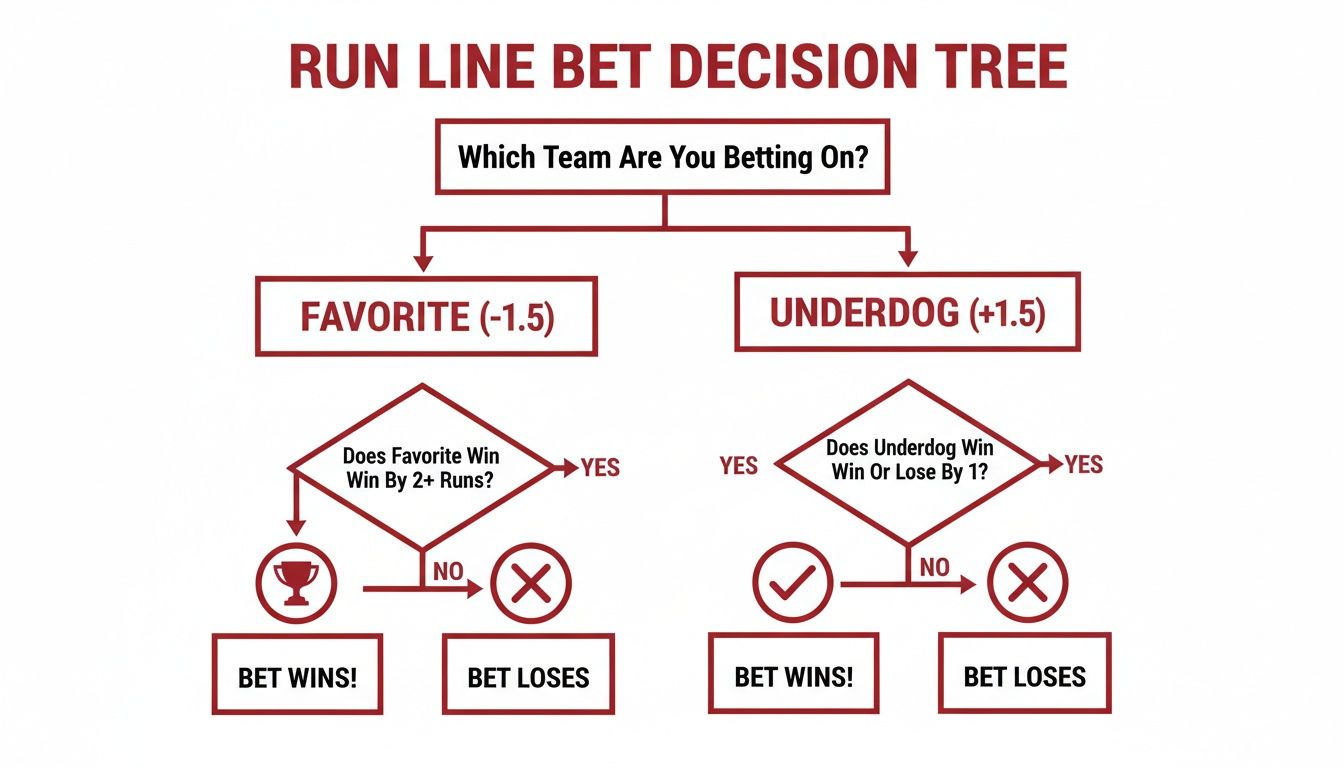
At its core, a favorite needs to win comfortably, while an underdog just needs to keep it close or pull off the upset.
The core decision is simple: Bet the moneyline when you want to pick an outright winner with acceptable odds. Bet the run line when the moneyline offers poor value, and you have a strong opinion on the margin of victory.
The run line became a staple for baseball bettors because of the natural parity in MLB, making it a critical tool for sharp bettors comparing lines at offshore sportsbooks like Xbet and BUSR. The standard -1.5/+1.5 spread was introduced to give bettors a real alternative to those lopsided moneylines, and its popularity exploded after 2018.
Looking at recent data from 2025, consensus closing lines have created a surprisingly balanced market against the spread, with underdogs covering roughly 52% of the time across the league. You can dig deeper into these kinds of trends over at EV Analytics.
Proven Strategies for Winning Run Line Bets

Alright, now that you know what a run line is, let's get to the fun part: actually winning these bets. Making money on the run line isn't about luck or just picking the better team. Sharp bettors know it’s about digging into the specifics of each matchup to find a real edge.
Winning consistently means doing your homework before you ever log into a site like Bookmaker.eu or BUSR. It's not enough to know the Yankees are good. You need to figure out why they're poised to win by at least two runs, or why the underdog has a great shot at keeping it close. That’s how you find value in the -1.5/+1.5 spread.
Key Factors to Analyze
Before you even think about placing a bet, there are a few core variables every successful bettor breaks down. These factors are often the difference between a one-run nail-biter and a comfortable blowout, which is everything when it comes to run line betting.
- Starting Pitcher Matchup: Don't just look at the big-name ace. Dig into their recent performance—ERA, WHIP (walks and hits per inning pitched), and strikeout-to-walk ratios. A dominant starter facing a weak lineup is a classic recipe for a -1.5 bet.
- Bullpen Strength: A game is often won or lost in the 7th, 8th, and 9th innings. A team with a shaky bullpen is a huge red flag for a -1.5 bet because they can easily let a late lead slip. On the flip side, a team with lockdown relievers gives you much more confidence that they can protect a two-run lead.
- Recent Offensive Performance: Is a team seeing the ball well or are they in a slump? Check out their runs scored and team batting average over the last week or so. An offense that's on a hot streak is far more likely to give their pitcher the run support needed to cover -1.5.
This is the kind of nitty-gritty analysis that separates casual fans from strategic bettors. You’re building a case for why a team won’t just win, but win by the right margin.
Finding Value in Home Underdogs
One of the most popular—and historically profitable—run line strategies is to back the home underdog at +1.5. The logic is simple but incredibly powerful.
Think about it: the home team is guaranteed to bat in the bottom of the ninth inning if they're trailing. This gives them three extra outs to either tie it up, walk it off, or at the very least, lose by a single run. That built-in advantage makes the +1.5 cushion a fantastic value proposition, especially in games projected to be tight, low-scoring affairs.
Professional bettors often hunt for value with home underdogs on offshore sites like Bet105 and Cosmobet. That guarantee of a ninth-inning at-bat provides a statistical edge that isn't always fully priced into the odds.
The data backs this up. Against the spread (ATS) records, which track run line performance, show that even baseball's top dogs struggle to cover the spread consistently. For instance, recent records show the Mets at 77-85 (47.5% cover rate), the Astros at 77-85 (47.5%), and the Yankees at 80-89 (47.3%). It highlights just how often betting on the underdog at +1.5 can pay off. You can explore more of these MLB statistics and see how elite pitchers like Paul Skenes (1.97 ERA) can stifle offenses and help underdogs keep games close.
The High-Risk Reverse Run Line
Feeling bold? For bettors chasing a bigger payout, the "Reverse Run Line" is a high-risk, high-reward play. This strategy involves taking an underdog to not just win, but to win by two or more runs—betting them at -1.5.
You'll find these alternate lines at sportsbooks like Xbet and BetAnything. Sure, it's a longshot, but the odds reflect that and can be incredibly juicy, sometimes climbing to +300 or higher. This bet makes sense when you believe a strong underdog is being seriously overlooked and has the offensive juice to dominate a slumping favorite.
Exploring Alternate Run Lines and Live Betting

The standard -1.5/+1.5 run line is the bread and butter of baseball betting, but your options definitely don't stop there. Offshore sportsbooks like BetAnything and Cosmobet open up a whole new layer of strategy with what are called alternate run lines. These give you the power to adjust the spread yourself, putting you in the driver's seat when it comes to managing risk and chasing bigger payouts.
Instead of being stuck with the default 1.5 runs, you can move the line. Think a dominant favorite is going to win in a blowout? You can bet them at -2.5 or even -3.5 to get much juicier odds. Of course, they'll need to win by a wider margin, but the potential reward is significantly higher.
On the flip side, maybe you want to give a scrappy underdog a little more breathing room. You can take them at +2.5, which creates a much bigger safety net for your bet. The payout won't be as large, but your ticket cashes even if they lose by a couple of runs.
Unlocking In-Game Action with Live Betting
The real fun begins once the first pitch is thrown. This is where the world of live betting comes in, transforming the run line from a fixed, pre-game number into a constantly shifting market that reacts to every hit, error, and pitching change.
As the game plays out, sportsbooks like BetOnline and Xbet are constantly adjusting run line odds based on the score, the inning, and which team has the momentum. For sharp bettors who are paying close attention, this creates a steady stream of fresh opportunities that didn't exist before the game started.
One of the best live betting strategies is to spot overreactions. If a heavy favorite gives up a couple of cheap runs in the first inning, their live run line odds might suddenly become incredibly valuable. That's your moment to pounce.
Seizing Live Betting Opportunities
Picture this: a powerhouse team unexpectedly finds themselves down 3-0 in the third inning. Their pre-game -1.5 run line is a distant memory. Now, the live run line might flip to that same team being +1.5 for the rest of the game. This is a golden opportunity to bet on a talented squad to mount a comeback.
Conversely, if an underdog jumps out to a surprising lead, you might find great value in betting on them with an even bigger run line cushion than what was offered pre-game.
This fast-paced style of wagering adds a completely new dimension to baseball betting. If you want to dive deeper, check out our in-depth guide on what is live betting. Mastering it turns every inning into a strategic opportunity.
Finding the Best Run Line Odds at Offshore Sportsbooks
Any serious bettor will tell you the same thing: the odds you get are just as important as picking the right team. This is where line shopping comes in—it’s the one skill that separates the pros from the casual players and is the key to building a bankroll over the long haul.
Think of it like this. One book might have an underdog at +150, but another has the same team at +155. It doesn't sound like a huge deal, but that extra $5 profit on every $100 you bet adds up fast over a 162-game MLB season. Not shopping for the best price is just leaving free money on the table.
The Power of Multiple Accounts
You can't effectively shop for lines without having accounts at a few different offshore sportsbooks. It's just not possible. This is the only way you can quickly jump between top sites like MyBookie, BetUS, and Bovada to see who’s offering the best price before you lock in your bet.
For example, you might see that Sportsbetting.ag has the best odds on a favorite at -1.5, while Xbet is giving a better price on the underdog at +1.5 for that same game. With accounts at both, you guarantee yourself the maximum value, no matter which side you’re taking. You can get a better handle on how to compare these options by checking out the best odds comparison sites.
The whole point of line shopping is to get the biggest possible payout when you win and risk the smallest amount when you lose. Having accounts at multiple sportsbooks makes this a reality.
On top of that, holding accounts at different books like BetOnline, Bookmaker.eu, and BUSR opens the door to a much wider variety of promotions. A lot of these offshore sites are known for their generous crypto deposit bonuses and reload offers.
You can use these promos to beef up your bankroll just for run line betting, giving you more ammo to work with. When you combine sharp line shopping with smart bonus hunting, you're putting yourself in the absolute best position to turn a profit.
Common Questions About Baseball Run Line Betting
Alright, let's wrap this up by tackling some of the questions I hear all the time from bettors just getting their feet wet with the run line. This quick FAQ will clear up any lingering confusion and get you ready to bet with confidence.
Is the Run Line Always -1.5/+1.5?
While -1.5/+1.5 is the standard you'll see on almost every game, it's far from your only choice. This is where offshore sportsbooks like MyBookie and BetOnline really shine, as they often post "alternate run lines" that give you more flexibility.
Feeling extra confident in a heavy favorite? You might be able to bet them at -2.5 for a much juicier payout. Or maybe you think an underdog will keep it close but want more of a safety net? You could grab them at +2.5, though the odds won't be as good.
What Happens to My Bet in Extra Innings?
This is a simple one: your run line bet is live until the game is final. Extra innings, rain delays, it doesn't matter. The final score is the only thing that counts.
So, if you backed a favorite at -1.5 and they finally walk it off with a one-run win in the 11th inning, your bet is still a loser. On the flip side, if you had the underdog at +1.5, you're cashing that ticket.
When Is the Run Line Better Than the Moneyline?
The run line is your best friend when you want to back a heavy favorite but can't stand the thought of laying a ton of juice. A top-tier team might be -300 on the moneyline, meaning you have to risk $300 just to win $100. That’s a tough pill to swallow.
But if you take that same team on the -1.5 run line, you might get great odds like +110. It's also a fantastic tool for betting on underdogs you think will play a tight, competitive game but might not have the firepower to win outright. That +1.5 run cushion is a massive advantage.
Can You Include Run Lines in a Parlay?
You absolutely can. Offshore sportsbooks like Bovada and Sportsbetting.ag make it easy to build parlays that include run line wagers.
You can mix and match a run line with a moneyline from another game, a total, or even point spreads from football and basketball. It’s a great way to build a single ticket with a shot at a massive payout. And once your bets are in, you’ll want to be glued to the action. You can check out the best way to stream MLB games to make sure you don't miss a pitch.
Now that you have a solid handle on what the run line means in baseball, you’re equipped to spot value and make smarter wagers. The best way to get started is to see what kind of odds and promotions are being offered at trusted offshore sportsbooks. For in-depth reviews and bonus info, head over to USASportsbookList at https://usasportsbooklist.com and find the perfect site for your style.