A sports betting ticket is your proof of purchase for a wager. Think of it as the official receipt—digital or physical—that locks in every detail of your bet. It's the contract between you and the sportsbook, clearly laying out the teams you picked, the odds you got, the amount you staked, and what you could win.
Your Guide to Reading a Sports Betting Ticket
That little digital slip on your screen or in your hand is the key to all the action. It's more than just a confirmation; it's a binding agreement for your wager. My goal here is to walk you through every number and term so you can turn any confusion into pure confidence.
First, we'll break down what a standard sports betting ticket from a site like Bovada or MyBookie looks like. Once you get the basic structure, you'll be able to place informed bets at any of the top offshore sportsbooks, whether it's BetUS, BetAnything, or Sportsbetting.ag.
The Core Components of Your Ticket
No matter where you bet—Xbet, BetOnline, or Cosmobet—every ticket contains the same essential information. These core pieces work together to define your bet and tell you exactly what you stand to win.
This diagram boils it down to the three pillars of any betting ticket: your bet, the odds, and the payout.
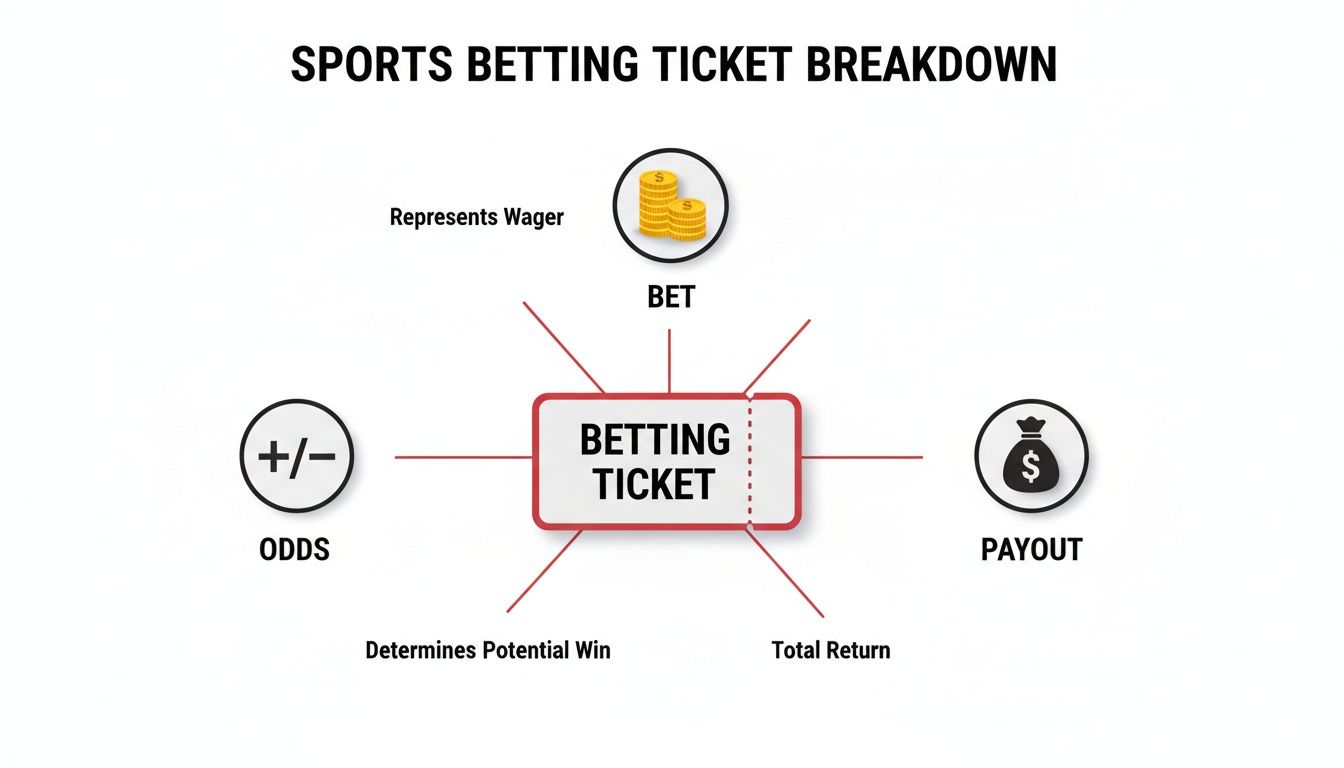
It’s really a simple formula: the amount of your bet, multiplied by the odds, determines your final payout.
To make it even clearer, here’s a quick rundown of what you’ll find on a typical ticket.
Key Elements on a Sports Betting Ticket at a Glance
| Element | What It Means | Example |
|---|---|---|
| Bet Type | The kind of wager you placed. | Moneyline, Point Spread, Over/Under, Parlay |
| Selection | The specific team, player, or outcome you bet on. | New England Patriots -3.5 |
| Stake (or Wager) | The amount of money you risked on the bet. | $100 |
| Odds | The price offered by the sportsbook, which determines your payout. | -110 |
| Potential Payout | The total amount you'll receive if your bet wins (your stake + profit). | $190.91 |
| Ticket Number | A unique identifier for your specific bet. | #A123-B456-C789 |
These are the building blocks. Once you know them, you can read any ticket from any bookie.
The Modern Betting Slip
The whole idea of a betting ticket has changed dramatically, especially with online platforms like BUSR, Bookmaker.eu, and Bet105 taking over. This digital shift has sent wagering volumes through the roof.
Just look at the numbers in the United States: the total amount wagered skyrocketed from around $13.0 billion in 2018 to about $107.4 billion in 2024. That's a massive eightfold increase, and it's almost entirely driven by how easy it is to bet online now. You can dig deeper into the sports betting market growth trends on GlobeNewswire.
Today's digital ticket is a different beast. It often bundles multiple "micro-wagers" into a single product. This is something you'll see all the time when you start building parlays or Same Game Parlays (SGPs).
Breaking Down the Anatomy of a Betting Slip
Every betting ticket tells a story, and learning to read it is your first step toward making smarter wagers. Think of it as the receipt for your bet; every single number and word on that slip defines your risk and your potential reward. We're going to break down exactly what you'll find on a typical ticket from an offshore sportsbook like BetOnline or BetUS.
We’ll get past the obvious stuff like team names and event dates to dig into the concepts that truly matter for every bettor. This means understanding the odds format, the critical difference between what you risk and what you win, and all the little details in between.
Using clear examples from popular platforms like Sportsbetting.ag, we'll show you where to find each piece of information. The goal here is simple: to turn that confusing jumble of text and numbers into a clear, easy-to-read guide for your bet.
Stake vs. Payout: The Two Most Important Numbers
Before we dive any deeper, let's nail down the two most important figures on your ticket: the stake and the payout. Getting these mixed up is a classic rookie mistake that can really take the wind out of your sails.
- Stake: This is your skin in the game. It's the amount of money you're actually putting down on a specific outcome. On a MyBookie bet slip, you'll often see this labeled as "Risk" or "Wager."
- Payout: This is what you get back if you win—in total. The key thing to remember is that the payout always includes your original stake. It’s your profit plus your initial wager, all rolled into one.
For instance, if you put down a $110 stake on a bet with -110 odds, your potential payout will be $210. That’s your $100 in profit plus your original $110 back. Always double-check both numbers on your ticket before you hit that confirmation button.
Deciphering the Odds Formats
The odds are the heart and soul of any betting ticket because they determine how much you stand to win. While offshore sites like Bovada and Xbet usually default to American odds, most give you the option to switch between three main types.
Think of the odds format as the language the sportsbook uses to explain the probability of an outcome and how much you'll get paid. Learning to speak this language is non-negotiable if you want to be a serious bettor.
Here’s a quick look at what you’ll run into:
- American Odds: This is the standard in the U.S. It uses a plus (+) for underdogs and a minus (-) for favorites. A -150 line means you have to risk $150 to win $100. A +200 line means a $100 risk will win you $200.
- Decimal Odds: Big in Europe and Australia, this format shows the total payout for every $1 you bet. Odds of 2.50 mean you'll get $2.50 back for every $1 wagered (that's your $1 stake + $1.50 in profit).
- Fractional Odds: This is the old-school British format. Odds like 5/1 (read as "five-to-one") are pretty straightforward—you'll win $5 for every $1 you stake.
Knowing how to read these is essential. If you want to get more fluent, you can always learn more about sports betting lingo and how it all comes together on your ticket.
Rotation Numbers and Unique Identifiers
Finally, every ticket has a few numbers that have nothing to do with odds or scores. These are just administrative details that help you and the sportsbook keep track of everything. On sites like Bookmaker.eu and BUSR, these are all generated for you automatically.
One of these is the rotation number. This is a unique number assigned to each team in a game, which helps avoid any mix-ups, especially if you were betting in person or over the phone. When you're betting online at a site like BetAnything or Cosmobet, you'll mostly just click on team names, but those rotation numbers are still there, working behind the scenes.
Once you confirm your bet, your ticket also gets a unique ticket ID or reference number. This is basically your proof of purchase. It's the number you'll need if you ever have to contact customer support at a place like Bet105 about a specific bet. It's always a good idea to keep a record of it.
What Kind of Bets Can You Make on Your Ticket?
Your sports betting ticket is your portal to a massive world of wagers, each with its own strategy and potential payout. After you've picked a bet on a top offshore site like Xbet or Bovada, that choice gets locked into your digital slip. Let's break down how these different bet types actually look on your ticket and what they mean for your game plan, starting with the basics and moving up to the more advanced stuff.
The Three Foundational Bets
Every single bettor starts their journey with three core types of wagers. Think of these as the building blocks you'll find on any sportsbook, from BetUS to Sportsbetting.ag. They form the foundation for almost every other bet out there.
- Moneyline: This is as simple as it gets. You’re just picking the straight-up winner of the game. Your ticket will show the team you picked and the American odds that go with it (like Team A -150 or Team B +130). No point spreads, no fuss—if your team wins, you win.
- Point Spread: This bet is all about leveling the playing field. The favorite has to win by a certain number of points (say, -7.5), while the underdog can either lose by fewer than that number or win the game outright (like +7.5). Your ticket will show the spread you bet on right next to your team.
- Totals (Over/Under): Instead of picking a winner, you’re betting on the combined final score of both teams. The sportsbook sets a line (maybe 48.5), and you bet on whether the actual final score will be over or under that number.
These are called "straight bets," and they're the bread and butter of sports wagering. A ticket for a straight bet is clean and simple: one selection, one stake, and one potential payout.
Once you get the hang of the basics, you can start exploring bets that string multiple outcomes together for a much bigger potential reward. This is where your bet slip can get more complex, but also way more exciting.
A parlay is a single wager that links two or more individual bets. Here's the catch: to win a parlay, every single one of your picks—or "legs"—has to hit. If even one leg loses, the whole ticket is a bust. Offshore sites like BetOnline and MyBookie make it super easy to build these.
The real magic of a parlay is the payout. The odds from each leg are multiplied together, which can lead to a massive potential win compared to placing each bet separately. When you build one on a platform like Cosmobet, your bet slip will update the compounded odds and potential payout in real-time. If you're looking to really master this bet type, you can learn more in our complete guide explaining parlay betting.
A teaser is a special kind of parlay that only uses point spreads or totals. It lets you adjust the lines in your favor, but in exchange for a lower overall payout. For instance, a 6-point football teaser can turn a -7.5 favorite into a much more manageable -1.5 favorite, making them way more likely to cover the spread.
Your teaser ticket on a site like BUSR will look a lot like a parlay slip, but it will clearly state the teaser points you applied and show the new, adjusted lines for each leg of your bet.
Looking Ahead with Futures
A futures bet is exactly what it sounds like: a wager on an outcome that will be decided far in the future, not just in tonight's game. These are long-term plays on a team or a player.
Common examples you'll see on Bookmaker.eu include:
- Betting on the Super Bowl winner before the season even starts.
- Wagering on a specific player to win the MVP award.
- Picking a team to win their division or conference championship.
A futures ticket is usually very straightforward, just listing your selection and the longshot odds attached to it (e.g., "Los Angeles Lakers to Win NBA Championship +1800").
The financial side of these different bet types is a huge deal for sportsbooks. Ticket-level data shows why they offer such a diverse menu of wagers. Industry forecasts project the global sports betting market to explode, hitting somewhere between $100.9 billion and $119.3 billion in the mid-2020s. Some projections even see it climbing as high as $187.4 billion by 2030. This growth, fueled by online platforms that grabbed over 75% of the revenue in 2024, means sportsbooks have to balance high-volume, low-margin tickets (like live in-game bets) with higher-margin products like parlays to keep scaling. You can discover more insights about these global market projections on Spherical Insights.
By understanding how each of these wagers looks on your sports betting ticket, you can start to manage your risk better, spot value, and build a betting strategy that actually fits your goals.
Calculating Your Potential Winnings From the Odds
Alright, this is where the fun really begins—turning those numbers on your sports betting ticket into actual dollar signs. Figuring out exactly how much you stand to win is easily the most exciting part of placing a bet. Let's walk through how to calculate your potential payout using the American odds you'll see on every ticket.
We're going to break down those little plus (+) and minus (-) signs, showing you the simple math that separates an underdog from a favorite. You’ll have the formulas down in no time, whether you're risking $110 to win $100 on a standard -110 spread or putting $50 on a +150 long shot.
The Math Behind Favorite Bets (Minus Odds)
When you see a minus sign (-) next to a number, like -150 or -200, you’re looking at the favorite. That number tells you how much money you have to bet just to win a $100 profit. Think of it as a simple risk-to-win calculation.
The formula is pretty straightforward:
(Stake / Odds) x 100 = Potential Profit
Let's say you see a team listed with -140 odds and you want to put $70 on them. Here's how the math shakes out:
(70 / 140) x 100 = $50 Profit
If you win, you'd get back $120 total—your original $70 stake plus that sweet $50 profit. Minus odds always mean you’re risking more than you stand to win. To get a better handle on the basics, you can learn more about what odds are in betting in our complete guide.
The Math Behind Underdog Bets (Plus Odds)
The plus sign (+) points to the underdog, and that’s often where you find the bigger paydays. This number shows you how much profit you'll make for every $100 you risk. The potential returns are higher because the oddsmakers think that outcome is less likely to happen.
Here’s the formula for plus odds:
(Stake / 100) x Odds = Potential Profit
Imagine you spot a promising underdog listed at +180 odds and decide to place a $50 wager. The calculation looks like this:
(50 / 100) x 180 = $90 Profit
A winning ticket here would get you $140 back ($50 stake + $90 profit). Betting on underdogs can give you a much better return on your money, but it comes with a higher perceived risk.
To help visualize this, let's look at a few examples based on a standard $100 wager.
Payout Calculation Examples (American Odds)
| Odds | Type | Wager Amount | Potential Profit |
|---|---|---|---|
| -110 | Favorite | $110.00 | $100.00 |
| -150 | Favorite | $150.00 | $100.00 |
| +120 | Underdog | $100.00 | $120.00 |
| +250 | Underdog | $100.00 | $250.00 |
As you can see, the difference is clear. For favorites, you have to risk more than $100 to win $100. For underdogs, your $100 wager wins you more than $100.
Getting comfortable with these two simple formulas is the key to reading any sports betting ticket. It gives you the power to instantly size up the risk versus reward of any bet you're thinking about placing.
How Parlays Compound Your Winnings
Now, parlays are where things get really interesting. This is where you can chase those massive payouts. When you bundle multiple bets onto a single ticket, you essentially multiply the odds together. This compounding effect is how you can turn a small stake into a huge win.
But the math isn't as simple as just adding up the odds. Each "leg" of the parlay rolls its winnings into the next, so the total payout is calculated one step at a time. The good news is, your online bet slip does all this heavy lifting for you automatically, showing your final potential payout in real-time.
It's also worth remembering that the return on a sports betting ticket can be affected by outside factors. In many places, government taxes and the sportsbook's "hold"—the percentage of all wagers it keeps—can shape the odds you're offered. For example, U.S. states collected over $505.96 million in sports-betting tax revenue in just Q3 2023, a 20.5% jump from the previous year. This shows how a government's cut can influence the entire betting ecosystem. A $50 ticket in one state might have a different expected value than the same $50 ticket somewhere else.
Common Mistakes to Avoid When Placing Your Bet
A simple slip-up on your sports betting ticket can be the difference between a nice payout and a frustrating loss. Trust me, even seasoned bettors have face-palmed over a silly mistake. Avoiding these common errors is absolutely crucial to make sure the bet you think you're placing is the one that actually gets locked in.
It’s easy to get swept up in the action, but rushing through your bet slip is a recipe for disaster. This is your field guide to dodging those rookie mistakes, like misreading a point spread, clicking the wrong team by accident, or not knowing how a push will affect your parlay. The single most important habit you can build is to double-check every single detail on your bet slip at a site like Cosmobet before you hit that confirm button.
Overlooking the Details on Your Bet Slip
By far, the most common mistakes happen when bettors just don't give their ticket one last look. A simple typo in your stake or picking the wrong line can completely upend your wager. Before you ever finalize a bet on platforms like MyBookie or BetUS, you need to run through a quick mental checklist.
Here are the absolute must-check items:
- The Selection: Did you pick the right team? It sounds silly, but you'd be surprised how often similar names or logos cause a mix-up.
- The Bet Type: Is this a moneyline, a spread, or a total? Make sure you've clicked on the exact market you wanted.
- The Odds: Have the odds shifted since you added it to your slip? The number on that final ticket is the only one that matters.
- The Stake: Did you type in the right amount? A misplaced decimal can instantly turn a $10.00 bet into a $100.00 headache.
Taking just ten seconds to scan these four points on your Sportsbetting.ag or Xbet ticket can save you from a world of hurt.
Not Understanding Parlay Push Rules
Parlays are awesome for their huge potential payouts, but they also have some quirky rules that trip up a lot of new bettors. The biggest point of confusion is what happens when one of your picks ends in a "push"—a tie against the spread or total.
A huge mistake is thinking a push kills your entire parlay. At offshore sportsbooks like BetOnline or Bookmaker.eu, that's almost never the case.
In a standard parlay, a push doesn't void the whole ticket. Instead, that specific game is just removed from the equation. The parlay’s odds are then recalculated with the remaining live bets. A five-team parlay with one push simply becomes a four-team parlay.
What this means is your potential payout will be smaller than you originally hoped for, but your ticket is still very much in the game. Knowing this rule helps you manage expectations and avoid that sinking feeling when you see a smaller payout on what you thought was a perfect ticket.
Ignoring Final Confirmation
Every single reputable offshore sportsbook, from Bovada to BUSR, gives you one last look on a final confirmation screen before locking your bet in. Think of this as your last line of defense. This screen lays out every detail of your sports betting ticket one last time.
Do not skip this step. This is your chance to catch a fat-fingered stake, the wrong team, or odds that have moved against you. Once you smash that final confirm button at a site like Bet105 or BetAnything, your wager is final. It's done. In most cases, it can't be canceled or changed, which makes that final review absolutely essential.
Putting It All Together
Okay, you're no longer just staring at a screen full of numbers and symbols. You're starting to see the language of sports betting. Having a solid grip on the sports betting ticket is what separates a casual spectator from someone who can actually place smart, confident wagers. This knowledge is your key to getting in the game.
The actual process is pretty straightforward once you’ve done it a few times. It really boils down to a simple four-step routine that works whether you're betting at MyBookie, BetUS, or BetAnything. Nailing this sequence every time means you'll never accidentally place the wrong bet again.
Your Four-Step Pre-Bet Checklist
- 1. Lock in Your Pick: First things first, decide exactly what you want to bet on. This could be a simple moneyline on a game at Sportsbetting.ag or a more ambitious parlay you've pieced together over at Xbet. Know your target.
- 2. Read the Odds: Next, look at the American odds and understand what they're telling you. What’s the implied probability? What’s your potential return? You need to know instinctively what a -150 favorite means versus a +200 underdog.
- 3. Do the Payout Math: Quickly run the numbers in your head. How much do you stand to win based on what you're risking? Sure, platforms like BetOnline and Cosmobet calculate this for you, but truly understanding the math behind it is a non-negotiable skill.
- 4. Triple-Check Everything: This is the most critical step. Before you hit that confirm button on BUSR or Bookmaker.eu, give the entire ticket one final, careful review. Check the team, the spread, the odds, and especially your stake amount. One slip-up here can be costly.
Think of your sports betting ticket as your contract for the game. It's your official entry into the action, the tool that turns your sports knowledge into a tangible position.
If you're just getting your feet wet, my advice is to start simple. Stick to basic, straight wagers on a trusted offshore site like Bet105 or Bovada. This lets you get comfortable with the process and build some confidence without the headache of multi-leg parlays.
Once you get the hang of reading tickets and tracking how you do, then you can start branching out into more advanced strategies. With this guide in hand, that betting slip is no longer a jumble of confusing numbers—it's your map to making smarter betting decisions.
Your Betting Ticket Questions, Answered
Once you get the hang of filling out a betting ticket, a few common questions always seem to pop up. Let's walk through some of the most frequent situations you might run into at top offshore sportsbooks.
What Is a Push and How Does It Affect My Ticket?
Ever had a bet that didn't win, but you didn't lose either? That’s a push. A push happens when the final score lands exactly on the point spread or total, creating a tie for betting purposes.
Say you bet on a team favored by -3, and they win by exactly 3 points. That's a classic push. For a single straight bet at a site like MyBookie, a push is simple: your original stake is refunded right back to your account. No harm, no foul.
Things get a little different with parlays. If one leg of your parlay pushes, it's not a total loss. Instead, that game is just removed from the ticket, and the odds are recalculated based on the remaining bets. So, if you had a five-team parlay at BetUS and one game pushes, it just becomes a four-team parlay.
Why Did My Payout on Bovada Change?
You’re building a ticket on Bovada, you see a potential payout, but when you go to place the bet, the number is different. What gives? The main reason is that odds are constantly moving.
Sportsbooks like BetAnything and Sportsbetting.ag are always adjusting their lines in real-time. A key injury, a flood of money coming in on one side, or other market factors can shift the odds in a matter of seconds.
The odds you see while browsing are just a snapshot in time. They aren't locked in until you've entered your stake and hit that final confirmation button. This is why you always want to double-check that last screen before you submit your wager.
The odds shown on the final confirmation screen are the ones that count. Think of it as your official contract with the sportsbook, so give it one last look before you make it official.
Can I Cancel a Sports Betting Ticket After Placing It?
The short answer is almost always no. Once your bet is confirmed, it's considered final. This is standard procedure across the board, from industry giants like BetOnline and Xbet to old-school bookmakers like Bookmaker.eu. The wager is a binding agreement.
However, you might see a "Cash Out" feature on some sites like Cosmobet or BUSR. This isn't the same as canceling a ticket. The Cash Out option lets you settle a bet before the game ends. You can use it to lock in a small profit if your bet is winning or to cut your losses if it looks like a dud. Just know this feature isn't always available for every bet you make.
At USASportsbookList, we dive deep into reviews and comparisons of the best offshore sportsbooks out there, helping you find the right fit for your style. Check out our expert guides and bonus info at https://usasportsbooklist.com to place your next bet with total confidence.