A parlay calculator for a round robin is a game-changer because it cracks the code on one of the most strategic, yet often confusing, bets you can make. Instead of lumping all your picks into one high-stakes wager, a round robin breaks them into a series of smaller, linked parlays. This structure is brilliant because you don’t need every single pick to hit just to see a return, giving you a safety net that a traditional parlay simply can't offer.
What Is a Round Robin Parlay
If the term "round robin" sounds a little intimidating, just think of it this way: you're weaving a web of smaller bets instead of going all-in on a single, make-or-break wager. It’s a way to take a larger list of teams you like and slice them into multiple, smaller parlay combinations. It's a popular feature at sportsbooks like MyBookie and BetUS, where you'll see it right on the bet slip, giving you a more flexible way to play.
The biggest advantage is immediately obvious: you can still make money even if one or two of your picks don't pan out. That's a lifesaver compared to a standard parlay, where just one wrong leg means the entire ticket is trash.
The Core Concept of Combinations
Let's walk through a quick, real-world example. Say you've picked out three NFL teams you're confident will cover the spread on Sunday. Instead of a single 3-team parlay, you could bet a "3-team round robin by 2s." The sportsbook automatically builds three separate 2-team parlays for you out of your picks:
- Team A + Team B
- Team A + Team C
- Team B + Team C
Now, let's say Teams A and C win, but Team B loses. With a standard parlay, you'd be out of luck. But with this round robin, the "Team A + Team C" parlay still cashes. That built-in insurance is exactly why bettors love this strategy.
You can dig deeper into the mechanics in our guide explaining the round robin bet, but the basic idea is all about combinations. While it's a different context, understanding the structural principles of a round robin schedule in sports leagues can help you grasp the "every-combination-possible" concept.
Standard Parlay vs Round Robin Bet Structure
To really see the difference, it helps to put them side-by-side. Imagine you bet on 4 teams and one of them loses. Here’s how the payout structure would compare.
| Feature | Standard 4-Team Parlay | 4-Team Round Robin (by 3s) |
|---|---|---|
| Number of Bets | 1 single bet | 4 separate 3-team parlays |
| Total Stake | One wager (e.g., $100) | Stake per parlay (e.g., $25 x 4 = $100 total) |
| Scenario: 3 of 4 Win | Loss. The entire bet loses. | Partial Win. The one 3-team parlay with all winning legs pays out. The other three parlays lose. |
| Scenario: 4 of 4 Win | Full Payout. The entire parlay wins for a large payout. | Full Payout. All four 3-team parlays win, resulting in a large total payout. |
| Risk Profile | High-risk, high-reward | Lower risk, still offers significant upside |
This table shows exactly why round robins are so valuable. You sacrifice a bit of that massive, all-or-nothing payout for a much higher chance of walking away with something.
A round robin is a clever way to reduce your exposure to a single loss. By dividing your selections into multiple smaller bets, you're building a safety net that still offers great upside without betting the farm on one perfect outcome.
This betting style has absolutely taken off as online tools have made it easier to manage. The parlay market has surged, with parlay revenue climbing in many markets. This boom is directly tied to the accessibility of tools like a parlay calculator round robin, which lets anyone build these complex wagers without having to do the math by hand.
Using a Parlay Calculator for Your Round Robins
Forget the complicated math—an online parlay calculator for round robins does the heavy lifting for you, so you can spend your time making smart picks. If you’ve ever placed a bet at an offshore book like Xbet or Bookmaker.eu, the layout of these calculators will feel instantly familiar. They’re designed to mimic the bet slip process, making it a breeze to build out your wagers.
The real beauty of these tools is how they instantly translate your selections and stake into a clear picture of your total risk and potential reward. Trying to figure out all the combinations by hand gets incredibly tedious, especially once you go beyond four or five teams. A good calculator handles it all in a split second.
The Input Fields: What They Actually Mean
When you fire up a round robin calculator, you'll see a handful of core fields. Each one is essential for shaping your bet correctly.
- Number of Teams/Selections: Pretty straightforward. This is just the total number of individual bets, or "legs," you're stringing together for the round robin.
- Number of Ways (or Parlay Size): This is where you tell the calculator how to break down your selections. For instance, if you have 4 teams and choose "by 2s," you're creating six unique 2-team parlays from that group.
- Odds Input: You’ll need to punch in the odds for each of your picks here. The best calculators let you toggle between American (-110), Decimal (1.91), and Fractional (10/11) odds to match whatever your sportsbook displays.
- Stake: Pay close attention to this one. This field determines how much you're risking on each individual parlay combination, not the total amount.
Here’s a look at a pretty standard calculator layout. You can see how the fields for odds and the stake are laid out, making it easy to plug in your numbers.
This kind of visual setup is great because you can see your potential payout change in real-time as you tweak your selections or the stake.
Stake Per Bet vs. Total Stake: The Most Common Mistake
This is where so many bettors, especially those new to round robins, get tripped up and end up risking far more than they intended. The "Stake" or "Stake per Bet" field applies to each individual parlay that the calculator generates from your selections.
Let's say you build a 4-team round robin "by 3s." What you're actually creating is four separate 3-team parlays. If you enter $10 into that "Stake per Bet" box, you are not risking $10 in total. Your total risk is $40 ($10 x 4 parlays).
Some calculators are helpful enough to display a "Total Stake" figure for you, but you can't rely on that. You have to understand this distinction yourself before you head over to a site like BUSR to place the wager.
Always, always double-check your total stake before you hit that confirmation button. A simple mix-up on the "stake per bet" input is an easy way to accidentally place a much bigger bet than you planned for.
Whether you're using an existing tool or are nerdy enough to build your own, it helps to understand the logic. For anyone curious about how these calculators work under the hood, learning to effectively build and manage formulas in Excel gives you a great peek behind the curtain. And for a broader look at the strategy involved, our parlay betting explained guide offers more context on how these complex bets are put together. Getting a handle on these tools puts you in complete control of your bets.
Calculating Payouts with a Real-World Example
Alright, theory is one thing, but let's talk about how this works on a real NFL Sunday. This is where you'll really see the magic of a round robin parlay calculator and how this betting style, a favorite at offshore books like Heritage Sports, can be a lifesaver for your bankroll.
Let's say you've done the homework and you're feeling confident in four moneyline picks for the week:
- Dallas Cowboys (-150)
- Green Bay Packers (+120)
- Kansas City Chiefs (-200)
- San Francisco 49ers (-180)
Throwing them all into a standard four-team parlay is tempting, sure. But we all know how that story usually ends—one bad beat, and the whole ticket is trash. A round robin, on the other hand, gives you multiple ways to cash.
Breaking Down the Combinations
Using a calculator, you decide to structure this four-team group two ways: grouping them 'by 2s' and 'by 3s'. We'll put $10 on each individual parlay created.
- By 2s (6 Parlays): This creates every possible two-team combination from your four picks. Your total risk here is $60 ($10 x 6 bets).
- By 3s (4 Parlays): This does the same for every three-team combo. Your total risk is $40 ($10 x 4 bets).
The process for plugging this into a calculator is incredibly straightforward. You're basically just following a simple three-step flow.
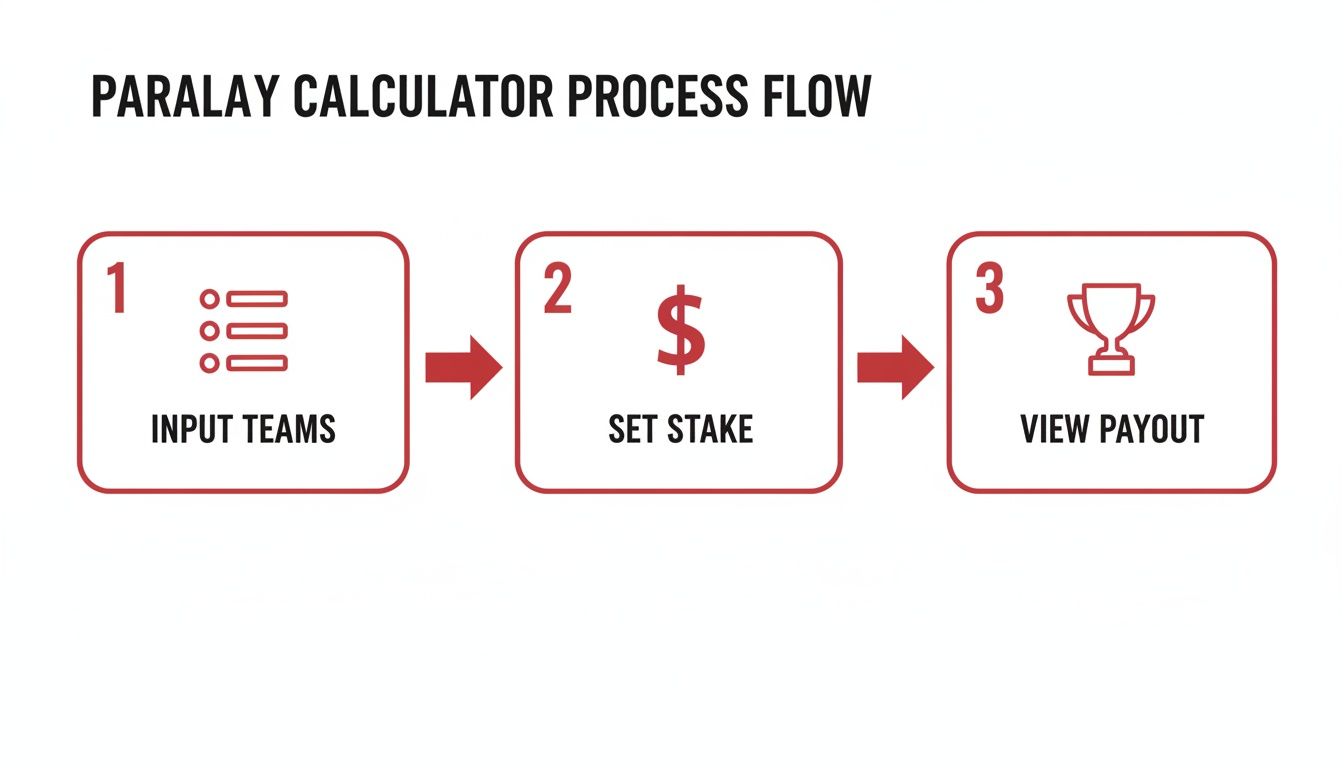
As you can see, you just pop in your teams, tell it how much to put on each combination, and it spits out all the potential payouts. Simple.
The Power of a Partial Win
Now for the scenario every sports bettor knows all too well: you almost nailed it, but one team lets you down. Let's imagine the Cowboys, Packers, and 49ers all handle their business, but the heavily favored Chiefs somehow get upset and lose.
If you had bet that standard four-team parlay, your ticket is dead. You lose every penny.
But with your round robin strategy, you're still in the money. Looking at your "by 2s" wagers, three of the six parlays are winners because they didn't include the Chiefs:
- Cowboys (-150) + Packers (+120): Your $10 bet pays $36.67
- Cowboys (-150) + 49ers (-180): Your $10 bet pays $22.22
- Packers (+120) + 49ers (-180): Your $10 bet pays $40.56
Your total return is $99.45 on the $60 you staked for this group, netting you a profit of $39.45. You got a pick wrong and still came out ahead. That's huge.
And what about the "by 3s" bets? In that same scenario, the single three-team parlay of Cowboys + Packers + 49ers is a winner. The other three combinations lose since they all had the Chiefs. That one winning ticket still brings back a good chunk of your investment, which is a much better feeling than a total loss. Understanding these combos is crucial for filling out your sports betting ticket correctly.
The real value of a round robin isn't just about hitting a massive payout. It’s about damage control. It turns what would have been a "total loss" into a "partial win" or at least a "small loss," which makes all the difference for staying in the game long-term.
The math starts to get complicated fast as you add more teams. A 3-leg round robin built from 4 teams (what we called 'by 3s') creates 4 separate parlay tickets (ABC, ACD, ABD, BCD). If you decided to put just $2 on each parlay, your total risk would be $8. This scaling is exactly why round robin calculators are essential tools. They let you see your total exposure and potential returns instantly, so you can place your bets at sportsbooks like Bookmaker.eu or BUSR with total confidence.
Once you've got the basics down, you can start digging into the more advanced strategies that really unlock the power of round robin betting. This is where things get interesting. Experienced bettors aren't just plugging random teams into a calculator; they're using specific tactics to manage their risk and hunt for serious value.
It's all about moving from a scattergun approach to something more surgical. Instead of just picking six teams you have a decent feeling about, you start building smarter wagers. You might balance a couple of heavy favorites with a few calculated risks on some underdogs. This is how you create scenarios where even if you don't hit every single leg, you can still walk away with a significant profit. That's what turns a decent Sunday into a fantastic one.
Many of the top sportsbooks, like BUSR or BetAnything, are perfect for this because they offer deep markets, giving you plenty of options to build these complex bets.
The Art of Keying a Team
One of the most powerful tactics in a sharp bettor's playbook is "keying" a team. The idea is simple: you find one team that you are absolutely, unshakably confident in—your lock of the week—and you build your entire round robin around that single pick.
When you "key" a team, you're telling the bet slip that this one pick must be included in every single parlay combination. If that key leg wins, your chances of turning a profit go through the roof. But if it loses, the entire round robin goes down with it. It’s a bold move reserved for picks you've done your homework on. Many of the best offshore sportsbooks like Bookmaker.eu and Heritage Sports make this easy to set up right on the bet slip.
- When to Use It: This strategy is perfect for a week where there's a huge mismatch on the schedule. Think of a top-tier NFL team at home against a struggling opponent with a backup quarterback. That's a prime spot for a key.
- How it Works: In a 4-team round robin, for example, you'd pick one team as your key. The system would then only create the 2-team or 3-team parlays that feature that specific team.
- The Risk: The main drawback is that it concentrates all your risk onto one game, which kind of goes against the natural diversification of a standard round robin.
It’s a high-risk, high-reward play that blends the safety net of a round robin with the aggressive upside of a traditional parlay.
By keying a team, you're essentially saying, "I'm so sure about this one pick that I'm willing to stake the success of my entire round robin on it." It’s a bold move that can pay off handsomely when your analysis is spot on.
Strategic Bankroll Management for Round Robins
This is what separates the pros from the amateurs. Proper bankroll management is crucial for any type of betting, but it's absolutely vital with round robins because of the multiple stakes involved. The single biggest mistake I see bettors make is not understanding their total exposure before hitting "submit."
A good parlay calculator round robin is your best friend here because it instantly clarifies your total risk.
Let's imagine you're building a 5-team round robin and breaking it down 'by 3s' on a site like Xbet. That structure creates 10 separate 3-team parlays. If you punch in $5 as your stake "per bet," your total risk isn't just $5—it's $50. That’s a critical distinction that can drain a bankroll fast if you're not paying attention.
The smarter way to approach it is to set your total budget first, then work backward. Decide you’re willing to risk $50 total on this wager. Then, you divide that $50 by the 10 combinations, which tells you your stake per parlay is $5. This simple habit prevents those accidental, oversized bets and keeps your bankroll healthy for the long haul.
Common Mistakes Bettors Make with Round Robins
Even experienced bettors can get tripped up by round robins if they aren't careful. I've seen it happen time and again. These mistakes are easy to make but can be brutal on your bankroll, turning what should be a smart, risk-managed wager into a costly lesson.
Knowing what to watch for is half the battle.
The "Stake Per Bet" Trap
By far, the most common and painful error is misunderstanding the 'stake per bet' field. A newcomer sees that box on the bet slip, punches in "$10" for a 5-team round robin 'by 3s', and thinks they're risking just ten bucks.
Wrong. That structure actually creates 10 separate parlays. At $10 per parlay, their actual total risk is $100.
This simple mix-up is a gut punch. Reputable offshore sportsbooks like Bet105 and Cosmobet always show a "Total Stake" or "Total Risk" summary on the bet slip, but it's on you to look at it before clicking "confirm."
Forgetting to Shop for the Best Lines
Another costly oversight is skipping the line shopping. When you're placing a round robin, you're not just placing one parlay—you're placing many. This means that even tiny differences in the odds get amplified across every single combination.
Think about it: getting +120 instead of +115 on just one of your picks can seriously juice the payout on every single parlay that includes that team.
Before you lock anything in, take a few minutes to compare odds. A quick check between sites like Bookmaker.eu, Heritage Sports, and BUSR might uncover better value that directly pads your wallet. Not doing this is basically leaving money on the table.
Getting Greedy with Too Many Teams
There’s always the temptation to load up a round robin with six, seven, or even eight teams. The thinking is that the built-in insurance of the format will protect you. But as you add more teams, the number of combinations—and your total risk—skyrockets.
Fire up a parlay calculator round robin tool and you'll see just how fast that cost balloons.
The whole point of a round robin is to manage your risk, not build a lottery ticket with a crazy high price tag. Chasing a monster payout by adding too many legs often creates a bet so expensive that you can win several of the parlays and still end up with a net loss.
Finally, don't fall into the trap of chasing a bad day with bigger and more complex round robins. If you're on a losing streak, a massive, multi-way wager is almost never the answer. Sticking to your strategy and having a crystal-clear understanding of your total risk is how you bet smarter, not harder.
Round Robin Betting FAQs
Got more questions? You're not alone. Here are some quick, no-nonsense answers to the most common things bettors ask about round robin parlays. Think of this as a final check to make sure you're ready to place your wagers with confidence.
Can I Still Win Money If Some Picks Lose?
Absolutely. In fact, that's the whole reason this bet type exists. A round robin isn't one big parlay; it's a bundle of smaller ones. As long as enough of your original picks hit to win at least one of those smaller parlays, you'll get a payout.
For example, let's say you built a 5-team round robin and bet it 'by 3s.' Even if two of your five teams lose, you could still have a winning 3-team combination in the mix, meaning you'd cash a ticket. It's a fantastic safety net that you just don't get with a traditional all-or-nothing parlay.
Which Offshore Sportsbooks Are Best for Round Robins?
From my experience, the top-tier offshore books like MyBookie, BetUS, and Bookmaker.eu are solid choices. Their bet slips are incredibly intuitive and make placing these complex wagers a breeze. They clearly show your total risk and potential return before you lock anything in, which is non-negotiable for this kind of bet.
It never hurts to shop around, though. I always recommend checking the odds at a couple of other reputable sites like Xbet or Heritage Sports just to make sure you're squeezing every last drop of value out of your combinations.
What Does "By 2s" or "By 3s" Mean?
Think of this as telling the sportsbook how big you want your mini-parlays to be. It's sometimes labeled as 'Ways' on the bet slip.
If you select 5 teams and bet them 'by 2s,' you're telling the calculator to create every single possible 2-team parlay from your picks, which works out to 10 separate bets. If you choose 'by 3s,' it creates every possible 3-team parlay (also 10 bets in this case). Your stake gets applied to each one of those smaller parlays.
Getting the 'Ways' setting right is the single most important part of using a parlay calculator round robin. It's what determines your total cost and how your payout is structured. Always double-check it.
Is a Round Robin Better Than Building Parlays Manually?
Functionally, they are the same thing—a round robin is just a massive time-saver. You could sit there and manually build dozens of individual parlay tickets, but why would you? The feature on sites like BUSR lets you do the exact same thing with a few clicks.
The odds don't change and the payouts are identical. The real advantage is efficiency and clarity. Seeing all your risk and potential reward in one clean ticket makes a parlay calculator round robin an invaluable tool for managing your bankroll and placing smarter, more organized wagers.
At USASportsbookList, we're all about giving you the edge. We provide in-depth reviews and head-to-head comparisons of the best offshore sportsbooks so you can bet with total confidence. Find trusted sites, grab exclusive bonuses, and check out our expert guides to level up your betting strategy. Explore our curated lists today at https://usasportsbooklist.com.