You're probably staring at a parlay slip on MyBookie, BetUS, or Bookmaker.eu right now, seeing a payout that looks a lot bigger than the straight bets you started with. That's the hook. A couple of picks together, and suddenly the return jumps enough to make you wonder whether the book is being generous or whether you're missing something in the math.
You're not missing anything mysterious. Parlay pricing is mechanical. Once you know the workflow, you can sanity-check almost any slip on offshore books like Heritage Sports, BUSR, BetAnything, Xbet, Bet105, or Cosmobet before you hit submit. That matters because the number on the screen isn't just a reward for being right on multiple games. It also reflects the pricing the sportsbook already built into each leg.

$250 + 100 Free Spins
All new players receive $250 in Free Bets and 100 Casino Spins. Join today and enter the promo code WELCOME in the cashier when you deposit $50 or more.

Get a 50% deposit bonus up to $1,000 with the code: CRYPTO1K. Valid on crypto deposits.


A bettor who knows how to calculate parlay odds usually makes fewer basic mistakes. You stop guessing what a push will do. You stop trying to multiply American odds directly. And you get a much better feel for whether the payout on your ticket looks normal for the legs you picked.
Why Understanding Parlay Math Matters
A new bettor usually learns parlays backward. First comes the payout. Then comes the excitement. Only after that do they ask how the number was built.
That's a bad order if you're using offshore books heavily. On a site like MyBookie or BetUS, it's easy to build a three-leg or four-leg parlay in seconds. The slip gives you a final price immediately, but if you don't know the math, you can't tell whether the number makes sense or how one changed leg affects the whole ticket.
The basic workflow is standard across calculators and books. You convert each leg from American odds to decimal odds, multiply the decimal numbers together, then calculate payout as stake × multiplier and profit as payout minus stake, and American odds should not be multiplied directly, as outlined in this parlay odds calculation guide. That's the whole engine.
Practical rule: If you can estimate a parlay before the bet slip does it for you, you're betting with your eyes open.
That skill also sharpens decision-making beyond sports betting. The same habit of checking price versus payoff is useful anywhere risk compounds. If you like tools that help improve trading P&L, the logic will feel familiar. Small edges and small pricing errors add up fast when multiple outcomes are tied together.
For beginners, the fastest way to stop treating parlays like lottery tickets is to understand the slip itself. If you want a broader primer on how these bets work on betting sites, this guide on parlay betting explained is a useful companion.
Decoding Sportsbook Numbers Odds Formats Explained
You're on MyBookie, you add a side at -110 and a prop at +150, and the bet slip spits out a parlay price right away. If you can't read the formats behind that number, you're trusting the book blind. That gets beginners in trouble fast, especially on offshore sites where house rules on pushes and canceled legs can change the final price after you place the bet.
Offshore books aimed at US bettors usually show American odds first. For parlay work, decimal odds are the clean format because they show the full return, with the sportsbook's vig already built into each leg's price. You are not adding vig later. It is already sitting inside numbers like -110 or -115.
American odds
American odds use a plus or minus sign.
- Positive odds show how much profit you'd win on a $100 stake.
- Negative odds show how much you need to risk to win $100 in profit.
A few common examples:
- +200 = 3.00 decimal
- +150 = 2.50 decimal
- +100 = 2.00 decimal
- -110 = 1.91 decimal
New bettors often read +150 correctly, then hesitate on -110. The shortcut is simple. Negative prices still convert into a decimal multiplier. They just return less because the book has priced that side as more likely, and because the vig is built into the market.
Decimal odds
Decimal odds show total return, not just profit. That includes your original stake.
That matters for parlays because decimals are the format you multiply. If one leg is 2.50 and another is 1.91, the combined price comes from those two numbers. That's also why decimal odds make push handling easier to understand on offshore books. If one leg pushes, the book usually grades that leg as 1.00, then recalculates the parlay with the remaining active legs.
For a US bettor using offshore sites, that point matters more than people realize. A push usually does not kill the whole parlay. It usually drops one leg out and reduces the payout.
Fractional odds
Fractional odds show profit relative to stake. They come up less often on MyBookie, BetUS, or Bookmaker screens, but you'll still see them in betting conversations and older strategy writeups.
If a price is listed at 3/2, you win $3 for every $2 staked, plus your stake back. If a parlay works out to about 3.78/1, the profit is about 3.78 times your stake.
You do not need fractional odds to calculate a parlay on an offshore sportsbook. You just need to recognize what they mean if you run into them.
Odds Conversion Quick Reference
| American Odds | Decimal Odds | Fractional Odds |
|---|---|---|
| +200 | 3.00 | 2/1 |
| +150 | 2.50 | 3/2 |
| +100 | 2.00 | 1/1 |
| -110 | 1.91 | about 10/11 |
| Parlay of +150 and -110 | 4.775 | about 3.78/1 |
The table is a working reference, not something to memorize. The practical habit is to spot the American number on the screen, know what it means, and switch to decimal when you want to check the math yourself.
The Core Calculation Turning Single Legs into Parlay Odds
A new bettor usually sees the parlay payout on MyBookie, figures the book already did the math, and clicks submit. Then a leg pushes, a line gets canceled, or the return looks shorter than expected. That is where doing the calculation by hand helps. You can check the slip before you place the bet, and you can spot grading issues after the game.

The three-step workflow
The process is simple:
- Convert each leg to decimal odds
- Multiply those decimal prices together
- Multiply the final decimal number by your stake to get total return
Profit is total return minus your original stake.
That is the whole calculation. The sportsbook already has the house edge built into each leg, so your job here is just to use the posted prices correctly. If you want a refresher on how that margin works, read this explanation of what the vig in betting means.
A clean three-leg example
Use a simple ticket:
- +200 = 3.00
- +150 = 2.50
- +100 = 2.00
Now multiply:
3.00 × 2.50 × 2.00 = 15.00
If you stake $20, your total return is:
$20 × 15.00 = $300
Your profit is:
$300 – $20 = $280
That jump catches beginners off guard. Parlay prices do not rise in a straight line. Each added leg multiplies what is already there, which is why the payout grows fast and also why one bad number can throw off your estimate.
The benchmark many bettors use
Two standard spread legs at -110 are the parlay every new bettor should know how to check.
- -110 = 1.91
- -110 = 1.91
- 1.91 × 1.91 = 3.65 if you carry the rounded decimals
That usually shows up on the slip at roughly +264 in American odds. Some books display a slightly different decimal because of rounding in the background, but the result should land in that range.
Here is the practical lesson. If your offshore slip for a two-leg -110 parlay is nowhere near that neighborhood, stop and look again. One leg may have moved, one market may be priced differently than you thought, or the book may be applying house rules you missed.
On offshore books, the safest habit is to rebuild the parlay from the leg prices on the screen instead of trusting the flashy payout box.
Pushes matter here too. If one leg in a three-leg parlay pushes, the book usually removes that leg and recalculates the ticket with the remaining prices. The pushed leg effectively becomes 1.00 in decimal terms, so it no longer changes the multiplier. That is a common source of confusion for US bettors using offshore sites, especially when they expected the full posted payout to stay intact.
Here's a quick visual explanation if you prefer watching the mechanics instead of reading them:
What works and what doesn't
What works on offshore books:
- Convert first: Turn American odds into decimals before you multiply anything.
- Check the slip after you do your own math: Use MyBookie or Bookmaker as confirmation, not as your first calculation.
- Keep an eye on rounding: Small differences happen, especially with negative odds and long parlays.
What doesn't:
- Multiplying American odds directly: +150 times -110 is not parlay math.
- Assuming every two-leg parlay pays about the same: A small change from -110 to -115 changes the final number.
- Ignoring pushes and canceled legs: Those settlement rules can cut the payout even when the ticket still wins.
Understanding the Vig and How It Affects Your Payout
A lot of bettors learn how to calculate parlay odds and still miss the most important part of the result. The payout isn't built from fair probabilities. It's built from sportsbook prices.
That distinction matters on every offshore book, whether you're betting at BetUS, BUSR, Cosmobet, or Heritage Sports. The house edge is already inside each leg before you ever multiply anything. So when you build a parlay, you're not just stacking picks. You're stacking the sportsbook's margin too.
Fair payout versus sportsbook payout
A useful benchmark makes the difference obvious. A common two-team NFL spread parlay pays about 2.64:1, while the mathematically true payout for two 50/50 events would be 3:1, as noted in this overview of parlay pricing and house edge.
That gap is the vig.
If you price two coin-flip style outcomes as if they were even, the return should be higher than what the sportsbook offers. But standard spread odds often come with a price like -110 instead of true even money. Once those prices are multiplied together in a parlay, the shortfall becomes visible.
Why the gap grows
The mistake beginners make is thinking the parlay payout is only about how hard it is to hit multiple picks. Difficulty is part of it, but pricing is the bigger practical issue.
Each leg carries house margin. Then you multiply those leg prices together. That means the sportsbook's built-in edge doesn't disappear when you parlay selections. It becomes part of the final number.
If a parlay payout feels lower than your gut expected, the slip is usually reflecting the vig you ignored on each leg.
That's why a bettor who only chases bigger headline payouts can still end up taking weaker prices overall. If you want a straightforward primer on that baked-in edge, this explanation of what the vig in betting means helps connect the pricing on single bets to what you see on parlays.
The practical takeaway
When you compare parlays on offshore sites, don't ask only, “What does it pay?” Ask, “What prices am I multiplying?”
That question keeps you from overvaluing long tickets just because the final return looks attractive.
A common mistake for a lot of new bettors occurs. A game lands on the number, gets postponed, or has a leg voided, and suddenly the payout on the final ticket doesn't match what they expected.
On most sportsbook calculators and settlement rules, a push or canceled leg is typically treated as 1.00 in the calculation, which reduces the wager to the next lowest number of remaining legs, as described by this parlay calculator explanation.
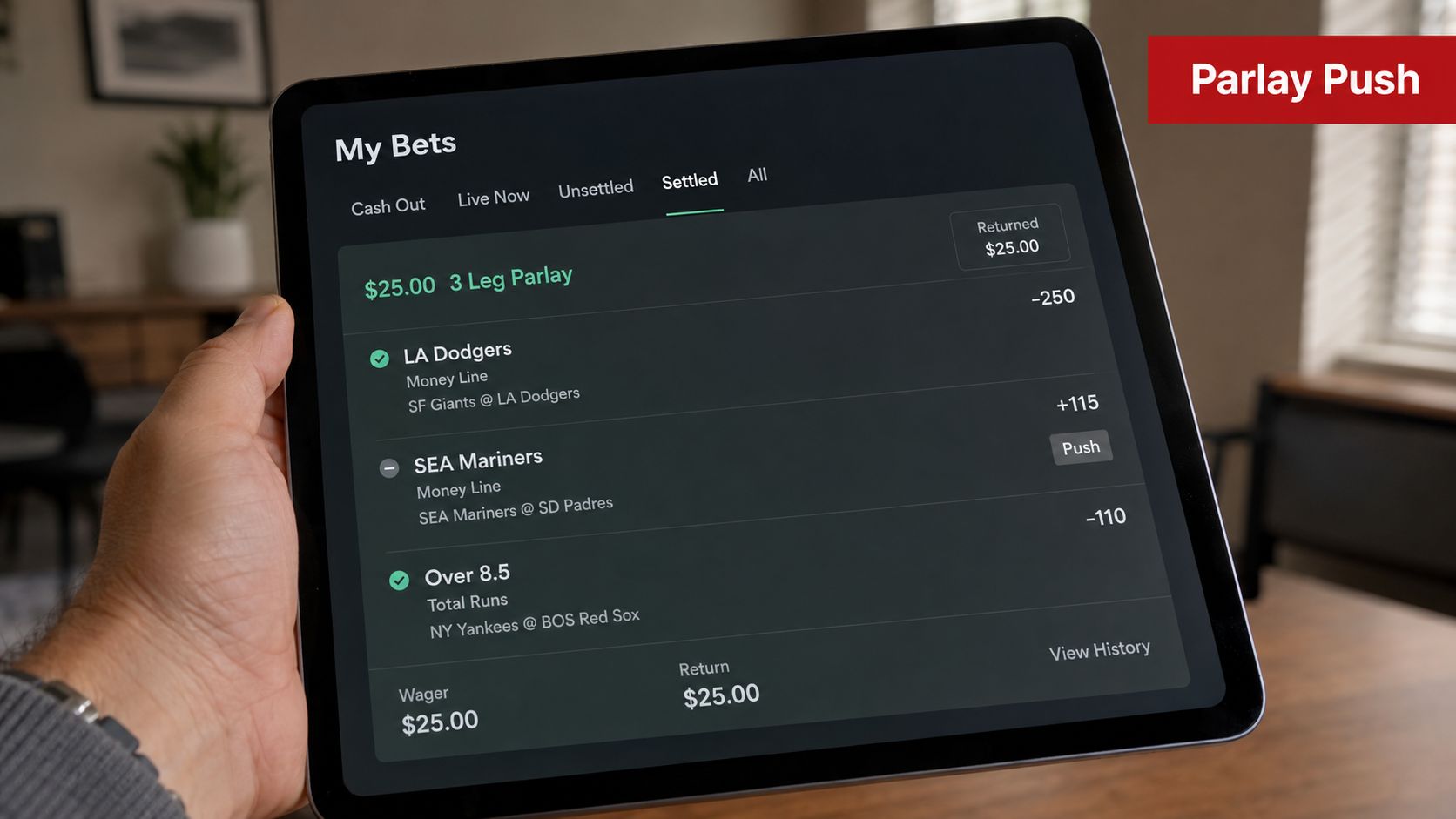
What a push actually does
A push doesn't usually kill the whole ticket.
Instead, the book typically removes that leg from the working price. Since 1.00 doesn't change a multiplication result, the practical effect is that the leg stops contributing any extra payout. Your parlay gets recalculated based on the remaining active selections.
That's why a larger parlay can settle like a smaller one if one leg doesn't stand.
How to think about it on offshore books
If you build a ticket at MyBookie, BetUS, Bookmaker.eu, or BUSR and one selection is voided, don't expect the original flashy payout to remain. The slip has to be repriced because one of the multipliers is gone.
Keep these habits in mind:
- Check house rules before kickoff: Books usually follow the same broad logic, but wording around postponed games can differ.
- Treat pushed legs as removed, not lost: Your ticket is usually reduced, not busted.
- Watch same-game and live markets carefully: Settlement details matter more when timing and grading get messy.
A pushed leg is usually dead weight, not a dead ticket.
That single idea clears up a lot of confusion for beginners.
Common Mistakes and Quick Calculation Tips
You're on MyBookie, the bet slip shows a payout that looks right, and you still need to know whether the number makes sense before you click confirm. That habit saves beginners money, especially on offshore books where a push, voided leg, or bad manual conversion can leave you wondering why the return dropped.
The mistake that shows up first is simple. New bettors try to multiply American odds as written. That breaks the math right away.
Use the same routine every time.
The mistakes that keep showing up
- Skipping the decimal conversion: American odds are fine for reading prices, but decimal odds are what you multiply in a parlay.
- Forgetting the vig is already baked in: The book has built its edge into each leg before you ever combine them. A parlay does not remove that cost. It stacks it.
- Misgrading a push in your head: On offshore sportsbooks, a push usually drops out of the ticket and the parlay gets repriced with the remaining legs.
- Trusting the slip without a quick check: Sportsbooks are fast, not flawless. If the payout looks off, run the math yourself and compare.
A good mental check is this: two standard -110 legs should price out to roughly +264 after conversion and multiplication, as noted earlier. If your slip is nowhere close, stop and check the inputs.
Keep the workflow tight:
- Write down each leg
- Convert each price to decimal odds
- Multiply the decimals
- Multiply by your stake to get total return
- Check house rules for pushes, cancellations, and postponed games
If you want to test different combinations, or see how a reduced ticket changes after one leg gets voided, a parlay and round robin calculator for offshore sportsbook betting is a practical shortcut.
One last mistake beginners make is treating the listed payout like a promise. It is only the expected return if every active leg stands and wins under that book's grading rules. On offshore sites, that last part matters more than people think.