You’re probably here because you’ve had both sides of the first basket market already. You’ve hit a juicy number on MyBookie or BetUS and felt like a genius before the first timeout. You’ve also watched your pick lose the opening tip, touch the ball once, and disappear before the game even settles in.
That swing is exactly why first basket props keep pulling bettors back in. The market is fast, the prices are attractive, and the edge feels close enough to touch if you can stop treating it like a dart throw.
Top Offshore Sportsbook Bonuses for September 2026


$1000 + $10 Casino Chip
New customer offer. First Deposit Bonus Up To $1,000 + $10 Casino Chip.


$750
Get a 150% Sport Free Play bonus up to $750 on your first Deposit up to $500. The minimum deposit is $50.
The difference between random guessing and repeatable first basket predictions is process. Not certainty. Not magic. Process. If you bet these props on offshore books like MyBookie, Xbet, BetAnything, Bet105, Cosmobet, BUSR, Bookmaker.eu, Heritage Sports, or BetUS, you need a workflow that starts before the odds screen and ends with a price comparison, not a gut call on the biggest name in the game.
Why First Basket Betting Is The Ultimate High-Risk High-Reward Prop
A first basket ticket gives you instant feedback. That’s part of the appeal and part of the trap.
You can bet a player at a strong number on Bookmaker.eu or Heritage Sports, get a clean opening script, and cash in less than a minute. You can also make the right read and still lose because the wrong player takes the first shot, the shot rims out, or the possession ends with free throws instead of a made field goal. This market rewards good prep, but it also punishes anyone who expects clean outcomes every night.
That’s why casual bettors often misread what’s happening. They assume first basket props are pure lottery bets because the sample on any single game is tiny. The sharper view is different. The event is volatile, but the setup isn’t random.
The appeal is obvious
On offshore books like MyBookie, BetUS, Xbet, and BUSR, first basket prices can be big enough to tempt anyone. A number like +800 looks exciting because it can turn one correct read into a meaningful return. It also encourages bad habits. Bettors start chasing names instead of possessions.
The market moves fast, so people default to star power. That’s usually where bankrolls leak.
A good first basket bet doesn’t start with “Who is the best scorer?” It starts with “Who controls the first possession, and where does that possession go?”
What makes this market beatable
The edge comes from narrowing chaos. You’re not trying to predict the whole game. You’re trying to predict the first clean scoring sequence.
That means asking better questions than the public asks:
- Who likely wins the tip
- Which team has the better opening-possession structure
- Which starter usually gets the first touch or first shot
- Which book is hanging the weakest number
This is why experienced bettors keep coming back to the market. The upside is high, but so is the mistake rate for anyone betting on reputation alone.
The hard truth
Even strong first basket predictions lose often. That doesn’t mean the process is broken. It means the market has variance baked into it.
If you want to survive it, you need discipline. Small sizing. Good records. Price sensitivity across BetAnything, Cosmobet, Bet105, and Bookmaker.eu. The bettor who treats first basket props like a model-driven niche can last. The bettor who treats them like a nightly parlay booster usually won’t.
Decoding The First Basket Market And Its Key Variables
The first basket market looks simple from the outside. Tip goes up, somebody scores, ticket wins or loses. In practice, it’s a short chain of connected events, and each link matters.
If you want sharper first basket predictions, break the market into sequence, not outcome. That’s how you stop guessing and start filtering.

Start with the possession path
The most useful way to frame the market is this:
- One team controls the opening possession
- One action creates the first shot
- One player finishes or fails
That sounds obvious, but most bettors skip straight to step three. They look at a list of names on MyBookie or BetUS and choose the best scorer, not the most likely first scorer. Those aren’t the same thing.
A team’s opening set often favors a certain role. Some teams open through a big at the rim. Others use a wing curling into space or a guard attacking downhill. First basket predictions get stronger when you track those early-game habits instead of full-game scoring averages.
Home court matters more than people think
One baseline matters before you even get into player names. Historical data shows home teams score the first basket about 52-54% of the time across NBA history, a stable edge tied to jump-ball officiating and home-crowd energy during the opening stretch, according to JediBets' breakdown of NBA first baskets.
That edge isn’t enough on its own to place a bet. It is enough to shape your starting assumptions.
If you’re building even a basic framework, home side gets the first look. Then you test whether the matchup supports or weakens that bias.
Practical rule: Don’t force a road player just because the odds look sexy. If the home team already owns the baseline edge and also projects better on the tip, you’re betting uphill.
Team variables and player variables are different
A common error among many bettors is a lack of precision in their approach. Team-level edges decide who gets the first real chance. Player-level edges decide whether that chance turns into points.
A clean process separates the two.
| Layer | What to study | Why it matters |
|---|---|---|
| Team level | Tip control, home floor, opening play style | Determines first possession quality |
| Player level | First-shot tendency, finishing type, role in starting unit | Determines who gets and converts the look |
That distinction matters if you’re trying to think like a model instead of a fan. If you want a useful primer on that mindset, DataTeams' predictive analytics resource is a good read because it frames prediction as pattern recognition, not narrative.
Odds movement still matters in a micro market
First basket props are thin compared with sides and totals, but they still react to lineup news, market demand, and sharper books posting cleaner numbers first. If you’re betting offshore, keep an eye on screens that show how prices shift before tip. A betting line movement tracker for sportsbook prices helps you spot whether a player is drifting to a better number or getting steamed before you lock in a ticket.
The bettor who understands the sequence has an edge over the bettor who just recognizes names. That doesn’t remove variance. It gives variance fewer chances to ambush you.
Assembling Your First Basket Data Toolkit
A workable first basket system doesn’t need a giant database. It needs the right inputs in the right order.
Most bettors over-collect. They dump in game logs, season averages, usage charts, and random trend notes, then wonder why every matchup still feels murky. A cleaner toolkit starts with one question: who is most likely to create the first scoring opportunity?
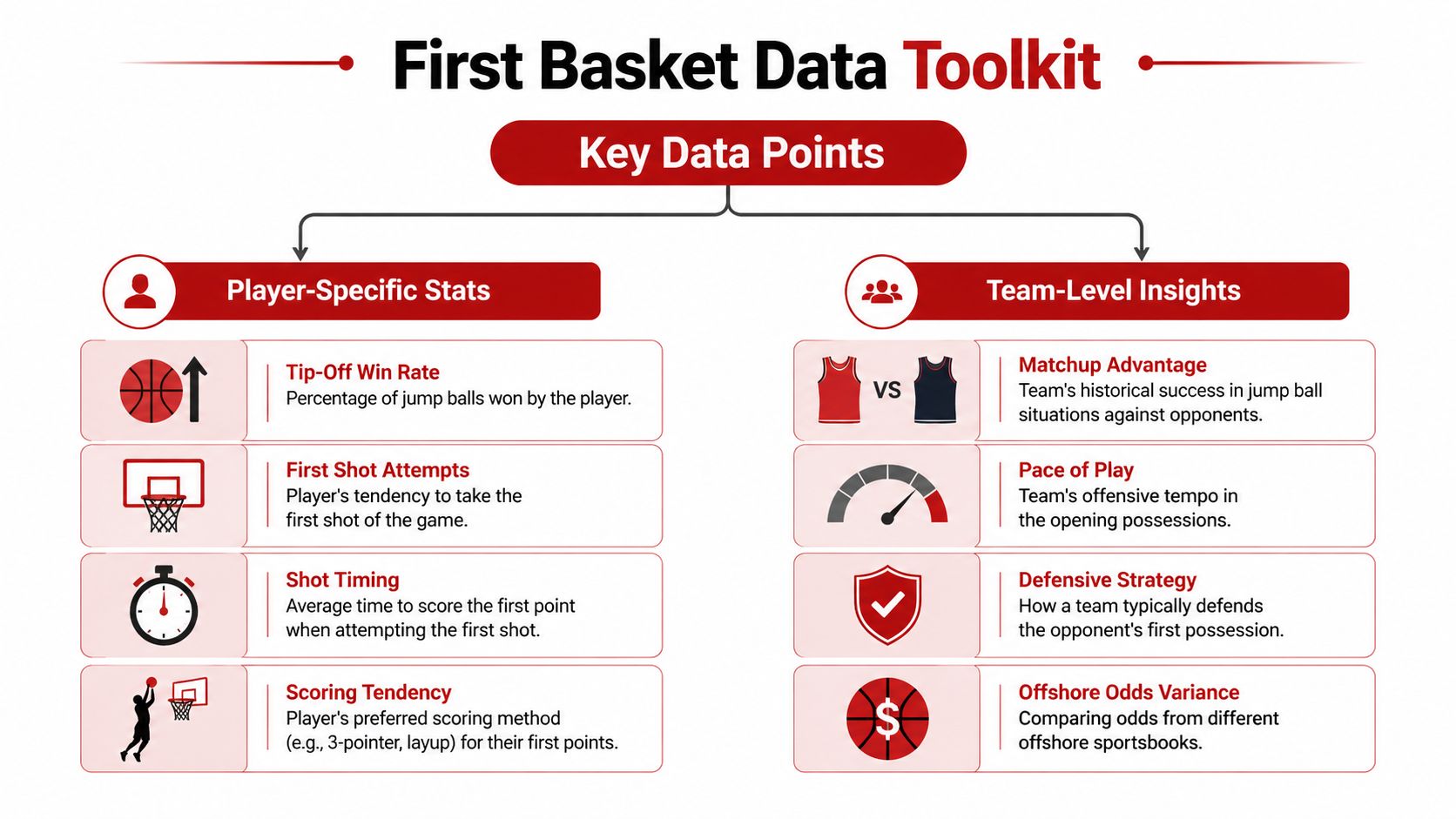
The foundation is tip control
The most underused input in first basket predictions is the jump ball. That’s a mistake.
The opening possession shapes everything that follows. The impact of tip-off win probability is a foundational but often overlooked factor. A team with a center carrying a 65.5% tip-win rate can increase its primary interior player’s first basket probability by 15-25% compared with losing the jump ball, according to OddsIndex's discussion of first basket matchups.
That doesn’t mean you blindly bet centers. It means you treat tip control as the gatekeeper variable. If a team is likely to secure the ball first and its opening structure favors an interior touch, the big immediately becomes more live than the market often reflects on offshore books like Xbet, Bet105, and Cosmobet.
Build your sheet in layers
A pregame sheet should be simple enough to use daily and strict enough to keep you from freelancing. Mine is built around four categories.
- Projected jump-ball edge: This is the first filter. If one side has a clear advantage at center, that team gets priority in the first scan.
- Opening-possession pecking order: Which starter usually gets the first touch, first action, or first clean look.
- Finish type: Is the likely attempt a rim finish, pull-up, catch-and-shoot, or post touch.
- Book price: Compare MyBookie, BetUS, BUSR, Heritage Sports, and Bookmaker.eu before making any decision.
That last category matters as much as the basketball angle. A correct read at a bad number is still a bad bet.
The player-level stats that actually matter
Once you’ve narrowed the likely team possession, shift to the starter group. You’re looking for specific role behavior, not broad scoring talent.
Track these player notes:
- First-shot involvement: Which starters regularly function as the first trigger in the offense.
- Shot location fit: Some players need a set to get their preferred look. Others can score off a broken first possession.
- Conversion comfort: A player who gets the first look but forces lower-quality early attempts may not be worth the price.
- Starting lineup stability: Sudden rotation changes can wreck assumptions based on prior games.
If the tip says one thing and the opening lineup says another, trust the possession path first and the name second.
Team context that bettors skip
Not every team uses the first possession the same way. Some coaches script a clean opening action. Others let the possession flow into early offense. Some defenses switch aggressively from the opening whistle, which can force the ball away from the player the market expects.
That’s why your toolkit should include qualitative notes, not just hard numbers. I want to know:
- Whether the team prefers early paint pressure
- Whether the opponent protects the rim well on initial actions
- Whether the likely first scorer depends on a set play or can create off movement
Those notes help when offshore books post a familiar star at a short number while a better structural fit sits deeper on the board at BetAnything or Bookmaker.eu.
Keep the sheet practical
You don’t need a polished dashboard. A simple spreadsheet or betting journal works if it’s organized. For each game, list the likely tip winner, the top two first-possession candidates on that team, and the best available price across your books.
Then add one line that matters more than most bettors realize: why this player is live on the first possession. If you can’t explain it in one sentence, you probably don’t have a real edge.
That rule cuts out a lot of weak bets.
Building Your Predictive Model A Step-By-Step Process
A profitable first basket process should feel repeatable. Not rigid, but repeatable. You want a workflow you can run every slate whether you’re betting on MyBookie, BetUS, Bookmaker.eu, or Heritage Sports.
The key is to think in ranked outcomes. You are not predicting a single destiny. You are building a short list of the most plausible first scorers, then deciding whether the available prices justify a bet.

Step one begins at center
A practical first basket model starts with the jump. A successful methodology involves evaluating the center matchup, where taller wingspans win about 55-65% of tips, then identifying first-possession players because starters take 70% of first shots. It also means checking price against expected hit rate, since +800 odds need an 11.1% break-even rate and are more attractive when the player has a 12-15% historical hit rate, based on the first basket methodology outlined in this video analysis.
That sentence contains most of the framework. The trick is using it without overcomplicating it.
The daily workflow
I use a five-step screen before betting any first basket prop.
Project the tip winner
Start with the center matchup. Height, wingspan, and jump-ball tendency matter because the opening possession is the root of the whole market.Map the first action
Ask what the offense is likely to run if it controls the tip. Is the ball entering the post, swinging to the wing, or flowing into a guard-led action?Narrow the shooters
Don’t carry five names. Carry two, maybe three. The goal is to identify the players most likely to take the first real shot.Check conversion fit
Some players take early attempts they don’t finish efficiently. Others get cleaner looks because the first action is designed for them.Compare price across books
The same read can be playable at Xbet and a pass at BetUS. Price decides whether analysis becomes a bet.
A hypothetical matchup
Take a made-up game between two contender-level teams with strong frontcourts and high-usage wings.
Team A has the better jump-ball profile. Team B has the stronger half-court defense. Team A also tends to open games by putting pressure on the rim before settling into perimeter actions. That immediately pushes the model toward Team A controlling the first meaningful possession and toward a first basket candidate who can finish inside.
Now compare two player types:
- Player One: high-profile wing, popular with the public, often priced shorter on MyBookie and BUSR
- Player Two: starting big, less public interest, better fit for the opening action, sometimes overlooked on BetAnything or Bet105
The public usually gravitates to Player One because he’s the top scorer overall. The model may prefer Player Two because the first possession is more likely to generate his shot.
The market often prices fame faster than it prices opening-possession role.
How to rank candidates
The point isn’t to force one name in every game. Some games produce no bet because your top options are priced correctly.
A simple ranking grid helps:
| Candidate type | Tip support | Opening set support | Price quality | Decision |
|---|---|---|---|---|
| Starting center | Strong | Strong | Fair to good | Viable |
| Starting wing | Moderate | Strong | Short | Often pass |
| Starting guard | Weak | Moderate | Big number | Only if role fits |
That table won’t make picks for you, but it keeps the thought process clean. It also protects you from chasing a longshot just because the payout looks fun.
Use model thinking, not model theater
A lot of bettors say they have a model when they really have a list of favorite angles. A real model has a sequence, a weighting logic, and a rule for saying no.
If you want a useful broad guide on that discipline, NILG.AI's piece on how to build predictive models is worth reading because it reinforces the need to define inputs, test assumptions, and avoid dressing opinion up as math.
You don’t need machine learning to make better first basket predictions. You do need consistency.
When to pass
Here, most bettors lose the plot. They think because they’ve done the work, they deserve a bet.
You don’t.
Pass when:
- The likely tip winner is unclear
- The opening action could feed too many players
- The book has already crushed the best number
- Lineup uncertainty changes first-possession roles
- You can’t separate your top choice from the next two names
That last point matters a lot on offshore books. If MyBookie, Xbet, and Bookmaker.eu all agree tightly on the same player range, your edge may already be gone.
For broader screens that complement this kind of projection workflow, some bettors also compare outputs from college basketball computer prediction tools. The sport is different, but the habit of translating team-level probability into bet selection is useful.
Keep records on the right things
Most first basket logs are too shallow. Bettors only track wins and losses.
Track these instead:
- Did your projected team win the tip
- Did your projected player get the first shot
- Was the shot quality what you expected
- Did you beat the best available number
- Was the bet still correct even though it lost
That record tells you whether your process is strong and your variance is noisy, or whether your reads are weak and the occasional hit is fooling you.
Finding Value On Offshore Sportsbooks Like MyBookie and Xbet
The first basket market is won at the number as much as the read. If your process identifies the right player class but you keep betting the worst available price, you’ll grind away any edge.
That’s why line shopping matters more in this market than many bettors realize. Offshore books don’t always move in sync. MyBookie, Xbet, BetUS, Bookmaker.eu, Heritage Sports, BUSR, Cosmobet, BetAnything, and Bet105 can hang noticeably different prices on the same player because this is a thinner prop market with less efficient pricing.
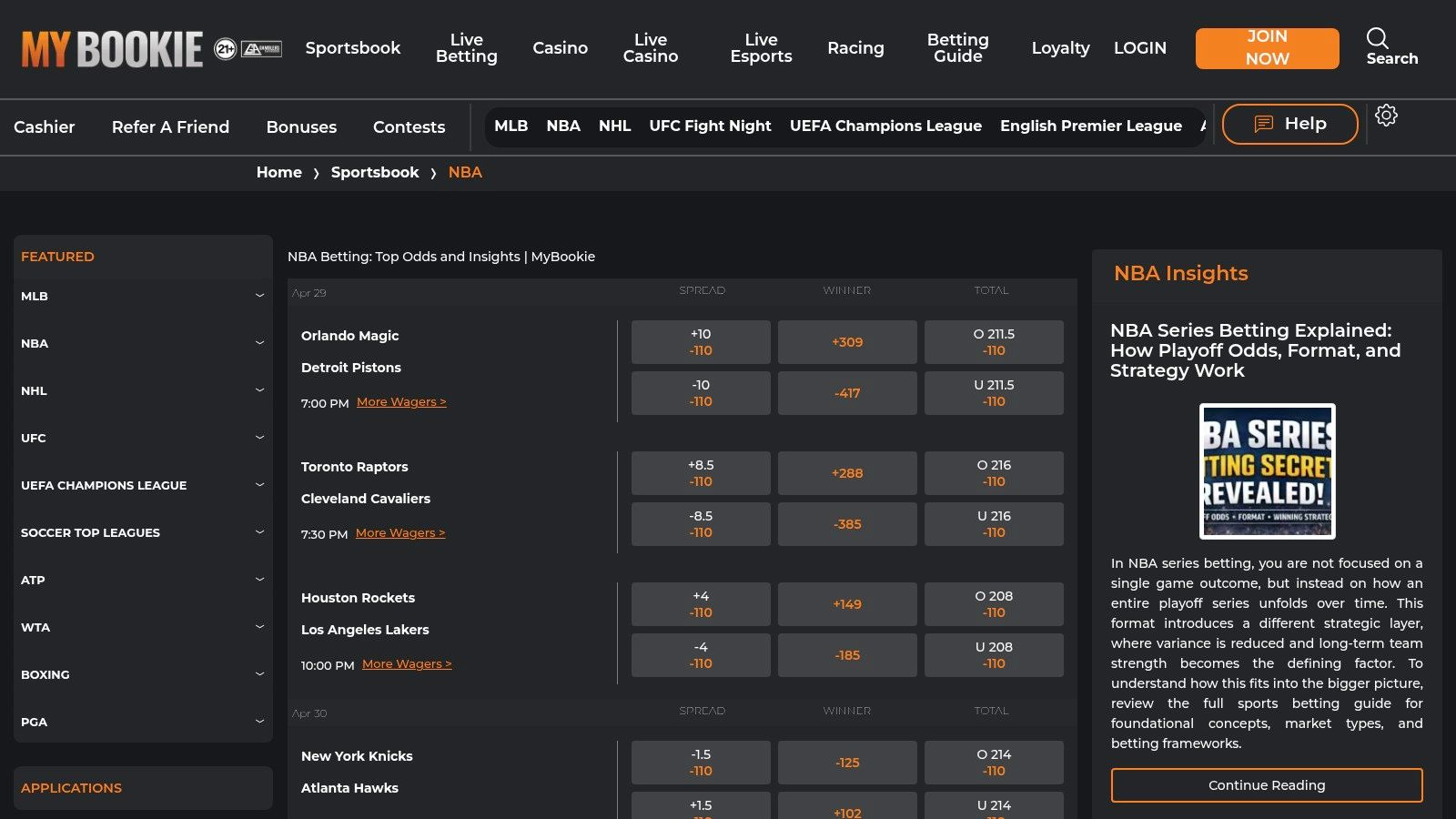
Price turns a good read into a good bet
A lot of bettors stop after player selection. That’s incomplete.
A first basket prediction only becomes actionable when your estimated probability beats the implied probability in the odds. Sometimes the right player at MyBookie is still a pass because Bookmaker.eu or Xbet offers a better number later. Sometimes the market gets it wrong and leaves a role player hanging at a stale price because most action comes in on stars.
That’s where niche value shows up.
Streaks matter, but only in context
One profitable wrinkle in this market is catching short-term role changes before books fully react. Recent 2026 data highlighted streaky first basket scorers such as Donte DiVincenzo at +27.70 Units and 185% ROI, and Jaden McDaniels at +26.10 Units and 435% ROI, showing how hot stretches can create value when offshore books are slow to reprice, as noted in this first basket trends piece.
The important part isn’t the streak itself. It’s why the streak exists.
Maybe a team changed its opening script. Maybe a starter’s role expanded. Maybe the matchup pushed early offense toward a less obvious scorer. If you can explain the mechanism, the streak may be actionable. If you’re just tailing makes, you’re probably late.
Don’t bet a streak because it happened. Bet it only if the underlying first-possession role still supports it.
How to compare offshore books
Different offshore books excel in different ways. Some post early. Some move slower. Some are better for niche props. That makes a multi-book approach valuable.
Here’s a practical way to shop:
- MyBookie: Good for broad menu access and fast checks on mainstream NBA prop boards.
- Xbet: Useful when you want to compare whether a player’s number drifted relative to other offshore markets.
- Bookmaker.eu: Often worth checking because sharper pricing there can tell you whether another book is stale.
- BetUS and Heritage Sports: Good comparison points when the market is split on star players versus role players.
- BUSR, BetAnything, Bet105, and Cosmobet: Worth scanning because thinner books can leave softer first basket prices hanging longer.
You don’t need to bet every book every night. You do need enough outs to avoid taking the worst number.
A simple value checklist
Before placing a first basket prop, I want four boxes checked:
- Structural support: The player fits the likely opening possession.
- Role support: The starting lineup and first-action tendencies point toward him.
- Price support: At least one offshore book offers a number that beats the rest of the screen.
- Bankroll support: The wager size matches the market’s volatility.
If one of those is missing, the bet usually isn’t worth it.
Bankroll discipline is part of the edge
This market can make bettors reckless because results land so quickly. A couple of hits at big prices can trick you into overbetting. A couple of misses can trigger chasing.
That’s a bad combination. First basket props should stay a small-slice market even for experienced players. You want enough exposure to capitalize on edge, not enough to let a rough week damage your bankroll.
For bettors who are still learning how to judge whether a number is worth taking, this guide to betting for value instead of chasing payouts is a useful framework. It reinforces the main rule of this market: long odds are not the same thing as value.
Advanced Tactics and Common Pitfalls To Avoid
Once your basic first basket process is stable, the next step is refinement. Not adding noise. Refinement.
That means improving how you classify player types, how you respond to small-sample data, and how you separate a good angle from an overfit story. The sharpest bettors in this market don’t just collect more information. They filter harder.
Smarter modeling beats louder opinions
There’s real upside in moving beyond manual notes and into structured player grouping. Advanced first basket modeling can adapt game-winner frameworks through c-means clustering on player stats, and those models have been described as outperforming human experts by 5-10%, producing 18-28% hit rates on player props and finding a 15% edge over the vig, according to Bryant University's data science research paper.
The practical takeaway isn’t that everyone needs to build a complex model tonight. It’s that classification matters. Grouping players by role, tip-linked opportunity, and first-shot tendency is more useful than grouping them by points per game.
A rim-running starter and a high-usage shot creator may both be strong scorers overall, but they aren’t interchangeable in the first basket market.
Advanced edges that are worth exploring
Experienced bettors can push their process further with a few targeted upgrades:
- Referee tendencies: Some bettors log jump-ball officiating patterns and opening whistle behavior. It’s niche, but it can sharpen a close center matchup.
- Opening-play clustering: Group teams by how they start games, not how they score over four quarters.
- Role-based buckets: Separate players into interior finishers, scripted wings, and self-created guards instead of treating all starters equally.
- Live reaction discipline: If you bet into offshore books that update quickly, be careful about chasing after a scratch or late market move unless you’ve already mapped the replacement role.
The more complex your system gets, the more important your “no bet” rule becomes.
The mistakes that empty bankrolls
Most losing first basket bettors don’t fail because they lack information. They fail because they misuse it.
Big warning: A hot streak is not a license to double your unit size. This market can humble a good process for multiple nights in a row.
Three mistakes show up constantly:
- Chasing after near misses: Your player got the first shot and missed. That hurts, but it doesn’t justify a larger bet on the next game.
- Overpaying for obvious names: Public stars often get priced as if overall scoring automatically translates to first-score role.
- Treating small samples as certainty: Recent results matter only if lineup role, tip control, and opening script still match.
Don’t confuse action with edge
A lot of bettors feel pressure to have a first basket play on every televised game. That’s entertainment thinking, not betting thinking.
You are allowed to pass. In fact, passing is a core skill in this market. If the tip edge is muddy, the first shot distribution is spread out, and the offshore board has already tightened, the best move is no move.
Some of the most profitable first basket predictions are the bets you never place because the market gave you no pricing mistake to attack.
The long-term mindset
This market rewards patience more than confidence. Confidence helps you fire when the setup and price align. Patience keeps you from forcing volume when they don’t.
The bettors who last on MyBookie, BetUS, Xbet, BetAnything, Bet105, Cosmobet, BUSR, Bookmaker.eu, and Heritage Sports usually share the same habits. They compare numbers. They log outcomes beyond wins and losses. They stay skeptical of their own hottest takes. They bet smaller than their excitement tells them to.
That’s the key advantage. Not predicting the future perfectly. Building a process that survives reality.
If you want a better way to compare offshore books before locking in first basket props, USASportsbookList is a solid place to review sportsbook options, bonus structures, and betting features for US players who want more than one out on niche markets.