You bet a side correctly for 57 minutes, then an empty-netter, a bad penalty, or a goalie pull wrecks the ticket. That’s the pain point that pushes a lot of hockey bettors toward nhl player prop bets.
Props let you isolate the part of the game you understand. Maybe you don’t trust a full team moneyline, but you do trust a top-line winger’s shot volume, a power-play quarterback’s assist path, or a goalie facing a heavy workload. That’s a different kind of edge. It’s narrower, more researchable, and often easier to price if you’re using offshore books like MyBookie, BetUS, Xbet, Bookmaker.eu, Heritage Sports, BUSR, BetAnything, Bet105, and Cosmobet.

$250 + 100 Free Spins
All new players receive $250 in Free Bets and 100 Casino Spins. Join today and enter the promo code WELCOME in the cashier when you deposit $50 or more.

Get a 50% deposit bonus up to $1,000 with the code: CRYPTO1K. Valid on crypto deposits.


The appeal is simple. A star can cash his points prop even if his team loses. A goalie can fly over saves in a game his club never really controls. A defenseman can clear blocked shots because the matchup forces long defensive-zone shifts. Team result still matters, but it matters less than role, usage, and game script.
Most casual bettors stop at box-score stats. That’s where mistakes happen. NHL props get priced off public names and recent results, but the better angles usually come from deployment, line mates, shot quality, and whether the market is hanging a stale number. Offshore books help because they often post broader prop menus, niche alternatives, and useful crypto funding options. They also give you more spots to line shop, which matters on props more than people think.
A half-point difference, a better plus price, or a softer under juice can be the difference between a good bet and a pass. That’s the whole game with nhl player prop bets. Not action for the sake of action. Better entries, better prices, and fewer guesses.
Beyond the Puck Line An Introduction to Player Props
Traditional hockey betting asks you to solve a messy problem. You need the right team, the right game state, and often the right late-game variance. Even if your handicap is strong, one odd bounce can flip the result.
Player props cut that problem down to size. Instead of betting the whole game, you’re betting a stat tied to one player’s role. That could mean a center’s points, a winger’s shots on goal, a defenseman’s assists, or a goalie’s saves. You stop depending on every skater on the roster and start focusing on one usage profile.
Why props fit hockey so well
Hockey is chaotic at the team level, but player roles are often clearer than the final score. Top-unit power-play forwards get recurring touches. Volume shooters keep firing even when the finish isn’t there. Defensive defensemen rack up blocks in the right matchup regardless of who wins.
That creates more controlled betting decisions.
Practical rule: If you can explain exactly how a player gets to the number, you have a prop worth considering. If your reasoning is just “he’s due,” you probably don’t.
Offshore books such as MyBookie and Xbet make this style practical because they usually offer a deep menu beyond moneyline, puck line, and total. You’re not limited to the same few mainstream choices. You can target a specific stat that matches your read on the game.
Where newer bettors usually go wrong
Most losses on nhl player prop bets come from betting names, not situations. A bettor sees a superstar and clicks the over without checking the matchup, recent ice time, power-play role, or whether the number has already been pushed too far.
A better approach is narrower:
- Start with role: Top line, second line, power play, penalty kill.
- Check the stat path: Is this player creating shots, finishing chances, or relying on teammates?
- Compare books: MyBookie may hang a different price than BetUS or BUSR on the same market.
- Know your market: Shots props behave differently from points props. Saves behave differently from goal scorer bets.
That’s why props are so attractive. They reward detail. If you’re willing to track deployment and price shop across BetAnything, Xbet, Bet105, Cosmobet, Bookmaker.eu, and Heritage Sports, you can often find cleaner opportunities than you’ll get on a full-game side.
What Exactly Are NHL Player Prop Bets
Think of a player prop like a personal stat checkpoint. The sportsbook sets a number for one player, and you bet whether he finishes over or under it. That’s the core of nhl player prop bets.
If the book posts a skater at 1.5 points, you’re only asking one question. Will he get 2 or more points, or 1 or fewer? That’s very different from betting his team to win the game.
Props versus team bets
A moneyline ticket depends on the final result. A puck line ticket depends on the margin. A game total depends on combined scoring. Player props focus on one athlete’s output.
That difference matters because the same game can produce opposite outcomes for team bettors and prop bettors. A team can lose 4-3, while its top center still cashes over 1.5 points. A goalie can lose while still flying over saves. A sniper can score anytime and still end up on the wrong side of the moneyline.
That’s why many bettors treat props as a separate discipline, not just an add-on.
How the line works
Sportsbooks such as BetUS or MyBookie post a line and attach odds. The line is the stat threshold. The odds tell you the price.
Examples:
- A center’s over/under 0.5 assists
- A winger’s over/under 3.5 shots on goal
- A goalie’s over/under saves
- An anytime goal scorer price, where the bet wins if the player scores at least once
The line isn’t random. Oddsmakers build it from recent production, role, matchup, and market action. Your job is to decide whether that number is too high, too low, or priced fairly.
The cleanest prop bets usually come from disagreement with the line, not from liking the player.
The most common markets
Here’s a quick-reference table you can use when browsing MyBookie’s NHL board.
| Prop Market | Description | Example Bet (at MyBookie) |
|---|---|---|
| Points | Combined goals and assists by one skater | Player over 1.5 points |
| Assists | Whether a player records helpers only | Player under 0.5 assists |
| Shots on Goal | Pucks officially recorded on net | Player over 3.5 shots on goal |
| Anytime Goal Scorer | Wins if the player scores once | Player to score anytime |
| Blocked Shots | Defensive blocks credited to one player | Defenseman over blocked shots |
| Goalie Saves | Total saves by the starting goalie | Goalie over saves |
If you need a quick primer on the mechanics, this guide on what a prop bet is lays out the basic structure clearly.
Why this market keeps growing with serious bettors
Props create more entry points than sides and totals. On a small slate, the full-game board may look sharp. The prop menu may still hold weak numbers, especially at offshore books that post broad menus across many players.
That’s one reason bettors use several outs at once. MyBookie may be stronger on one set of NHL props, while BetUS, BUSR, Heritage Sports, or Bookmaker.eu may offer better alternate lines or plus money variants. The bet itself is simple. The edge usually comes from choosing the right market and the right book.
Exploring the World of NHL Prop Markets
The NHL prop board gets interesting once you move past the obvious stars. Most bettors notice points and goal scorer props first. The sharper angles often sit one tab over.
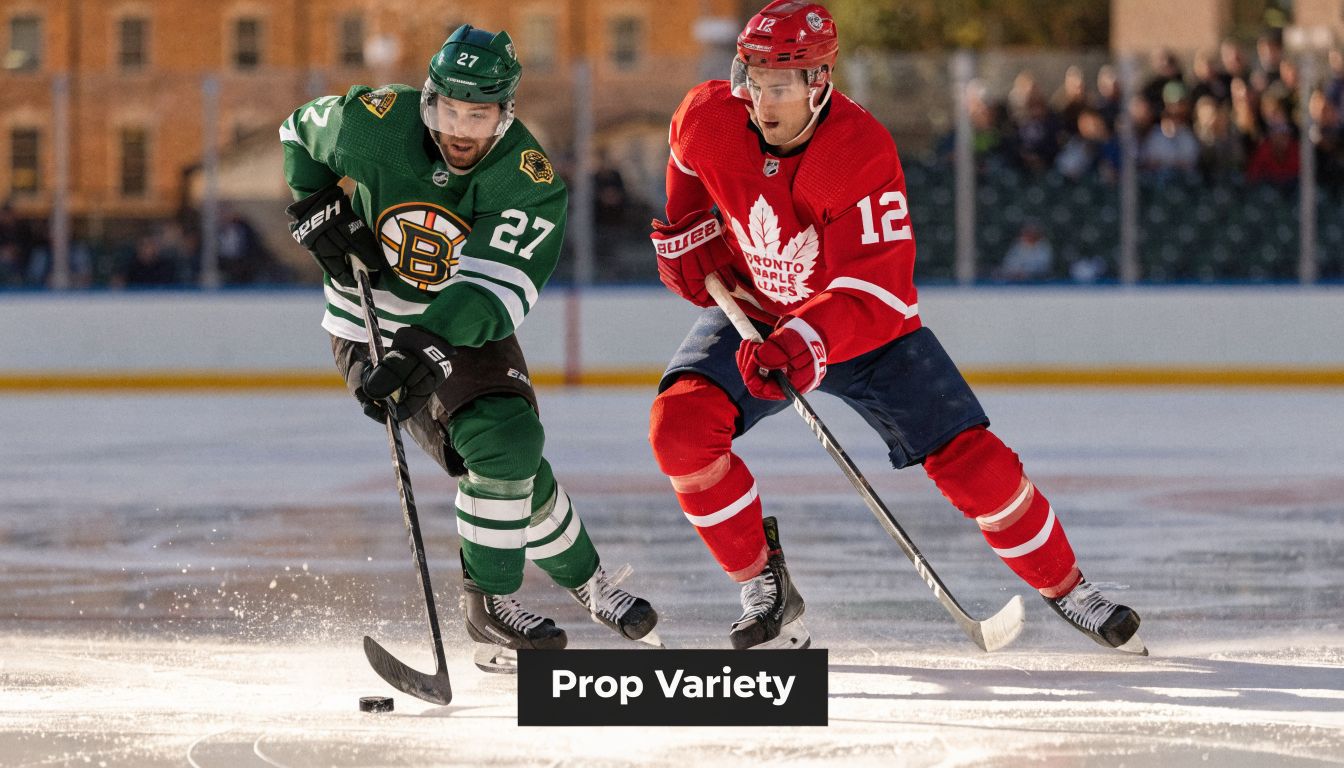
The core markets most bettors use
Points props are the headline market in hockey. Because the sport is lower scoring, books lean heavily on points overs and unders for top-six forwards and power-play quarterbacks. This is where role matters most. A first-line winger on the top power play has a much cleaner path to points than a skilled player buried in secondary usage.
Shots on goal props are usually more stable. They’re tied closely to role, ice time, and shooting tendencies. That makes them attractive for beginners, especially on books like MyBookie, BetUS, and Xbet that list broad shot markets.
Anytime goal scorer bets are higher variance. They can still be profitable, but they need more than “this guy is hot.” You want a player who is generating the right kind of chances, not just throwing harmless pucks from poor areas.
Assists props appeal to bettors who understand line chemistry. A pass-first playmaker on a loaded top unit can have value even if he isn’t the one finishing.
Blocked shots and goalie saves are less glamorous, but they can be excellent on offshore menus. Heritage Sports, Bookmaker.eu, and BUSR often attract bettors who look for those less crowded markets because public action tends to be lighter there.
A practical way to think about each market
Different props ask different questions:
- Points props: Is the player involved in enough scoring chances to beat the line?
- Shots props: Does his role create repeat volume?
- Goal scorer props: Are the chances dangerous enough, not just frequent enough?
- Goalie saves: Will game flow push rubber toward him?
- Blocked shots: Will his team spend enough time defending for the stat to pile up?
That last piece matters. A good player can still be a bad prop if the game script doesn’t fit.
Good prop betting starts with the stat type. Then it moves to the player. Most casual bettors reverse that order.
Niche props and futures are worth tracking
The prop market isn’t limited to game-day stat lines. Draft props are a good example of how deep this category has become. CBS Sports’ NHL Draft props coverage noted that Anton Frondell was listed at -160 to be the third overall pick, and that these futures represent 20-25% of the total NHL handle on major sportsbooks. That’s a useful reminder that player props now reach well beyond nightly box scores.
Offshore books like BetAnything, Bet105, and Cosmobet can be useful here because they often carry specialty boards that casual bettors ignore. Those markets are thinner, so you need to be careful with pricing, but they can also be slower to adjust.
What this means on a betting screen
On a busy night, your board might include:
- Top-line point props
- Alternate shots ladders
- Goalie saves on both starters
- Defenseman blocked shots
- Specialty futures and draft positioning markets
That range is what makes nhl player prop bets so useful. You’re not forced into one read on the whole game. You can express a narrow opinion and leave the rest alone.
Actionable Strategies for Winning Your Prop Bets
The biggest jump a bettor makes is moving from player names to player conditions. That’s where most prop value lives.
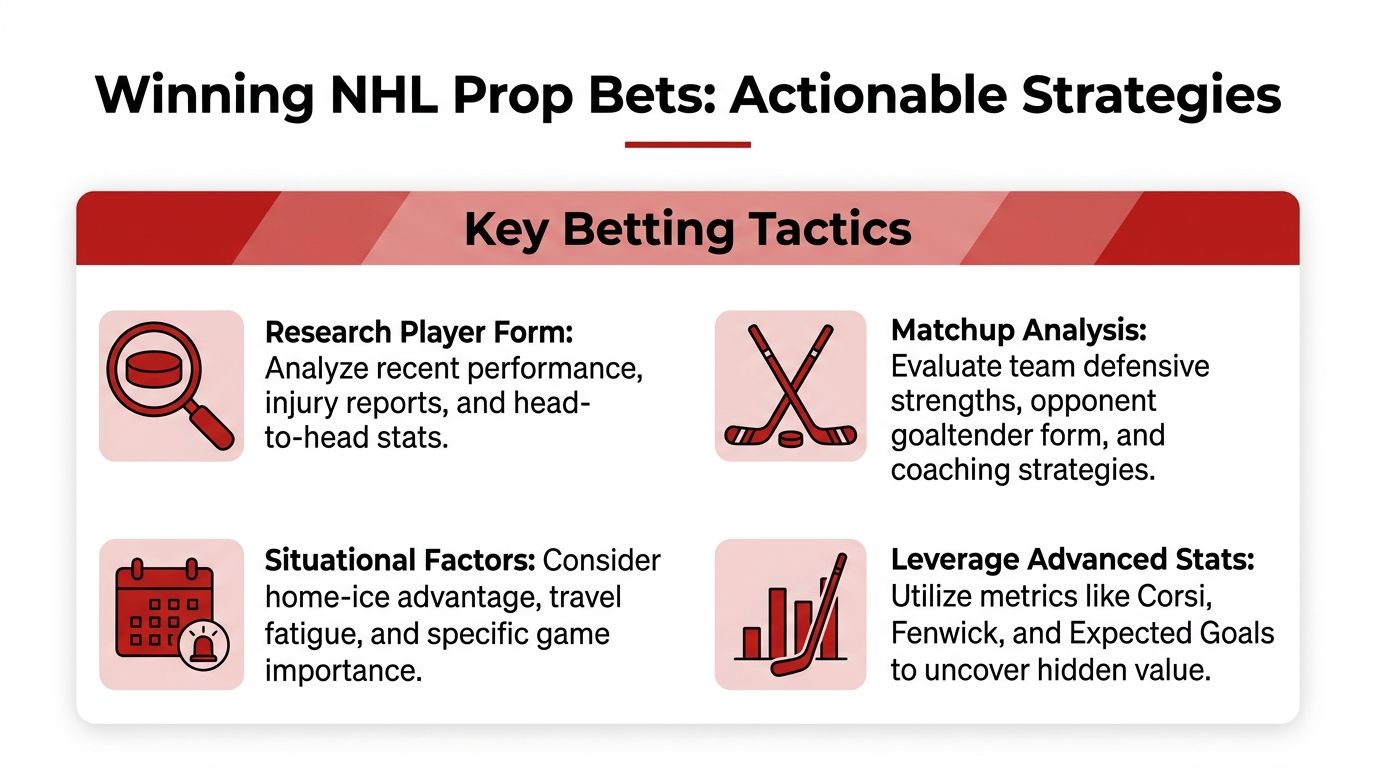
Start with process stats, not box-score totals
A player can look “cold” in goals while still creating strong chances. That’s exactly why advanced metrics matter in nhl player prop bets. SportBotAI’s NHL prop betting guide notes that a player with a high Expected Goals (xG) number but low actual goals is a prime candidate for an anytime goal scorer bet, and that players on teams with a PDO over 102 are likely to regress, making points unders attractive. The same guide adds that these regression-based plays can have hit rates over 60%.
That gives you a clear framework.
When xG helps
If a shooter is getting real chances from dangerous areas and the market is reacting only to the fact that he hasn’t scored lately, you may have an over worth considering. That applies most cleanly to anytime goal scorer and, in some spots, shot-plus-goal style angles if your book offers them.
When PDO helps
PDO is useful for identifying overperformance. If a player’s team is riding hot finishing and save percentage, his recent point streak may be getting too much respect from the market. That can create under spots, especially on inflated points lines.
Don’t pay for recent production if the underlying chance quality doesn’t support it.
Separate shot volume from actual scoring threat
A lot of guides stop at “shots are reliable.” That’s incomplete. Some players put pucks on net from low-danger areas and look active without creating much real scoring equity.
One useful example from broader NHL prop analysis is the idea that a player can post 20 shots over five games, but 18 of those attempts may come from low-danger areas. In that case, the volume is real, but the finishing signal is weak. That’s why a shots over can still be better than an anytime goal scorer over on the same player.
Many bettors misfire. They see volume and auto-bet the scoring prop. Better move: decide whether the player is a volume shooter, a true chance generator, or both.
Use role changes before the market fully catches up
Books react to goals and assists faster than they react to usage changes.
Watch for:
- Power-play promotions: A skater moving onto PP1 gets a clear bump in scoring path.
- Line changes: A winger joining a high-end center can become playable quickly.
- Injury absences: Missing teammates can lift minutes and touch volume for others.
- Coach deployment: Late defensive usage can hurt overs even for skilled players.
These are ideal spots for offshore books because the menu is often broad enough to attack multiple angles. MyBookie may post the basic points and shots props. Bookmaker.eu or Heritage Sports may have alternate lines that fit the read better. BetUS, BUSR, and Xbet may differ on juice enough to change whether the bet is worth making.
Here’s a practical sequence I use before locking a prop:
- Check projected line combinations
- Confirm power-play unit
- Review recent shot and chance profile
- Compare prices across books
- Decide whether the edge is on over, under, or no bet
That last option matters. Passing is part of winning.
A quick visual breakdown can help if you’re still building your process:
Matchup context changes everything
Not all opponents defend the same way. Some suppress slot chances. Some allow perimeter volume but protect the middle. Some take penalties that create extra power-play opportunity. Others play a low-event style that kills points upside.
This is why one prop type may be better than another on the same player.
A winger facing a structured defensive team might still clear shots because he’ll fire from the outside, but his goal scorer price may not be worth it. A goalie facing a shot-heavy opponent can be a good saves over candidate even if his win equity is poor.
Live betting can work, but only with a clear reason
Live NHL props can be useful on offshore books that keep menus open, but they’re not automatic value. The best live entries happen when the game confirms your pregame read without the result showing up yet.
Examples:
- A shooter has multiple quality looks but no goal
- A top line is dominating offensive-zone time
- A goalie’s workload is clearly rising with game state
- A coach shortens the bench and boosts a key player’s minutes
Don’t chase live overs just because the pregame ticket looks bad. Use live betting to improve entry price or add exposure when the process looks stronger than the scoreboard.
What doesn’t work consistently
A few habits burn bankroll fast:
- Betting star overs blindly: Public players are often taxed.
- Ignoring the under: Some of the best prop spots are unders when a line is inflated.
- Parlaying fragile props: Correlation isn’t always your friend in hockey.
- Overreacting to one game: One hat trick doesn’t rewrite a player’s role.
The best nhl player prop bets usually look boring before puck drop. That’s normal. Sharp prop betting is rarely about excitement. It’s about catching mispriced usage before everyone else does.
Finding the Best Offshore Sportsbooks and Odds
A solid handicap can still lose value if you bet it at the wrong book. That’s why offshore selection matters almost as much as the pick itself.
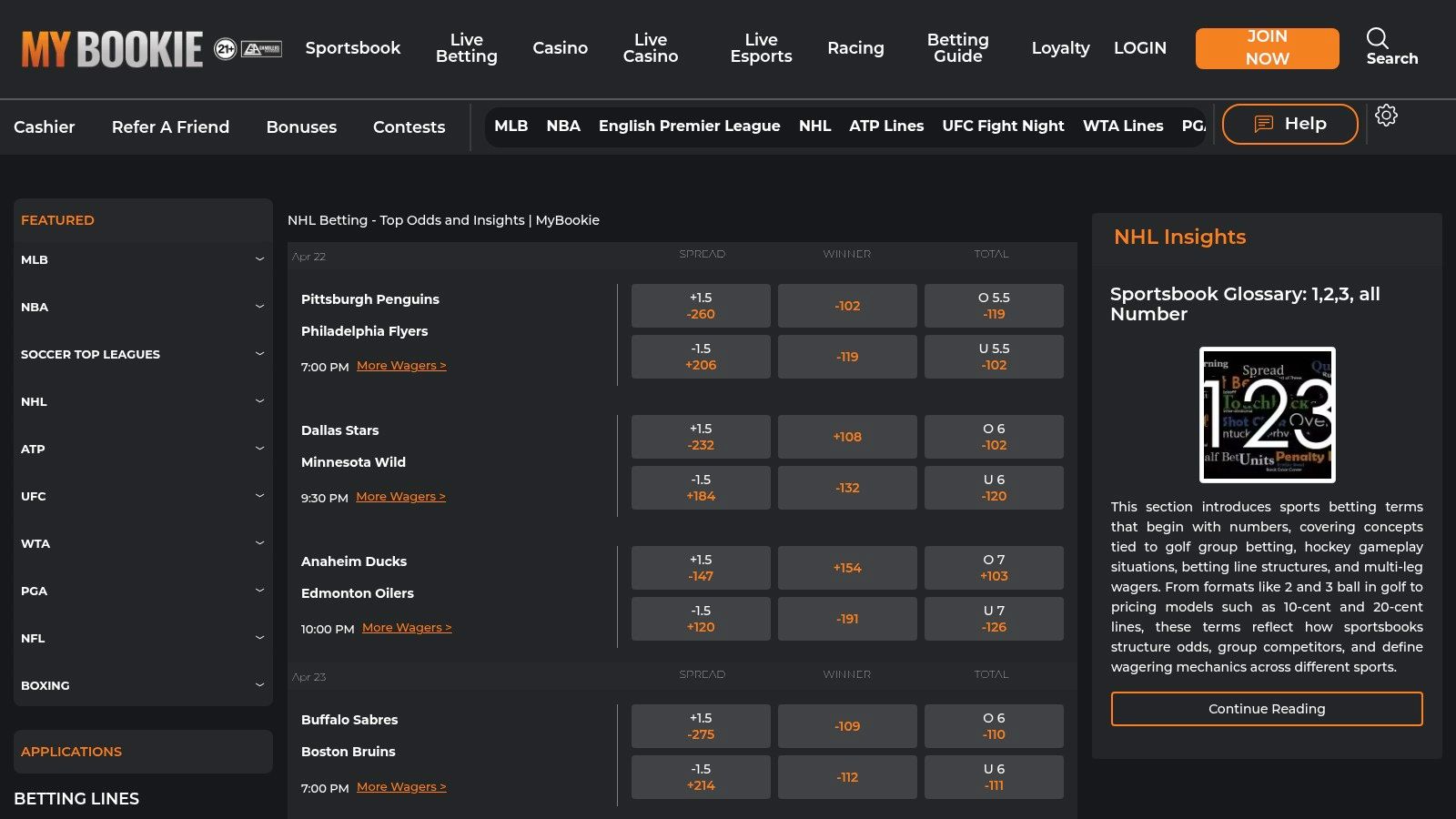
What to compare before you bet
The first item is market depth. Some books post a narrow NHL prop board. Others go much deeper into alternate shots, assists, goalie saves, and defense-first stats. MyBookie, BetUS, Bookmaker.eu, Heritage Sports, and BUSR are all worth checking because they don’t always mirror each other.
The second item is price quality. One book may hang over 3.5 shots at a cheaper number while another pushes you to 4.5 or taxes the same line harder. Prop betting is full of thin edges, so line shopping is mandatory.
The third item is live usability. If you bet NHL props in-game, a clunky interface kills opportunity. You want a book that refreshes quickly, keeps the board available, and doesn’t make you hunt through nested tabs while the number moves.
Where offshore books can help
Offshore sportsbooks often stand out in a few areas that matter for prop bettors:
- Broader niche markets: BetAnything, Bet105, and Cosmobet can be useful when you want more than the standard menu.
- Alternative pricing: Xbet, BUSR, and Heritage Sports may price the same player differently enough to matter.
- Crypto funding options: Many offshore books make deposits and withdrawals more flexible for bettors who prefer crypto.
- Integrated products: Some bettors like having sportsbook and casino access under one account, which is common at books like MyBookie and BetUS.
If you’re comparing several operators at once, this rundown of the best NHL betting sites is a helpful place to sort by features that matter to hockey bettors.
A prop edge without line shopping is incomplete. Price is part of the handicap.
A practical shortlist by betting style
If you’re betting mostly mainstream skater props, MyBookie is usually one of the first books to check because the NHL menu is easy to use and broad enough for routine nightly work.
If you care about board depth and veteran-book reputation, Bookmaker.eu and Heritage Sports deserve a look. They tend to attract bettors who value cleaner execution more than flashy design.
If bonuses and account flexibility matter more, BetUS, Cosmobet, and BUSR often get attention from players who want extra promo value or multiple payment methods.
If you’re a pure comparison shopper, add Xbet, BetAnything, and Bet105 to your rotation. The goal isn’t loyalty. The goal is getting the best number.
What matters more than marketing
Ignore the homepage hype and focus on four questions:
| Question | Why it matters |
|---|---|
| Is the NHL prop board deep enough? | More markets mean more chances to attack your specific read |
| Is the pricing competitive? | Better odds turn marginal bets into playable bets |
| Is live betting smooth? | NHL props can move fast once the game starts |
| Are deposits and withdrawals workable for you? | Convenience matters if you bet regularly |
That’s the right way to evaluate offshore books for nhl player prop bets. Not by slogans. By menu quality, price, speed, and flexibility.
Smart Bankroll Management for Long-Term Success
Most bettors spend more time picking props than protecting their bankroll. That’s backwards. Good bankroll management keeps you alive long enough for your edge to matter.

Use units, not vibes
A unit is your standard bet size. It gives structure to your decisions and stops you from doubling stakes because a prop “feels right.”
You can use a flat unit system or a percentage-based approach. Either works if you stay consistent. What fails is random bet sizing based on emotion, recent results, or how much you like a player.
Why props make discipline even more important
NHL props come with variance. A player can dominate chances and miss. A goalie can lose shot volume because his team controls the puck. A points over can die because teammates fail to finish.
That’s normal. It doesn’t mean the process was wrong.
The bankroll protects the process from short-term noise.
If you don’t size bets properly, one rough stretch can wipe out the benefit of strong reads. That’s especially true if you’re betting multiple books like MyBookie, BetUS, Bookmaker.eu, and BUSR and firing across several markets in one night.
Practical rules that actually help
- Flat-bet most props: Keep your standard stake steady.
- Scale only for clear edge differences: Not every play deserves extra exposure.
- Don’t chase losses live: A bad pregame read doesn’t need a reckless in-game fix.
- Track by market: Shots, points, goalie saves, and goal scorer bets behave differently.
- Limit prop parlays: They look fun, but they also multiply variance.
A good staking plan also reduces tilt. When you know exactly what one loss costs, bad beats feel smaller and decision-making stays cleaner.
For a deeper framework, this guide on sports betting bankroll management covers the discipline side that most bettors skip.
The mindset shift that matters
Treat nhl player prop bets like a portfolio of small positions, not lottery swings. Your job isn’t to win every night. Your job is to keep making better entries than the market and let the results stack over time.
That sounds less exciting than chasing a giant parlay. It’s also the approach that gives you a chance to last.
Frequently Asked Questions About NHL Props
Are nhl player prop bets better than sides and totals
Not automatically. They’re better when your read is strongest on one player’s role rather than the full game outcome. If you trust a skater’s shot volume more than you trust his team to win, a prop is the cleaner bet.
Which NHL props are best for beginners
Shots on goal are often the easiest starting point because they’re tied closely to usage and shooting tendency. Goalie saves can also be straightforward if you understand likely game flow. Goal scorer props are exciting, but they’re usually more volatile.
Is it better to bet pregame or live
Both can work. Pregame is better when you catch a soft opener or want the widest menu. Live works best when the game confirms your read and the market hasn’t fully adjusted.
The mistake is betting live just to rescue a bad pregame ticket. Live entries should still follow the same logic as pregame bets.
How do offshore sportsbooks fit in for US bettors
Offshore books like BetAnything, Bet105, MyBookie, BetUS, Xbet, Cosmobet, BUSR, Bookmaker.eu, and Heritage Sports give US bettors access to broad prop menus, alternative pricing, and crypto-friendly funding options. The key is choosing books carefully, reading the terms, and using a consistent process for deposits, withdrawals, and line shopping.
What should I look for before placing a prop
Three things matter most:
- Role: Line placement, power-play usage, expected minutes
- Market type: Points, shots, saves, assists, or a niche defensive stat
- Price: Compare the line and juice across books before betting
How do crypto bonuses work on offshore books
The exact terms vary by sportsbook, so always read the promo details before claiming one. In general, the process is simple: create the account, choose the qualifying crypto deposit method, opt into the offer if required, and check rollover terms before betting. The bonus only helps if the wagering rules fit how you bet.
Should I bet overs or unders more often
Neither by default. Overs get more public attention, but unders can offer value when a player’s recent production is inflated by shooting luck, hot team finishing, or temporary usage that the market has overreacted to. The right side is the side where the number is off.
Can I use multiple offshore books at once
You should if you’re serious about props. Different books price the same player differently, and the whole point of line shopping is to capture the best version of the bet. That matters on props because edges are often thin.
If you're comparing offshore books for NHL props, bonuses, payout methods, and crypto options, USASportsbookList is a useful starting point. It helps narrow the field so you can spend less time searching and more time finding bets worth making.