College basketball computer predictions are a whole different beast than just picking teams based on gut feeling. Think of them as data-driven forecasts that use complex algorithms to cut through the noise and predict game outcomes, point spreads, and totals. Instead of relying on human intuition, these systems chew through mountains of statistical data to find patterns, giving you a much more objective look at a team's real strength—something a simple win-loss record can never show you.
What Are College Basketball Computer Predictions
Imagine having an elite scouting team that has watched and analyzed every single play of every game all season long. That’s essentially what college basketball computer predictions are. They don't care about media hype or last week's hot take. Instead, these systems process massive datasets to spot predictive trends that most of us would completely miss. They go way beyond surface-level stats to figure out how good a team actually is.
These algorithms dig into key performance indicators like points per possession, strength of schedule, and defensive efficiency. This number-crunching allows them to create a power rating for every team, which is then used to forecast how they’ll stack up against a specific opponent. It’s the difference between just guessing who will win and calculating the most probable outcome based on cold, hard evidence.
This diagram shows you the key pieces that make a modern prediction model tick.
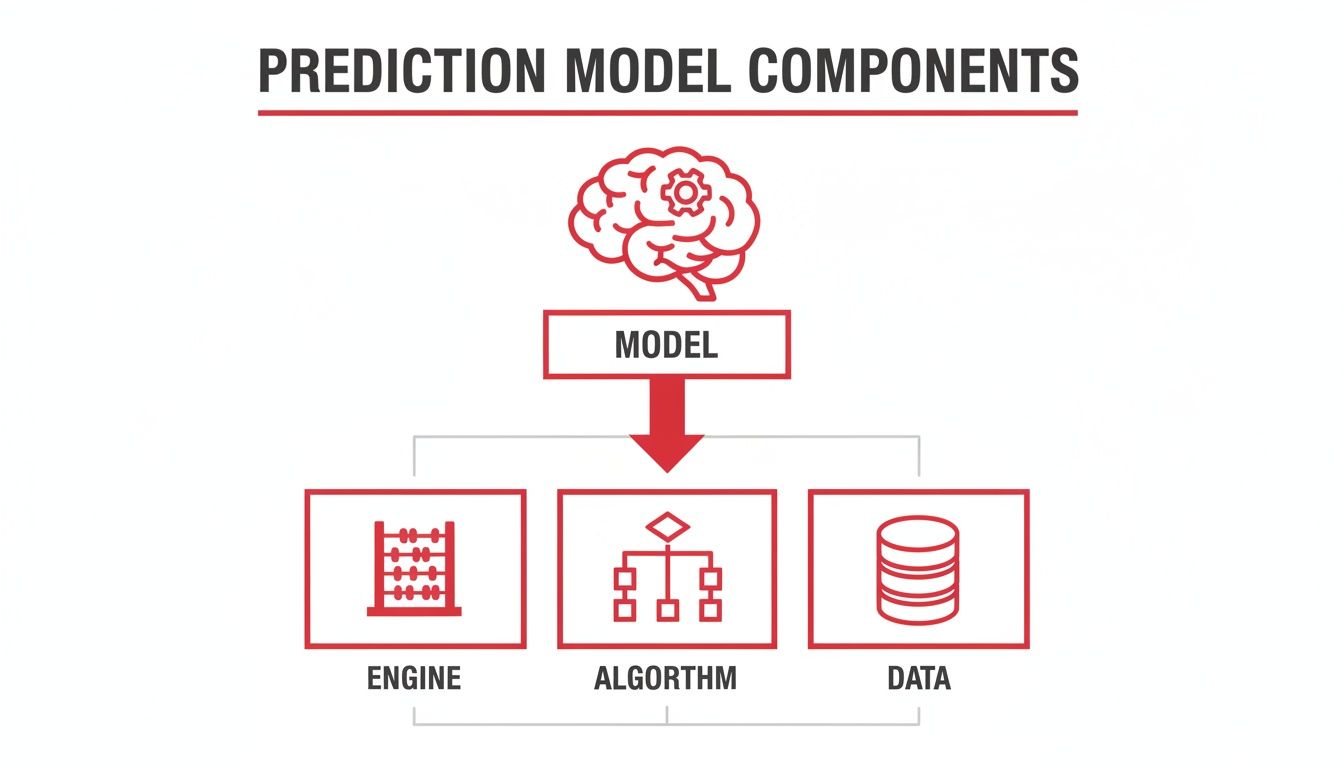
As you can see, a prediction model is a system. Raw data gets fed into a statistical engine, which then gets interpreted by an algorithm to spit out a forecast. It’s a structured approach designed to take emotion and bias completely out of the equation.
The Foundation Of Data-Driven Betting
At its core, any solid prediction model is built on three pillars. Let’s break down what really makes these systems work.
This table outlines the essential elements that power modern college basketball prediction algorithms.
Core Components Of A Computer Prediction Model
| Component | Function | Example Metric |
|---|---|---|
| Vast Data Inputs | Feeds the model with raw information from games. | Play-by-play data, box scores, player efficiency ratings. |
| Statistical Engine | Processes and contextualizes the data. | Adjusts for home-court advantage and opponent strength. |
| Predictive Algorithm | Applies rules to turn processed data into a forecast. | Generates a projected point spread or over/under total. |
Understanding this foundation is the first real step toward making smarter, data-informed wagers.
Having an analytical edge is what separates sharp bettors from the public, especially when you're looking for value. For instance, let's say a model projects a team to win by 8 points, but a sportsbook like Bovada or BetOnline has the line at -5.5. The model has just flagged a potentially profitable opportunity. Savvy bettors use these insights to find lines that are out of whack with the market.
The goal isn't to find a "crystal ball" that is always right. The real purpose of using college basketball computer predictions is to consistently identify betting lines that offer mathematical value over the long run.
By trusting the data, you can make more disciplined decisions and steer clear of the classic mistakes that come from emotional betting. Whether you're placing a bet at MyBookie or BetUS, having a quantitative reason for your pick is what separates the winners from the losers. This methodical approach is what transforms sports betting from a game of chance into a game of skill.
How Algorithms Decode NCAAB Games
To really understand how college basketball computer predictions work, you’ve got to peek under the hood. These algorithms aren't just tallying up wins and losses; they're dissecting a team’s DNA, focusing on the metrics that reveal its true efficiency and style of play. They think like a seasoned analyst, not just a casual fan.
One of the most important metrics is Adjusted Efficiency. This isn't your grandpa's points-per-game stat, which can be seriously misleading. Instead, it measures how many points a team scores (Adjusted Offensive Efficiency) or allows (Adjusted Defensive Efficiency) per 100 possessions, all while factoring in the quality of their opponent.
This approach levels the playing field completely. A team dropping 85 points on a cupcake non-conference opponent is far less impressive than a team grinding out 75 points against a top-tier defense. Models use this metric to build a much more accurate power rating for every single team in Division I.
The Four Factors of Success
Beyond just overall efficiency, many of the sharpest predictive models are built around what’s known in basketball circles as the "Four Factors." These are four key statistical areas that have been proven time and again to have a strong connection to winning games. By weighing these elements, an algorithm gets a detailed picture of a team's real strengths and weaknesses.
- Effective Field Goal Percentage (eFG%): This metric gives extra weight to three-pointers, painting a much clearer picture of a team's shooting ability than the old-school field goal percentage.
- Turnover Percentage: Models look at how often a team coughs up the ball per possession. Taking care of the rock is a fundamental part of consistent performance.
- Offensive Rebounding Percentage: This tracks how good a team is at creating second-chance scoring opportunities by grabbing its own misses. It’s all about hustle.
- Free Throw Rate: How often does a team get to the charity stripe? This shows aggressiveness and the ability to manufacture easy, clock-stopping points.
By digging into these factors, a model can pinpoint specific matchup advantages that might fly under the radar. For instance, a team that crashes the offensive glass might have a huge edge against a squad that’s lazy on the defensive boards—a nuance that sportsbooks like Bookmaker.eu or Sportsbetting.ag might not fully price into their opening lines.
Knowing what the models are looking for is also a game-changer for bettors, which is exactly why we put together a guide on how to use a betting line movement tracker to see where the data and public opinion collide.
Pioneering Predictive Analytics
The idea of using efficiency stats to predict games has been refined for decades. One of the most influential systems out there is Ken Pomeroy's college basketball ratings, a foundational tool for computer predictions since 2002. His system uses advanced regression analysis to forecast games with incredible precision, adjusting for strength of schedule across all 353 Division I teams.
The whole model is designed to minimize prediction errors by tweaking hundreds of variables, all centered around points per possession—a metric that blows raw scoring out of the water. In one study analyzing 311 games between elite offensive rebounding teams and poor defensive ones, the system's average prediction error was under 1 point per 100 possessions. That's stunning accuracy in a sport known for its chaos. You can find more breakdowns of this powerful approach over at The Power Rank.
By understanding how these models weigh specific elements, you get a much deeper appreciation for the data that drives the college basketball computer predictions you see. This knowledge lets you size up the betting lines at offshore sportsbooks like MyBookie or BetUS with a much sharper eye.
The Game-Changing Power Of AI And Machine Learning
If traditional algorithms are the smart kids in class, then artificial intelligence and machine learning are the brilliant prodigies. This is where college basketball computer predictions get seriously futuristic, moving beyond fixed formulas and into systems that actually learn, adapt, and get better on their own.
Unlike older models that need a human to go in and tweak the code, these advanced systems get sharper with every single game played. They're smart enough to spot emerging trends on their own—like a team that suddenly catches fire from three-point range or a defense that’s locking down opponents—and adjust their logic automatically. For a bettor, that dynamic ability is a massive advantage, especially when you're trying to find value in a fast-moving market.

Unlocking Probabilities With Monte Carlo Simulations
One of the coolest tools in an AI's arsenal is something called a Monte Carlo simulation. The best way to think about it is this: instead of just spitting out one final score, the AI "plays" the game thousands of times in a fraction of a second. Each simulation is a little different, creating a whole universe of possible outcomes.
By running these countless simulations, the model gives us something far more valuable than a simple pick: a precise win probability. It might find that Team A beats Team B in 7,200 out of 10,000 simulated matchups, which translates to a 72% chance of winning. This gives you a much deeper read on a game than a point spread ever could, helping you size up moneyline odds on sites like MyBookie or Xbet with way more confidence.
AI doesn't just predict an outcome; it calculates the probability of every possible outcome. This allows bettors to move beyond asking "who will win?" and start asking "how likely are they to cover the spread?"
This simulation-based approach is an absolute game-changer for finding an edge. It’s fantastic at flagging those spots where an underdog has a much better shot at an upset than the public thinks, pointing you toward juicy moneyline opportunities others might completely miss.
How AI Processes Millions Of Data Points
The real magic of AI is its sheer horsepower. These systems can process information on a scale that's just impossible for a human brain. We're talking millions of data points, from individual player efficiency ratings and tempo-free stats to real-time betting line movement and last-second injury news. It's this firehose of information that allows the AI to generate predictions that are incredibly dynamic and responsive.
AI algorithms can pull data from hundreds of sources and crunch tens of millions of data points for daily picks. A huge part of this success comes from using Monte Carlo simulations, running each game 10,000 times to model outcomes based on everything from individual player matchups to breaking news.
This is especially powerful when it comes to live betting. As a game unfolds, an AI model can process new information on the fly—like a star player picking up two quick fouls—and instantly update its win probability. For bettors using platforms like BetOnline or Cosmobet, this is a huge leg up, letting you make sharp, data-backed wagers as the game's momentum shifts in real time.
Finding Betting Value At Offshore Sportsbooks
Let’s be real: having a killer college basketball computer prediction is only half the battle. A perfect forecast is completely useless if you can’t get the right price. In sports betting, profit comes from finding value, not just picking winners. This is the crucial leap from thinking like a fan to operating like a sharp.
The single most important strategy for turning those predictions into cash is line shopping. It’s a simple concept: you compare the point spread your model spits out against the odds posted at various offshore sportsbooks. You’ll find that bookmakers like BetUS, BUSR, and BetAnything often have slightly different numbers on the exact same game. Those tiny differences are where you make your money.

Think of it this way. If your computer model crunches the numbers on a big rivalry game and projects the home team should win by 10 points, that number is now your anchor. It’s your version of the truth. From there, you go hunting across the market to see how the sportsbooks’ version of the truth compares.
Turning Predictions Into Actionable Bets
Let's walk through a real-world example. Say your model is high on Duke to handle North Carolina, projecting a solid 10-point victory. Now it's time to check the lines at your favorite offshore sites.
- BetOnline has Duke listed at -9.5. This is almost identical to your projection, so there's not much meat on the bone here.
- Sportsbetting.ag is offering Duke at -9. This is a little better, giving you a one-point cushion against your number.
- Cosmobet has Duke listed at -7.5. Ding, ding, ding! This is the jackpot.
That 2.5-point gap between your model's prediction (-10) and the line at Cosmobet (-7.5) is your entire edge. It’s pure mathematical value. You're getting a team you believe should win by double digits, but you only have to lay a little over a touchdown. These are the golden opportunities that build a bankroll over the long haul. You can dive deeper into this core concept in our guide explaining the fundamentals of betting for value.
Remember, college basketball computer predictions aren't crystal balls. They are sophisticated tools designed to do one thing: identify pricing mistakes in the betting market.
Integrating Models Into Your Daily Routine
To consistently find these spots, you need a disciplined process. Just checking one prediction and one sportsbook won't cut it. The best bettors are systematic.
- Generate Your Numbers: First thing's first. Run your model or check your trusted prediction source to get your projected spreads for the day's entire slate of games.
- Scan the Market: Have accounts funded at multiple offshore sportsbooks—think MyBookie, Xbet, and Bookmaker.eu—and compare their lines side-by-side for every game.
- Identify Discrepancies: Hunt for the biggest gaps between your number and the books' numbers. As a rule of thumb, a difference of 2 points or more is often significant enough to warrant a bet.
- Place Your Wager: Pull the trigger at the sportsbook offering the most favorable line. Over hundreds of bets, getting that extra half-point or full point makes a massive difference to your bottom line.
By making this routine a habit, you transform abstract computer predictions into a concrete, repeatable strategy for attacking the college basketball betting market.
Common Mistakes To Avoid When Using Predictions
If you want to use college basketball computer predictions effectively, you first have to understand their limits. These models are powerful, no doubt. But treating them like infallible crystal balls is the fastest way to drain your bankroll. The biggest mistake I see bettors make is blindly following every single pick without a shred of critical thought.
An algorithm doesn't know that a team's star point guard is fighting the flu. It has no idea that a recent coaching change completely destroyed the locker room morale. These are the human elements—the qualitative factors—that are totally invisible to a model built strictly on historical stats. It can't see a sudden, game-changing event coming.
Looking Beyond The Numbers
Another classic blunder is getting caught up in recency bias. A model is designed not to overreact to a single shocking upset, but we humans often do. Just because some Cinderella team pulled off a miracle win last week doesn't mean their fundamental statistical profile has changed overnight. The numbers are there to keep you grounded in reality.
The real purpose of a computer prediction is to give you an objective, data-driven baseline. Your job is to layer on the human context the model can't see. You're a critical thinker, not just an algorithm follower.
This is where doing your own homework becomes non-negotiable. Think of the model's output as the starting point, not the final word. When a prediction jumps out at you, that’s your signal to start digging and figure out why the model sees an edge. This analytical approach is what separates the consistently successful bettors on sites like Bet105 or Bovada from those just chasing picks.
Practical Strategies for Smarter Betting
So, how do you actually sidestep these traps? It all comes down to building a process that marries the model's cold, hard data with your own analysis. This balanced strategy is your best defense against risk and leads to much more informed wagers at sportsbooks like BetOnline.
- Cross-Reference Multiple Models: Never put all your faith in a single source. If two or three reputable models are all pointing to the same value play, that strengthens the case significantly.
- Analyze the "Human" Factors: Always check the injury reports, look for lineup changes, and consider travel fatigue. A team playing its third road game in five days is a prime candidate to underperform its projections.
- Understand Matchup Dynamics: A model might heavily favor a team that looks superior on paper. But if that team historically struggles against a specific defensive scheme, like a 2-3 zone, you could be walking right into a trap.
By making these strategies part of your routine, you'll get much better at spotting the difference between a statistically sound bet and a potential disaster. This disciplined approach ensures you’re getting the most out of college basketball computer predictions without getting burned by their blind spots when placing your bets at sites like MyBookie and Sportsbetting.ag.
Common Questions About Computer Predictions
Diving into the world of college basketball computer models can feel a bit overwhelming at first. Let's tackle some of the most common questions bettors have and give you some straight answers on how to use these tools to your advantage.
Are College Basketball Computer Predictions Actually Worth Using?
Absolutely, but you have to treat them as a powerful tool, not a magic eight ball. Computer predictions give you a completely unbiased, data-driven look at a game, which is perfect for sniffing out value that the general betting public might miss. The top models consistently hit win rates that clear the 52.4% break-even point against the spread.
Where they really shine, though, is when you pair their raw data with your own research. The sharpest bettors I know use a model's output as a starting point. They see a game flagged as a potential opportunity and then they dig deeper. The final step is always line shopping at different offshore sportsbooks like MyBookie or BetOnline to squeeze every last drop of value out of the number.
What Is The Most Accurate Prediction Model?
That’s the million-dollar question, isn't it? There's no single "best" model, because some might perform better on certain conferences or specific types of matchups. That said, a few systems have definitely earned their reputation for long-term consistency.
- Established Systems: Models like Ken Pomeroy's (KenPom) are the gold standard for a reason. They're highly respected because their methodology is transparent and their track record speaks for itself.
- AI-Driven Platforms: Some newer platforms are using machine learning to get an edge, and they're showing some really impressive results by quickly adapting to new trends as the season unfolds.
My advice? Find a model with a proven track record that you can trust. An even better approach is to track a few of the top models. When you see two or three different systems all pointing to the same side of a game, that's a strong signal that you've found a genuinely valuable line.
How Do I Use Computer Models To Bet Totals?
Most of the advanced college basketball computer predictions do more than just pick a winner—they project a final score. This is done by crunching the numbers on each team's pace of play (how many possessions they average per game) and their offensive and defensive efficiency ratings.
Using this info is pretty straightforward. You just compare the model's projected total to the Over/Under line posted at a sportsbook like Sportsbetting.ag or Xbet. Let's say a model projects a game to finish with 155 points, but the sportsbook has the line at 150.5. That gap signals a potential value play on the Over.
Of course, you should always cross-reference this with other factors, like a team's recent shooting slump or a key injury, before you pull the trigger.
Computer models are fantastic at forecasting game totals. They stick to objective stats like pace and efficiency, which strips out all the emotional bias that tends to push public money one way or the other on Over/Under lines.
Can Computer Models Predict March Madness Upsets?
Yes, and this is one of their most valuable uses. Computer models are incredible for putting a real number on a potential March Madness upset. While they'll almost always favor the higher-seeded team, their real magic is in identifying matchups where a scrappy underdog has a statistical profile that makes them far more dangerous than their seed suggests.
For example, a model might flag a matchup between a high-flying, fast-paced favorite and a slow, methodical team with an elite defense. The model sees a potential clash of styles where the underdog can control the game.
Instead of just spitting out a winner, the models give you a precise win probability. This helps you spot live underdogs with juicy moneyline odds at sites like BUSR, Cosmobet, or Bookmaker.eu, turning potential Cinderella stories into profitable bets.
At USASportsbookList, we're all about giving you the insights and reviews you need to find the best offshore sportsbooks for your betting style. Check out our guides to get an edge and make smarter wagers. Learn more at https://usasportsbooklist.com.