Forget trying to just pick winners. The real secret to long-term success in sports betting is learning how to spot market inefficiencies. In the world of professional betting, this is called betting for value. It's a simple discipline: you only place a wager when the odds you're getting are better than the real probability of that outcome happening.
Unlocking the Professional Approach to Betting
Think of it like finding a rare comic book at a garage sale for a dollar. You know it's worth a hundred times that, so you snap it up, knowing you've locked in a profit. That's exactly what value betting is. It completely changes your mindset from a fan hoping their team wins to a sharp investor looking for undervalued assets in the betting market. This is the single biggest principle that separates casual bettors from the pros.

$2,500 Use code - PROMOBUCK2 to get a 125% First Deposit Bonus at the BetNow sportsbook when you deposit with Crypto.


$2,750
200% Crypto Bonus PLUS 10% Gamblers Insurance with a minimum $100 deposit and a maximum of $1,500. Use Code: JOIN200 in the Cashier.

This isn't about predicting the future. It’s about understanding that sportsbooks like MyBookie or BetUS set their odds based on a mix of statistics and, just as importantly, public opinion. Sometimes, their numbers are just a little bit off. That creates a small but powerful edge for anyone who knows how to find it.
The Power of Positive Expected Value
That mathematical edge has a name: positive expected value (+EV). Anytime you place a bet where the sportsbook's odds are juicier than the actual chances of it winning, you've found a +EV wager. Now, any single bet can still lose—that’s just variance. But making +EV bets over and over again is the only proven way to be profitable in the long run.
Here's the difference in thinking:
- Casual bettors ask: "Who's going to win this game?"
- Value bettors ask: "Do the odds at Bovada give me a fair price on this team's chances of winning?"
That tiny shift in perspective is everything. It turns betting from a simple guessing game into a calculated investment strategy. The data backs this up, too. A 2020 analysis showed that bettors who systematically hunt for value wagers achieved an average ROI of 7.3% over three years. You can learn more about how data drives betting profits to see the full story.
Ultimately, betting for value means you're always getting your bets "on sale." By consistently shopping for these discount prices across different sportsbooks like BetOnline and Sportsbetting.ag, you're building a portfolio of bets that is mathematically designed to win over time. This guide will show you exactly how to do it.
Calculating Your Edge with Expected Value
To really succeed with value betting, you need a way to measure whether the odds you’re looking at are actually a good deal. That tool is Expected Value (EV). It's the simple but powerful math that tells you, on average, how much you can expect to win or lose per bet if you were to make that same wager over and over again.
Here's the formula in a nutshell:
(Probability of Winning x Potential Profit) – (Probability of Losing x Stake) = Expected Value
Let’s boil it down with a simple coin toss. If you bet $10 on heads at even money (+100 odds), your EV is zero. Why? Because you have a 50% chance to win $10 and a 50% chance to lose $10. It’s a wash in the long run.
But what if someone offered you +110 odds on that same coin toss? All of a sudden, you have positive expected value (+EV). If you made that bet forever, you're mathematically guaranteed to come out ahead. This is the absolute core of value betting—finding those +110 odds on what is truly a 50/50 shot.
From Odds to Opportunity
To bring this concept into the world of sports, the first step is to convert the sportsbook's odds into an "implied probability." This number reveals the percentage chance the bookie is giving an outcome.
For positive odds (the underdog, e.g., +150), the formula is: 100 / (Odds + 100)
- Example: +150 odds = 100 / (150 + 100) = 40% implied probability.
For negative odds (the favorite, e.g., -120), the formula is: Odds / (Odds + 100)
- Example: -120 odds = 120 / (120 + 100) = 54.5% implied probability.
Once you have that implied probability, you can stack it up against your own assessment of the "true" probability. If your research and analysis tell you the actual chance is higher than what the odds imply, you've just spotted a potential value bet.
This is the logical flow you should follow every single time you look for a bet.
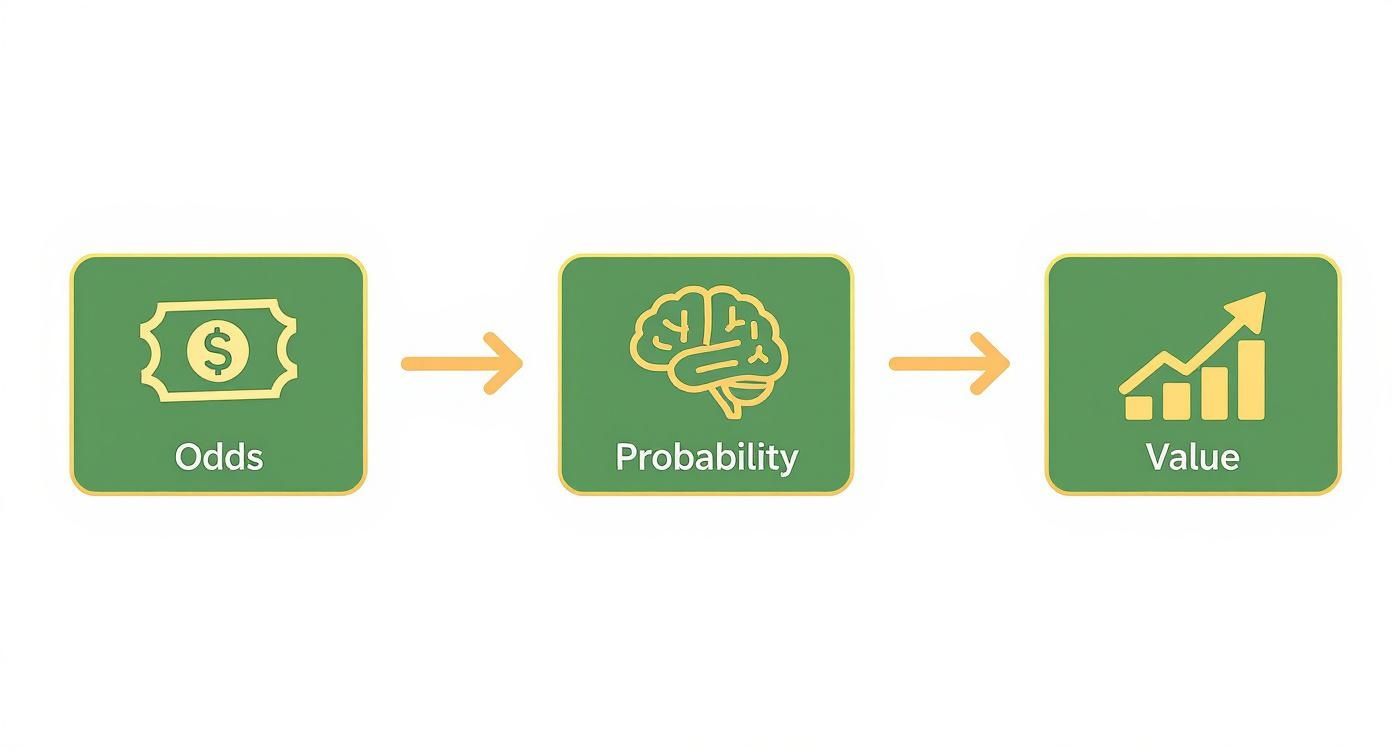
You start with the market price (the odds), figure out its true likelihood (your probability), and then decide if there's a profitable edge to be had (value).
Putting It All Together: A Real-World Example
Let's imagine the Green Bay Packers are facing the Chicago Bears, and BetOnline is offering the Packers moneyline at +120. A $100 bet here would net a $120 profit if they win.
Here’s how we break it down:
-
Calculate Implied Probability: Using our formula for positive odds, +120 implies a probability of 45.5% (100 / (120 + 100)). The bookie is saying Green Bay has about a 45.5% chance.
-
Estimate True Probability: You've done your homework—analyzed matchups, injuries, and recent performance. Your conclusion is that the Packers actually have a 50% chance to win this game.
-
Calculate Expected Value: Now we plug everything into the EV formula.
- (0.50 x $120) – (0.50 x $100)
- $60 – $50 = +$10
That +$10 result is your edge. It means that for every $100 you wager on this line, you can expect to profit an average of $10 over the long haul. This is a crystal-clear +EV bet and the perfect illustration of value betting in action.
Positive vs Negative Expected Value Scenarios
To see how this plays out in different situations, let’s look at a few examples of a $100 bet. This table shows how the relationship between your probability and the bookmaker’s odds creates either a winning or losing proposition over time.
| Scenario | Your True Probability | Bookmaker Odds (Implied Probability) | Expected Value (EV) | Decision |
|---|---|---|---|---|
| Clear +EV | 50% | +120 (45.5%) | +$10.00 | Bet |
| Slight +EV | 55% | -110 (52.4%) | +$4.55 | Bet |
| No Edge (0 EV) | 50% | +100 (50%) | $0.00 | Pass |
| Clear -EV | 40% | +120 (45.5%) | -$8.00 | Pass |
As you can see, a +EV decision isn’t just about finding underdogs; you can find value on favorites too. The key is that your assessed probability is higher than the bookie’s implied probability.
While you can do these calculations manually for single bets, more complex situations might call for a tool like an arbitrage betting calculator. By consistently finding and placing these +EV wagers, you stop gambling and start treating sports betting like a disciplined mathematical investment.
Finding Value Opportunities on Offshore Sportsbooks
So, you understand what expected value is. Now for the fun part: finding it. Value doesn't just show up on your doorstep; you have to go out and hunt for it. And the single most powerful tool in your arsenal is line shopping.
Line shopping is exactly what it sounds like: comparing the odds for the very same bet across multiple offshore sportsbooks. This is where having accounts at a few different sites—think Sportsbetting.ag, Xbet, and Bookmaker.eu—instantly gives you a massive edge. You wouldn't buy a new TV without checking the price at a few different stores, right? The same logic applies here. A tiny difference in the odds from one book to another can be what separates a losing bet from a profitable one.

Why Odds Differ Between Sportsbooks
You might be wondering why BetOnline would offer a different line on a game than Bovada. It all comes down to how these books manage their risk and their business. Those little discrepancies are your golden tickets, and they pop up for a few key reasons:
- Balancing the Books: A sportsbook's dream is to have perfectly balanced money on both sides of a bet. That way, they make a guaranteed profit from the juice (the vig) no matter who wins. If too much cash pours in on one side, they’ll tweak the odds to make the other side look more attractive.
- Fading the Public: The general betting public loves to bet on popular teams, star players, and overs. This creates a wave of "public money" that sharp oddsmakers at books like BUSR anticipate. They'll often "shade" their lines against the public, creating juicy value on the unpopular side for bettors who know what to look for.
- Different Opinions: At the end of the day, oddsmakers are human. Sometimes, the experts at one book simply see a game differently than the experts at another, leading to natural differences in their opening lines.
For bettors who want to exploit these differences, getting familiar with the world of offshore sports betting is the first step to building a winning line shopping strategy.
A key principle of value betting is recognizing that you are not betting against the teams on the field; you are betting against the market's perception of those teams, which is represented by the odds.
Actionable Tactics for Spotting Value
Just having accounts at multiple sportsbooks isn't the whole game. You need a process to consistently find those profitable spots. Effective betting for value is proactive, not passive.
Here are a few proven tactics you can start using today:
- Scout Lines Early: Lines are at their "softest" right when they're released. For the NFL, this is usually Sunday evening or Monday morning. As the week goes on, sharp, professional money pours in and the lines get more efficient, squeezing out the obvious value. Get in there early.
- Hunt in Niche Markets: Big-name books like MyBookie and BetUS pour enormous resources into setting razor-sharp lines for major markets like the NFL or NBA. They have less time and data for smaller markets—think college player props or obscure soccer leagues. This is where you can often find mispriced lines just waiting to be picked off.
- Monitor Line Movement: Keep an eye on how lines move during the week. A sudden, sharp move often signals big money from professional syndicates or important breaking news (like an injury). A book like Cosmobet might be a step behind in adjusting its lines, creating a small window of opportunity for you to jump on the old number.
Using Data to Make Smarter Predictions
To consistently find value, you have to master one thing: being more accurate than the sportsbook. That’s it. To get there, you need to ditch the gut feelings and start thinking like a pro, which means embracing a data-driven approach to sharpen your predictions. It’s all about digging into the numbers to find an edge the market completely missed.
Professional bettors don't just pick a team they like; they analyze everything. They're looking at historical performance, situational trends, and key matchups to build a statistical picture of the game. This process lets them create their own odds, which they then compare against the lines offered at sportsbooks like Cosmobet or Bookmaker.eu.
Leveraging Advanced Metrics
To really get an advantage, you have to look past simple win-loss records. Advanced metrics give you a much deeper look at a team's true performance, often uncovering strengths or weaknesses that the standard box scores don't show.
For example, in soccer, Expected Goals (xG) tells you how many goals a team should have scored based on the quality of their chances. A team that's creating tons of high-quality chances (high xG) but isn't scoring might just be unlucky. They’re likely due for a big offensive game, making them a seriously undervalued betting target.
In the NFL, a stat like DVOA (Defense-adjusted Value Over Average) is huge. It measures a team's efficiency play-by-play, adjusting for the situation and the opponent. It cuts through the noise.
These tools help you answer the questions that matter:
- Is that team’s winning streak for real, or have they just been lucky?
- Does a certain team always dominate a specific style of play?
- Is that underdog actually much better than everyone thinks?
By bringing these kinds of metrics into your analysis, you can spot teams that are systematically mispriced by the market at sites like BUSR. That’s the perfect setup for a value bet.
Building Your Analytical Framework
You don't need a supercomputer to get started. The goal is just to build a simple, repeatable way to challenge the bookmaker's numbers. Pick a sport you know inside and out and start by focusing on just a few key data points.
Historical data is a proven goldmine for betting for value. One study showed that betting on dominant home teams with specific odds profiles yielded an average ROI of 12.4% over five years. Another analysis from 2021 found that using advanced metrics like xG to find undervalued soccer teams generated a 9.7% ROI over two full seasons. You can find more insights on how betting statistics can transform your strategy and see for yourself just how powerful a data-first approach can be.
This whole process is about finding a story the numbers support but that the odds at BetAnything don't fully reflect. Once you can consistently prove the sportsbook wrong—even by a tiny margin—you’ve cracked the code to value betting.
Bankroll Management and the Value Bettor's Mindset
Spotting a +EV opportunity is a huge step, but honestly, it's only half the battle. To actually make money long-term with betting for value, you need two other skills that are just as important: rock-solid bankroll management and the right mental game.
Losing streaks are going to happen. Let me repeat that: they are absolutely, 100% inevitable, even when you have a mathematical edge. Your ability to ride out those downswings without blowing up your account is what separates the pros from the pack.
This is where you have to flip a switch. Stop thinking like a fan and start acting like a portfolio manager. A fund manager doesn't panic and sell everything after a few bad days on the stock market; they trust their strategy. Your betting bankroll is your investment capital, and your number one job is to protect it.

The Golden Rule of Staking
The simplest and most effective way to protect that capital is with flat-stake betting. It’s a straightforward rule: you risk the exact same small percentage of your total bankroll on every single bet. It doesn't matter how much you love a play; the stake size stays the same.
The gold standard is to risk just 1-2% of your bankroll per wager. If you’re working with a $1,000 bankroll, every single one of your bets should be between $10 and $20. This simple discipline makes it impossible for one or two bad beats to wipe you out.
Sure, there are more advanced strategies out there like the Kelly Criterion, which tailors your stake size based on how big your edge is. But flat-staking is the bedrock of survival. It stops you from chasing losses when you're cold or getting reckless after a big win. If you want to build a truly solid financial foundation, check out our complete guide to sports betting bankroll management.
Developing a Professional Mindset
At the end of the day, your psychology will either make you or break you as a value bettor. The market is going to test your patience every single day, and making emotional decisions is the fastest way to zero out your account.
Here’s the mindset you need to adopt to win:
- Process Over Results: Forget about the outcome of any single game. Your job is to focus on making good, positive EV decisions over and over. Short-term wins and losses are just noise; a solid long-term process is what actually creates profit.
- Emotional Detachment: Never, ever bet on your favorite team unless the numbers scream value. Betting has to be a cold, calculated business decision you make at sportsbooks like MyBookie or BetUS, not a way to root for your squad.
- Patience and Discipline: This is the hardest part. The real discipline in value betting is knowing when not to bet because there's no edge. Sometimes the smartest move you can make is just closing the Bovada app and waiting for a better spot tomorrow.
Value betting is a marathon, not a sprint. Proper bankroll management keeps you in the race, and a professional mindset is what guides you across the finish line.
Common Myths About Value Betting Debunked
There are a lot of misconceptions out there that can completely torpedo a solid betting strategy before it even gets off the ground. When you first dive into betting for value, you'll run into some common myths that seem to make sense but are actually traps. Let’s bust these myths right now so you can stay on the right track.
One of the biggest whoppers is that value is only found on longshot underdogs. A lot of new bettors fall for this one, thinking a +EV wager has to be some crazy, high-odds bet. That's just not true. Value is simply a gap between the odds and the real probability, and that gap can show up anywhere.
For instance, you might see a heavy favorite listed at -300 on BetAnything. That looks expensive, right? But if your own numbers show their true chance of winning makes those odds a steal, it's a fantastic value bet. The odds alone don't create value—it's how they stack up against reality.
Value Betting Is Not A Magic Bullet
Another dangerous myth is thinking that value betting guarantees a win every single time. Believing this will only lead to frustration when, inevitably, some of your bets lose. You have to remember: this is a long game.
A +EV bet means you have a mathematical edge that pays off over hundreds, or even thousands, of wagers. It says nothing about the outcome of the next game you bet on at Bet105.
Think of it like being the house at a blackjack table. The casino has a small, long-term edge, but it still loses plenty of individual hands. Your job is to become the casino, not to win every hand you're dealt.
Having this mindset is absolutely crucial for survival in sports betting. You will hit losing streaks, even when you’re consistently making smart, value-driven plays. The key is to trust your process, manage your bankroll like a pro, and understand that profit is measured over seasons, not just a single weekend. Stick with the plan, and you’ll sidestep the common pitfalls and build a betting approach that lasts.
Common Questions on Value Betting
Once you've got the basics down, a few practical questions always seem to pop up as you start putting betting for value into practice. Let's tackle some of the most common ones to clear things up and build on what you've learned.
How Do I Figure Out the "True" Probability?
This is the million-dollar question, isn't it? Estimating the real probability of an outcome is the true art of being a sharp bettor. It's not about finding some magic number; it's about building a more accurate assessment than the bookmaker.
This comes down to rolling up your sleeves and doing the research. You'll be digging into statistical models, historical performance data, advanced metrics, and even qualitative stuff like player injuries or team morale. Your goal isn't to be perfect, but to be consistently better than the implied probability from offshore books like BUSR or MyBookie. The sharper your analysis, the bigger your long-term edge.
Can I Actually Find Value on a Heavy Favorite?
You bet. A lot of new bettors think value only exists on underdogs, but that's a huge misconception. Value has nothing to do with how high or low the odds are; it's all about the gap between those odds and the true probability.
Let's say you handicap a heavy favorite and determine they have an 85% chance of winning. But you find a sportsbook like BetOnline offering odds that only imply an 80% chance. That 5% gap is your value. Think of it as getting a discount on an outcome that's already very likely to happen. Value can pop up anywhere—from the biggest longshots to the most lopsided favorites.
How Much of My Bankroll Should I Bet?
This is just as important as finding value in the first place. Without disciplined bankroll management, even the best value bettors go broke. It’s completely non-negotiable.
For anyone starting out, the best approach is flat-stake betting. It's simple: you risk the exact same percentage of your total bankroll on every single value bet you find, typically 1-2%. This strategy is designed to protect you from the inevitable ups and downs of sports betting. It keeps you in the game through a losing streak and prioritizes long-term survival over chasing a quick score.
Finding the best odds is the key to unlocking value. At USASportsbookList, we review and compare the top offshore sportsbooks to help you find the best lines and maximize your edge. Explore our detailed sportsbook reviews today and start betting smarter.