Think of sports betting odds as the language of a sportsbook. They tell you two crucial things: the implied probability of something happening and exactly how much money you'll win if you're right. Getting a handle on this language is the absolute first step to making smarter bets.
Your Foundation for Understanding Sports Betting Odds
Welcome to the only guide you'll need on how sports betting odds actually work. Before you can jump in and confidently place a wager at top offshore sportsbooks like MyBookie or BetUS, you have to know what those numbers—the -150s and +200s—really mean. The easiest way to think about it is that odds are just a price tag for a specific outcome. They show you the cost of the bet and what you get back if it hits.
Top Offshore Sportsbook Bonuses for September 2026


$1000 + $10 Casino Chip
New customer offer. First Deposit Bonus Up To $1,000 + $10 Casino Chip.


$750
Get a 150% Sport Free Play bonus up to $750 on your first Deposit up to $500. The minimum deposit is $50.
These numbers aren't just pulled out of thin air. Expert oddsmakers, like the ones at Bookmaker.eu, use a ton of data, sophisticated models, and their own expert analysis to set the opening lines. They have two main goals: first, to reflect the real-world chances of an event, and second, to encourage people to bet on both sides of the action. When betting is balanced, the sportsbook makes its profit no matter who wins.
The Three Pillars of Betting Odds
Every single bettor needs to get comfortable with the three main ways odds are presented. They might look completely different, but they're all saying the same thing about an outcome's probability and payout. Being able to read all three is a huge advantage when you're shopping for the best lines.
- American Odds: This is what you'll see most often in the U.S. They're easy to spot with their plus (+) and minus (-) signs.
- Decimal Odds: Common in Europe, Australia, and Canada, this format is super straightforward for calculating your total return for every $1 you bet.
- Fractional Odds: The traditional format in the UK, these odds clearly show the profit you'll make relative to your stake.
The core idea is simple: odds are a direct translation of probability into a financial proposition. Once you master reading them, you unlock the ability to properly assess risk, calculate winnings in your head, and ultimately, spot real value in the betting market.
To help you get a quick handle on these, here's a simple breakdown of the three formats and what they tell you.
Quick Guide to Betting Odds Formats
| Odds Format | What It Shows | Example | Commonly Used In |
|---|---|---|---|
| American | How much to bet to win $100 (negative odds) or how much you win for every $100 bet (positive odds). | -110 or +150 | United States |
| Decimal | The total payout (stake + profit) for every $1 wagered. | 1.91 or 2.50 | Europe, Canada, Australia |
| Fractional | The potential profit relative to the stake. The first number is profit, the second is stake. | 10/11 or 3/2 | United Kingdom, Ireland |
Getting familiar with how each of these works is key, as different sportsbooks might default to different formats.
What Is the Sportsbook's Cut?
It's also critical to realize that the odds you're betting on have a built-in profit margin for the sportsbook. You'll hear this called the "vig" or the "juice." It’s just the small commission the bookie takes for the service of accepting your wager. It's the reason why the implied probabilities of all outcomes in a game will always add up to more than 100%.
A classic example is seeing both sides of a point spread bet listed at -110 at a site like Heritage Sports. That extra bit on top of an even money bet is the vig. This built-in house edge is how sportsbooks guarantee they stay in business. Understanding this is fundamental, and we'll walk you through how it all works, step-by-step.
Decoding the Three Main Types of Betting Odds
If you want to understand how sports betting really works, you have to speak the language. That language is odds. Sportsbooks use three main formats to tell you the same two things: how likely an outcome is and how much you stand to win.
They might look completely different at first glance, but they're just different dialects telling the same story. Getting a handle on them is a must if you want to shop for the best lines at sites like Xbet or Bookmaker.eu.
This visual breaks down how odds connect the probability of a win, your potential payout, and the different formats you’ll see out there.
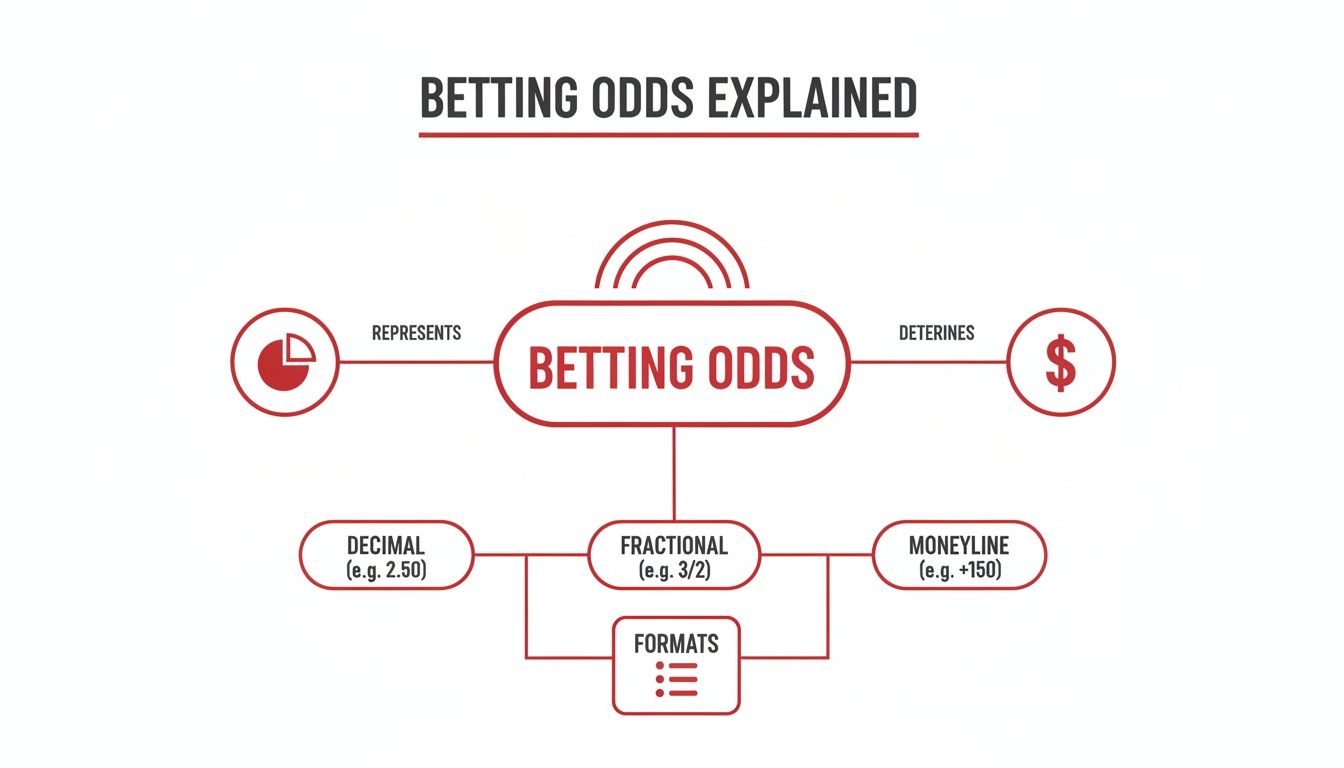
As you can see, all three pieces are tied together. Each format is just a different window into the exact same bet.
American Odds: The US Standard
Walk into any US-facing offshore sportsbook, from MyBookie to BetAnything, and you'll be greeted by American odds. You'll know them by the plus (+) or minus (-) sign right in front of a number. The whole system revolves around the magic number $100.
- The Minus Sign (-): This points to the favorite—the team the bookmaker expects to win. The number tells you how much cash you need to risk just to win $100. So, if you see odds of -150, you have to lay down $150 to pocket a $100 profit.
- The Plus Sign (+): This is for the underdog, the longshot. The number here shows you the profit you'll make on a $100 bet. Odds of +200 mean a successful $100 wager brings back $200 in pure profit.
This format makes the risk vs. reward crystal clear. You have to risk more to win less on a heavy favorite, but a small bet on an underdog can lead to a huge payday.
Decimal Odds: Simple and Direct
Hugely popular across Europe, Canada, and Australia, decimal odds are probably the easiest to understand right out of the gate. They show you the total return for every $1 you bet, which includes your original stake.
Calculating your potential payout is dead simple: just multiply your stake by the decimal odd.
Calculation Example: Let's say you bet $10 on a team with 2.50 decimal odds. Your total return would be $25 ($10 stake x 2.50). That's your original $10 back plus $15 in profit.
It's a clean system. Anything over 2.00 means you're betting on an underdog (you'll more than double your money). Anything under 2.00 is a favorite. A perfect even-money bet is exactly 2.00. Many modern sites like Cosmobet and BUSR let you toggle between formats, so knowing decimals is a handy skill.
Fractional Odds: The UK Tradition
Fractional odds are the old guard, the original format born in the UK and still the standard for horse racing. They show you the potential profit in relation to your stake. Think of the fraction as "what you'll win" to "what you'll bet."
- Example 1 (Underdog): Odds of 5/1 (read as "five-to-one") are straightforward. You win $5 in profit for every $1 you wager.
- Example 2 (Favorite): Odds of 1/2 (read as "one-to-two") mean you'll win $1 in profit for every $2 you risk.
You won't see them as often for football or basketball on sites like Bet105, but they're essential if you dip your toes into international sports or the racetrack. The real power comes from being able to switch between all three formats in your head. It lets you spot value instantly, no matter what sportsbook you're on.
Calculating Payouts and Implied Probability
So, you know how to read the odds. That's step one. But the real edge comes from understanding what those numbers actually mean. Odds are more than just payout multipliers; they're the sportsbook's way of telling you the probability of an outcome. This is where the concept of implied probability becomes your secret weapon.
Think of implied probability as a way to translate betting odds into a simple percentage. By converting the odds, you can see, in plain English, the chances a bookmaker like Heritage Sports is giving a team to win. This lets you compare their number to what you think the chances are. Spotting a big difference between those two is how you find real value.
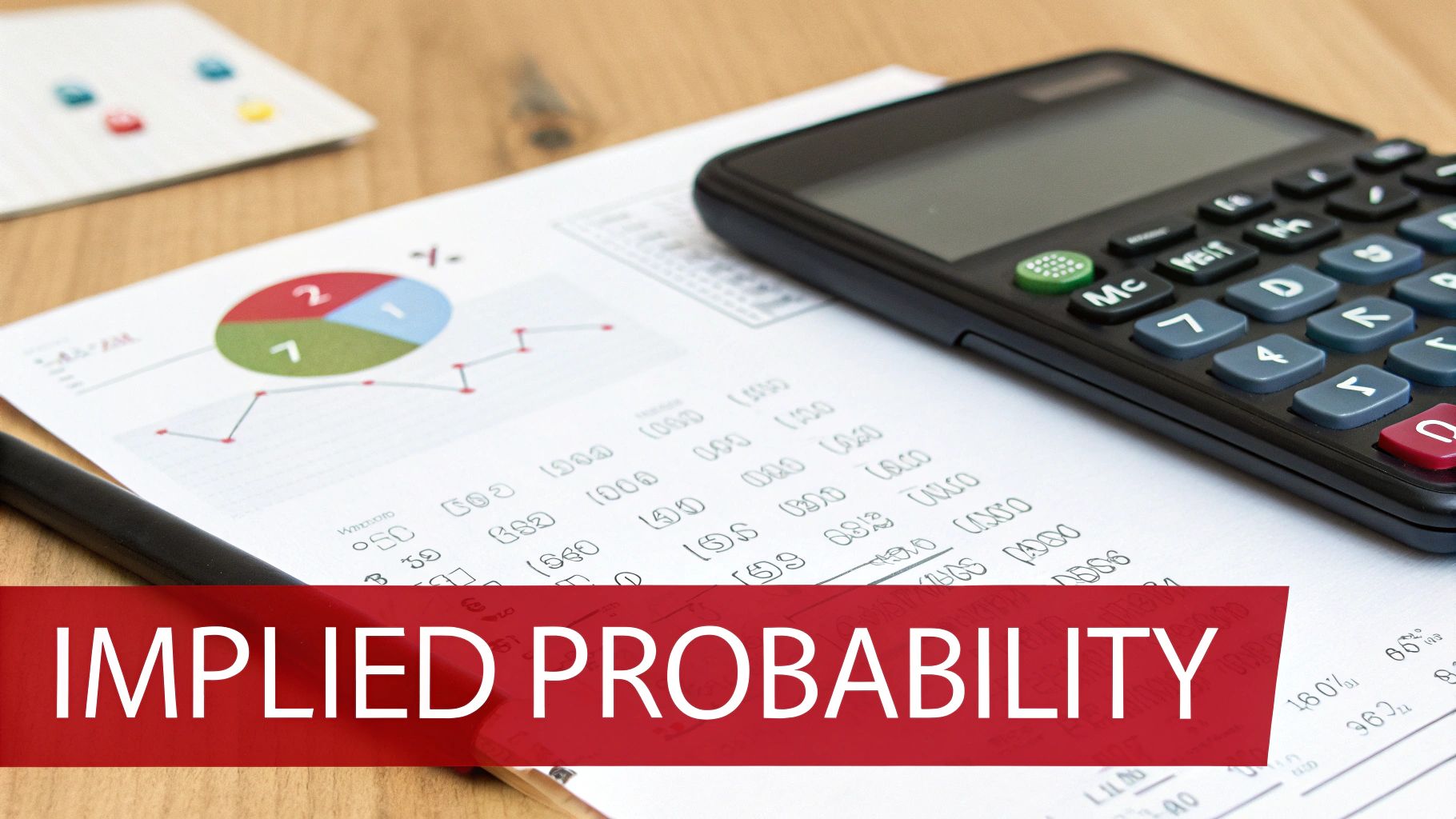
This is a fundamental shift in thinking. You stop looking just at the potential payout and start focusing on the probability—and that’s exactly how the pros approach the market.
How to Calculate Implied Probability from American Odds
Turning American odds into a percentage is a piece of cake once you have the formulas down. There’s one for favorites (the negative number) and one for underdogs (the positive number).
1. For Favorites (Negative Odds)
The formula you need is: Odds / (Odds + 100) * 100
Let's use odds of -150. Just drop the minus sign for the math.
- 150 / (150 + 100) = 150 / 250 = 0.60
- Now, multiply by 100 to get the percentage: 60%
That 60% is the sportsbook's assessment of the favorite's chance to win.
2. For Underdogs (Positive Odds)
The formula here is: 100 / (Odds + 100) * 100
Let's say the odds are +200.
- 100 / (200 + 100) = 100 / 300 = 0.333
- Multiply by 100 to get your percentage: 33.3%
According to these odds, the underdog has a 33.3% shot at pulling off the upset. Once you get these simple calculations down, the whole world of betting odds starts to make a lot more sense.
Understanding the Sportsbook's Cut: The Vig
Okay, if you add the two probabilities from our example (60% + 33.3%), you get 93.3%. That seems a bit off, right? In a real betting market, you'll notice something strange: the total will always be over 100%.
Why? This is the sportsbook’s profit margin, known as the vigorish or just the "vig." Offshore books like BUSR and Bookmaker.eu aren't dealing in "true" odds. They build their commission right into the numbers by slightly inflating the probabilities on both sides.
The vig is the built-in advantage for the house. That extra percentage over 100% is how sportsbooks guarantee they make money over the long run, regardless of which team wins. It's the cost of doing business for the bettor.
A classic example is a point spread bet, where you'll often see odds of -110 on both teams. The implied probability for -110 is 52.38%. Add the two sides together (52.38% + 52.38%), and you get 104.76%. That extra 4.76% is the book's commission—their vig.
A Real-World Payout and Probability Example
Let's pull up a classic game to see this in action. For the NFC Championship on January 18, 2015, the Seattle Seahawks were massive home favorites against the Green Bay Packers.
The Seahawks were sitting around -400 on the moneyline. Using our formula for favorites (400 / (400 + 100)), that translates to an implied probability of 80%. This meant you had to risk a whopping $400 just to win $100.
The Packers, as the underdog at +320, had an implied probability of about 23.8%. Add them together, and you're at nearly 104%, which shows you the sportsbook's built-in edge. For a closer look at how these numbers show up on your wager, check out our guide on the modern sports betting ticket.
Seattle famously won that game in a wild comeback, cashing those -400 moneyline tickets and proving the oddsmakers right.
Applying Odds to Common Bet Types
Alright, you’ve got the theory down—you can read the numbers and see the implied probability. Now it's time to take that knowledge from the classroom to the field. Let's see how these odds actually play out in the three most common wagers you'll find at any top-tier offshore sportsbook: the Moneyline, the Point Spread, and the Total.
Think of these as your foundational toolkit. Each one gives you a different angle to attack a game, and knowing how the odds work for each is non-negotiable. Whether you're scrolling through the lines at MyBookie or BetUS, mastering these bets is your ticket to placing smarter, more confident wagers.
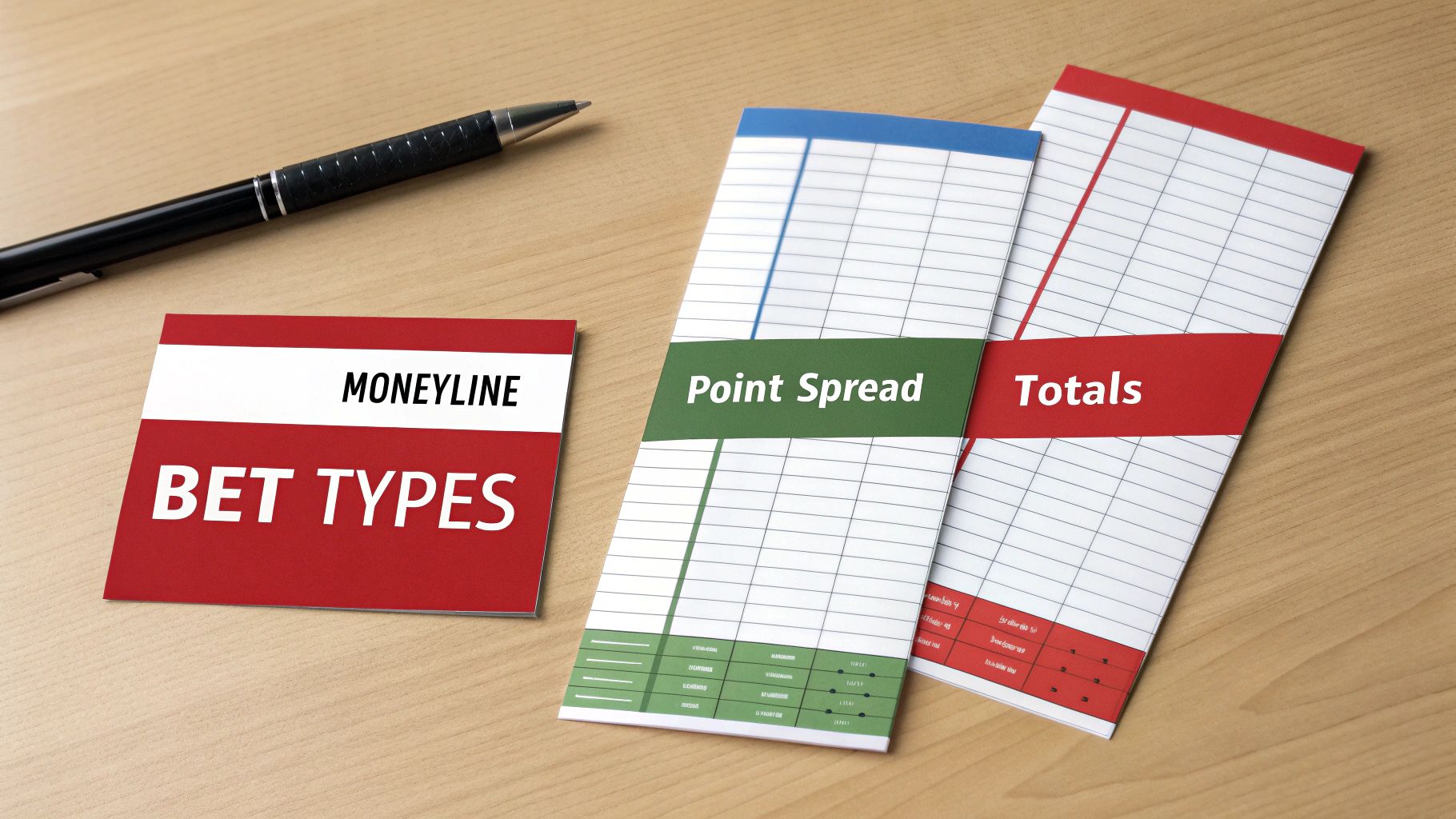
Let's break down how odds shape these core wagers.
To get a clearer picture of these essential bet types, here's a quick side-by-side comparison.
Comparing Common Bet Types
| Bet Type | Betting Objective | Example Scenario |
|---|---|---|
| Moneyline | Simply pick the outright winner of the game. | Bet on the Lakers to beat the Celtics. If the Lakers win, you win. |
| Point Spread | Bet on a team to win by a certain margin or lose by less than that margin. | Bet on the Chiefs -7. They must win by more than 7 points for your bet to cash. |
| Totals (Over/Under) | Bet on whether the combined score of both teams will be higher or lower than a set number. | The Over/Under for a soccer match is 2.5 goals. Bet 'Over' if you expect 3+ goals. |
Each of these bets offers a unique way to engage with a game, depending on where you see the most value.
The Moneyline Bet Explained
The moneyline is as straightforward as it gets. Your only job is to pick who wins the game. No spreads, no conditions—if your team's hand is raised at the end, your ticket cashes. It's the purest form of sports betting.
Of course, the odds are what make it interesting. A heavy favorite will have negative odds (like -300), which means the payout is smaller because they're expected to win. The underdog, on the other hand, gets positive odds (like +250), offering a handsome reward for taking on more risk.
- Favorite Example: A -300 favorite requires a $300 bet to win $100.
- Underdog Example: A +250 underdog pays $250 in profit on a $100 bet.
Because of its simplicity, the moneyline is a great place to start. It’s a direct test of your ability to just plain pick winners.
How Point Spreads Work
The point spread is the great equalizer. Oddsmakers at places like Bookmaker.eu and Xbet create a handicap for the favorite to bring both sides of the bet to a near 50/50 proposition. That’s why you almost always see odds of -110 on both the favorite and the underdog.
When you bet on the favorite, they don't just have to win; they have to win by more than the point spread. If you take the underdog, they can either win the game outright or lose by less than the spread. This is what's known as "covering the spread."
A classic real-world example is Super Bowl X back on January 18, 1976. The Pittsburgh Steelers were 7-point favorites against the Dallas Cowboys. Bettors taking the Steelers needed them to win by more than a touchdown. Pittsburgh won the game 21-17, but that 4-point margin wasn't enough to cover the spread. It’s a perfect illustration of how a team can win the game but still lose the bet for spread bettors. For more cool historical data, you can dig into archives at sites like Covers.
Understanding Totals or Over/Under Bets
The third pillar of sports betting is the Total, often called the Over/Under. With this bet, you forget about who wins or loses. All you care about is the combined final score of both teams. Oddsmakers at a site like Cosmobet will post a number, and your job is to predict whether the actual score will go over or under it.
A Totals bet allows you to have a strong opinion on a game's flow—whether it will be a high-scoring shootout or a defensive battle—without needing to pick a winner.
Let's say the Over/Under for an NBA game between the Lakers and Celtics is set at 220.5 points. You have two options:
- Bet the Over: You win if the final combined score is 221 points or higher (e.g., a 115-106 final).
- Bet the Under: You win if the final combined score is 220 points or lower (e.g., a 105-101 final).
Just like point spreads, the odds on Totals usually hover right around -110 for both sides. That extra juice is the sportsbook's built-in commission, or "vig."
Why Odds Change and How to Find Betting Value
One of the biggest mistakes I see new bettors make is assuming that betting odds are set in stone. They'll spot a line on a site like Bet105 on a Monday morning and figure that’s what it will be right up until kickoff. The truth is, odds are a living, breathing number. They're constantly on the move, reacting to a whole host of factors.
Figuring out why these lines shift is a huge piece of the puzzle when you’re learning how odds work in sports betting. At the end of the day, the main reason lines move is that sportsbooks are managing their risk. The oddsmakers at places like BetUS and MyBookie aren't just trying to predict the future; their real job is to set a line that gets people to bet roughly the same amount of money on both sides.
When they get that balance right, they guarantee themselves a profit from the vig, no matter who actually wins the game. But if a tidal wave of cash comes in on one side, they’re suddenly exposed and could take a massive hit. To avoid that, they'll tweak the odds—making the less popular side a little more tempting and the favorite a bit less attractive—to steer the money back toward a nice, safe equilibrium.
The Forces That Move the Lines
So, what makes an oddsmaker at a book like Bookmaker.eu actually shift a line? While getting balanced action is their primary goal, a ton of real-world stuff happens that forces their hand before a game even starts.
Here are the main culprits behind changing odds:
- Betting Volume (Public Money): This is the most common reason. When the general public all piles onto one side, sportsbooks will move the line to encourage bets on the other team. You see this all the time in big, televised games where there's a clear popular team.
- Sharp Money: This is the opposite of public money. When respected, professional bettors—the "sharps"—drop a large wager, sportsbooks sit up and take notice. They trust the judgment of these bettors and will often move a line just based on their action.
- Team News and Injuries: Nothing moves a line faster than news. A last-minute injury to a star quarterback or a key player getting ruled out can completely change a team’s outlook, forcing oddsmakers to make a quick and significant adjustment.
- Weather Conditions: Don't forget about Mother Nature. For outdoor sports like football, things like heavy wind, snow, or a downpour can wreak havoc on scoring and gameplay, causing oddsmakers to adjust point spreads and totals accordingly.
The Art of Finding Betting Value
All of this leads us to the single most important concept if you want to be a successful bettor long-term: finding value. Value betting isn't just about picking winners. It’s about finding odds that are better than they should be.
In simple terms, a value bet exists when you believe the true probability of an outcome is higher than the implied probability offered by the sportsbook's odds. Learning how to spot these discrepancies is what separates casual bettors from profitable ones.
Let's say you've done your homework on a game and figure an underdog has a real 40% chance of pulling off the upset. The sportsbook is offering them at +200 odds, which only implies a 33.3% chance. That's a value bet. Even if that underdog ends up losing, you made the right play because the odds were in your favor. For a deeper dive, check out our guide on betting for value, which breaks the whole strategy down.
Over/under totals are a fantastic place to hunt for value. The public absolutely loves to bet the over, and all that one-sided money can push the line up by a point or two. This often creates some sneaky value on the under. For instance, a study of NHL games from 2008-2023 found that overs on a total of 5.5 only hit 49% of the time. That suggests there's often an edge to be found by betting against the grain. You can dig into historical odds and results yourself on sites like Oddsportal to find your own trends.
Essential Strategies for Smart and Responsible Betting
Getting a handle on how odds work in sports betting is the first step, but it’s just the beginning. The real trick to long-term success—and enjoyment—is learning to apply that knowledge with smart, disciplined strategies. It's the difference between guessing winners and making calculated decisions that give you the best possible shot.
This is where you graduate from simply gambling to strategic betting. By putting a few key principles into practice, you can protect your money, squeeze more value out of your wins, and make sure this hobby stays fun. Think of this as the final piece of the puzzle on your journey from novice to sharp, informed bettor.
Always Go Line Shopping for the Best Odds
If there's one habit that separates casuals from sharps, it's line shopping. Never, ever settle for the first odds you see. Different offshore sportsbooks will almost always have slightly different lines on the exact same game, and those little variations add up in a big way over time.
Let's say you've got your eye on an NFL underdog. You log into MyBookie and see they’re offering moneyline odds of +150. Good, but is it the best? Before you lock it in, you pop over to BetUS and find the same team listed at +160. That extra +10 might not look like a game-changer, but it’s more profit for the exact same amount of risk. Why leave money on the table?
Consistently finding the best available price at sites like MyBookie, Xbet, or Bookmaker.eu is like giving yourself a raise on every single winning ticket. It’s a pro-level move that any bettor can—and absolutely should—be making.
Master the Art of Bankroll Management
Your bankroll is the pot of money you’ve specifically set aside for betting. This is crucial: it should only be money you are completely comfortable with losing. The golden rule here is to never, ever risk a big chunk of it on one game. Most seasoned pros stick to what’s called a flat-betting approach.
This means you only risk 1% to 3% of your total bankroll on any single bet.
- If you're working with a $1,000 bankroll, your standard bet size should be somewhere between $10 and $30.
- This simple rule is your shield against the inevitable losing streak. And trust me, they happen to everyone.
- It also takes the emotion out of the equation. No single game can wipe you out, so you can think clearly.
This disciplined system keeps you in the game through the natural ups and downs of sports betting. Sites such as BUSR and Heritage Sports make it simple to keep track of your wagers and stay on the straight and narrow.
Practice Responsible Gambling Habits
At the end of the day, sports betting should be an entertaining hobby that adds a little spice to the games you love. That's only possible if you’re committed to responsible gambling from the very start. You have to set clear boundaries for yourself before you ever place a single bet.
Stick to these simple but non-negotiable guidelines:
- Set Strict Limits: Decide on a budget—whether it's daily, weekly, or monthly—and treat it like a hard rule. Never chase your losses by depositing more money than you originally planned.
- Bet with Your Head, Not Over It: Avoid betting when you're emotional or under the influence of alcohol. Your best asset is clear judgment, so don’t compromise it.
- Know When to Take a Break: If betting starts to feel more like a source of stress than fun, it’s time to step away. The games will still be there when you're ready to come back with a clear head.
- Recognize the Signs: Be honest with yourself. Are you hiding your betting from family? Borrowing money to bet? Wagering more than you can truly afford? These are red flags for problem gambling.
By combining what you’ve learned about odds with these essential strategies, you’re building a smart, healthy, and sustainable approach to your new hobby. That’s how you keep it fun for the long haul.
Got Questions About Sports Betting Odds?
Even when you think you have the basics down, a few questions always pop up. It's totally normal. Getting the hang of sports betting odds is a process, and nailing down these common sticking points will give you a ton of confidence before you put your money down.
Let's clear up some of the most frequent questions I hear from new bettors.
What Does -110 Mean in Sports Betting?
If you've spent any time looking at point spreads or totals, you've seen -110 everywhere. It’s the standard price you’ll find at pretty much every offshore sportsbook, from MyBookie to BetUS. This number is the book's commission, better known as the "vig" or "juice."
Think of it this way: to win $100, you have to risk $110. That extra $10 is the sportsbook’s cut. This small, built-in margin is how they stay in business and guarantee a profit, no matter who wins the game. It's the cost of placing the bet.
How Do I Calculate Payouts From American Odds?
Working out your potential winnings with American odds is a piece of cake once you get the hang of it. The whole system is built around the magic number of $100. Just pay attention to the plus (+) or minus (-) sign.
- Negative (-) Odds (The Favorites): This number tells you how much you need to bet to win $100. So, for odds of -150, you'd bet $150 to see a profit of $100.
- Positive (+) Odds (The Underdogs): This is the fun one. This number shows you the profit you’ll make from a $100 bet. At +200 odds, your $100 wager brings back a $200 profit.
The math scales up or down for any amount. A $15 bet at -150 odds wins you $10. A simple $10 bet at +200 odds doubles your money with a $20 win. Plus, most sites like Xbet and BetAnything do the math for you right on the bet slip.
Why Should I Use Multiple Offshore Sportsbooks?
This is one of the most important habits you can develop as a bettor. Using several different sportsbooks is a strategy called "line shopping," and it’s how you squeeze every last drop of value out of your bets. A book like Bookmaker.eu might have slightly different odds on a game compared to Heritage Sports or BUSR.
By checking the lines across a few sites, you guarantee you're getting the best possible price for your bet. This small edge is what separates casual bettors from the sharps who win consistently.
It might not seem like a big deal at first, but over a season, getting a better moneyline price or an extra half-point on a spread adds up. It's a simple step that directly improves your bottom line every time you cash a ticket.
Ready to put this knowledge into practice? At USASportsbookList, we've done the legwork, reviewing and ranking the top offshore sportsbooks out there. You can compare bonuses, check out their features, and find the perfect fit to start your betting journey. Check out our expert guides and find your next betting site at https://usasportsbooklist.com.