Instead of just betting on who wins or loses, point spread betting is all about the margin of victory. Offshore sportsbooks use a point handicap—the spread—to even the odds between two mismatched teams. This creates a much more interesting and balanced bet, no matter who is playing.
What Exactly Is Point Spread Betting?

Picture this: the reigning Super Bowl champs are facing a team that’s on a massive losing streak. A straight-up bet on who will win (a moneyline bet) is hardly exciting. The odds on the favorite would be so low you'd risk a fortune for pennies, while betting on the underdog is a true Hail Mary. That’s where the point spread changes the game entirely.
Point spread betting transforms a potential blowout into a nail-biter. Oddsmakers at offshore sportsbooks like MyBookie and BetUS analyze the matchup and set a "spread," which is basically a handicap for the better team. This magic number creates a balanced betting market that attracts action on both sides of the contest.
Favorites vs. Underdogs: The Plus and Minus Signs
When you pull up a betting line on a site like Bovada, you’ll see a number with a plus (+) or minus (-) sign next to each team. This is the heart and soul of point spread betting.
- The Favorite (-): The team expected to win gets the minus sign. This is the number of points they have to win by for your bet to pay out. If a team is listed at -7.5, they need to win by 8 points or more.
- The Underdog (+): The team expected to lose gets the plus sign. This is the cushion they have; they can lose by less than this number (or win outright) and you still win your bet. If a team is +7.5, they can lose by up to 7 points and your ticket still cashes.
Here's a pro tip: A sportsbook's main goal isn't to perfectly predict the final score. It's to set a line that gets roughly half the money bet on the favorite and half on the underdog. That way, they make their profit on the commission (the vig) no matter who covers.
For instance, you might see the Green Bay Packers at -3.5 against the Chicago Bears at +3.5 on BetOnline. A bet on the Packers only cashes if they win by 4 or more points. A bet on the Bears wins if they pull off the upset or if they lose by 3 points or less. It’s this simple handicap that makes every game a toss-up for bettors.
Decoding a Point Spread Bet
Let's break down what you're looking at with a quick-reference table.
| Component | What It Means | Example (Chiefs -7.5) |
|---|---|---|
| Team Name | The team you are betting on. | Kansas City Chiefs |
| The Minus Sign (-) | Indicates the team is the favorite. | The Chiefs are expected to win. |
| The Number (7.5) | The point spread or handicap. | The Chiefs must win by more than 7.5 points. |
| The "Hook" (.5) | The half-point ensures there are no pushes (ties). | A 7-point Chiefs win means the bet loses. |
This structure is what makes point spreads the most popular way to bet on football and basketball, turning even the biggest mismatches into compelling wagers.
The Surprising History of the Point Spread

To really get a feel for point spread betting, you have to look at where it came from. Before the 1940s, betting on sports was a pretty straightforward affair: you just picked the team you thought would win. That's it.
This created a massive headache for bookmakers. Whenever a powerhouse team was slated to play a cellar-dweller, almost every single dollar would pour in on the heavy favorite. If the favorite won—which they usually did—the bookie was on the hook for a huge payout with almost no money from the losing side to cover it. The system was broken.
The Math Teacher Who Changed Everything
The fix came from a pretty unexpected place: a Chicago bookmaker named Charles McNeil, who used to be a math teacher. McNeil cooked up a radical idea that completely changed the game. Instead of just betting on who wins, what if you could bet on the margin of victory?
McNeil’s invention, the point spread, was brilliant in its simplicity. It essentially gave the underdog a head start before the game even began. By handicapping the favorite with a point deficit they had to overcome to win the bet, he made wagering on the underdog a genuinely appealing option. For the first time, both sides of a bet had real action, which was a revelation for balancing the books. You can read more about this massive shift on pro-football-history.com.
By creating a balanced market, the point spread ensured that sportsbooks could profit from their commission (the vig) rather than gambling on the outcome of the game itself. This fundamental principle is still the engine that drives modern offshore sportsbooks like MyBookie and BetUS today.
This concept really caught fire in the 1950s, landing at the perfect time as televised football started booming. As fans across the country watched from their living rooms, the point spread added a whole new dimension to the experience.
Suddenly, it wasn't just about whether your team won the game. It was about whether they "covered the spread." This made every single play and every point crucial, turning passive viewing into the kind of interactive, nail-biting experience that platforms like Sportsbetting.ag and Bookmaker.eu still deliver today.
How to Read Point Spread Odds and Payouts
Okay, so you’ve got the handicap down. Now let’s talk about the part that really matters: turning those numbers into actual cash.
Look next to any point spread at a sportsbook like BetOnline or Bovada, and you’ll spot another number—almost always -110. This is the price tag on your bet. In the betting world, we call this the vigorish, or just “vig” or “juice.”
Think of it as the sportsbook's fee for handling your action. This little number is everything when it comes to understanding your potential payout and what you’re risking. If you're new to this, -110 might seem a bit weird, but the concept is actually very simple.
A -110 line is standard. It just means you have to risk $110 to win $100. If your bet hits, you get your original $110 stake back plus your $100 profit, for a total of $210 coming back to you.
This is exactly how sportsbooks ensure they make money. As point spread betting exploded in popularity with the rise of televised sports in the 1950s, this commission structure became the industry standard. With balanced action on both sides, that juice gives the house about a 4.4% profit margin.
For bettors, this means you need to win more than you lose just to stay afloat. That magic number is 52.38%. Win that percentage of your bets, and you’ll break even. Anything higher, and you’re in the black. It’s a critical figure to burn into your brain if you're serious about this.
Why the Juice Changes
While -110 is what you’ll see most of the time, especially at top offshore sportsbooks like Sportsbetting.ag, you’ll sometimes notice it shift. You might see the juice on the favorite move to -115 while the underdog’s side moves to -105. What gives?
It's all about the sportsbook balancing its books.
- -115 Juice: When you see this, it means a lot of money is flowing in on that side. The book makes it a little more expensive to bet on the popular team (risk $115 to win $100) to discourage more action.
- -105 Juice: In turn, the other side becomes a "cheaper" bet (risk $105 to win $100). This encourages bettors to put money on the less popular side, helping the book balance its risk.
These tiny shifts in juice are huge tells. They show you where the money is going and can often signal that the point spread itself is about to move. This is why learning how to read betting lines is such a fundamental skill.
This infographic breaks down the core concepts of risk, reward, and the break-even point associated with standard point spread odds.
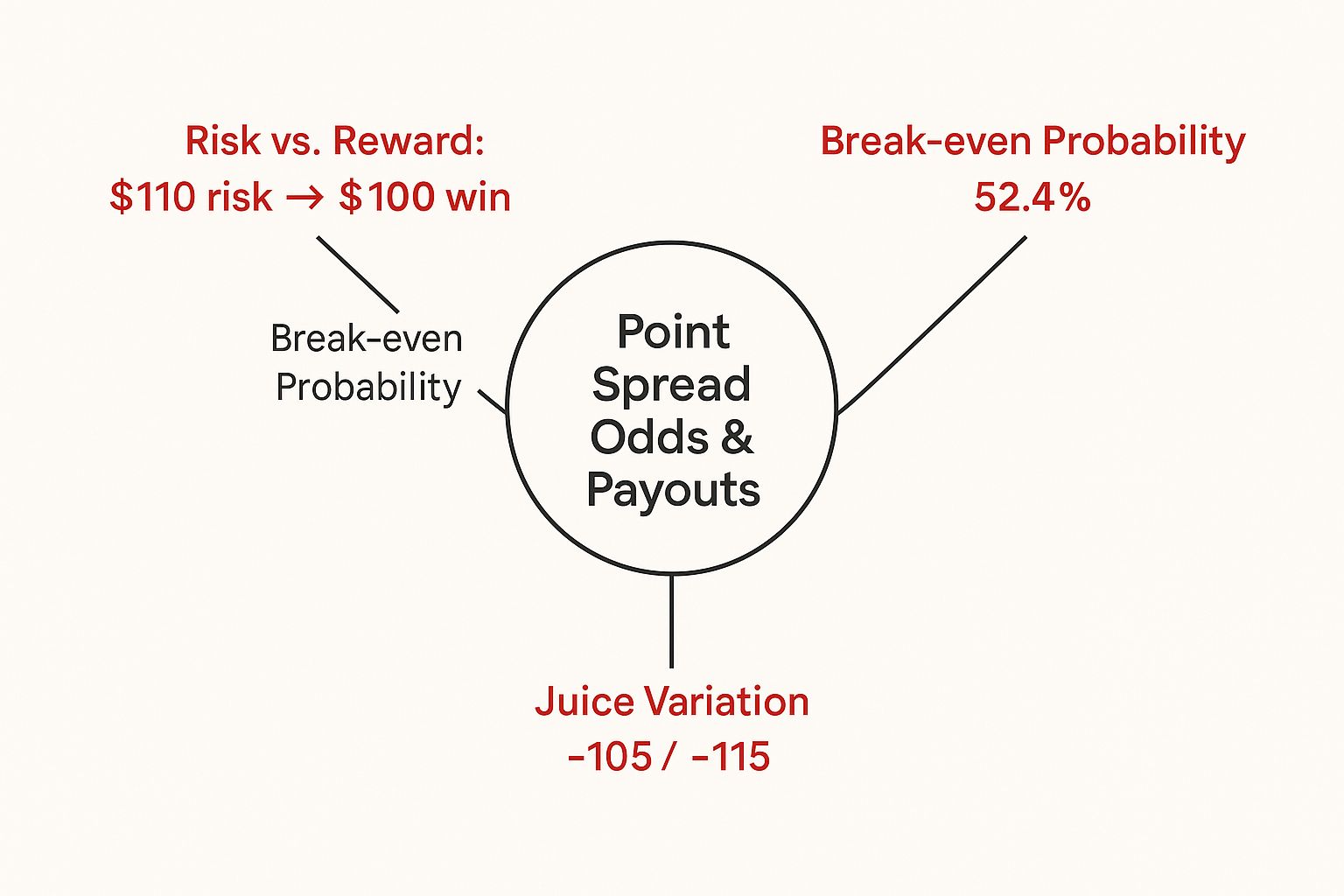
As the image shows, that standard -110 line directly creates the risk-reward ratio and the all-important 52.4% win rate needed to be a profitable bettor long-term.
Once you get a feel for these numbers, you can glance at any line on Bookmaker.eu or Xbet and immediately know your risk, your potential payout, and what it takes to come out ahead.
Understanding Payouts and Break-Even Points
The juice directly impacts your bottom line. Even small shifts from the standard -110 can change how often you need to win to be profitable. This table breaks down how different odds affect your payout and that critical break-even percentage.
| Odds (Juice) | Wager to Win $100 | Total Payout on a $110 Bet | Break-Even Win Rate |
|---|---|---|---|
| -105 | $105.00 | $214.76 | 51.22% |
| -110 | $110.00 | $210.00 | 52.38% |
| -115 | $115.00 | $205.65 | 53.49% |
| -120 | $120.00 | $201.67 | 54.55% |
As you can see, finding lines with reduced juice (like -105) can significantly lower the bar for profitability, while laying more juice (-115 or -120) means you have to be much sharper with your picks to make money.
How Sportsbooks Actually Set Point Spreads
Ever wonder where a point spread number comes from? It’s not some random digit pulled out of thin air. Oddsmakers at offshore sites like Cosmobet and Bet105 are masters of a fascinating balancing act that’s part advanced math, part market psychology.
Their main goal isn't just to predict the final score down to the decimal. The real mission is to land on a number that splits the betting action right down the middle—a near 50/50 split between the favorite and the underdog. When they nail this balance, the sportsbook guarantees itself a profit from the commission (the vig), no matter which team actually covers.
The Ingredients of a Betting Line
To cook up that initial line, oddsmakers blend a potent mix of data, experience, and predictive modeling. It all starts with a few key ingredients.
- Power Ratings: Think of this as a numerical grade for every team, constantly updated based on performance and overall strength.
- Computer Models: These sophisticated algorithms chew through mountains of historical data, team stats, and specific matchup details to spit out a preliminary spread.
- Situational Factors: Oddsmakers are human, and they account for things the models might miss—key player injuries, grueling travel schedules, and even a nasty weather forecast that could change everything.
But that initial number is just the starting point. Once the line goes live on a site like MyBookie or Bookmaker.eu, it becomes a living, breathing thing. It moves based on new information and, most importantly, where the money is going. If you're curious about the pros behind this process, you can learn more about who creates NFL betting lines and how it all works behind the curtain.
Why Spreads Are So Accurate
Even though balancing the books is the top priority, these lines end up being incredibly precise. One deep-dive analysis of NFL games from 2002 to 2022 found that sportsbook point spreads accounted for about 86% of the variation in actual victory margins.
The study also showed the average point spread was 2.21 points, which is unbelievably close to the actual average margin of victory of 2.19 points. That’s the statistical power of the market at work.
A sportsbook line is dynamic. If too much money comes in on one side, oddsmakers will adjust the spread—for example, moving a line from -6.5 to -7—to make the other side more attractive and rebalance their risk.
This constant push and pull is what makes point spread betting so compelling. It's a true numbers game where data, market forces, and expert analysis all collide.
Practical Strategies for Betting the Spread
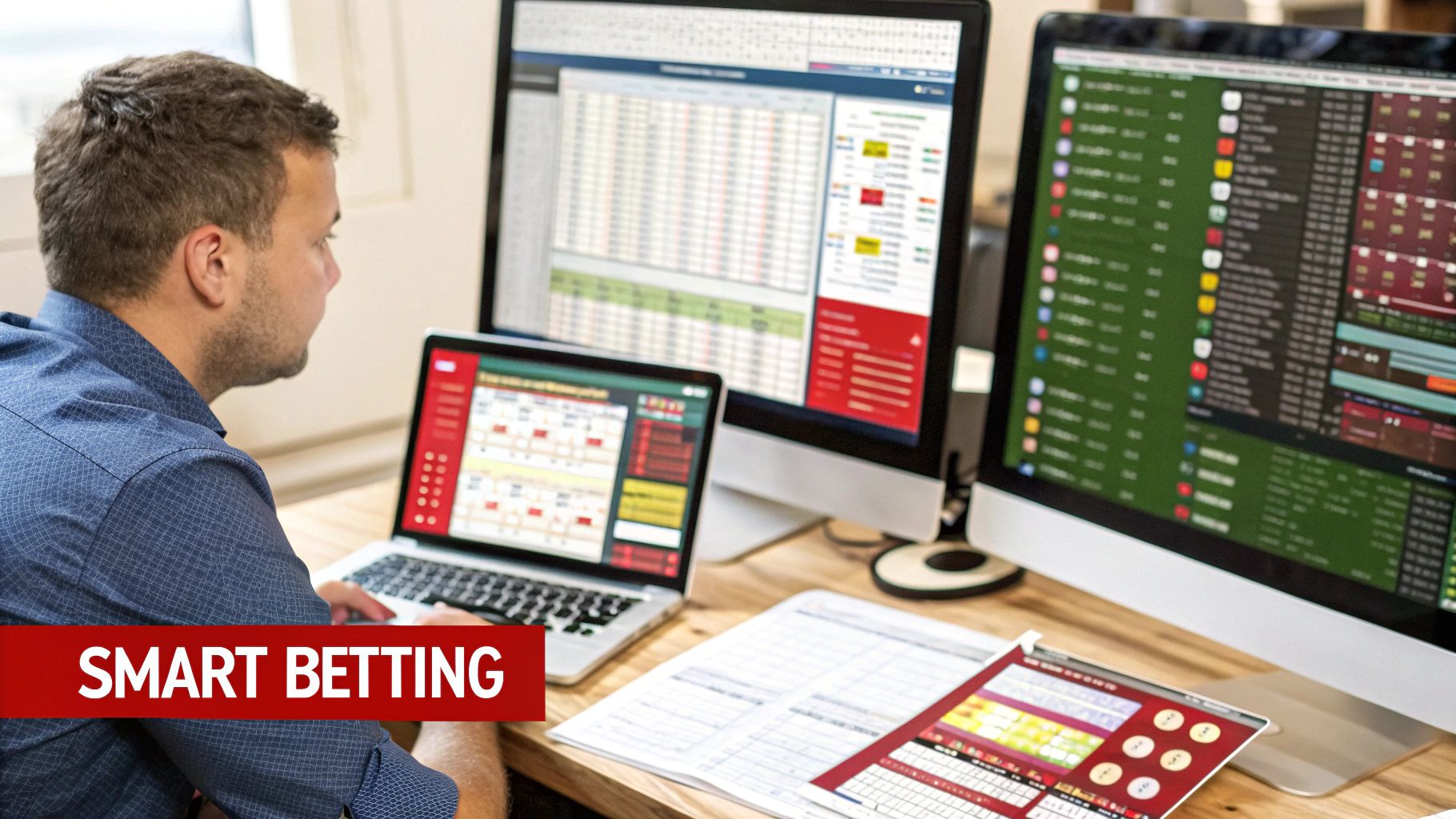
Knowing the rules is one thing, but playing the game smartly is what separates the casual bettor from the sharp. Once you've moved past the basics of understanding point spread betting, it's time to get disciplined. Weaving a few core strategies into your process can make a world of difference over the long haul.
Look, this isn't about some secret formula that guarantees wins. The best bettors don't win every single time; they find value, manage their bankroll, and make consistently smart decisions. Adopting a few practical tactics will help you start thinking like a pro and give your wagers a real fighting chance.
Always Shop for the Best Line
If you take only one piece of advice from this guide, let it be this one. Never, ever place a bet without checking the spread at multiple offshore sportsbooks. You'll often find that sites like BUSR, BetAnything, and Sportsbetting.ag have slight differences in their lines—and that tiny variance is where your profit lives.
Getting the Dallas Cowboys at -6.5 instead of -7 is a massive win before the game even kicks off. That half-point difference, often called the "hook," can be the sole reason a ticket cashes instead of pushing. Over a full season, consistently finding the best number will dramatically improve your results. You can use a good sports betting odds comparison tool to make this a quick and easy habit.
Fade the Public
"Fading the public" is a classic, time-tested strategy. It boils down to one simple idea: bet against the team that everyone else is betting on. Casual bettors love to pile on popular teams, recent winners, or squads with big-name quarterbacks, and this herd mentality can seriously warp the point spread.
When a lopsided amount of public money comes in on one side, sportsbooks like MyBookie and Xbet often adjust the line to encourage betting on the other team. This adjustment can create some incredible value on the less popular side.
By learning to spot these overhyped teams, you can take advantage of the market's overreaction. You'll often find a better number on the underdog or a deflated line on a solid, but less-popular, favorite.
Understand Key Numbers in Football
In the NFL, not all numbers are created equal. Thanks to the scoring system (touchdowns for 7 points with the PAT, field goals for 3), final margins of victory cluster around specific numbers. The most important key numbers by far are 3 and 7.
A huge percentage of all NFL games are decided by one of these two margins. This means there's a world of difference between a spread of -2.5 and -3.5, or +6.5 and +7.5. Securing a line on the favorable side of these key numbers is a fundamental building block of a winning football betting strategy. When you see a spread sitting on 3 or 7 at a site like Bookmaker.eu, you know you're at a critical decision point that demands your full attention.
A Few Lingering Questions on Point Spreads
Even once you get the hang of the basics, a few common situations can still throw a wrench in things for new bettors. Let's tackle some of the most frequent questions that pop up. This will help clear up any lingering confusion before you start looking for lines at an offshore sportsbook like Xbet or Bookmaker.eu.
Think of this as your final checklist to make sure you’re betting with total confidence.
What Happens If the Final Score Lands Exactly on the Spread?
You'll hear experienced bettors call this a "push," and it's basically a tie. Your bet didn't win, but it didn't lose either.
For instance, if you bet a favorite at -3 and they win by exactly three points, that's a push. When that happens, sportsbooks such as Bovada just return your original stake to your account. No harm, no foul. This is exactly why you see so many spreads with a half-point attached (like -3.5 or +7.5)—that little ".5" makes a push impossible.
Does the Spread Change After I Place My Bet?
Absolutely not. The point spread you bet is the point spread you get, period. It's locked in the moment you place your wager.
The line will almost certainly move during the week as money comes in from the public. But if you snagged an underdog at +7 on Tuesday and the line gets bet down to +6 by Sunday, your ticket is still golden at +7. This is a huge piece of the puzzle and a core reason why timing your bets and shopping for the best number is a vital strategy for long-term success.
Is a Point Spread Bet Better Than a Moneyline Bet?
One isn't "better" than the other—they're just different tools for different jobs. A moneyline is as simple as it gets: you're just picking the team you think will win the game, no matter the score. The point spread, on the other hand, is all about the margin of victory.
The best bet is always the one where your analysis reveals the most value. Sometimes that's backing a heavy favorite on the spread; other times, it might be taking an underdog on the moneyline for a bigger payout.
A spread lets you back a heavy favorite without having to risk a ton of cash for a tiny return, something you'll see offered on every game at sites like BetOnline and BetUS. On the flip side, it gives you a way to support an underdog and still cash your ticket even if they lose a close game. Knowing when to use each one is a hallmark of a sharp bettor.
Now that you've got a solid foundation for how point spread betting works, you’re ready to start exploring the odds and finding your edge. For detailed reviews of the best offshore sportsbooks and exclusive bonus offers, check out USASportsbookList at https://usasportsbooklist.com.