Let's be honest: winning consistently at soccer betting isn't about luck. It's a game of discipline and strategy.
Most bettors lose in the long run because they skip the boring stuff. But if you can master three core principles—managing your money, finding value in the odds, and picking the right sportsbook—you’ll already have a massive edge over the field.
Building Your Foundation for Consistent Wins

Before you dive into team stats or look for the perfect matchup, you have to build a solid foundation. Too many people treat betting like buying a lottery ticket instead of making a calculated investment, and that's a surefire way to go broke.
The secret isn't some magic formula. It’s about creating a simple framework that shields you from making emotional decisions and sets you up for long-term profit. And it all starts with the single most important rule in betting.
Master Disciplined Bankroll Management
Your bankroll is the money you've set aside only for betting. This isn't your rent money or your grocery budget—it's capital for your wagering. The whole point of managing it is to make sure you can ride out the inevitable losing streaks without wiping out your account.
The best way to do this is to establish a "unit size." A unit is just a fixed percentage of your total bankroll that you risk on any single bet. For most people, a standard unit should be 1-2% of your total bankroll. Nothing more.
Here's how that plays out:
- If you have a $1,000 bankroll: Your standard unit size is just $10 to $20 per wager.
- Surviving a bad run: With this method, you'd need to lose an astonishing 50 to 100 consecutive bets to lose everything. If you're betting with any kind of strategy, that's just not going to happen.
This simple rule takes emotion out of the equation. You won't be tempted to chase your losses with bigger bets or get cocky after a few wins. It keeps you in the game long enough for your skill to actually matter. For a deeper dive, check out our complete guide on sports betting bankroll management.
To give you a clearer picture, here's a quick rundown of some popular strategies you can use to protect your capital and stay in the game for the long haul.
Essential Bankroll Management Strategies
| Strategy | Description | Recommended For |
|---|---|---|
| Flat Betting | Wager the same amount (e.g., 1% of your bankroll) on every bet, regardless of confidence or odds. | Beginners, as it's the simplest and safest method to control risk. |
| Percentage Model | Wager a fixed percentage of your current bankroll. Your stake size increases after wins and decreases after losses. | Intermediate bettors who want their stake size to reflect their bankroll's performance. |
| Kelly Criterion | A more complex formula that calculates the optimal stake size based on the perceived value of the odds. | Advanced bettors who are confident in their ability to accurately calculate probabilities. |
Each of these models offers a structured way to approach staking, but the core idea is always the same: protect your capital so you can survive the downswings and capitalize on the good runs.
The Art of Finding Value Bets
Once your money management is locked in, the next step is finding "value." This is where the real skill comes in. Winning isn't about just picking teams you think will win; it’s about finding odds that are mispriced in your favor. This is the only way to be profitable long-term.
Value betting is simply identifying a gap between the odds a sportsbook offers and the true probability of something happening. If you think a team has a 50% chance to win, but the odds imply they only have a 40% chance, you've found a value bet.
Let's say Manchester City is playing Burnley. You might see BetUS offering odds of -500 for a City win, which is an implied probability of 83.3%. If your research tells you their actual chance is maybe 90%, there's no real value there. The price is too high.
But what if you see a "Both Teams to Score" prop on MyBookie at +150 (40% implied probability)? If your analysis suggests the true chance of that happening is closer to 55%, that's your edge. That's the bet you make.
Choosing the Right Offshore Sportsbook
Your ability to find these value bets is directly linked to the sportsbooks you use. This is non-negotiable.
Using offshore sites like BetUS, Bovada, and MyBookie is a must for any serious bettor. They often have more competitive odds and a much wider selection of markets than you'll find elsewhere. Having accounts at multiple books like BetOnline and Bookmaker.eu lets you "line shop"—checking which site offers the best price for the exact bet you want to make.
This data-driven approach is critical, especially as the industry gets bigger and smarter. The global sports betting market is projected to hit nearly USD 298.1 billion by 2035, and that growth means more opportunities but also sharper competition. A solid foundation is more important than ever.
Finding Hidden Value in Soccer Markets
Most casual bettors get stuck on one simple question: who's going to win? It makes sense. The 1X2 (Win/Draw/Win) market is the most popular, but it's often the least profitable. The real secret to learning how to win in soccer betting is looking beyond the obvious and finding an edge where others aren't even looking.
The biggest profits are often hidden in plain sight, far from the spotlight of the main match odds. If you specialize in these less-trafficked areas, you can gain a real information advantage and consistently find bets worth making.
Look Beyond the Obvious 1X2 Market
Laser-focusing on the match winner is a classic strategic mistake. Bookmakers like BetAnything and BUSR pour massive resources into setting razor-sharp 1X2 lines because that's where the public money floods in. This means the odds are usually incredibly efficient, leaving almost no value on the table for you.
The trick is to pivot to alternative markets where the lines might be a bit softer. These bets require more specialized knowledge, which naturally filters out a huge chunk of the casual betting crowd.
Here are a few powerful alternatives I always keep in my back pocket:
- Asian Handicaps: This is a game-changer. It gets rid of the draw, creating a straight two-way bet. By applying a goal handicap, it levels the playing field between a powerhouse and an underdog, forcing you to analyze not just if a team will win, but by how much.
- Over/Under Goals (Totals): Instead of picking a winner, you’re just betting on the total number of goals in the game. This is perfect for times when you have a strong read on the match's flow—like a tight, defensive slugfest or an wide-open shootout.
- Both Teams to Score (BTTS): A simple "Yes" or "No" wager on whether both teams will find the back of the net. It's a fantastic market when two aggressive, yet defensively shaky, teams go head-to-head.
By specializing in one or two of these, you can develop a much deeper understanding than the average bettor. That's always the first step toward finding consistent value.
Dissecting Stats for an Edge
To actually win in these niche markets, you need to go deeper than just wins and losses. For example, if you're looking at an Over/Under bet, knowing who's higher in the league table is almost useless.
Your research needs to center on what directly impacts scoring. I always look at these key data points:
- Team Form & Style: Does a team press high and create chaos, or do they prefer to sit back in a low block? A team on a winning streak is great, but if their wins are all 1-0 defensive masterclasses, they're a terrible choice for an "Over" bet.
- Head-to-Head (H2H) History: Some matchups are just guaranteed fireworks, while others are notoriously dull affairs. Past results can reveal tactical clashes that repeat themselves year after year.
- Situational Factors: Never underestimate this. Injuries to key players—especially a star striker or a rock-solid center-back—can completely change a game's expected goal count. Also, think about travel fatigue for a team playing on the road after a long midweek European trip.
A common trap is assuming a top team will always score a bunch of goals. A dominant team playing a packed-in defense just before a huge Champions League match might be perfectly happy to grind out a 1-0 win. In that spot, the "Under" is often the real value play.
A Real-World Value Scenario
Let's walk through how this works with a hypothetical Premier League match: Everton vs. Brighton over at BetOnline. The 1X2 odds are tight, with no obvious value on either side. Most bettors would just skip this game. But a sharp eye sees an opportunity somewhere else.
Here's the breakdown:
- Initial Analysis: I know both Everton and Brighton have decent attacks but have been leaky at the back all season. Digging deeper, Everton's home games have seen both teams score in 65% of matches. Brighton's away games? That number is even higher, hitting the mark 70% of the time.
- Market Check: I log into BetOnline and see the odds for "Both Teams to Score – Yes" are sitting at -110. In betting terms, this implies a probability of about 52.4%.
- Finding the Value: My research clearly shows the true probability is much closer to that 65-70% range. The book's line is way off, seriously underestimating how likely it is that both teams get on the scoresheet. That -110 price isn't just a bet; it's a fantastic opportunity.
This is a perfect example of ignoring the crowded main market to find a statistical edge. While everyone else was arguing about who would win, you spotted a clear pricing error in a prop bet. This is the heart and soul of value betting. To learn more, check out our complete guide on the essentials of betting for value.
Success in soccer betting isn't about having a crystal ball. It’s about being a specialist, gaining an information advantage, and knowing exactly where to hunt for odds that don’t reflect reality.
Developing Your Data-Driven Research Process
Relying on gut feelings or blind team loyalty is the fastest way to drain your betting account. If you really want to learn how to win in soccer betting, you have to leave the hunches behind and build a repeatable research process grounded in cold, hard data. This framework is what separates the casual punter from the consistently profitable bettor.
It’s all about looking past the final score and digging into the numbers that reveal a team's true performance. By focusing on modern statistics, you can uncover patterns that the general public—and sometimes even the sportsbooks—completely overlook.
This simple three-step visualization breaks down the core of any solid betting strategy: research, analyze, and then bet.
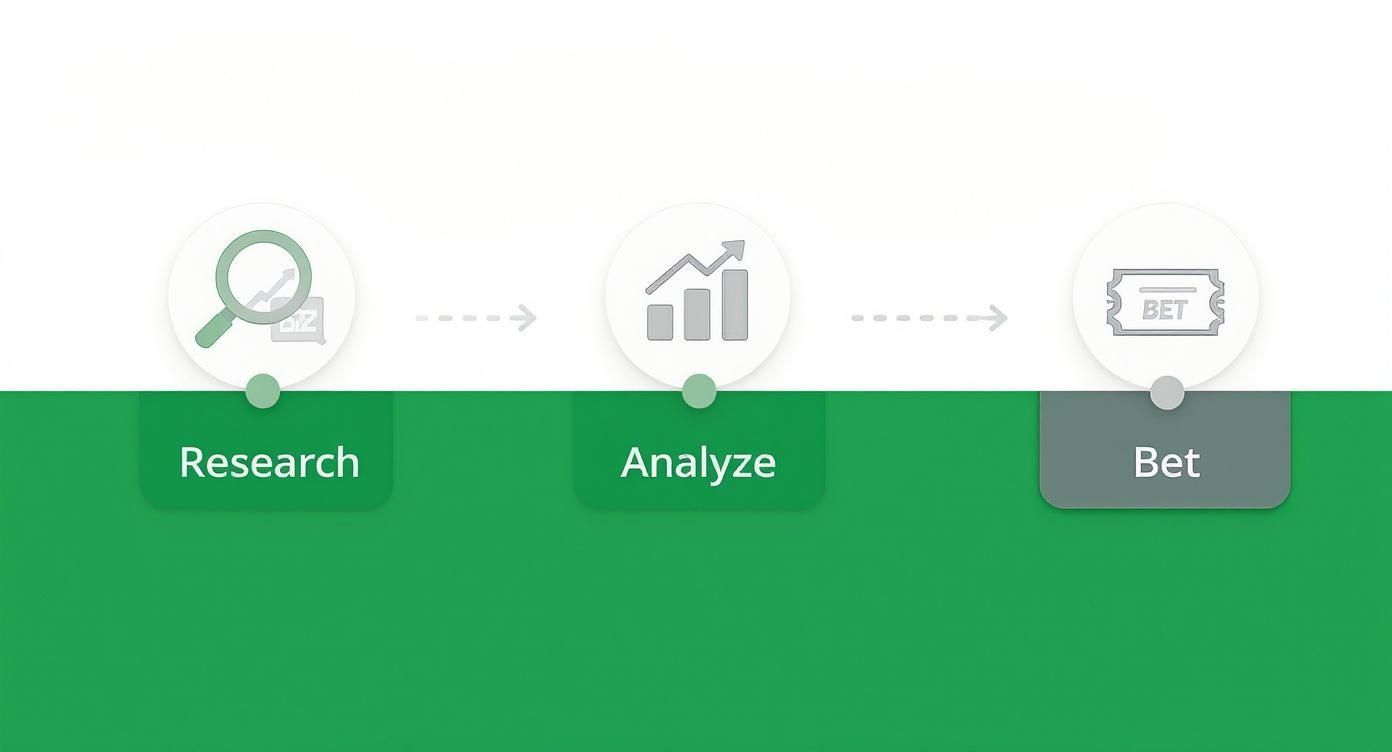
Notice that placing the bet is the very last step. It only happens after you’ve put in the work.
Focus on Metrics That Matter
Look, not all stats are created equal. Things like possession percentage and pass completion are interesting, but they don't always put the ball in the back of the net. Your time is better spent on performance metrics that have a much stronger correlation with winning.
These are the modern stats that form the backbone of my pre-match analysis:
- Expected Goals (xG): This is the big one. xG measures the quality of a team's scoring chances, telling you if a team is getting lucky with world-class strikes or unlucky by missing sitters. Over a season, a team's actual goals almost always trend back toward their xG.
- Shots on Target (SoT): Simple, but incredibly effective. It's a raw indicator of offensive pressure. A team that consistently tests the keeper is far more dangerous than one just blasting hopeful shots from 30 yards out.
- Expected Goals Against (xGA): This is the defensive side of the coin. It shows the quality of chances a team is giving up. A low xGA means a defense is solid, even if they've conceded a few fluky goals recently.
The good news is you don't have to be a data scientist to find this stuff anymore. Many top-tier offshore sportsbooks are catching on. For instance, sites like Bovada and BetUS often build these advanced stats right into their match previews, which saves you a ton of time.
Building Your Pre-Bet Checklist
To stay disciplined, you need a process. A simple checklist you run through before every single wager forces you to be objective and keeps you from falling for a "good feeling" about a match.
My personal checklist is pretty straightforward:
- Check the Advanced Stats: Do the xG and xGA numbers back up the odds? Is one team massively overperforming or underperforming its underlying metrics?
- Analyze Team News: Are there any last-minute injuries, suspensions, or surprise squad rotations? The absence of a key defensive midfielder can completely change the shape of a game.
- Review Situational Factors: Is this a heated rivalry match? Is one team fresh while the other just played a grueling midweek Champions League fixture? Context is everything.
- Compare Odds: Have I shopped around at multiple books like BetOnline, Sportsbetting.ag, and Bookmaker.eu to make sure I'm getting the absolute best price? Squeezing out that extra value adds up.
A perfect real-world example of this is spotting a team with a stellar home defensive record (low xGA) facing an opponent with great away attacking numbers (high xG). If that strong home defense is up against a potent but potentially travel-weary attack, the "Under" on total goals often has some quiet value that most bettors miss.
This structured approach turns betting from a pure gamble into a calculated decision. And thanks to soccer's massive popularity, the data has never been more accessible. As of 2025, football betting accounts for a staggering 47.9% of the entire global sports betting market. You can discover more insights about the market dominance of football betting to see just why so much data is available to us.
Using this data through a repeatable process isn't just a good idea—it's your most reliable path to gaining a long-term edge.
Mastering In-Play Betting and Line Shopping
Just because the match has kicked off doesn't mean your work is done. Far from it. Some of the juiciest opportunities in soccer betting only show up once the game is underway.
To really level up your strategy, there are two tactics you absolutely have to get a handle on: mastering in-play wagering and the disciplined practice of line shopping. These skills are what separate casual bettors from sharp, profitable ones. They move you from just predicting a result to actively reacting to the game's flow and market shifts.
Capitalizing on Live Betting Opportunities
In-play, or live betting, is exactly what it sounds like: placing bets while the match is happening. It's fast-paced and requires quick thinking, but it's not about making wild guesses. It’s all about spotting momentum swings and pouncing on odds that haven't quite caught up to what's happening on the pitch.
Here's a classic scenario I see all the time: A heavy favorite, like Real Madrid, is playing a weaker team at home. They're dominating the first 20 minutes, but a fluke counter-attack leads to a shock goal for the underdog. Suddenly, Real Madrid's pre-match odds of -400 to win might jump to -120 on a live platform like Xbet. That's your moment. You know they're the better side, and one unlucky goal doesn't change that.
For a deeper dive, our guide asking what is live betting breaks down all the essentials.
Here’s what I'm always looking for during a match:
- Tactical Shifts: Did a manager bring on an extra attacker at halftime? That's a huge signal they're going for it, often creating value in the "Next Goal" or live "Over" markets.
- Key Injuries: If a team's star center-back limps off, the odds for their opponent to score are going to change. Your job is to get a bet in before the market fully adjusts.
- Red Cards: This is the biggest game-changer. A sending-off can flip a match on its head. While the team with the man advantage will see their odds to win shorten dramatically, there's often hidden value in betting on the shorthanded team to simply dig in and hold on for a draw.
The key is to have a pre-game thesis and see if the live action confirms or denies it. If you expected a tight, low-scoring affair and the first half is a wide-open track meet with multiple shots on target, it's time to adjust and look at the live "Over" goals line.
The Non-Negotiable Edge of Line Shopping
Line shopping is one of the simplest—and I mean simplest—ways to boost your profits over the long run. All it means is comparing the odds for the exact same bet across multiple sportsbooks to make sure you’re getting the best price. It sounds basic, but the impact is massive.
Think about it: you wouldn't buy a TV without checking the price at a few different stores, right? So why would you place a bet without doing the same? Every single tick of difference in the odds is pure profit added to your bottom line.
This is exactly why having accounts at several top offshore sportsbooks is a non-negotiable part of any winning strategy. You need access to places like Sportsbetting.ag, Bookmaker.eu, BetUS, Bovada, and MyBookie to do this effectively. One book might consistently have the best Premier League moneylines, but another could offer better odds on Champions League totals.
Let's see what this looks like with a real-world example. Say you're looking to bet on Manchester City to win their next match.
Odds Comparison Across Top Offshore Sportsbooks
Before you place that bet, taking just 30 seconds to check the lines can make a real difference. Here’s a look at how odds for the same bet can vary.
| Bet Type (Man City to Win) | BetUS Odds | Bovada Odds | MyBookie Odds |
|---|---|---|---|
| Decimal Odds | 1.85 | 1.91 | 1.88 |
| American Odds | -118 | -110 | -114 |
| $100 Bet Payout | $185 | $191 | $188 |
In this scenario, placing your wager at Bovada instead of BetUS gets you an extra $6 on a single $100 bet. That might not sound like a fortune, but imagine that small edge compounded over hundreds of bets throughout the season. That difference is what separates a small winning year from a significant one. The best price is always the right price, and line shopping guarantees you find it every single time.
The Psychology of a Winning Bettor

Once you've got a handle on the data and know how to find the best odds, you’ll discover your toughest opponent is staring back at you in the mirror. The mental game is what really separates the pros from the amateurs. It isn't about being a robot; it's about making sure your emotions don't get a vote when your money is on the line.
Think of discipline as the glue that holds your entire strategy together. Without it, the best analysis in the world will fall apart the minute you hit a cold streak or get greedy during a heater. This is where you truly learn how to win in soccer betting for the long haul.
Look, every single person who bets on sports—no matter how sharp—will go through incredible highs and gut-wrenching lows. The secret is to treat both the same way: with a cool head. Nailing three bets in a row doesn't make you a betting god, and losing five straight doesn't mean your system is broken.
When you're winning, it's so tempting to jack up your unit size and start betting more aggressively. That’s just greed and overconfidence talking. On the flip side, after a few bad beats, panic can creep in. You start "chasing" your losses with bigger, dumber bets just to break even. Both are pure poison for your bankroll.
The only antidote is sticking to your bankroll management plan like your life depends on it. Whether you just cashed five winners on MyBookie or got cleaned out on three straight at BUSR, your next bet is still one unit. That mechanical consistency is your best defense against emotional decisions.
Overcoming Common Cognitive Traps
Our brains are wired with mental shortcuts that help us in everyday life but can absolutely wreck us in betting. Just being able to spot these "cognitive biases" in your own thinking is half the battle.
Here are the two biggest mental traps you'll fall into:
- Recency Bias: This is when you give way too much weight to what just happened. You see a team get hammered 4-0, and your brain screams that they're trash. But what if that was just one awful game in a season of otherwise stellar defensive play? Don't let one result cloud the bigger picture.
- Confirmation Bias: This is the sneaky habit of only looking for info that confirms what you already believe. If you want to bet on Manchester United, you'll find every stat that supports your case and conveniently ignore all the data screaming at you to stay away.
A simple trick to fight this is to play devil's advocate before you place a wager. Seriously, try to build the strongest possible argument against the bet you want to make. It forces you to look at the situation objectively, not just the way you want to see it.
A successful bettor's mindset is that of a detached analyst, not a hopeful fan. The goal isn't to be right about a team; it's to be right about the odds offered at sportsbooks like BetOnline and Bovada.
Meticulous Record-Keeping Is Non-Negotiable
This is the big one. You can't improve what you don't measure. Keeping a detailed log of every single bet you make isn't just a good idea—it's the absolute foundation of long-term success.
And I'm not just talking about wins and losses. Your spreadsheet needs details.
- Date and Match: The specific game.
- Sportsbook Used: Where you placed the bet (e.g., Xbet, Cosmobet, Bet105).
- Bet Type: Moneyline, Asian Handicap, Over/Under, etc.
- Stake: Your unit size or exact dollar amount.
- Odds: The price you locked in.
- Result: Win, Loss, or Push.
- Profit/Loss: The final number.
- Notes: A quick line on why you made the bet.
This data becomes your personal performance report. After 50 or 100 bets, you can slice and dice the numbers to find clear patterns. Maybe you'll find you're crushing Premier League Over/Under bets but are getting killed on Champions League moneylines.
This kind of honest self-assessment helps you plug the leaks in your strategy. It shows you exactly where you have a real edge, so you can focus your energy and money there. Without records, you're just gambling. With them, you're running a business.
Common Questions on Winning at Soccer Betting
As you get deeper into your betting strategy, you're going to have questions. Everyone does. Getting straight answers is the best way to avoid the common pitfalls that burn through bankrolls. These are a few of the questions I hear all the time from bettors trying to get an edge.
What Is a Realistic Win Rate to Aim For?
This is the big one, and the answer usually catches people off guard. You don't need to hit 70% or 80% of your bets to make money. That’s a fantasy.
For bets around even money (-110 odds), a consistent win rate of 55-60% isn't just realistic—it's phenomenal. That's pro-level territory.
The goal isn't to never lose; it's to make smart, profitable decisions over hundreds of bets. A sharp bettor using sites like BetUS or MyBookie might lose 45 out of 100 wagers but still walk away with a fat profit. Why? Because they consistently found value—odds that were better than the real probability of that outcome.
Don't chase wins, chase value. A single well-researched bet with a real edge is worth more than ten 50/50 guesses. Obsessing over a high win rate will only lead you to force bad plays.
How Many Sportsbooks Should I Use?
Simple answer: more than one. I tell everyone that having accounts at a minimum of three different books is essential. Honestly, five or six is even better. Spreading your action across top offshore books like Bovada, BetOnline, Bookmaker.eu, and Sportsbetting.ag is a non-negotiable part of a winning strategy.
This has nothing to do with grabbing more bonuses. It’s all about line shopping.
As we covered earlier, even a tiny difference in odds can mean thousands of dollars in profit over a season. By having multiple accounts, you ensure you get the absolute best price for every single bet you place. No single sportsbook has the best line on every game, every single time. It's just not possible.
Can I Make a Living from Soccer Betting?
Theoretically, yes. Realistically, it's incredibly hard and not a path for 99% of people.
Going pro requires a massive bankroll, unshakable discipline, and thousands of hours staring at spreadsheets and building models. It’s a full-time job with extreme psychological pressure. It's not glamorous.
The real goal for most bettors should be to build a consistent, profitable side income. Think of it as a serious hobby that pays well. The strategies in this guide are built to help you do just that—turn a casual pastime that loses money into a sharp one that wins. Trying to go pro without the bankroll and experience to back it up is the fastest way to go bust.
How Do I Know If I Have a Real Edge?
There's only one way to know for sure: track everything. I mean everything. After you have a sample size of at least 200-300 bets, the numbers will start to talk.
Your spreadsheet is your report card. Break down your results by:
- League: Are you crushing it in Serie A but getting killed in La Liga?
- Bet Type: Are Asian Handicaps your sweet spot? Are you bleeding cash on straight moneylines?
- Sportsbook: Is your record better with the lines at Xbet compared to BetAnything?
If you can show a consistent profit over a large number of bets, you have a proven edge. Your records are the ultimate truth-teller. They cut right through feelings and lucky streaks to show you exactly where your money is being made.
At USASportsbookList, our job is to help you find the best sportsbooks to put these strategies into action. We offer detailed reviews and head-to-head comparisons of the top offshore sites, so you always have access to the competitive odds and deep markets you need to win. Check out our curated lists and expert guides to take your betting to the next level by visiting us at https://usasportsbooklist.com.