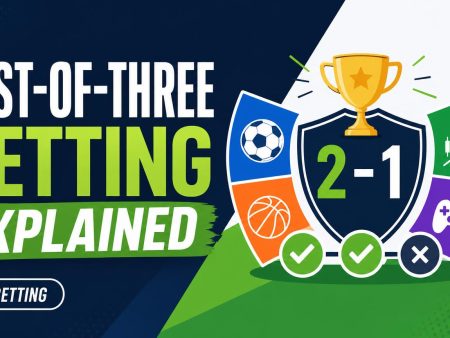
A winning favorite can still produce a losing bet.
The favorite closes a best-of-three series 2–1, yet the Maps -1.5 wager is graded as a loss. That result often feels wrong at first: teams cannot win half a map, so why does the market use a decimal?

$2,750
200% Crypto Bonus PLUS 10% Gamblers Insurance with a minimum $100 deposit and a maximum of $1,500. Use Code: JOIN200 in the Cashier.


$250 + 100 Free Spins
All new players receive $250 in Free Bets and 100 Casino Spins. Join today and enter the promo code WELCOME in the cashier when you deposit $50 or more.

Get a 50% deposit bonus up to $1,000 with the code: CRYPTO1K. Valid on crypto deposits.
The half-map is a handicap, not a literal score. Subtracting 1.5 from the favorite’s map total means an ordinary match victory is not enough; the team must finish at least two maps ahead. In a best-of-three, that requires a 2–0 sweep. A 2–1 win settles the match winner market, but it does not cover -1.5. That distinction is the main danger: a strong price on the favorite may quietly demand a decisive result rather than merely predicting which team wins.
How the -1.5 maps handicap is settled
- Maps -1.5
For settlement, 1.5 maps are subtracted from the backed team’s final map total. The adjusted score must still beat the opponent’s map total.
- Winning margin
The backed team must win the series by at least two maps. A one-map victory does not cover the handicap.
- Half-map
The 0.5 is only a settlement device; no half-map is played or awarded during the match.
- No push
Because map totals are whole numbers, subtracting 1.5 prevents an adjusted tie. The bet therefore settles as either a win or a loss.
If the backed team wins 3–1, its adjusted total is 3 − 1.5 = 1.5. Since 1.5 remains above the opponent’s 1, the bet wins.
A 3–2 result becomes 1.5–2, so the bet loses despite the backed team winning the series.
Which series scores cover -1.5 maps?
A -1.5 maps bet requires the selected team to win the series by at least two maps. The qualifying final scores therefore depend on how many maps can be played.
| Series format | Covers -1.5 | Does not cover |
|---|---|---|
| Best-of-three | 2–0 | 2–1, any loss |
| Best-of-five | 3–0 or 3–1 | 3–2, any loss |
In a best-of-three, there is no room to drop a map: only a sweep leaves the favorite two maps ahead. A closer look at how best-of-three wagers work can help distinguish the map handicap from a standard match-winner bet.
A best-of-five provides slightly more flexibility. The favorite may lose one map and still cover at 3–1, but a 3–2 win falls short because the winning margin is only one map.
Check formats that do not fit the pattern
A conventional best-of-one cannot produce a two-map winning margin, so a standard -1.5 maps line would not normally apply. If such a listing appears, the label may refer to rounds, an aggregate score, or multiple scheduled matches rather than one map.
Unusual formats—such as two-map sets, advantage starts, or tournament-specific series—also deserve a rules check. The market description and bookmaker’s settlement rules determine which maps count, particularly when forfeits, cancellations, or pre-awarded map advantages are involved.
Settlement examples at a glance
For these examples, the first number is the map total won by the team backed at -1.5 maps. The opposing team’s score stays unchanged.
| Series format | Actual score | Adjusted score | Bet result |
|---|---|---|---|
| Best-of-three | 2–0 | 0.5–0 | Win |
| Best-of-three | 2–1 | 0.5–1 | Loss |
| Best-of-five | 3–1 | 1.5–1 | Win |
| Best-of-five | 3–2 | 1.5–2 | Loss |
The calculation is always the same: selected team’s maps − 1.5. A 2–0 result becomes 0.5–0, so the adjusted score still favors the selection. A 2–1 result becomes 0.5–1, turning the series win into a handicap loss.
The best-of-five examples follow the same logic. A 3–1 victory becomes 1.5–1 and covers, while a 3–2 victory becomes 1.5–2 and does not. The selected team therefore needs to win by at least two maps; simply winning the series is not enough.
Match winner vs. map handicaps
These markets may feature the same teams, but they reward different results. A match winner bet only asks which team wins the series, while a map handicap also measures the final margin.
| Selection | Scores that win the bet |
|---|---|
| Team to win the match | 2–0 or 2–1 |
| Team -1.5 maps | 2–0 only |
| Team +1.5 maps | 2–0, 2–1, or a 1–2 loss |
The key difference is visible in a 2–1 result. The series winner cashes a match-winner bet but fails to cover -1.5 maps because the winning margin is only one map. Meanwhile, the losing team covers +1.5 maps, as adding 1.5 to its one map produces an adjusted score of 2.5–2.
A best-of-three underdog at +1.5 therefore does not need to win outright. Taking one map is enough, but a 0–2 defeat loses the bet. Handicap direction and final score matter more than the “favorite” or “underdog” label: settlement follows the selected team’s map line, regardless of pre-match expectations.
Map handicaps are not round handicaps
A maps -1.5 wager is settled from the final series score. It does not matter whether each map was dominant, close, or decided after overtime. By contrast, CS2 round handicaps apply to the round score on a particular map, unless the bookmaker explicitly lists another scope.
Consider a best-of-three in which the favorite wins 2–0, with both maps ending 13–11. The maps -1.5 bet covers because the favorite won by two maps. However, a -3.5 round handicap on either map loses: each victory came by only two rounds.
If one map instead ends 13–8, its five-round margin covers a -3.5 round handicap. That result still counts as just one map won when settling the series-level market.
The market label identifies the scoring unit:
- Maps -1.5: uses maps won across the series.
- Rounds -3.5: usually uses the round margin within the specified map.
Bookmaker rules should be checked for overtime treatment and whether round handicaps include or exclude extra rounds.
A handicap of -1.5 maps and -1.5 rounds may look similar, but they settle against entirely different score lines.
Why the -1.5 price is higher
A match-winner bet allows the favorite to drop a map and recover. Maps -1.5 does not: in a best-of-three, only a 2–0 result qualifies. Because fewer final scores win the wager, bookmakers normally offer higher odds—and therefore a larger potential return for the same stake.
That price reflects a stronger prediction. Backing the favorite outright says it should advance; taking -1.5 says it should win decisively. Several factors can affect whether that extra risk looks reasonable:
- Map pool: A deep pool makes it harder for the underdog to steer the series toward favorable territory.
- Veto: The pick-and-ban order may remove a favorite’s weak map—or leave the underdog with a strong comfort pick.
- Straight-map form: Recent 2–0 results can be relevant, especially against comparable opposition, but small samples may mislead.
- Side strengths: Starting on a preferred attacking or defensive side can shape a map, depending on the game and rules.
- Roster changes: A new player, stand-in, or role swap may weaken coordination even when raw talent remains strong.
- The underdog’s best map: One credible specialty map may be enough to ruin the handicap without winning the match.
None of these signals settles the bet alone. The more useful question is whether the expected veto leaves the favorite with two convincing map matchups. If not, the bigger price may simply be compensation for a fragile 2–0 requirement.
When a match does not finish normally
An official tournament result does not automatically determine the bet. A team may be awarded a win after a disconnect, withdrawal, or disqualification, while the sportsbook voids the map handicap because too few maps were completed.
Before placing the bet, the relevant esports market and settlement rules should be checked for four points:
- Completed-map requirement: Some operators need a specified number of maps to finish.
- Declared results: Others accept the organizer’s awarded score, including forfeits.
- Scheduled format: A change from best-of-three to best-of-one may void the original market.
- Operator void policy: Postponements, roster changes, server failures, and abandoned maps can be treated differently.
The sportsbook’s published grading rules govern the wager. The tournament’s result matters only where those rules say it does.
Unusual settlement cases
What happens after postponement?
Books may keep the bet pending if play resumes within a stated window. Otherwise, they usually void it.
How are forfeits or retirements settled?
Some books require all scheduled maps; others recognize the official result. A walkover before play commonly means a void.
What if the series is shortened?
The handicap may be void when fewer maps are played than advertised. A result already mathematically decided may still stand.
What if the format was listed incorrectly?
A mistaken best-of-three or best-of-five listing can trigger a void. Palpable-error and format rules determine settlement.
Does Valorant overtime change it?
Overtime can affect round-market grading under Valorant overtime and handicap rules. It rarely changes a map handicap because the map still counts as one win.
Operator rules control every exception. Save the listed format and settlement terms before placing a wager.
-
Confirm the selected team
The -1.5 handicap must appear beside the intended side.
-
Read the sign carefully
A minus handicap means the team must overcome a map deduction.
-
Check the scheduled series length
Only 2–0 covers in a best-of-three; 3–0 and 3–1 cover in a best-of-five.
-
List the covering scores
Every winning scoreline must leave the selected team ahead by at least two maps.
-
Review disruption rules
Check the sportsbook’s treatment of abandoned matches, withdrawals, postponements, and altered formats.
The final question is simple: will the selected team win by at least two maps? A -1.5 maps bet predicts the margin of victory, not merely a match win. A one-map victory still loses the wager.