Arbitrage betting is a way to lock in a guaranteed profit by betting all possible outcomes of the same event at different sportsbooks when the combined implied probability is less than 100%. Most arbitrage opportunities are tiny, and 98% of them return less than 1.2%, so this is usually a volume game, not a magic shortcut.
You're probably here because you've seen someone say arbing is “free money” and wanted to know whether that's real, exaggerated, or already dead. The short answer is that the math is real. The hard part is everything around the math.
Top Offshore Sportsbook Bonuses for September 2026


$1000 + $10 Casino Chip
New customer offer. First Deposit Bonus Up To $1,000 + $10 Casino Chip.


$750
Get a 150% Sport Free Play bonus up to $750 on your first Deposit up to $500. The minimum deposit is $50.
If you use offshore books like MyBookie, BetUS, BetAnything, Xbet, Bet105, Cosmobet, BUSR, Bookmaker.eu, and Heritage Sports, you'll sometimes see the same game priced differently enough to create a window. That window can let you bet both sides and come out ahead no matter who wins.
That sounds simple. It isn't simple in practice.
Arbing is closer to trading than traditional betting. You're not trying to outsmart the market with a hot take on a side or total. You're trying to exploit pricing errors and move fast before those prices disappear.
The Bettor's Dream of a Guaranteed Win
A lot of bettors have had this moment. You place a bet on a game, the game starts, and your mood swings with every possession, serve, or drive. Arbitrage betting flips that feeling on its head. If you do it correctly, the result stops mattering.
Say you've got one side of a tennis match at BetUS and the other side at MyBookie. The match starts. One player breaks serve early. Normally that would either make you feel great or sick. In an arb, it barely changes your pulse because you've already built the profit into the ticket structure.
That's why arbing gets so much attention. It promises something sports bettors rarely get, which is control.
It's not about picking winners
The biggest misunderstanding around what is arbitrage betting is that it's some advanced handicapping method. It isn't. A sharp bettor can use arbing, but you don't need to predict the winner to make it work.
What matters is the disagreement between sportsbooks.
If Bookmaker.eu hangs a better number on one side while BUSR or Heritage Sports posts a better number on the other, the gap between those prices can create a surebet. The opportunity comes from the market being out of sync, not from your sports opinion.
You can know nothing about the teams involved and still understand an arbitrage spot, because the edge comes from the odds, not the matchup.
That's also why offshore books matter in this conversation. They often move at different speeds, shade lines differently, and cater to different customer flows. When you keep accounts at several books, you give yourself a better chance of catching those mismatches before they vanish.
Why people get hooked on it
Arbing appeals to two kinds of bettors:
- The frustrated bettor who's tired of losing close calls and wants less variance.
- The process bettor who likes spreadsheets, calculators, and repeatable systems more than game-day sweating.
But there's a catch. The dream is real only if your execution is clean. Miss one side, misread one market, or get limited by a sportsbook, and the “guaranteed” part disappears fast.
The Core Concept Behind Arbitrage Betting
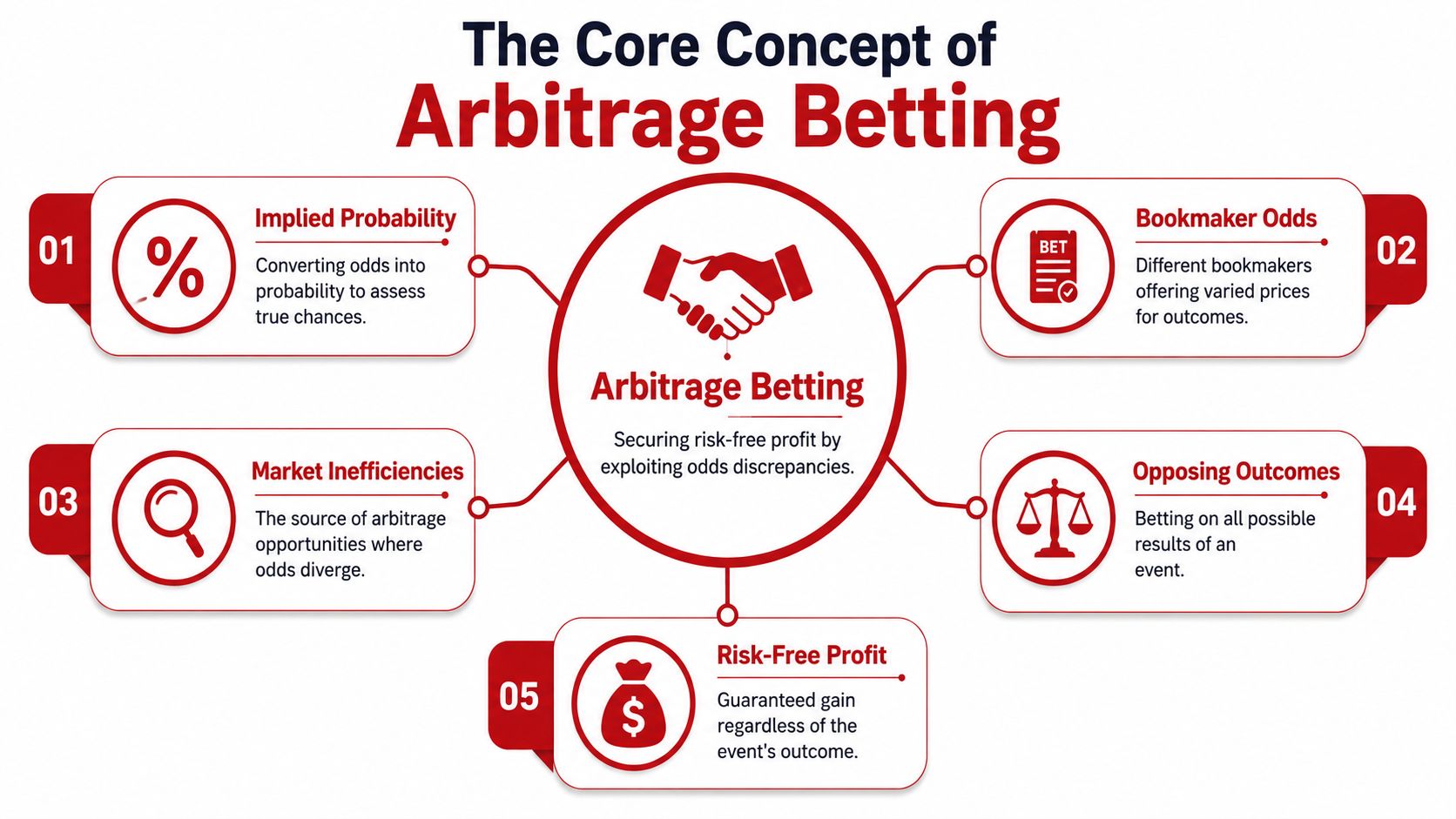
At its core, arbitrage betting is just math. The key idea is implied probability, which is the percentage chance suggested by a set of odds. When the implied probabilities for all mutually exclusive outcomes add up to less than 100%, a bettor can split stakes across sportsbooks and guarantee a profit, as explained in Smarkets' guide to arbitrage betting.
Why books usually leave no room for profit
Sportsbooks don't price markets to be fair. They build in margin, often called the vig, juice, or overround. One source cited in the verified data describes a typical market as around 105% overround, while an arbitrage appears when the combined market drops below 100%, such as 99%, 98%, or 97%.
That's why a normal market isn't an arb. If you take both sides at the same sportsbook, you usually lock in a loss because the book's margin is sitting in the middle.
A simple way to think about it is retail pricing. One store sells a TV for less than its real value. Another store is willing to pay more than that same amount for the same item. If you can buy and sell at the same time, your profit is built in before you leave the parking lot.
Arbitrage betting works the same way. You're buying one price at Bet105 or Cosmobet and matching it against a conflicting price at BetAnything or Xbet.
A cleaner way to picture the math
For a two-outcome event, such as tennis, you take the best odds available on each player and convert them into implied probabilities. If the total is under 100%, the market is in your favor.
Here's the logic in plain terms:
- Outcome A price implies one percentage chance
- Outcome B price implies another percentage chance
- Combined total under 100% means there's room to distribute your stakes and still finish ahead
Smarkets also gives a useful exchange-based example. It shows a £100 back bet at 2.4 hedged with a £115.38 lay bet at 2.1 to create a guaranteed outcome profile. That example matters because it shows the same principle even when one side of the trade is placed on an exchange instead of a standard sportsbook.
Practical rule: Arbitrage betting isn't prediction. It's price shopping with math attached.
If you remember one thing from this section, remember that. Arbing is a pricing exercise. Once you understand that, the strategy stops looking like gambling theory and starts looking like trade execution.
A Step-by-Step Arbitrage Example with Calculations
Let's make it concrete with a simple tennis example using BetUS and Xbet. Tennis is a good teaching market because there are only two outcomes. One player wins, the other loses.
Assume you find these decimal odds:
These numbers are valid to use because they match an example included in the research material and stay within the verified framework for explaining the math qualitatively.
Step one: confirm the arb exists
Convert each price into implied probability:
- Player A at 2.2 = 1 / 2.2
- Player B at 2.1 = 1 / 2.1
That gives you:
| Sportsbook | Selection | Decimal Odds | Implied Probability |
|---|---|---|---|
| BetUS | Player A | 2.2 | 45.45% |
| Xbet | Player B | 2.1 | 47.62% |
Add them together and you get 93.07%.
Because the total is under 100%, this is an arbitrage opportunity.
Step two: split your stakes correctly
This aspect usually trips up beginners. Finding the arb is only half the job. You also need to size the two bets so the payout is balanced.
If your total outlay is $201.57, a proportional split from the research example would be:
- $98.44 on Player A at 2.2
- $103.13 on Player B at 2.1
Why those amounts? Because the lower odds side gets the larger stake. That balances the possible returns.
If you want help doing that without hand-calculating every line, a good starting point is learning how to calculate betting odds before you try to arb live markets.
Step three: check the payout on both outcomes
Now look at what happens if either side wins:
| Outcome | Winning Bet Return | Total Staked | Guaranteed Profit |
|---|---|---|---|
| Player A wins | 2.2 × 98.44 = 216.57 | 201.57 | 15 |
| Player B wins | 2.1 × 103.13 = 216.57 | 201.57 | 15 |
That's the heart of arbing. Different event result, same profit.
Understanding the theory often comes after seeing a table like that. The next mistake is assuming profits like this are common and easy to capture all day long. They aren't. According to Wikipedia's arbitrage betting overview, 98% of arbitrage opportunities return less than 1.2%. That means most real arbs are far thinner than the clean teaching examples people use in guides.
What this looks like on offshore books
In practice, you might find one side at MyBookie and the other at BetUS, or one side at Bookmaker.eu and the other at BUSR. The challenge isn't understanding the formula. The challenge is moving before one of those numbers changes.
That's why seasoned arbers keep funds parked across multiple books instead of trying to deposit only after they spot the opportunity. If you have to move money first, the arb is usually gone before you can click confirm.
This video gives a useful visual sense of how bettors think through these spots in practice:
A final point matters here. Small margins change the psychology of betting. If you're used to chasing a big score, arbitrage feels boring. If you're comfortable grinding, the appeal starts to make sense.
Benefits Versus The Unspoken Risks of Arbing
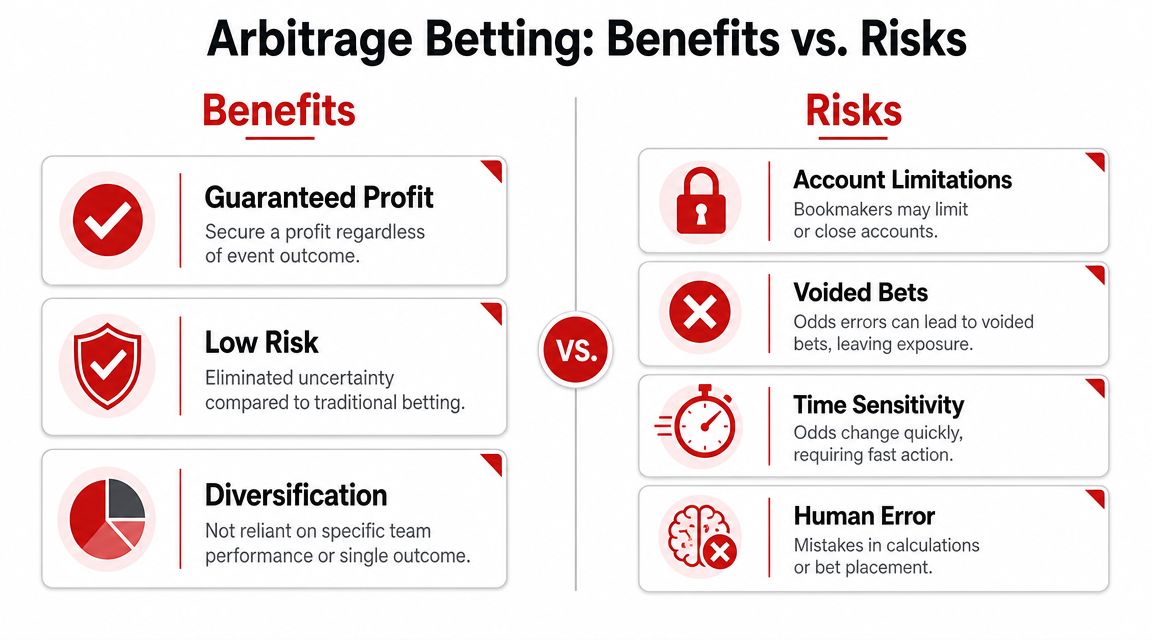
Arbitrage betting gets advertised as risk-free, and mathematically that's true only when everything goes exactly right. In practice, the clean math sits on top of messy execution.
What makes arbing attractive
The benefits are real:
- Outcome doesn't matter: Once both sides are placed correctly, you aren't sweating the final score the way a normal bettor does.
- No handicapping edge required: You don't need to be better than the market at predicting winners.
- Repeatable structure: The process can be repeated across many events if you have enough accounts and enough speed.
That's why offshore books like MyBookie, BUSR, and Heritage Sports draw attention from arbers. Different books post different prices, and those differences create the openings.
What actually goes wrong
The practical risks matter more than the textbook definition. As noted in SEON's explanation of sports betting arbitrage, odds can change in seconds, bets must often be placed nearly simultaneously, and sportsbooks may restrict or ban accounts that show arbing behavior.
Here's how that plays out in real use:
| Benefit | Real-World Risk |
|---|---|
| Guaranteed profit on paper | One side moves before you place the second bet |
| Lower dependence on luck | A typo or wrong market selection can leave you exposed |
| Scalable process | Books can limit stakes or close profitable accounts |
The account limitation problem
This is the part beginners underestimate.
Sportsbooks don't like customers who only take efficient prices and never gamble recreationally. If your history shows precise stake sizing, repeated price-sensitive betting, and no normal betting behavior, you can get limited. Bettors often call this gubbing. It means the book doesn't ban you outright, but it slashes the amount you're allowed to bet.
At that point, the account still exists, but it's far less useful.
With offshore books like BetAnything, Bet105, Cosmobet, and Bookmaker.eu, account management becomes part of the skill set. Not just line shopping. Not just math. Account survival.
Some bettors fail at arbing not because they can't find opportunities, but because they can't keep usable accounts long enough to exploit them.
Common mistakes that trigger trouble
A few patterns stand out:
- Odd-looking stakes: Highly specific amounts can scream calculator use.
- Only betting obvious arbs: If every wager is a market mismatch and nothing else, your profile looks sharp immediately.
- Slow second-leg placement: If your first bet is down and the return side disappears, you've turned an arb into a regular gamble.
If you want a broader view of reducing exposure once one side is already placed, it helps to understand bet hedging strategies because hedging logic overlaps with how experienced bettors control damage when a perfect arb breaks mid-execution.
The honest takeaway is simple. Arbitrage betting can remove game risk, but it introduces operational risk. For many bettors, that's the main battle.
Essential Tools and Account Setup for Arbers
A bettor trying to arb manually with one browser tab and one sportsbook account won't last long. The setup matters almost as much as the math.
Why manual searching usually isn't enough
You can find an occasional arb by hand. You probably can't do it consistently.
Prices move quickly, and offshore books don't all update at the same speed. If you're flipping between MyBookie, BetUS, Xbet, and BUSR by hand, you'll miss a lot of windows. That's why experienced arbers use oddsmatchers, scanners, or arb finders to scan multiple books at once.
These tools don't guarantee profit by themselves. They just reduce the time between seeing a mismatch and acting on it.
The tool finds the opening. You still have to decide whether the price is stable enough, whether both accounts are funded, and whether the bet size is worth the account risk.
The account list matters
If you want real access to offshore arbs, you need multiple live accounts ready to go. That usually means keeping at least a working spread of options such as:
- MyBookie for one side of a market
- BetUS for another
- Bookmaker.eu when you need a sharper line source
- Heritage Sports, BUSR, Cosmobet, BetAnything, Bet105, and Xbet for extra coverage
The key is not just opening them. It's keeping them funded enough that you can act immediately.
A calculator also saves time when the pressure is on. If you don't want to build your own spreadsheet from scratch, an arbitrage betting calculator helps you size the legs fast enough to avoid fumbling the entry.
How people try to stay under the radar
There's no perfect way to avoid limits, but bettors usually try to look less robotic.
Some common habits include:
- Round some stake sizes: Perfectly strange decimal stake amounts can stand out.
- Mix in normal bets: Some bettors place occasional standard wagers instead of only pouncing on obvious arbs.
- Avoid smashing every soft line: If you attack every obvious error instantly, your account ages badly.
- Keep records by book: If one site starts trimming your limits, you need to know before your next arb relies on it.
None of this makes you invisible. It just helps you avoid looking like a pure extraction machine from day one.
Bankroll Management and Getting Started Safely
The safest way to start arbing is to treat it like a process drill, not an income plan. Use a small, dedicated bankroll and assume your first goal is learning execution.

Keep your money organized
Arbing spreads your funds across multiple sportsbooks. That creates a problem traditional bettors don't deal with as much. You can be profitable on paper while still running short at the exact book you need for the next opportunity.
A simple spreadsheet goes a long way. Track:
- Sportsbook used
- Event and market
- Stake on each side
- Expected profit
- Actual result
- Current balance by book
If you need a primer on disciplined sizing and allocation, this guide to sports betting bankroll management is useful before you start moving funds across several offshore accounts.
A cautious starting checklist
Don't overcomplicate your first week. Start with a short list:
Open a few accounts first
Pick several offshore books you're likely to compare, such as MyBookie, BetUS, Xbet, and Bookmaker.eu.Fund them lightly
You want enough money to place both sides of a small arb without scrambling.Test a scanner or calculator
You don't need a huge stack of software on day one. You do need a reliable way to confirm stake sizing.Place very small arbs at first
Early mistakes are usually mechanical. Wrong market, wrong odds format, wrong stake size.
Start small enough that a setup mistake feels annoying, not expensive.
One more point. If you're in the US, betting winnings can have tax implications. I'm not giving tax advice here, but you should keep records good enough that you're not trying to reconstruct your betting history later from account screenshots and email receipts.
Is Arbitrage Betting Still Worth It in 2026
Yes, arbitrage betting is still worth considering in 2026 if you like low-margin, process-driven betting and you're realistic about the workload. No, it isn't easy money.
The math behind arbing is solid. The challenge is everything that happens after you find the edge. You need speed, funded accounts, clean record-keeping, and a plan for what to do when a sportsbook limits your action. With offshore books like MyBookie, BetUS, BUSR, Bookmaker.eu, Heritage Sports, BetAnything, Bet105, Cosmobet, and Xbet, the opportunity is real, but so is the friction.
If you've been asking what is arbitrage betting, the best answer is this: it's not a betting secret. It's a trading workflow built on price discrepancies. For the right bettor, that can still be profitable. For the wrong bettor, it becomes a stressful grind with tiny margins and constant account issues.
If you're comparing offshore books and want a practical place to start, USASportsbookList is a useful resource for reviewing sportsbook options, features, and betting tools before you build out an arbing setup.