Walk into any serious sports betting circle, and you'll hear the term "units" thrown around constantly. It's not just jargon—it's the foundation of a disciplined, long-term betting strategy. Forget about dollar signs for a moment; mastering units is the first real step toward thinking like a professional.
So, What Is a Betting Unit?
A betting unit is simply a set percentage of your total betting bankroll. For most bettors, the standard is 1%.

$250 + 100 Free Spins
All new players receive $250 in Free Bets and 100 Casino Spins. Join today and enter the promo code WELCOME in the cashier when you deposit $50 or more.

Get a 50% deposit bonus up to $1,000 with the code: CRYPTO1K. Valid on crypto deposits.


Think of your bankroll like an investment portfolio. A savvy investor doesn't dump all their cash into a single stock. Instead, they allocate small, consistent percentages across different assets. That's exactly what a unit system does for your betting—it turns random gambling into a structured investment strategy.
By standardizing your bet size to a unit, you strip away the emotional highs and lows tied to specific dollar amounts. A 1 unit bet is a 1 unit bet, whether your bankroll is $500 or $50,000. This keeps your decision-making clear and focused on the value of the wager itself.
How to Calculate and Use Your Unit Size
Determining your unit size is straightforward. Just decide on a percentage—again, 1% is the gold standard for a reason—and apply it to your bankroll. If you’re a bit more aggressive or have a high risk tolerance, you might go up to 2%, but we rarely recommend going higher than that for a standard bet.
Let's look at a few common bankroll sizes to see how this works in practice.
Calculating Your Unit Size at 1% of Bankroll
| Total Bankroll | Unit Percentage | Your 1 Unit Bet Size |
|---|---|---|
| $100 | 1% | $1 |
| $500 | 1% | $5 |
| $1,000 | 1% | $10 |
| $5,000 | 1% | $50 |
| $10,000 | 1% | $100 |
As you can see, the unit system scales perfectly. The bettor with a $10,000 bankroll isn't ten times "better" than the one with a $1,000 bankroll—they're just operating at a different scale. Their discipline, however, can be identical.
Why Units Are Essential for Every Bettor
Adopting a unit-based approach does more than just organize your betting; it builds the discipline needed to survive and thrive.
The core idea is simple: a unit system ensures that each bet carries the same relative weight against your bankroll. This protects you from catastrophic losses during a cold streak and promotes steady, long-term growth.
Here’s why it’s a non-negotiable for anyone serious about winning:
Bankroll Protection: Sticking to units is your best defense against going broke. It prevents you from betting half your bankroll on a "sure thing" and watching your funds get wiped out by an unlucky break.
Honest Performance Tracking: Measuring your record in dollars can be misleading. Are you up $500 because you got lucky on one big bet, or because you made 50 smart, well-researched wagers? Tracking your profit in units (e.g., "I'm up +15 units this month") gives you a true measure of your skill.
Emotional Discipline: We’ve all felt the temptation. You lose a tough one and want to double down on the next game to win it back. A unit plan is your firewall against emotional betting, stopping you from chasing losses or getting overconfident after a big win.
This concept is a cornerstone of any successful betting strategy and a key piece of the broader world of sports betting lingo. It’s the language that separates the casual fans from the sharp bettors.
Finding Your Ideal Unit Size
Alright, this is the million-dollar question—or maybe the ten-dollar question, depending on your bankroll. So, how much should one unit actually be? Getting this right is probably the single most important decision you'll make.
For most bettors, the sweet spot is somewhere between 1% and 3% of your total bankroll.
That range isn't just some number pulled out of thin air; it’s a time-tested way to manage risk and stay in the game long-term. A more conservative bettor with a $1,000 bankroll might set their unit at $10 (1%). This lets them ride out the inevitable cold streaks without breaking a sweat. On the other hand, a more seasoned player with a bigger appetite for risk and a $5,000 bankroll could comfortably set their unit at $150 (3%).
The key is to be honest with yourself about your risk tolerance. If the thought of losing a few bets in a row makes you nervous, stick to the lower end. For those who want to dig a bit deeper, this whole concept is closely related to financial trading. A lot can be learned from studying classic position sizing principles, which apply just as much to betting on the NFL as they do to stocks.
Reassessing Your Unit Size
Here’s something a lot of new bettors miss: your unit size isn't set in stone. Your bankroll will go up and down, and your unit size should move with it.
A good rule of thumb is to recalculate your unit size whenever your bankroll changes by a significant amount, like 25% up or down. This keeps your bets proportional to what you currently have, not what you started with. This is a core part of a disciplined approach, and we cover some more advanced strategies in our guide on sports betting bankroll management.
This simple decision tree below lays out the whole process, from figuring out your unit size to actually placing the bet.
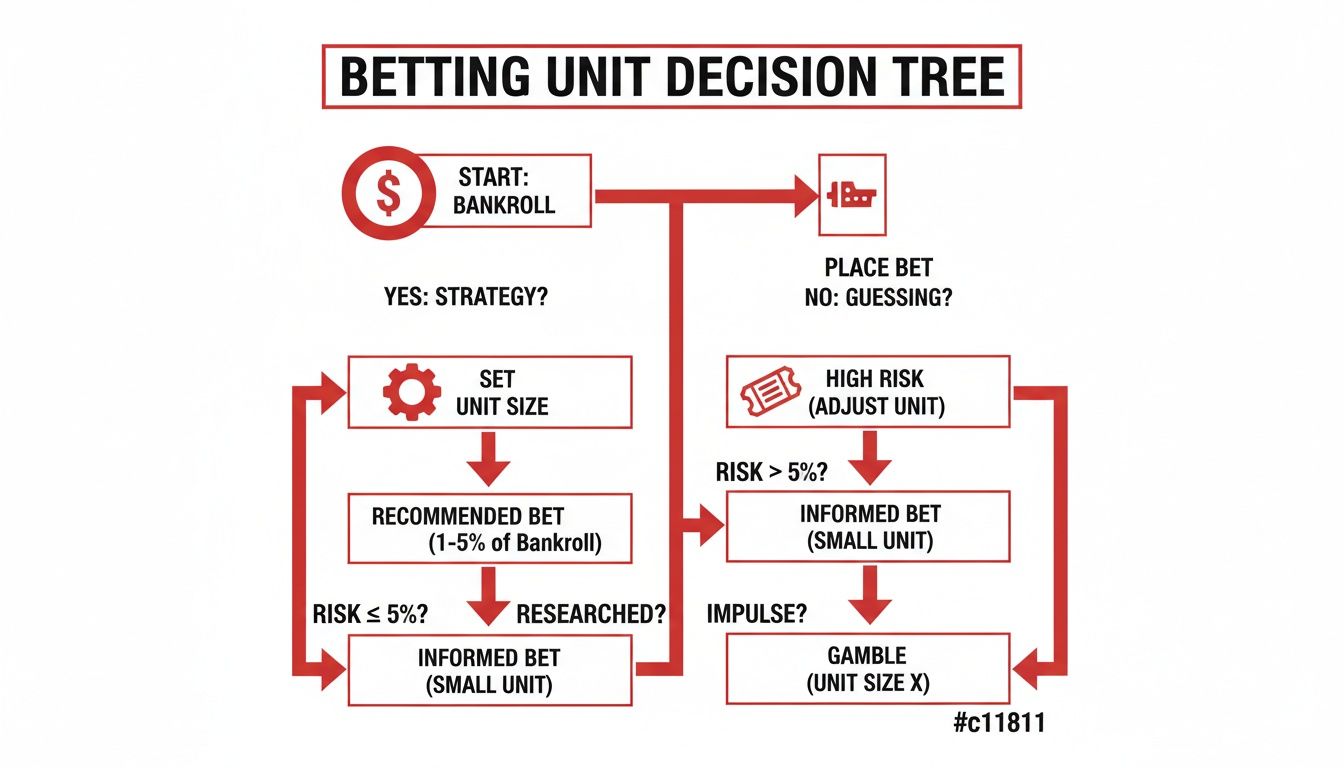
As you can see, everything starts with a clear-eyed look at your bankroll. Only then can you set a disciplined unit size before you even start looking at the odds.
Takeaway: Your unit size should be a living number that adapts to your bankroll's performance. Sticking to a fixed dollar amount while your bankroll fluctuates defeats the purpose of the unit system and exposes you to unnecessary risk.
Alright, let's get that theory off the page and into the real world. This is where the discipline of using a unit system really starts to pay off.
Imagine you're logged into your BetAnything account, looking at the board. You've set your bankroll at $2,000, so your standard 1-unit bet is a crisp $20 (which is 1% of your total roll).
Here’s how you’d put that into action on a few different plays:
- The Standard Play: You spot an NFL spread you like at -110 odds. This is a solid, everyday bet. You'd make a 1-unit play, risking $22 to win $20. It's a simple, controlled wager that represents just 1% of your bankroll.
- The Confident Play: After doing a deep dive on an NBA moneyline, you feel you've found a serious edge. You might bump this up to a 2-unit play, risking $40. You're backing your confidence with a bigger stake, but it’s still locked within your predefined system.
- The Underdog Shot: You find a +200 MLB underdog that looks way undervalued. A 1-unit bet here means risking $20 to win a cool $40. Even though the potential payout is much higher, your risk remains consistent and managed.

Tracking Performance Like a Pro
This is where the true power behind what is a unit in betting really clicks. The pros trading lines on sites like Bookmaker.eu and Heritage Sports don't obsess over dollar amounts; they live and die by their unit count.
A bettor's record isn't just about wins and losses. It’s about units won or lost. Saying you’re “+31.5 units” for the season is the ultimate scoreboard—it cuts through the noise of bankroll size and reveals pure betting skill.
This universal metric creates a level playing field for comparison. A sharp bettor on BUSR risking $10 per unit can perfectly compare their performance against a high-roller at BetUS who’s laying down $1,000 per unit. It all comes back to the units.
Units also neatly account for the odds. For example, winning a 2-unit bet on a -150 favorite only nets you 1.33 units in profit. But nailing a 2-unit bet on a +150 underdog? That brings home a full 3 units.
As any seasoned handicapper will tell you, this system naturally rewards you for finding and hitting those valuable underdog plays. If you want to see the math, you can read our full breakdown of how units reward value plays.
Exploring Advanced Unit Staking Strategies
Once you have your betting unit locked in, the next question is how to use it. While the simplest path is often the best, some bettors like to experiment with different staking models beyond just betting one unit on every play.
Let's break down the three most common ways bettors approach this.
Flat Betting: This is the gold standard for disciplined bankroll growth. Every single bet you place is for 1 unit. No exceptions. It doesn’t matter if you’re on a heavy -500 favorite or a longshot +300 underdog—the risk is always the same.
Percentage Staking: This is a more dynamic approach where your bet size is a set percentage of your current bankroll. When you win, your bankroll grows, and so does your next wager. When you lose, your bets get a little smaller, which helps protect your capital during a cold streak.
Confidence Model: Just like it sounds, this model has you vary your stake based on how confident you feel. You might risk 1 to 5 units per play. A standard bet could be 1-2 units, but for a pick where you feel you have a major edge, you might risk 3, 4, or even 5 units.
Comparing Unit Staking Strategies
To help you visualize the differences, this table breaks down the three main unit-based staking strategies. It’s designed to help you decide which approach best fits your betting style and risk tolerance.
| Staking Strategy | How It Works | Pros | Cons |
|---|---|---|---|
| Flat Betting | Wager the same amount (1 unit) on every bet, regardless of odds or confidence. | • Removes emotion • Easy to track performance • Protects bankroll |
• Slower, steadier growth • Doesn't capitalize on high-confidence plays |
| Percentage Staking | Wager a fixed percentage (e.g., 1-2%) of your current bankroll on every bet. | • Automatically adjusts to bankroll size • Can accelerate growth during hot streaks |
• Requires constant recalculation • Can increase exposure during a losing run |
| Confidence Model | Wager a variable number of units (e.g., 1-5 units) based on your confidence level. | • Maximizes returns on high-value bets • Flexible and adaptable |
• Highly susceptible to emotion • Can lead to chasing losses and quick bankroll drain |
While the Percentage and Confidence models look appealing on paper, they bring extra risk and complexity to the table. For the overwhelming majority of bettors, especially those using offshore sportsbooks like BUSR or Cosmobet, the flat betting model is the smartest and most sustainable path.
Why? Because it forces discipline and takes emotion out of the equation. Those two factors are the bedrock of long-term profitable betting.
The goal of any staking strategy is to maximize profit while minimizing risk. Overly complex systems often lead to emotional decisions and bankroll disaster.
Ultimately, the best system is the one you can follow without deviation. Flat betting gives you the clearest and safest road to building a bankroll, free from the temptation to go big just because of a gut feeling.
Using Units for Crypto Betting and High Rollers
This is where the unit system really proves its worth—in the more specialized corners of the betting world, especially for crypto bettors and high rollers. The same simple framework scales beautifully, whether you're betting pennies or a fortune.
For anyone using Bitcoin on offshore sites, units are a total game-changer. Think about it: instead of pegging your wagers to a wildly fluctuating dollar value, you define your unit as a fixed piece of your crypto holdings, like 0.0005 BTC. This simple move shields your betting strategy from the crypto market's insane volatility. It’s a crucial discipline, especially when trying to take advantage of the big crypto deposit bonuses many sportsbooks throw around.
On crypto-friendly offshore books, where 2026 bonuses can average $1,500 for Bitcoin deposits, this strategy makes a real difference. One analysis showed that unit sizing helped 65% of players turn a short-term profit, compared to just 28% of those who didn't use a unit system. If you’re diving into that world, it's worth checking out how a modern Web3 betting and prediction platform handles these market dynamics.
Units for High-Stakes Players
For high rollers, the unit system isn't just about money management—it's about discipline and privacy. A whale dropping $10,000 per game can talk about their "5-unit play" in a forum just as easily as someone betting $50. It levels the playing field, creating a community focused on strategy, not just the size of your wallet.
This common language lets the biggest sharks in the game track their performance and share tips without having to flash their bankroll. It’s all about the quality of the pick, not the cash behind it. You can find a list of sportsbooks that get this and cater to bigger players in our guide on the best sportsbooks for high rollers.
Common Mistakes to Avoid With Unit Betting
Look, having a unit system is half the battle. But knowing what is a unit in betting is one thing; actually sticking to the plan when things get heated is what separates winning bettors from the pack. The whole point of unit betting is to build discipline, and that discipline is what turns your strategy into actual profit.
The biggest and most dangerous mistake? Chasing losses. We’ve all been there. You have a brutal Sunday on a site like MyBookie, and every instinct screams at you to double or triple your bets to win it all back in a single shot. This is a one-way ticket to a zero-dollar bankroll. A tough loss on Sunday never justifies a reckless 10-unit bet on Monday Night Football.

Staying Disciplined
Right behind chasing losses is making emotional wagers. Dropping 5 units on your favorite team just to "show your support," with zero data backing it up, isn't strategy—it's just pure fan-fueled gambling. The unit system exists specifically to take that emotion out of your decisions.
The moment you ditch your unit structure—whether you're feeling overconfident after a win or frustrated by a loss—is the moment you give up your edge. The system's entire power comes from its consistency.
Finally, don't jump ship just because you hit a losing streak. Variance is a totally normal part of sports betting. Even the sharpest pros grinding it out on Bookmaker.eu or BetUS have to ride out cold spells. Sticking to your 1-unit base plan through the good times and the bad is what keeps you in the game long enough to see real growth.
Your Questions About Betting Units Answered
Once you start putting the unit system into practice, you'll inevitably run into a few specific scenarios. It's one thing to know the theory, but another to apply it in the heat of the moment. Let's tackle some of the most common questions that come up.
How Many Units Should I Bet On A Parlay?
Think of parlays as lottery tickets—fun to play, but not something you bet the house on. Because they are inherently high-risk, you need to adjust your staking accordingly.
Most sharp bettors I know risk only a small fraction of their standard unit on these. We’re talking 0.25 or 0.50 units at most. This lets you chase those massive payouts on a site like MyBookie without blowing a hole in your bankroll when one leg of the parlay busts.
Should My Unit Size Be The Same For Every Sport?
Yes. One hundred percent. This is non-negotiable if you want to accurately track your performance.
Your 1-unit bet has to represent the same dollar amount whether you're wagering on the NFL, the Premier League, or an MLB underdog. Keeping it consistent is the only way to get a true, apples-to-apples comparison of your profitability across different sports.
Maintaining a consistent unit size across all sports is fundamental to accurate performance tracking. It allows you to objectively compare your profitability in different markets, a practice used by pros on sites like Bookmaker.eu and Heritage Sports.
How Often Should I Recalculate My Unit Size?
You don't need to do this every day. In fact, you shouldn't. Recalculating too often leads to erratic staking and defeats the purpose of the system, which is to provide stability.
A good rule of thumb is to re-evaluate your unit size only after a significant change to your bankroll—think a 25% swing, either up or down. Alternatively, you can schedule it for natural breaks in the calendar, like the start of a new season.
Can I Use The Unit System For Live Betting?
Absolutely, and you definitely should. The unit system is arguably most valuable during live betting.
When you're in the middle of a fast-moving game on a platform like Xbet, it's easy for emotion and adrenaline to take over. Having a pre-defined unit size is your defense against impulse. Sticking to it religiously keeps you disciplined and prevents those oversized "gut feeling" bets that can wreck an account in minutes.
At USASportsbookList, we provide comprehensive reviews and guides to help you make informed decisions. Discover top-rated offshore sportsbooks and exclusive bonuses by visiting us at https://usasportsbooklist.com.