Learning to read betting odds is actually pretty simple once you get the hang of it. At its most basic, a minus sign (-) points to the favorite, and a plus sign (+) shows you the underdog. Those numbers attached to the signs are all about your potential payout. You'll run into three main styles—American, Decimal, and Fractional—at nearly every offshore sportsbook, from big names like Bovada to other mainstays like MyBookie.
Your First Look at Betting Odds
Before you jump in and place a wager at an offshore book like BetUS, you have to speak the language. At first glance, betting odds can look like a jumble of numbers and symbols. But really, they're just a straightforward way of telling you two critical things: the implied chance of something happening and exactly how much cash you stand to win.
Think of odds as the price tag on a bet. Getting a firm grip on what they mean is non-negotiable, because they spell out the sportsbook's opinion on an event and, more importantly, your potential profit.
Globally, you'll see three main formats. Fractional odds are big in the UK, decimal odds are the standard across Europe and Canada, and you guessed it—American odds are what you’ll find at most US-facing offshore sportsbooks like BetOnline and Xbet. They all tell the same story, just in a different dialect. Fumbling the translation can lead to some seriously bad bets, which nobody wants. You can dig deeper into the global sports betting market to see how these trends play out worldwide.
The Three Main Odds Formats
Here’s a quick rundown of the formats you need to know. The good news is that most modern offshore sites, including Sportsbetting.ag and Bookmaker.eu, let you toggle between them with a single click. Still, knowing them by sight is a core skill for any bettor.
- American Odds: These are the ones with the plus (+) or minus (-) signs, like -150 or +200. This is the default setting for most offshore books like BetAnything serving the US market.
- Decimal Odds: You'll see these as a single number with a decimal point, like 1.50 or 3.00. They're popular because they make calculating your total return incredibly simple.
- Fractional Odds: The old-school format, shown as a fraction like 1/2 or 5/1. It’s a classic, especially in horse racing circles on sites like BUSR.
The core idea behind all odds is risk versus reward. Lower odds point to a more likely outcome (the favorite), so the payout is smaller. Higher odds signal a longshot (the underdog), but they dangle a much bigger potential prize if your bet hits.
Instantly Spotting the Favorite and Underdog
The fastest way to size up any game is to find the favorite. With American odds, it’s a piece of cake: the team with the minus sign (-) is always the favorite. The one with the plus sign (+) is the underdog. No exceptions.
It’s just as easy with the other formats. For decimal odds, the lower number is the favorite. When you see fractional odds, the smaller fraction (like 1/2, where the top number is smaller than the bottom) is the favorite.
This simple check gives you an instant snapshot of how the oddsmakers at sites like Cosmobet see the matchup, which is the perfect starting point before you dive any deeper.
For a quick reference, here's a cheat sheet to help you make sense of it all on the fly.
Betting Odds Cheat Sheet
| Odds Format | Favorite Indicator | Underdog Indicator | Example Payout |
|---|---|---|---|
| American | The minus sign (-) | The plus sign (+) | Bet $110 on -110 odds to win $100. |
| Decimal | The lower number (e.g., 1.91) | The higher number (e.g., 2.50) | A $100 bet at 1.91 returns $191 total. |
| Fractional | The smaller fraction (e.g., 1/2) | The larger fraction (e.g., 5/1) | A $100 bet at 5/1 odds wins $500. |
Keep this handy, and you'll be able to interpret any betting line you come across, no matter the format. It's the first step toward placing smarter, more informed wagers.
Decoding American Odds: The Plus and Minus System
When you pull up an offshore sportsbook like BetOnline or Sportsbetting.ag, the first thing you’ll probably see are the plus (+) and minus (-) signs next to every team. This is the classic American odds format, and it’s the default for most sites catering to US bettors.
At its core, the entire system revolves around a simple baseline: a $100 wager. The plus and minus signs are your instant guide to who's the favorite and who's the underdog, but their main job is to show you exactly how much you can win or how much you need to risk. Once you get the hang of the $100 reference point, the math becomes second nature for any bet amount.
The Minus Sign Explained: The Favorite
If you see a minus sign, you're looking at the favorite. That number tells you how much money you have to lay down to win $100 in profit. Think of it as a "risk-to-win" scenario.
For example, say the Dallas Cowboys are listed at -150 on the moneyline over at Bovada. This means you need to bet $150 to win $100. If the Cowboys get the victory, you'll get your $150 stake back plus the $100 profit, for a total payout of $250.
This setup makes perfect sense—you're risking more than you stand to win because the sportsbook sees them as the more likely team to win the game.
The Plus Sign Explained: The Underdog
On the flip side, the plus sign always points to the underdog. The number after the (+) shows you the profit you'll make for every $100 you wager. This is a "risk-for-reward" situation.
Let's imagine you're checking out the NBA lines on MyBookie and you see the Miami Heat priced at +130. A $100 bet on the Heat would score you $130 in pure profit if they pull off the upset. Your total return would be $230—your original $100 bet plus your $130 in winnings.
Betting on underdogs offers a bigger payday for a smaller risk, simply because it’s a less probable outcome. The plus sign is your signal that a bigger reward is on the table.
Pro Tip: I like to think of the odds as a conversation with the bookie. A minus sign is them saying, "You'll have to give me this much to win $100." A plus sign is them saying, "We'll give you this much if you risk $100 and win."
Calculating Payouts for Any Stake Amount
Of course, you’re not locked into betting exactly $100. That's just the benchmark to make understanding the odds easy. Here’s how to quickly calculate your potential profit for any amount you actually want to wager.
For Minus Odds (Favorites):
The formula is: (100 / Odds) * Stake = Profit
Let's say you're on BetUS and want to put $40 on a UFC fighter who is a heavy -200 favorite.
- Calculation: (100 / 200) * $40 = 0.5 * $40 = $20 profit
- Your total payout would be $60 (your $40 stake back + $20 profit).
For Plus Odds (Underdogs):
The formula is: (Odds / 100) * Stake = Profit
Imagine you spot a promising MLB underdog at +180 on Bookmaker.eu and decide to throw $25 on them.
- Calculation: (180 / 100) * $25 = 1.8 * $25 = $45 profit
- Your total payout would be $70 (your $25 stake back + $45 profit).
Getting comfortable with these quick calculations is a must for managing your bankroll and spotting value. The plus and minus system might look a little strange at first glance, but you'll find it becomes the most intuitive way to read the board in no time.
Mastering Decimal and Fractional Odds
While American odds are the default setting at most offshore sportsbooks, you'll quickly discover that international-facing sites like Bookmaker.eu and Bet105 often lean on decimal and fractional formats. Getting fluent in all three is a massive advantage. It means you can jump between sportsbooks and instantly spot the best line without fumbling for a converter tool.
Honestly, many new bettors find decimal odds to be the easiest format to grasp right out of the gate. There's no plus or minus sign to worry about and no tricky fractions to solve in your head. It’s just one clean number that does the heavy lifting for you.
Understanding Decimal Odds
Decimal odds are refreshingly simple: they show you the total payout for every one unit you bet. This figure already includes your original stake, which makes the math incredibly straightforward.
The formula is as simple as it gets: Stake x Decimal Odds = Total Payout.
Let's imagine you're checking out the English Premier League lines on BetUS. You see Manchester United listed at 1.85 to win. If you decide to put down $50, the calculation is a breeze.
- Calculation: $50 (your stake) x 1.85 (the odds) = $92.50
That $92.50 is your total return. To figure out your actual profit, just subtract your original $50 stake, leaving you with $42.50 in pure winnings. Simple as that.
As a rule of thumb, anything over 2.00 is an underdog, and anything under 2.00 is a favorite. A line of exactly 2.00 is a straight even-money bet—double your money if you win.
Key Takeaway: Think of decimal odds as a direct multiplier for your stake. It’s the most efficient way to see your total potential return without any extra math.
Cracking the Code of Fractional Odds
Fractional odds are the old-school classic of the betting world, with deep roots in UK bookmaking and horse racing. They might look a bit intimidating at first, but they’re actually very descriptive once you know what you're looking at. For a really deep dive, especially for the track, our guide on how to read horse racing betting odds is a great resource.
The fraction literally tells you the Profit/Stake.
- 5/1 is read as "five-to-one." For every $1 you wager, you win $5 in profit.
- 2/5 is read as "two-to-five." For every $5 you wager, you win $2 in profit.
It's easy to spot the favorite and the underdog. If the first number (numerator) is bigger, it's an underdog. If the second number (denominator) is bigger, you're looking at a favorite.
Calculating Payouts with Fractional Odds
The calculation for fractional odds is also pretty clean once you see it in action.
The formula is: (Numerator / Denominator) x Stake = Profit
Let's say you're on Cosmobet and see a tennis player with 5/2 odds to win a tournament. You feel good about it and drop a $40 bet.
- Calculation: (5 / 2) x $40 = 2.5 x $40 = $100 profit.
- Your total return is that $100 profit plus your original $40 stake, bringing your total to $140.
Now for a heavy favorite. Imagine a boxer is listed at 1/4 odds on Xbet. You bet $100 on them to win.
- Calculation: (1 / 4) x $100 = 0.25 x $100 = $25 profit.
- You'd get back $125 in total—your $25 profit on top of your $100 stake.
Being able to flip between these formats mentally is a skill that separates sharp bettors from the crowd. It opens up more offshore sportsbooks and ensures you're always grabbing the best possible value for every single bet you make.
How to Calculate Implied Probability and Find Value
Alright, this is where we separate the casual fans from the sharp bettors. The odds you see on sites like Xbet or BUSR aren't just numbers telling you what you'll get paid. They're the sportsbook’s opinion, translated into a percentage. We call this implied probability.
Learning how to convert those odds back into a percentage is the single most important skill for finding real value. It’s the difference between hoping you’ll win and building a strategy that gives you a genuine long-term edge.
The Math Behind Implied Probability
Every set of odds, no matter the format, has a probability baked right into it. The formulas to uncover this percentage are actually pretty simple, and they absolutely need to be in your toolkit. Once you know them, you can instantly see the chance a sportsbook is giving to any outcome.
For Minus Odds (Favorites):
- Formula: Odds / (Odds + 100) = Implied Probability
- Let’s use the classic -110 line you see on almost every point spread at a book like BetOnline.
- Calculation: 110 / (110 + 100) = 110 / 210 = 52.4%
For Plus Odds (Underdogs):
- Formula: 100 / (Odds + 100) = Implied Probability
- Say you spot a nice moneyline underdog at +150 on MyBookie.
- Calculation: 100 / (150 + 100) = 100 / 250 = 40%
These numbers pull back the curtain on the sportsbook's thinking. That -110 line means the book thinks there's a 52.4% chance of that side covering, while the +150 odds suggest a 40% chance for the underdog to win outright.
This infographic breaks down how different odds formats are just different languages for saying the same thing.
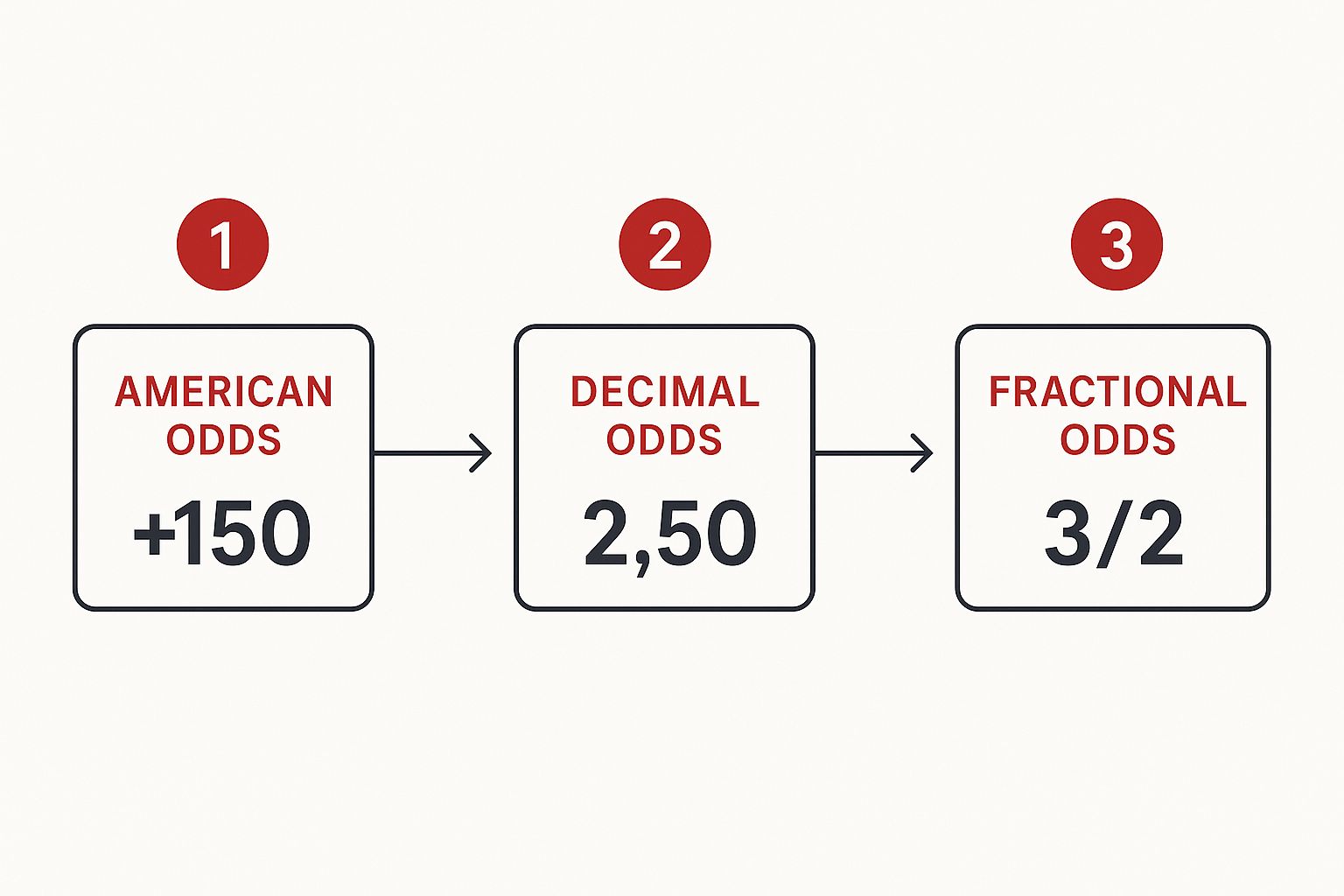
As you can see, American odds of +150, Decimal odds of 2.50, and Fractional odds of 3/2 are all the exact same bet. They represent the same risk, the same payout, and the same implied probability.
Spotting Value: The Sharp Bettor's Edge
Figuring out the implied probability is only half the job. The other half—the fun part—is using that info to find value. A value bet exists when you believe the actual chance of something happening is higher than what the sportsbook's odds are telling you.
This is the entire game. You aren’t betting on teams; you’re betting on numbers. If you think an underdog has a 50% chance to win, but the sportsbook is offering you +150 odds (which implies only a 40% chance), you’ve found a value bet.
Honestly, this process is more art than science. It takes your own research, your own analysis, and sometimes just a gut feeling backed by experience. You're trying to out-handicap the oddsmakers, finding a spot where their "price" on a team is just too low. Consistently finding these mismatches is a core pillar of our guide on how to make money betting on sports, because that’s what creates profit over the long haul.
Your mission is to develop your own method for judging probability. Maybe you build a statistical model. Maybe you follow injury reports and team news more obsessively than anyone else. Whatever your angle is, you use it to find gaps between your number and the book's.
Using Historical Data to Find an Edge
One of the most effective ways to find value is by digging into past data. Historical sports betting odds data has become a non-negotiable tool for pros who want to spot trends, sharpen their predictions, and manage risk. By tracking how lines move, you can see where the market might be inefficient. It's the same data that books like Bovada and BetUS use to set their own lines in the first place.
By doing your homework, you can form your own educated opinion on a game's likely outcome. If your analysis tells you a team has a 60% chance of winning, your next step is to hunt for odds that suggest a lower probability.
- First, calculate the implied probability from the sportsbook's odds.
- Then, compare that number to your own assessment.
- If your number is higher, you've got a potential value bet on your hands.
For instance, you see a team listed at -120 at Sportsbetting.ag. The implied probability there is 54.5%. If you genuinely believe their true chance to win is closer to 60%, that 5.5% difference is your edge. That’s what sharp, analytical sports betting is all about.
Putting It All Together With Real-World Examples
Theory is one thing, but staring at a screen full of live odds is where the rubber meets the road. This is the moment we move from ideas to action. Let's walk through a few common betting scenarios you'd find on any major offshore sportsbook to really lock this in.
I find the best way to learn is by doing. So, let’s build a virtual betting slip with three different wagers across popular sports. We'll stick to a standard $50 stake for each bet to see exactly how the numbers crunch in the real world.
NFL Point Spread Bet
Point spreads are the absolute bread and butter of NFL betting. For spreads, you’ll almost always see the odds hovering right around -110 for both teams. That -110 is the sportsbook’s commission, often called the "juice" or "vig."
Imagine we're looking at a classic rivalry on Bookmaker.eu: the Green Bay Packers vs. the Chicago Bears.
- The Line: Green Bay Packers -3.5 (-110)
- This means the Packers are favored and need to win by 4 points or more for the bet to cash.
Here’s how that single line breaks down across the board for our $50 wager:
- American: At -110, you have to risk $50 to win a profit of $45.45.
- Decimal: Converted, this is 1.91. A $50 bet returns a total of $95.50 (your $50 stake + $45.50 profit).
- Fractional: This works out to 10/11. A $50 bet nets $45.45 in profit.
- Implied Probability: The -110 odds give the Packers a 52.4% implied chance of covering that 3.5-point spread.
Your job as the bettor is to decide if their true chance of winning by 4+ points is higher than 52.4%. If you think it is, you've found a good bet.
MLB Moneyline Bet
Baseball is heavily driven by moneyline betting, where you just need to pick the outright winner. The odds can swing wildly from game to game, which is where hunting for valuable underdogs on sites like BetAnything can really pay off.
Let's say we spot this matchup:
- The Line: Los Angeles Dodgers (-160) vs. San Diego Padres (+140)
- The Dodgers are the clear favorite, but we see some potential value in the Padres as the underdog. We'll put our $50 on them at +140.
Let's break down that Padres bet:
- American: A $50 wager at +140 odds would profit $70 if the Padres win.
- Decimal: Converted, this is 2.40. Your $50 stake returns $120 total ($70 profit).
- Fractional: This is 7/5. A $50 stake returns $70 in profit.
- Implied Probability: The +140 odds suggest the Padres have a 41.7% chance of winning the game.
If your own handicapping tells you the Padres have a better than 41.7% shot to pull off the upset, that's a value play worth considering.
European Soccer Total (Over/Under)
Finally, let's look at a soccer total—also known as an Over/Under. This is a simple bet on the total number of goals scored by both teams combined, a popular market on Bet105.
- The Line: Over 2.5 goals (-120) in a match between Real Madrid and Barcelona.
- Anticipating an offensive game, we'll place our $50 on the Over.
Here’s the breakdown for the Over 2.5 goals bet:
- American: A $50 bet at -120 will profit $41.67.
- Decimal: This converts to 1.83. A $50 stake returns $91.67 total ($41.67 profit).
- Fractional: This is 5/6. A $50 stake profits $41.67.
- Implied Probability: The -120 odds give the Over a 54.5% implied chance of hitting.
Running through these examples shows that the core principles are the same no matter the sport or bet type. It’s all about translating the odds into probability and payout to make an informed decision.
This is also why finding the offshore sportsbooks with the most favorable lines is so critical. Squeezing out an extra few dollars on every win adds up fast. Using one of the best odds comparison sites can give you an immediate edge by ensuring you always get the best price for your wager.
Final Takeaway: The process is always the same. Read the odds, calculate the potential payout for your desired stake, and convert the odds to an implied probability. The final step is comparing that probability to your own analysis to decide if the bet offers value.
The global sports betting market was valued at approximately USD 103 billion and is projected to more than double by 2033. A key driver of this growth is the increasing sophistication of bettors who are learning to read and interpret various odds formats to find value, especially in the booming live betting sector available on offshore sites. This growing knowledge base is turning casual fans into calculated bettors.
Common Questions About Reading Betting Odds
Once you get the hang of American, decimal, and fractional odds, a few real-world questions always seem to follow. This is where the theory meets the pavement. Let's tackle some of the most common sticking points bettors run into, so you can look at the lines with total confidence.
What Does It Mean When Odds Change?
If you're watching the lines on a site like MyBookie and see the numbers move, that’s called "line movement." Odds aren't set in stone; they're dynamic and shift for a couple of key reasons.
The main driver is pure betting action. When a ton of money pours in on one side of a bet, the sportsbook has to adjust the odds to make the other side more appealing. It's their way of balancing the books to minimize risk and try to guarantee a profit no matter who wins. For instance, if the Kansas City Chiefs open at -150 and a tidal wave of bets hits them, you might see a book like BetOnline shift that line to -160 to tempt people into betting on their opponent.
The other big factor is new information. This could be anything from a last-minute injury to a star quarterback, a sudden weather forecast change, or even locker-room drama. Pro bettors live and breathe line movement because it tells a story about where the big money is going and what the market really thinks about the game.
How Do I Calculate Payouts for Bets Under $100?
Great question. Most of us aren't betting in clean $100 increments, so knowing how to calculate payouts for any amount is essential. Thankfully, the math for American odds is pretty simple once you see it laid out.
For favorites (the minus sign), the formula is:
(100 / Odds) * Stake = Profit
Let's say you want to put $20 on a big favorite listed at -140 on Bovada.
- Calculation: (100 / 140) * $20 = 0.714 * $20 = $14.28 profit.
For underdogs (the plus sign), it's even easier:
(Odds / 100) * Stake = Profit
Picture yourself spotting a live underdog at +120 on BUSR and deciding to risk $20.
- Calculation: (120 / 100) * $20 = 1.2 * $20 = $24 profit.
And don't forget, with decimal odds, it's the simplest of all—just multiply your stake by the odds for your total payout (which includes your initial wager).
What Is the Difference Between Moneyline, Point Spread, and Totals Odds?
These are the three pillars of sports betting. Understanding how the odds work for each is fundamental to knowing how to read betting odds like a pro.
- Moneyline: This is the most straightforward bet: who is going to win the game, period. The odds (like +150) simply tell you the payout for picking the outright winner.
- Point Spread: This is all about the margin of victory. A line like -7 (-110) means the favorite has to win by more than 7 points for your bet to cash. That "-110" is the price of the bet, often called the "juice" or "vig."
- Totals (Over/Under): Here, you're betting on the combined final score of both teams. If a game's total is 48.5 points (-110), you're just wagering whether the actual final score will be higher or lower than that number.
While all three use odds, each one applies them to a totally different aspect of the game's outcome.
Are Odds Different on Offshore Sportsbooks?
Absolutely, and this is a concept that separates casual bettors from sharp, profitable ones. Offshore sportsbooks like Bovada, BetUS, and Sportsbetting.ag are all fighting for your action. One of the best ways they compete is by offering better odds—or what's known as "reduced juice."
For example, one offshore sportsbook might post a standard point spread line at -110, while another like BetAnything offers the exact same game at -105. That might not look like a huge deal, but that five-cent difference adds up massively over the course of a season and can be the difference between winning and losing money long-term.
This is why "line shopping" is a non-negotiable habit for serious bettors. By holding accounts at several different offshore sites like Xbet, Cosmobet, and Bookmaker.eu, you can quickly compare the lines for any bet you want to make and guarantee you're always getting the best possible price.
Ready to put your knowledge to the test? USASportsbookList is your go-to resource for finding the best and most trusted offshore sportsbooks. We provide in-depth reviews and bonus information to help you find the perfect site for your betting style, ensuring you always get the best odds and promotions available. Check out our curated list at https://usasportsbooklist.com.