Ready to bet on the Preakness but not sure where to start? It's easier than you think. The whole process boils down to picking a solid offshore sportsbook, getting some money in your account, and learning the lingo of the racebook.
Once you know the difference between a Win, a Place, and a Show bet, you're pretty much ready for the second jewel of the Triple Crown. This guide will walk you through it, so you can place that first wager feeling like you know what you're doing.
Your Essential Preakness Betting Quickstart Guide
The Preakness Stakes, rolling around every third Saturday in May, is a massive event for horse racing fans and bettors alike. If you're new to the scene, it can feel a little overwhelming, but it's really just a few simple steps.
First things first: you need a reliable place to bet. For most US bettors, offshore sportsbooks are the way to go. They offer great odds and you can access them from almost anywhere. Reputable books like MyBookie, BetUS, and Bookmaker.eu have been around the block and have dedicated racebooks built for horseplayers. After you pick one, it's time to fund your account.
Getting Your Account Ready for Race Day
Signing up is the easy part. Funding your account is where a little strategy comes in. Sure, you can use a credit card, but a lot of savvy bettors have switched over to crypto for a few key reasons.
- Bigger Bonuses: Sportsbooks like BUSR and Xbet are known for rolling out the red carpet for crypto deposits with much larger bonuses.
- Faster Transactions: Forget waiting around. Crypto deposits and withdrawals are almost always faster and have fewer hiccups than old-school banking methods.
- Enhanced Privacy: Using crypto keeps your betting activity more private.
With money in your account, head over to the racebook. This is your command center for all things horse racing, and you'll find the Preakness Stakes at Pimlico Race Course featured prominently.
I've found that the best offshore racebooks, like the ones on Heritage Sports or Bet105, make this super intuitive. Just click the "Horse Racing" or "Racebook" tab, select the Preakness, and you’ll see the entire field of horses with their morning-line odds. This is where the real fun starts.
From here, it's all about understanding what you're looking at. The betting menu ranges from dead-simple wagers on a single horse to complex, multi-horse combinations called exotics that can lead to massive paydays. To get you started, here’s a breakdown of the most common wagers you'll see at sites like Cosmobet and BetAnything.
Common Preakness Bet Types Explained
Before you can cash a ticket, you need to know what you’re betting on. Here’s a quick look at the most popular wagers, from the basics to the big-money exotics.
| Bet Type | What It Is | Difficulty Level | Payout Potential |
|---|---|---|---|
| Win | Your horse must finish in first place. | Low | Moderate |
| Place | Your horse must finish in first or second place. | Low | Low |
| Show | Your horse must finish in first, second, or third. | Low | Very Low |
| Exacta | Pick the first two finishers in the correct order. | Medium | High |
| Trifecta | Pick the first three finishers in the correct order. | High | Very High |
| Superfecta | Pick the first four finishers in the correct order. | Very High | Extremely High |
The "straight" bets (Win, Place, Show) are perfect for beginners. As you get more comfortable reading the program and handicapping the race, you can move on to the exotics (Exacta, Trifecta, Superfecta), where the real money is made.
Choosing the Right Offshore Sportsbook
Picking where you’ll lay down your Preakness money is a huge decision. It's about more than just placing a bet; the right sportsbook becomes a trusted partner for the big race, offering solid odds, a platform that doesn't feel like a science project, and promos that actually help your bottom line. I’ve seen plenty of sites come and go, but the mainstays like MyBookie, BetUS, and Bookmaker.eu have earned their stripes over the years with solid racebooks and, most importantly, reliable payouts.
Your choice really comes down to what you value most. Are you hunting for the biggest bonus to maximize your bankroll, or do you just want a clean, simple mobile site that lets you get your bets in fast? When you're just figuring out how to bet on the Preakness, a user-friendly site makes a world of difference. It lets you focus on picking winners, not fighting with the website.
Evaluating Key Features
Don't be fooled by a flashy homepage. A great sportsbook and a great racebook aren't always the same thing. You need to dig a little deeper to see what they offer for horse racing specifically.
Here’s what I always look for:
- Racebook Interface: How quickly can you find Pimlico and the Preakness? Some sites bury the racebook, which is a major red flag. Platforms like Heritage Sports and BUSR are known for their clean layouts. You can jump to the track, pick the race, and build your ticket without any headaches. The last thing you want is to be fumbling around a clunky site as the horses are heading to the gate.
- Betting Markets: Do they offer more than just the basic Win, Place, and Show wagers? A top-tier racebook will have the full menu of exotics—Exactas, Trifectas, Superfectas—giving you more ways to hit a big score.
- Competitive Odds: Most online racebooks use the same pari-mutuel pool as the track, so the odds are standard. However, some books like BetAnything might offer fixed-odds futures bets leading up to the race. It never hurts to have accounts at a couple of different places to shop around for the best value.
Security is another piece of the puzzle you can't ignore. When you're funding an account, you need to know your financial info is locked down. A big part of this is understanding card-not-present fraud, a risk with any online purchase. The good sportsbooks invest heavily in security to keep your data safe.
This quick decision tree can help you figure out where to start.
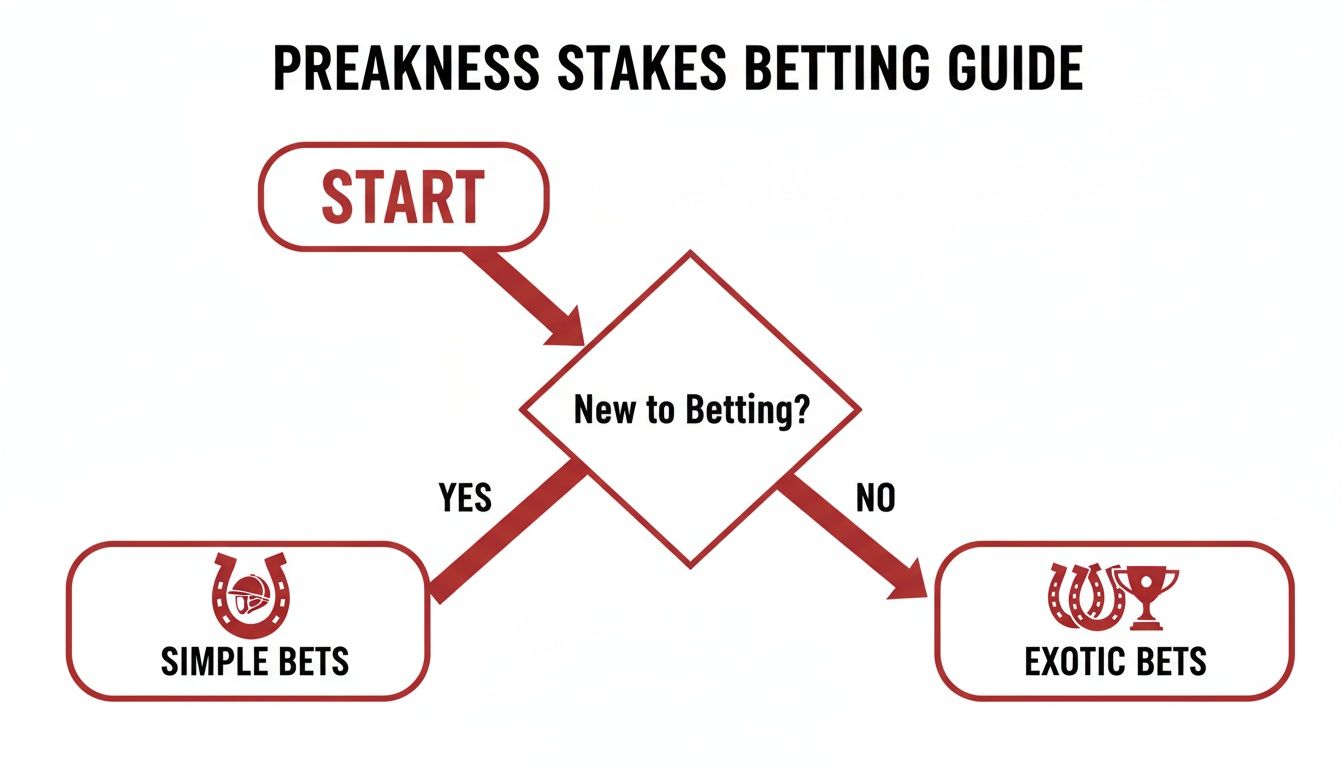
As the flowchart shows, if you're new to the game, stick with the simple stuff first. If you've been around the track a few times, you can jump right into the more complex exotic bets.
Maximizing Value with Bonuses
Here’s where offshore sportsbooks really shine: the bonuses. These promos can give your starting bankroll a serious boost, giving you more ammo for the Preakness. The best deals are almost always tied to crypto deposits.
For example, a site like Xbet or Cosmobet might offer a 50% match if you use a credit card. But if you deposit with Bitcoin or another crypto, that bonus could jump to 100% or even 150%. That’s a massive advantage that instantly increases your betting power.
Think of it this way: a $200 deposit with a 100% crypto bonus instantly turns into a $400 bankroll. That extra $200 can be used to cover more exotic combinations, place a larger win bet on your top pick, or simply give you more cushion to ride out the ups and downs of a race day.
Just remember to read the fine print before you grab a bonus. The key thing to look for is the rollover requirement—that’s the amount you have to bet before you can cash out any winnings from the bonus. Lower is always better. Some sites, like Bet105, are known for having player-friendly terms, making it much easier to actually turn that bonus money into withdrawable cash.
How to Read the Preakness Program Like a Pro
Any seasoned bettor will tell you that a winning ticket is often decided long before the horses even break from the gate. The real work starts with the race program—that dense booklet of names and numbers that can look like a foreign language at first glance.
But learning to decode it is the single best thing you can do to move beyond betting on a cool name or your favorite jockey colors. This is where you graduate to making calculated wagers.
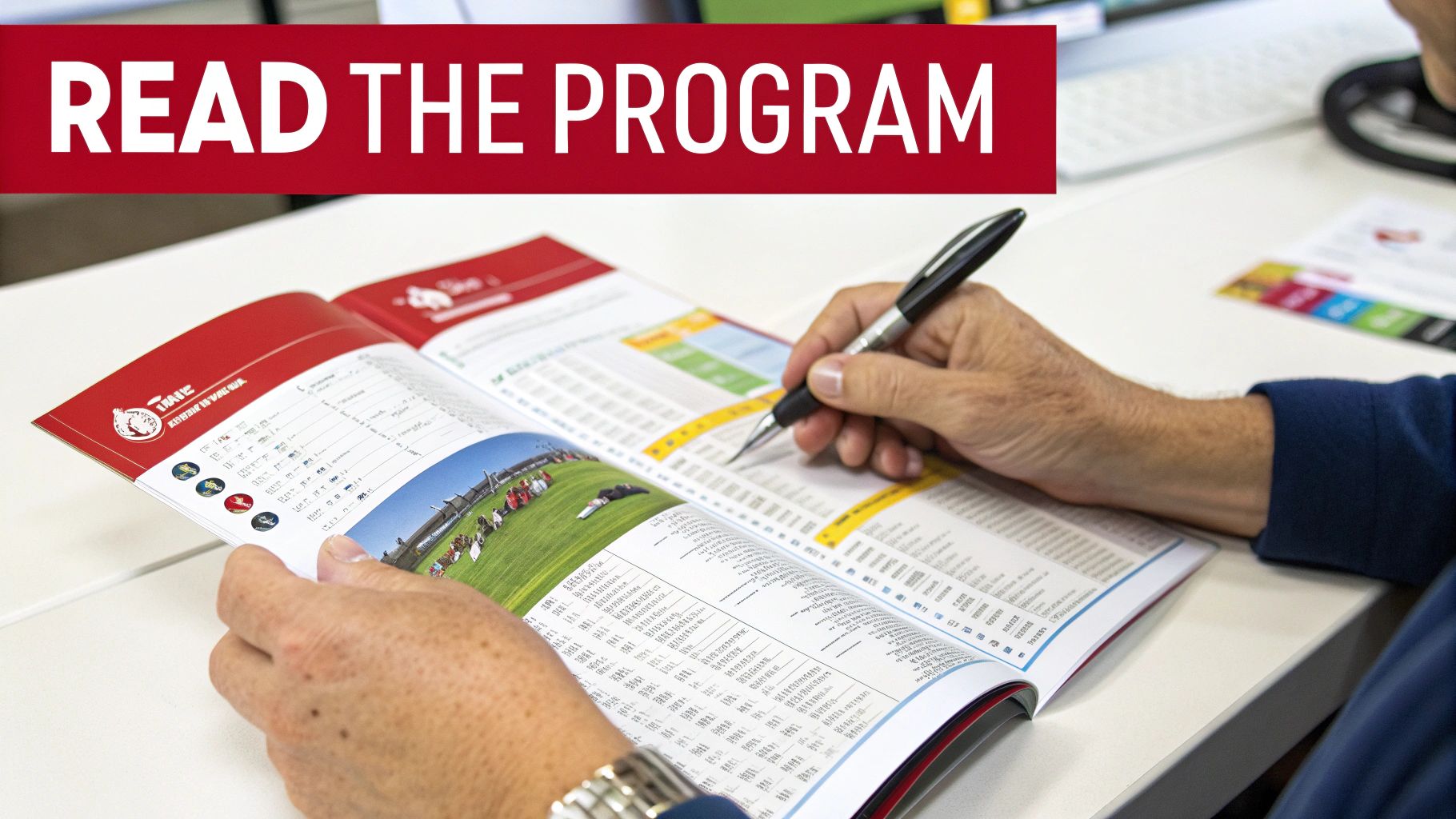
Think of the program as your ultimate cheat sheet. It’s packed with raw data on everything from a horse’s recent performance to the stats of its jockey and trainer. This is how you spot vulnerable favorites and uncover those hidden gems that pay big.
Decoding Past Performance Data
The heart and soul of any program is the Past Performance (PP) section. This is where you’ll find a horse’s recent race history. Don't just glance at the win/loss record; you’re looking for patterns.
Here are a few data points I always zero in on:
- Speed Figures: Metrics like Beyer Speed Figures are gold. They tell you exactly how fast a horse ran in previous races, adjusted for track conditions. Consistent, high numbers are a massive green flag.
- Class of Race: Was the horse running against killers or in softer company? A horse stepping up in class for the Preakness might be in over its head, while one dropping down from a tougher race could be ready to dominate.
- Jockey and Trainer Stats: Check the win percentages for the jockey-trainer combo. A high-performing duo is a force to be reckoned with, especially if they have a history of success at Pimlico.
To really get an edge, I like to apply fundamental analysis principles to my handicapping—just like a stock investor would. It forces you to look at the underlying strengths and weaknesses of each horse, helping you see beyond the surface-level odds to find real value.
Understanding the Odds: Morning Line vs. Live Odds
When you first open the program, you'll see the morning line (M/L) odds. These aren't the final odds; they're just the track handicapper's best guess at how the public will bet. They’re a solid starting point, but that's all they are.
The real action happens with the live odds you'll find on offshore sportsbooks like MyBookie and BetUS. These odds fluctuate right up until the race starts, reflecting where the actual money is going. If a horse starts getting hammered with late bets, its odds will plummet.
Need a refresher on the basics? Check out our guide on how to read horse racing betting odds.
This is where savvy bettors make their money. The morning line might have a horse at 8-1, but if the public overlooks it, you could snag 15-1 odds at a site like BetAnything just before post time. Shopping around for the best price is a non-negotiable part of a winning strategy.
Crucial Factors Beyond the Numbers
The program gives you the stats, but you have to supply the context. Things like post position and track conditions can completely change a horse's chances, especially at a historic track like Pimlico.
Since the starting gates were introduced back in 1909, post position #6 has been the most successful, producing 17 Preakness winners (14.9%). Post #7 isn't far behind with 14 wins (13.3%), while the dreaded post #14 has produced zero winners. Zilch.
Recent history also shows that early speed is king at Pimlico, with winners often clocking blistering opening fractions around the :46-48 mark. This is the kind of historical data that can help you filter out the contenders from the pretenders.
A talented horse stuck on the far outside might be a risky bet, no matter how good its numbers look. On the other hand, if rain is in the forecast, a horse with a good draw and a proven record on a muddy track could be an incredible value play.
This is what handicapping is all about: combining the hard data from the program with these outside factors to build a winning ticket.
Crafting Your Preakness Betting Strategy
Once you've got a handle on reading the program, it's time to turn that insight into an actual betting strategy. A smart approach to the Preakness isn't just about falling in love with one horse; it's about building a portfolio of wagers that balances risk and gives you a few different ways to end the day in the black.
For anyone just getting their feet wet, the smartest move is to start simple. Wagers like Win, Place, and Show are your bread and butter for a reason. They let you get in on the action and feel the thrill of the race without a huge upfront risk. This is how you build your confidence—and just as importantly, your bankroll.
Building Your Bankroll with Straight Wagers
One of the biggest mistakes I see new bettors make is immediately diving into complex exotic bets. You're much better off starting with a more measured approach. Let's say you've done your homework and feel really good about one horse in particular. A great starting point is to make your primary wager a "Win" bet on that contender.
But you can also give yourself a bit of a safety net. Back up that main bet with smaller "Place" or "Show" wagers on the same horse, or maybe on another one you think has a decent shot to hit the board. That way, even if your top pick gets nosed out at the wire, you can still cash a ticket. It keeps you in the game.
Sportsbooks like MyBookie and BetUS are perfect for this, as they clearly show your potential payout right on the bet slip before you confirm. That kind of transparency is a huge help when you're just learning how to manage your funds for a big race day.
Unlocking Big Payouts with Exotic Bets
Okay, once you're feeling comfortable, it's time to chase the big score. This is where exotic wagers come in, and it's how a small bet can turn into a massive payday. We're talking about the Exacta (picking the first two finishers in the correct order) and the Trifecta (the top three). These are the bets that create legends.
The real beauty of exotics is their flexibility. You don't have to nail a perfect 1-2-3 finish to win. Experienced bettors use techniques like "boxing" their picks to dramatically improve their odds.
- Boxing an Exacta: Let's say you like horses #4 and #7. Boxing them means you win if the finish is 4-7 or 7-4. It costs twice as much as a straight bet, but it also gives you two ways to win.
- Boxing a Trifecta: It's the same idea, just with three or more horses for the top three spots. A three-horse trifecta box covers all six possible finishing combinations for those horses.
Another pro-level move is "keying" a horse. If you are absolutely convinced one horse is going to win but you're fuzzy on who will finish second and third, you can key that horse in the top spot over a handful of others. You can build these kinds of tickets at sites like Cosmobet, and it's a great way to lower your cost compared to a full box while still aiming for that huge payout.
Analyzing Historical Trends for an Edge
The Preakness is its own unique beast, and looking at its history gives you some serious clues. It's not the chaotic, 20-horse cavalry charge of the Kentucky Derby. The smaller field often gives an advantage to horses with tactical speed—the ones who can break well and secure a good spot early without burning too much energy.
This race is also famous for its shocking upsets. The money pouring in on this race is staggering; the total wagering handle hit an all-time high of $67,731,145 in 2021. With that much money in the pools, the potential for a massive score is very real. Just look at Master Derby's 1975 win at 23-1 odds, which paid a record $48.80 on a simple $2 ticket. More recently, six of the last eight winners paid double-digit returns. And the 2024 Exacta? It paid a very nice $119.40 for a $2 wager. You can always find more Preakness betting insights and data on how the favorites typically perform.
This history of longshots blowing up the tote board is precisely why exotics are so compelling for the Preakness. One surprise horse sneaking into the top two or three can make those payouts explode. Imagine you handicap a 15-1 shot to run second to the favorite and you build that Exacta on a site like Bookmaker.eu. That ticket could easily be worth several hundred dollars on a small bet. The trick is to blend what you see in the program with a healthy respect for this race's wild side.
Placing Your Bet: A Step-by-Step Guide
Alright, you’ve done your homework, studied the program, and you've got a horse—or a few—that you're feeling good about. Now comes the fun part: turning that handicapping into a live ticket. Let's walk through exactly how to get your bet down so you know what to expect when it's go-time.
The great news is that the best offshore racebooks like Xbet and Bet105 have made this whole process incredibly simple, even if it's your first time at the digital window. Their layouts are intuitive, whether you're on your laptop or sneaking in a bet on your phone at a Preakness party. The idea is to get you from thinking about a bet to holding a ticket in seconds.

Finding Your Way to Pimlico
First thing's first: log into your sportsbook. You'll need to find the racebook, which is almost always a main category at the top of the page, clearly marked "Horse Racing" or "Racebook." On sites like MyBookie and BUSR, it’s impossible to miss.
Once you click in, you’ll see a list of all the tracks running races that day. Just scroll through the list to find Pimlico Race Course. On Preakness Saturday, you can bet it'll be the star of the show, featured right at the top.
Building Your Ticket: From Simple to Exotic
This is where the magic happens. After you select the Preakness Stakes, the site will display the full field of runners, complete with their odds, jockeys, and trainers. Let's run through a couple of common plays.
The Straight-Up 'Win' Bet:
This is the bread and butter of horse racing. You like a horse, you bet it to win.
- Pick Your Pony: Find your horse in the list and just click on its name.
- Select 'Win': The bet slip will pop up. Make sure "Win" is selected.
- Set Your Stake: Type in how much you want to risk.
- Confirm: Give it one last look to make sure everything is right, then hit that "Place Bet" button.
That's it. You're in. For a deeper dive into the mechanics, our guide on how to place a horse racing bet online has you covered.
Putting Together a 'Trifecta Box':
Feeling a bit more adventurous? Let's say you've narrowed the race down to three horses—maybe #2, #5, and #8—but you aren't sure who will win, just that they'll be the top three. Time for a trifecta box.
- Select Your Horses: Tick the boxes next to #2, #5, and #8.
- Choose the Bet: Find the exotic wagers menu and select "Trifecta."
- Box It Up: Look for a "Box" checkbox on the slip. Clicking this is key—it covers every possible finishing order for your three horses.
- Enter Base Wager: Decide your base amount, like $1. A $1 trifecta box with three horses costs $6 total, since you're covering six different combinations.
- Confirm the Bet: The total cost calculates for you. Review it and lock it in.
Pro Tip: Keep an eye on the wager minimums. While books like Bookmaker.eu and Heritage Sports cater to big bettors, most exotic bets have tiny minimums—sometimes $0.10 or $0.50. This lets you build out some pretty wild, multi-horse tickets without breaking the bank.
Confirming and Cashing In
Once you've placed your bet, the money comes out of your account balance and the wager is locked. You can see all your action in an "Open Bets" or "My Bets" tab, which acts as your digital ticket.
And the best part? After the race goes official, any winnings are dropped right back into your account. Instantly. This is a massive perk of using top-tier sites like BetUS or BetAnything. No waiting in a cashier line—the money is yours to use for the next race or to withdraw.
Smarter Betting Through Bankroll Management
Nailing a winner as it thunders across the finish line is a massive thrill, but the real secret to making money on the Preakness isn't just about picking fast horses—it’s about discipline. Smart bankroll management is what truly separates the pros from the casual players. It’s the safety net that ensures one bad beat or an unlucky photo finish doesn’t wipe you out for the day.
Before you even glance at the racing form, you need to set a hard budget and commit to it. This isn't just a friendly tip; it's the golden rule of betting. Decide on a number you are completely okay with losing. Once that cash is in your MyBookie or BetUS account, that’s your war chest for the entire day. No reloading.
The Unit System: A Bettor's Best Friend
To bring some real structure to your wagering, you need to adopt the unit system. A "unit" is just a set percentage of your total bankroll, usually somewhere between 1% and 5%.
Let’s say you’ve set aside a $200 bankroll for the Preakness.
- A 1% unit would be $2.
- A 5% unit would be $10.
This simple system keeps you consistent. Your standard, everyday bets on horses you have a good feeling about might be one unit ($2). But when you find a horse you absolutely love—your strongest conviction of the day—you might bump it up to three or five units ($6-$10). Using units is a game-changer because it stops you from making those wild, emotional bets after a tough loss or getting too cocky after a big win. It's a proven method for protecting your funds, and you can get a deeper dive with this excellent guide to sports betting bankroll management.
The mental game is half the battle. You have to fight that urge to "chase" your losses with a desperate, oversized bet on the last race. By the same token, if you hit a monster trifecta on a site like Bookmaker.eu, you have to resist the temptation to get reckless and give it all right back.
Successful betting is a marathon, not a sprint. When you manage your money with the same focus you put into handicapping the horses, you set yourself up for a profitable—and much more enjoyable—day of wagering on the Preakness Stakes at sportsbooks like BUSR and Heritage Sports.
Got Questions About Betting on the Preakness?
Jumping into the action for a race like the Preakness Stakes can bring up a few last-minute questions. Whether you're placing your first-ever horse bet or just need a quick refresher, we've got you covered with some straight answers to get you ready for the big day.
What’s the Easiest Bet for a Preakness Newbie?
If you're just getting your feet wet, keep it simple. Your best friends are the classic "Win," "Place," and "Show" bets.
- A "Win" bet is exactly what it sounds like—you're betting on your horse to finish first.
- A "Place" bet cashes if your horse finishes first or second.
- A "Show" bet gives you a win if your horse finishes in the top three.
These are the bread and butter of horse racing for a reason: they're easy to understand and a great way to get a feel for the action without a complex ticket. You could also try an "Across the Board" wager, which is just a combination of all three on one horse. It gives you multiple ways to cash.
Are Offshore Sportsbooks a Legit Way to Bet on the Preakness?
Absolutely. Offshore sportsbooks like MyBookie, BetUS, and Bookmaker.eu have been serving US bettors for years. Because they operate in different legal jurisdictions, they're accessible to pretty much everyone in the States.
These aren't fly-by-night operations; they're established brands with a long track record of paying out winnings on major events like the Preakness. For many bettors, they are a trusted and secure alternative.
How Does Betting with Crypto Work?
Using cryptocurrencies like Bitcoin (BTC) has become a really popular way to fund a betting account because it’s fast and secure. On sportsbooks like BUSR or Xbet, the process is a breeze. You just head to the cashier, pick your crypto, and the site gives you a wallet address. Then you send the funds over from your personal crypto wallet.
The best part? Crypto deposits are almost always faster than waiting on a credit card or bank transfer. On top of that, sites like Cosmobet and Bet105 often roll out much bigger welcome bonuses for crypto users, giving you some extra firepower for your bankroll right from the start.
What's the Difference Between Fixed Odds and Pari-Mutuel Wagering?
Understanding the difference here is key. With fixed-odds, which you'll find at many offshore sites like BetAnything, you lock in your price the moment you place the bet. If you bet on a horse at 10-1, that's exactly what you'll get paid if he wins, no matter what happens to the odds later.
Pari-mutuel wagering is the traditional system used at the track. All the money for a certain bet type goes into a big pool. The final odds—and your potential payout—aren't locked in until the betting windows close just before the race starts. Your payout fluctuates based on how much money came in on each horse. The top offshore racebooks, including Heritage Sports, will often give you the choice between both for major races.
Ready to get in on the Preakness action? USASportsbookList is the best place to find detailed reviews and bonus comparisons for top-tier offshore sportsbooks. Check out our guides and find the perfect site for you at https://usasportsbooklist.com.