A bet takes seconds to place; the business behind it is much harder to read.
An app flashes a boosted price before kickoff, and the market looks simple: pick a side, enter a stake, wait. Yet that screen sits atop licensing, odds models, trading desks, payment costs, taxes, marketing deals, and risk controls.
Top Offshore Sportsbook Bonuses for September 2026

$2,750
200% Crypto Bonus PLUS 10% Gamblers Insurance with a minimum $100 deposit and a maximum of $1,500. Use Code: JOIN200 in the Cashier.


$250 + 100 Free Spins
All new players receive $250 in Free Bets and 100 Casino Spins. Join today and enter the promo code WELCOME in the cashier when you deposit $50 or more.

Get a 50% deposit bonus up to $1,000 with the code: CRYPTO1K. Valid on crypto deposits.
Record handle does not mean record profit. Betting totals include money returned as winnings, while promotions may purchase activity rather than loyalty. Legalization expands access, but every jurisdiction adds different taxes and rules. Big numbers can signal scale without showing whether operators, partners, or governments earn much.
Who is behind the sportsbook?
A sportsbook brand is often the visible front of a longer chain. One company may own the app and customer relationship while others supply technology, prices, data, or payments. The name on the screen may not be the party carrying the bets.
| Participant | Main role |
|---|---|
| Operator | Holds the licence, markets the service, and usually manages customers and betting liability. |
| Platform vendor | Provides account, wallet, risk, and bet-settlement technology. |
| Odds and data supplier | Delivers fixtures, scores, statistics, and price feeds. |
| Payment processor | Handles deposits and withdrawals, including transaction checks. |
| Affiliate | Refers customers through reviews, advertising, or comparison sites for a fee. |
| Sports organization | Stages events and may sell data, media, or sponsorship rights. |
| Regulator | Sets licence conditions, audits conduct, and enforces local rules. |
Contracts decide the dividing lines. A white-label brand may control marketing while a licensed operator owns customer accounts. Technology can be almost entirely outsourced, and betting risk may remain with the operator or be managed by a specialist supplier. Regulatory responsibility follows the licensed entities—not merely the consumer-facing name.
What happens from opening line to payout
-
1. The opening price is posted
Traders or automated models estimate a starting probability, then build in the bookmaker’s margin. The process varies, as explained in who creates sportsbook opening lines.
-
2. The market tests it
Prices may move after team news, changes at larger sportsbooks, respected betting action, or an imbalance in the book’s exposure. A move does not necessarily mean the original score forecast changed.
-
3. The wager passes checks
Before acceptance, systems apply stake limits, account restrictions, location and identity controls, market-status checks, and fraud monitoring. The offered price may change while confirmation is pending.
-
4. Risk is managed
Once accepted, the bet becomes part of the sportsbook’s liability. Traders can adjust odds, lower limits, suspend the market, or hedge exposure elsewhere.
-
5. The result is graded
After the event, settlement rules and an official data source determine whether the wager won, lost, pushed, or became void. Corrections can occasionally delay grading.
-
6. Funds become payable
Winnings are credited to the betting balance. Withdrawal then passes through payment, identity, anti-money-laundering, and regulatory checks before funds are released.
A shortening price can reflect new information, influential bets, movement elsewhere, or liability management. It should not automatically be read as the sportsbook’s latest prediction.
From betting volume to actual profit
Handle
The total amount staked, including money later returned to bettors. It measures activity, not sportsbook income.
Gross gaming revenue (GGR)
Handle minus settled payouts. A sportsbook taking $1 million in bets and paying back $930,000 records $70,000 in GGR.
Hold
GGR divided by handle; in the example, 7%. It shows the operator’s realized margin before most costs.
Net gaming revenue (NGR)
GGR after deductions such as bonuses, free bets and certain taxes or platform charges. Reporting conventions vary, so comparisons require care.
Operating profit
What remains after supplier fees, payment processing, payroll, marketing, compliance and other operating expenses are deducted.
A strong hold over a weekend may reflect several popular bets losing at once, while one customer-friendly result can sharply reduce it. Short periods, unusual outcomes and bet mix—such as parlays versus lower-margin straight bets—can all skew the figure. Longer time frames and consistent reporting definitions provide a more useful comparison.
What powers a sportsbook
A polished betting site is the visible layer of a much larger stack. Account systems hold customer details and balances, while trading tools combine odds feeds, market rules and liability controls. Bet settlement then updates wallets after results are confirmed.
Other services handle less visible but essential work:
- Geolocation and identity checks determine whether a customer is eligible to bet.
- Payment gateways manage deposits, withdrawals, fraud screening and chargebacks.
- Compliance tools support responsible-gambling controls, reporting and anti-money-laundering reviews.
- Marketing systems issue bonuses, track affiliates and segment customers.
- Support teams resolve verification, settlement and payment disputes.
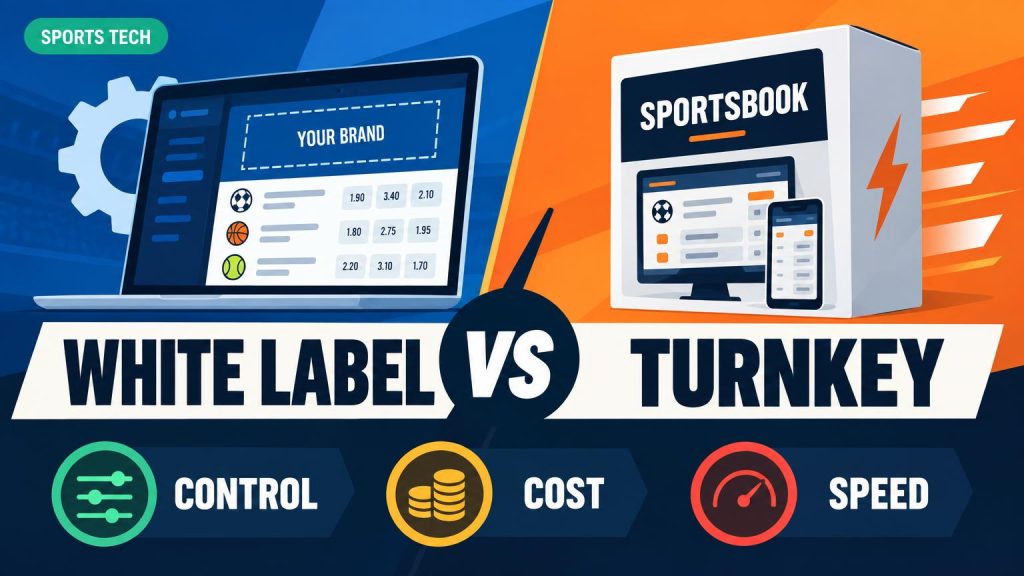
The way these components are sourced shapes the business:
| Approach | Speed and cost | Control and dependence |
|---|---|---|
| Internal build | Slowest and most expensive | Maximum control, but requires deep technical staff |
| Turnkey platform | Faster launch with predictable setup | More flexibility than white label, though core systems remain supplier-dependent |
| White label | Fastest and usually lowest upfront cost | Least control over product, roadmap and sometimes licensing arrangements |
Few operators build every layer themselves. Even established brands commonly buy data, payments or verification services, making supplier reliability almost as important as the customer-facing product.
How licensing changes the experience
A sportsbook license is not a universal passport. It authorizes defined products and locations: sports betting may be permitted while casino games, live betting, or certain events remain restricted. Geolocation commonly checks where a wager is placed.
Regulated markets usually require identity and age checks, anti-money-laundering controls, tax reporting, responsible-gambling tools, and safeguards for customer funds. Taxes may fall on the operator, be withheld from winnings, or remain the bettor’s responsibility under local law.
Offshore sites may accept customers where local options are limited, but availability does not equal local authorization. Cross-border use can bring currency conversion, card declines, intermediary fees, slower withdrawals, and reduced chargeback access. Local regulators often offer formal complaints; offshore recourse depends on the licensing body and its ability to enforce decisions.
Confirm the licensed domain, permitted location, account currency, withdrawal terms, fees, and complaint process. Check the operator in the regulator’s public register.

Sportsbooks do not simply balance both sides
It manages a portfolio of potential payouts rather than forcing each market into perfect balance.
Uneven stakes may be acceptable when the price still offers sufficient margin, liabilities remain within limits, or risks offset across related bets.
Prices can move because of new information, competitor odds, concentrated stakes, or changing liability.
A move may seek better pricing, discourage more bets on one side, or attract action on another. Books may also hedge with other operators, though hedging has costs.
Customer behavior, fraud, payments, bonuses, and regulatory duties can matter as much as match exposure.
A profitable-looking wager may still involve stolen funds, promotion abuse, chargeback risk, identity checks, or suspicious-activity reporting.
Useful information does not automatically make an account commercially attractive.
The debate over limiting winning bettors instead of copying their selections reflects a real tension: sharp action can refine a market while repeatedly beating stale prices, bonuses, or limits.
The practical objective is controlled exposure at acceptable expected profit—not identical stakes on every possible result.
Normal volatility and real trouble
Sportsbook earnings rarely move in a straight line. Major tournaments and football seasons lift betting volume, while quieter months reduce it. A run of customer-friendly results can compress margins; favorable outcomes, especially failed parlays, can quickly reverse that effect.
Promotions add another cycle. Operators often spend heavily when entering a market or acquiring customers, depressing near-term profit before wagering activity matures. Comparing equivalent periods—not simply consecutive months—helps explain why sportsbook revenue changes by season.
Normal variation becomes more concerning when several problems persist across comparable seasons:
- Handle falls while competitors or the wider market grow.
- Promotional spending produces little repeat activity.
- Payout delays, regulatory breaches, or payment failures increase.
- Cash burn continues despite stable betting volume.
Operators absorb much of this volatility. Vendors may earn steadier per-transaction, subscription, data, processing, or licensing fees. Affiliates, leagues, and governments can also collect commissions, rights payments, or taxes before the operator reaches profit—although their income still depends on volume, contracts, and operator solvency.
The stronger test is whether weak results reflect the sports calendar and customer outcomes—or persistent deterioration in retention, compliance, liquidity, and market share.
A practical checklist for testing industry claims
-
Pin down the jurisdiction
A national or global statement may hide major differences between states or countries. Confirm whether the figures cover one licensed market, several regulated markets, or offshore activity.
-
Identify the company’s role
Determine whether the named business holds the customer license, supplies technology, manages trading risk, processes payments, or merely owns the brand. Several companies may sit behind one sportsbook.
-
Match the reporting periods
Monthly, quarterly, annual, and year-to-date numbers are not directly comparable. Check whether an unusually large event or launch period distorted the result.
-
Separate handle from revenue
Handle is the amount wagered; gross gaming revenue is stakes minus payouts. Neither equals profit, and percentage growth can look dramatic from a small starting base.
-
Check which costs are included
Look for promotions, gaming taxes, supplier fees, payment costs, payroll, and market-access charges. “Adjusted” earnings may exclude expenses that still consume cash.
-
Verify the license and protections
Find the regulator’s register rather than relying on a logo. Note the legal license holder, complaint route, fund-segregation rules, and any responsible-gambling controls.
Industry claims become clearer when four trails are followed separately: the license, the technology, the risk, and the money. The same brand name may lead to different companies on each trail.
A credible assessment reconnects them: who is legally accountable, who runs the platform, who absorbs betting outcomes, and where customer stakes ultimately become costs, revenue, or profit.