Ever seen that -1.5 next to your favorite baseball team on a betting site and scratched your head? That’s the run line, a staple of baseball wagering. Just think of it as giving one team a bit of a head start before the game even begins, all to even the odds.
Decoding the Baseball Run Line

So, what exactly is a run line? At its core, it's just baseball's version of the point spread. It’s a handicap that sportsbooks put in place to level the playing field between a heavy favorite and a scrappy underdog. Offshore books like Bovada and BetOnline almost always set this spread at 1.5 runs.
This simple number creates two totally different bets:
- Betting the Favorite (-1.5): For this bet to win, your team has to win the game by two or more runs. A walk-off single in the bottom of the ninth for a one-run victory won't cut it.
- Betting the Underdog (+1.5): Here, your team has two ways to win the bet. They can either pull off the upset and win the game outright, or they can lose by just a single run.
This setup adds a fun layer of strategy that goes way beyond just picking a winner. It makes you think not just about who will win, but by how much.
Run Lines vs. Other Spreads
While a moneyline bet is a straight-up bet on who will win the game, the run line brings the margin of victory into play. The concept is a dead ringer for point spreads in football or basketball, which you can read all about in our guide to understanding point spread betting.
The run line is just a specific type of point spread where one team has to cover a certain number of runs. Here's a little secret from my years of betting: even the most dominant MLB favorites only cover that -1.5 run line about 40–45% of the time. Winning by a comfortable margin is tougher than it looks.
That's why digging into the matchups on sites like MyBookie or BetUS before placing a run line bet is so critical.
How Run Line Bets Work with Real Examples
Theory is one thing, but let's see how a run line bet actually plays out in the real world. Say you're scrolling through a sportsbook like BetUS and find a matchup between the Los Angeles Dodgers and the Arizona Diamondbacks. The lines might look a little something like this.
The Dodgers are the favorite, so you'll see them listed at -1.5, while the underdog Diamondbacks sit at +1.5. This 1.5-run handicap is the entire foundation of run line betting, and it creates two totally different ways to approach the game.
Betting on the Favorite
If you decide to put your money on the Dodgers at -1.5, you're not just saying they'll win—you're betting they'll win by a comfortable margin. For your ticket to cash, the Dodgers have to beat the Diamondbacks by two or more runs.
- Winning Score: Dodgers win 6-3. The margin is 3 runs, which easily covers the 1.5 spread. Your bet is a winner!
- Losing Score: Dodgers win 5-4. They won the game, but by only 1 run. Since that's less than the 1.5 you needed, your bet loses.
This is the classic trade-off you make. You get much better odds than you would on a simple moneyline bet, but you need the favorite to truly dominate, not just squeak by with a win.
Betting on the Underdog
Now, let’s flip the script. If you bet on the Diamondbacks at +1.5, you've got a fantastic safety net. Your bet wins if the D-backs pull off the upset and win the game outright, OR if they lose by just a single run.
Key Takeaway: Betting the +1.5 run line gives you two paths to victory. The team can either win the game or keep the final score within a one-run margin, providing a valuable cushion for close contests.
To make this crystal clear, we've put together a table showing how different outcomes affect your bet.
Example Run Line Bet Outcomes
This table shows how different final scores impact a run line bet on a favorite (-1.5) versus an underdog (+1.5).
| Team You Bet On | Their Run Line | Final Score Example | Did Your Bet Win? |
|---|---|---|---|
| Dodgers (Favorite) | -1.5 | Dodgers win 7-4 | Yes (won by 3 runs) |
| Dodgers (Favorite) | -1.5 | Dodgers win 2-1 | No (only won by 1 run) |
| Diamondbacks (Underdog) | +1.5 | Diamondbacks lose 4-5 | Yes (lost by 1 run, covered the spread) |
| Diamondbacks (Underdog) | +1.5 | Diamondbacks win 3-2 | Yes (won the game outright) |
As you can see, a final score of 4-5 in favor of the Dodgers would still make you a winner if you bet on the Diamondbacks, because they "covered" the +1.5 spread. This is a go-to strategy on sites like Sportsbetting.ag when you're expecting a tight, low-scoring game.
Getting a feel for these little details is a huge part of learning the ropes. If you want to dig deeper, you can explore our comprehensive guide on how to read betting lines.
Understanding Run Line Odds and Payouts
Ever wonder why you sometimes get a better payout betting a favorite at -1.5 than just picking them to win outright? It all comes down to the odds attached to the bet. Unlike a football spread that usually hovers around -110, baseball run line payouts are far more dynamic because they have to account for the true difficulty of the wager.
When you bet a heavy favorite on the run line at -1.5, you'll often see juicy plus-money odds, maybe something like +150. What that means is a winning $100 bet would pocket you $150 in profit. The sportsbook is rewarding you for taking on a bigger risk—it's much harder to win by two runs than it is to just win the game. This is the perfect way to squeeze some real value out of a team that's a massive favorite on the moneyline.
On the flip side, grabbing the underdog at +1.5 will almost always come with minus-money odds, like -170. This is the opposite scenario. You have to risk $170 just to win $100. Why the lower payout? Because you're getting a cushion. You're paying for the safety net of being able to cash your ticket even if your team loses by a single run. Reputable sportsbooks like Bookmaker.eu lay these odds out clearly, so you can always weigh the risk against the potential reward.
Decoding the Payouts
Thanks to the explosion of offshore sportsbooks, we have more access to run line data than ever before. In the old days, odds were much harder to track. Now, you can shop around for the best lines in seconds. You might see a favorite open at -1.5 (-110), but if the sharps (professional bettors) jump on the underdog, that line could quickly shift to -1.5 (+100). Learning to spot these movements is key. You can discover more about how MLB lines move and find value at a site like OddsTrader.
Key Takeaway: The odds on a run line are a direct reflection of how tough the bet is. Betting a favorite to cover the -1.5 is a bigger ask, so you get a bigger payout. Backing an underdog at +1.5 is a safer bet, so your return will be smaller.
This simple decision tree nails the concept for a favorite on the run line.
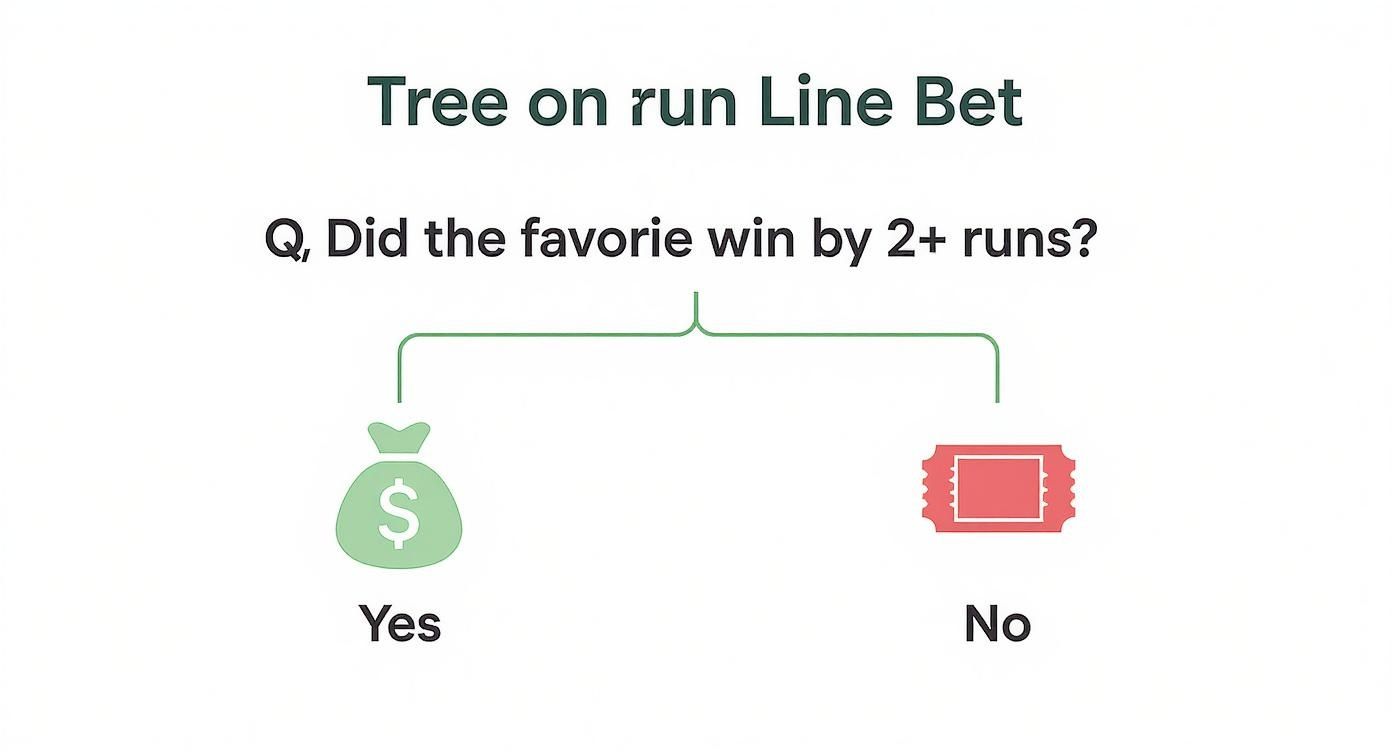
When it's all said and done, your bet on the favorite comes down to one question: did they win by at least two runs?
Actionable Strategies for Run Line Betting
Winning on the run line consistently goes way beyond just picking the better team on paper. If you want to make smarter bets, you need real strategies that help you spot actual value in the market. This means digging into what really drives the margin of victory, not just who gets the W.
Anyone who's been around the block knows that certain matchups create perfect opportunities for a run line score. The real trick is knowing what to look for when you're scanning the odds on an offshore site like Xbet or BUSR.
Key Factors for Analysis
Before you even think about placing a run line bet, you absolutely have to break down these parts of the matchup:
-
Starting Pitcher Duel: This is almost always the most important piece of the puzzle. A dominant ace going up against a weak lineup is a classic recipe for a low-scoring game, which makes the underdog at +1.5 look mighty attractive. On the flip side, a shaky fifth starter can get shelled and give up runs in bunches.
-
Bullpen Strength: A team with a suspect bullpen is a huge risk to cover a -1.5 run line. It doesn't matter if their starter leaves with a three-run lead; a weak relief staff can let the other team right back in it, turning a potential blowout into a one-run heartbreaker.
-
Offensive Production: Take a hard look at recent runs per game. A red-hot offense playing in a hitter's park against a mediocre pitcher is an ideal setup for a -1.5 run line wager. They simply have the firepower to win by a comfortable margin.
-
Park Factors: Some ballparks are pitcher's paradises where home runs go to die. In these stadiums, the +1.5 underdog often carries more value because building and holding a multi-run lead is just plain harder.
By hunting for the best odds at various offshore books, you can maximize your potential returns. A favorite might be -1.5 (+110) on one site but -1.5 (+125) on another—that difference adds up significantly over time.
Think about this scenario: the New York Yankees, who are averaging 5.5 runs per game, are at home facing a pitcher with a 5.20 ERA. This situation screams blowout potential, making a -1.5 bet on a site like MyBookie a really appealing play. Always shop the lines on different platforms like BetUS and BetOnline to make sure you're squeezing every last drop of value out of your wager.
Exploring Alternate and In-Game Run Lines
The standard -1.5/+1.5 run line is what most bettors know, but it’s really just the tip of the iceberg. Sportsbooks like Cosmobet and Bet105 go way deeper, offering a whole playbook of alternate and in-game options that give you more ways to play.

These aren't your basic spreads. They’re designed for bettors who want to fine-tune their wagers based on exactly how they see a game playing out.
Alternate Run Lines Explained
Think of alternate run lines like an adjustable difficulty setting in a video game. If you're absolutely convinced a heavy favorite is going to win in a blowout, why settle for the standard line? You can often bet them at -2.5 or even -3.5 and get a much sweeter payout in return.
On the flip side, maybe you like an underdog but want a little extra cushion. You can "buy" a run and grab them at +2.5. It'll cost you some juice (meaning a lower payout), but it dramatically increases your chances of cashing the ticket. This kind of flexibility, featured on sites like MyBookie and BUSR, is gold for bettors who have a strong read on a matchup.
First 5 Innings Run Lines
One of my favorite ways to bet on baseball is the First 5 Innings (F5) run line. This wager cuts right to the chase, focusing squarely on the starting pitcher duel and taking the bullpens completely out of the picture. No more sweating a ninth-inning meltdown from a shaky closer.
Your F5 bet is settled after five full innings, giving you a quick result. Plus, certain teams are just built differently in the early going. You might find a team with a dominant ace and a top-heavy lineup covers the F5 run line over 55% of the time, while a team known for late comebacks often starts slow.
In-Game Run Line Opportunities
The action doesn't stop when the game starts. Live betting opens up a whole new world, with run lines shifting in real-time after every hit, run, and pitching change. This is where sharp bettors can really find an edge.
Say a big favorite gives up a cheap run in the first inning. Suddenly, their live run line might look a lot more appealing than it did pre-game. To really pounce on these moments, you need a solid grasp of what live betting is and how to read the momentum of a game. Platforms like Bovada and BetOnline are built for this, with fast-updating odds that let you react to the game as it unfolds.
Common Run Line Betting Questions
Once you start dipping your toes into run line betting, you'll find a few key questions come up time and time again. Let's break down the most common ones so you can feel confident before you head over to your favorite offshore sportsbook.
Is the Run Line a Better Bet Than the Moneyline?
Honestly, it all boils down to where you can find the best value. I’ve found the run line is often a much smarter play when you're looking to back a heavy favorite. Why? Because it gives you a much better payout than a straight-up moneyline bet.
Think about it: a huge favorite might have moneyline odds sitting at a painful -300, but their run line odds at -1.5 could be a much more appealing +110. On the flip side, taking an underdog at +1.5 is like having an insurance policy—they can lose by one run, and you still cash your ticket. It always pays to shop around at sportsbooks like MyBookie or BetAnything to see which market really makes sense for that specific game.
What Does a -1.5 Run Line Mean?
This is the absolute heart of what a run line is in baseball. When you see a team with a -1.5 run line, it simply means they have to win the game by two or more runs.
It doesn’t matter if they win by two runs or ten runs. As long as they win by at least a two-run margin, your bet is a winner. If they only win by one run, or if the game ends in a tie or they lose, that -1.5 bet is a loss. Just think of it as betting on a team to win decisively, not just squeak by.
Can a Run Line Bet End in a Push?
Not with the standard 1.5 run line, and that’s because you can’t score half a run in baseball. Since the final margin will always be a whole number (one run, two runs, etc.), it can never land on exactly 1.5. Your bet will always be either a win or a loss. No ties.
However, you might occasionally see alternate lines at offshore sites like Cosmobet or Bookmaker.eu that use whole numbers, like -1 or -2. In those rare cases, a push is possible. If you bet on a team at -1 and they win by exactly one run, the bet is a push, and you get your stake back.
Where Can I Bet on Baseball Run Lines?
For the best variety of MLB markets and really competitive run line odds, established offshore sportsbooks are the way to go. Top-tier sites like MyBookie, BetUS, BetOnline, Bovada, and Sportsbetting.ag are well-known for their deep baseball betting menus. They’ve got everything from the standard run lines to alternates, First 5 Innings bets, and great live betting action.
At USASportsbookList, we provide detailed reviews and comparisons to help you choose the best platform for your betting style. Find trusted sportsbooks with great bonuses by visiting https://usasportsbooklist.com.